3 Estate Planning Tools to Utilise Right Now

writing something on paper

In Singapore, there’s always a constant strive to earn more money.

It’s perfectly understandable considering how high goods and services are priced, and how we want to provide a better future for our family.

Some of us take the next step by preserving our wealth and future income through the use of different types of insurance.

But only a few go even further to make it all fool-proof with estate planning.

What is estate planning all about? And what are some of the easy things we can do right now?

Let’s find out.

What Is Estate Planning?

When death happens, all your eligible assets (e.g properties, money in the bank account, investments, insurance) will form your estate which will be distributed according to prior instructions (if any).

The purpose of estate planning (which can only be done before death) is to decide how your estate is going to be distributed upon the inevitable.

This distribution is indicated with the use of several legal documents.

All these ensure that the wealth you’ve accumulated thus far will go to the intended beneficiaries (people/entities who’ll be receiving your assets), in a timely and efficient manner.

Why Should You Care?

We tend to focus on wealth accumulation (savings and investments) and wealth preservation (insurance).

But a lot less on wealth distribution (estate planning), which is equally important in the grand scheme of things.

Why?

When estate planning tools are not set up and death happens, consequences will come up.

Firstly, the process of unlocking assets will be more tedious and complex. This inevitably prolongs the time for beneficiaries to receive proceeds. If the family depends on timely money coming in, this issue will be more dire. Who’s going to provide them with liquidity to pay off current bills and expenses?

Secondly, also because of the complex and lengthy process, it’ll cost more.

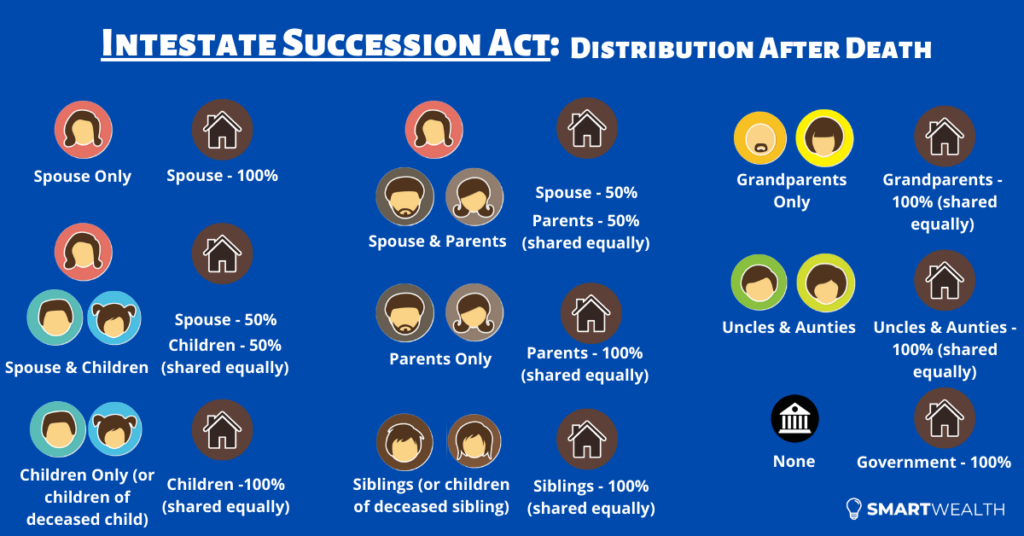
And lastly, most of the proceeds will go according to the intestate succession act or the Muslim law.

Therefore, your assets may not go to the intended people. And even if they do, not in the correct allocation that you wish for.

For example, if your spouse, children and parents are still living, your assets will be distributed to your spouse and children only, and none goes to your parents (even if they raised you up since young).

And it could also go to the unintended people.

For example, if your spouse and children are still living, and you think that your spouse doesn’t deserve anything, distribution will still go to your spouse.

These will cause ugly disputes amongst family members because there’s no clear and distinct indication of WHO should receive WHAT.

Furthermore, when you’re not around anymore, there’s no one else to turn to except for any legal documents you leave behind.

But when you employ even the simplest of estate planning tools, you effectively eliminate all these potential problems.

What are some of them?

3 Core Estate Planning Tools in Singapore

When dealing with financial matters, there’s always some resistance in taking action.

For example, people always want to find out what’s the best investment before investing, which is perfectly fine. But a problem that comes out from that is that too much information paralyses them and nothing is done in the end.

It’s also the same with estate planning.

But I can assure you that setting up these 3 tools will have the most impact and take the least amount of effort.

1) CPF Nomination

If you’re a Singapore Citizen or a Permanent Resident, you will have CPF accounts – Ordinary, Special, MediSave, Retirement.

If you don’t make a CPF nomination, and death happens, distribution of CPF savings will take a longer time, higher costs and goes by the law.

So you’d always want to get it done. It’s free anyway.

But most see it as a hassle because it used to be done via hardcopy forms (with 2 witnesses) or by going to the CPF service centres.

However, back in 2020, CPF allowed the nomination to be done online, and this made the application easy and convenient. While you still need 2 witnesses, the entire process is done electronically. If you want a step-by-step guide, you can check out how to make a CPF nomination online.

Even if a nomination is made, you can easily change it in the future. It’s usually done by submitting a new one, and that will override the existing nomination.

2) Insurance Policy Nomination

If you’ve bought life insurance and think nothing else needs to be done, think again.

The second part is to make a nomination where you can specify who will receive the proceeds and in what percentage.

Nominations can be made on life insurance policies with a death benefit. Take note that nominations can only be done on private individual policies and not on company/group insurance – they’re not owned by you.

There are 2 types of nominations: revocable and irrevocable (trust). Most choose the former as the nomination can be changed easily in the future.

Although it isn’t compulsory, it’ll be useful.

This is because by nominating, the insurance company can pay out directly to the beneficiaries when there’s an eligible claim. This effectively bypasses the usual probate process, saving time and money.

But here’s a trick question: do you want to nominate all your insurance policies?

The answer: it depends.

If your proceeds are large and all your policies are nominated, it’ll mean that your beneficiaries will receive the proceeds all at once.

Will they be able to handle such amounts?

There are many cases where the beneficiaries mishandle monies, and in the end, it got them into further trouble.

So if your proceeds aren’t that much (which you should have it reviewed), then it wouldn’t matter all too much.

But if it amounts to a bigger sum, you can make nominations on a few policies just for liquidity purposes. The rest can still be specified in a Will to pay out on a staggered or monthly basis.

To make a nomination, you can download the relevant forms from the insurance company, fill it out properly and sign in the presence of 2 witnesses. Or you can approach your financial consultant to help you with it.

3) Writing a Will

Even when you’ve done the CPF and insurance policy nominations, some assets will still be left out.

Examples:

  • Money in the bank account
  • Investments over several platforms
  • Properties (depending on the ownership type)
  • etc

If you don’t make a Will, all these will still be distributed according to the intestate law or the Muslim law.

Other than the usual benefits of writing a Will, you can also use it to appoint a guardian to take care of young children and create a testamentary trust to stagger payouts.

How do you create a Will?

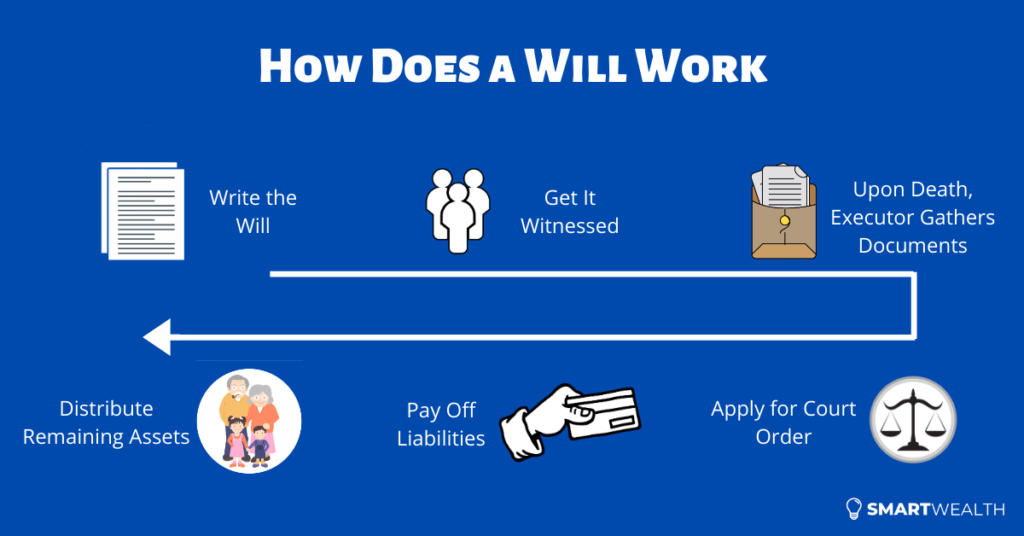
You can DIY or you can pay someone else to do it for you.

Just know that getting a professional to write a Will only costs a few hundred dollars.

The obvious advantage is convenience but more importantly, the Will is drafted to be able to stand in court if challenged.

Other Points to Take Note Of

Apart from the 3 basic tools mentioned above, there are other aspects you should know also.

Firstly, setting up trusts can give you greater control.

Although the Will covers most needs, the trust will bring estate planning to the highest level.

These benefits include:

  • can be created when you’re living
  • provide for a special needs child
  • utmost confidentiality
  • delaying gifts to beneficiaries
  • etc

While higher net-worth individuals derive more value from it, there are affordable trusts out there that can suit the needs of the masses.

Secondly, a distant cousin to estate planning is advance care planning.

Have you thought of what happens when you’re neither “dead” nor “alive”? In other words, mentally incapacitated.

You can’t do anything about your finances. And estate planning doesn’t kick in.

That’s when advance care planning comes in. It also involves different tools such as the Lasting Power of Attorney and the Advance Medical Directive.

These are important because it will specify what happens next when certain situations come up.

For example, when an Advance Medical Directive is done up, you specify that you don’t wish to be on life support to artificially prolong your life.

And for the last point, you need to have wealth.

You see, if you don’t have any wealth (your liabilities are higher than assets), there’s nothing to distribute even if you’ve done estate planning properly. Even if you’re mentally incapacitated, there may not be money to even pay for your medical expenses.

That’s why, financial planning (wealth accumulation and insurance protection), estate planning and advance care planning, all have a part to play in the bigger picture.

If one is missing, your financial plan is not wearing its full suit of armour. And when a battle comes, damages will be done.

What’s Next?

Estate planning is often in the back seat.

But at times, you have to bring it to the forefront.

That means either to set up the tools or to review them.

So take small steps by looking at the 3 basic ones first – CPF Nomination, Insurance Policy Nomination, and Writing a Will.

And then explore other areas when you’re ready.


About the Author:

Abram Lim runs SmartWealth which covers topics on personal finance – insurance, savings, investments, retirement planning, etc. It strives to produce research-backed articles so that readers can make better financial decisions with objectivity.

Read More...

Ponder over these things if you want to be on track to building your retirement fund

two elderly persons sitting on a swing

Whether you’re young or old, it’s never too early to start thinking about saving up for retirement. After all, it’s the best way to guarantee a comfortable life after you cross that critical stage.

However, you must start planning to make sure everything gets taken care of. Even though it might seem scary at first, have no fear. By reading this article alone, you’re already making that crucial first step.

It takes dedication and discipline to get where you want to be, including consistent savings and investments. You’re going to need to consider various factors specific to you and figure out how to handle risk best.

When jumping into retirement fund planning, it’s best to set a particular goal to build around it. Let’s dive right into the things to ponder over.

Your retirement goal

retirement savings in a coin jar

Image Credits: Mint

To get a basic idea of how much money you need to have after you retire, you must consider what age you want to retire and what you envision your lifestyle to be. After that, there are several methods to give you an estimate of what you might need.

Take advantage of the Central Provident Fund (CPF) Board’s tools to help you with your planning:

You can also do a quick computation to see how much you will need if you plan to retire for a certain number of years. For example, if your retirement will last 20 years and you require S$5,000 a month to get by, you will need S$5,000 x 12 months x 20 years = S$1.2 million.

Just keep in mind that this doesn’t include other factors like assets and liabilities. Those who want a more accurate number should seek a financial consultant’s assessment.

Things to think about

#1: Inflation rates
Singapore's inflation rate

Image Credits: Statista

Singapore’s inflation rates have averaged at around 2.51% from 1962 up to 2020 and have fluctuated recently within the last four years at percentages between -0.52% and -0.57%.

If you haven’t started investing already, consider doing so because your money will lose purchasing power if it sits in a savings account.

#2: Risks
a man reaching for an apple on stacked chairs

Image Credits: wsj.com

Risk can be defined as the degree of uncertainties in an investment decision and/or possible financial loss. The younger you are, the more risks you can afford to take. If you’re a little older, it might be riskier to invest a lot of money and potentially lose it all when the market is greatly affected.

Therefore, it depends on what point you are at in life. Be sure to consider how much risk you’re willing to take on and set up some plans accordingly.

#3: Diversification
never put all your eggs in one basket

Image Credits: news.warrington.ufl.edu

“Never put all your eggs in one basket” is a tactical move that makes perfect sense in several areas of our lives. This includes investments and fund management.

For healthy risk management, diversification in your retirement portfolio is always crucial. Balancing your investments means that there won’t be a disaster for you if one industry crashes in the market.

The importance of diversification in investing is not to be taken lightly. For more details on the technique to reduce potential risks, click here.

#4: Time horizon
investment-horizon

Image Credits: corporatefinanceinstitute.com

Try to identify what time horizon your investments are geared towards, whether short, medium, or long-term.

If you’re leaning towards short-term, you can afford to go for riskier investments, potentially earning you higher expected returns. On the other hand, if you’re long-term, you will want to invest in lower-risk funds that provide stability and predictable returns.

In general, if you start your retirement journey when you’re young, you can invest with higher-risk investments and slowly transit to low-risk ones in the future.

#5: Payout mode
savings against time

Image Credits: policypal.com

Take your payout mode into account.

Sometimes, insurance savings plans, for example, will need you to lock in your amount for several years before you can even access it. If liquidity is important to you, pay attention to the fine details of your plans you’re considering and consult a financial planner for elaborate help along the way.

Search on the internet, and you will find a couple of retirement savings plans. We will list some here for your perusal:

Final thoughts
a women writing down something on her notebook

Image Credits: unsplash.com

You will already be way ahead of the curve if you start early and stop putting off retirement planning.

A study has shown that Singaporeans start planning for retirement at around 38 years old. That’s why within the age group, only two-fifths of Singaporeans feel confident with a comfortable retirement. See if you can look for little areas around your life where you can save some money to invest without affecting your current lifestyle or budget.

Oh yes, before we let you go, have you heard of CPF’s Matched Retirement Savings Scheme (MRSS) for senior Singaporeans?

MRSS is ideal for those aged 55 to 70. As the Singapore government will match every dollar of cash top-ups (annual cap at S$600) made to the Retirement Account, this is one way to increase monthly retirement payouts effortlessly.

Help your parents, aunts, and uncles check if they can tap on the scheme using the MRSS eligibility checker here!

Read More...

What is lifestyle inflation? How do you avoid it?

receiving a louis vuitton package

In finance terms, we hear about inflation all the time. But what about lifestyle inflation? This is essentially a kind of habit, and both its presence and the problem it causes can be sneaky.

Simply put, lifestyle inflation happens when your pay increases or you undergo a promotion and your costs of living rise as a result. This alludes to those expenses that aren’t necessary. If you think “oh, that won’t happen to me”, be careful. It’s not called “lifestyle creep” for no reason because it creeps up on you!

Don’t fall into the trap of spending more money as your lifestyle changes. Here are some realistic tips to keep you on the lookout.

#1: Know your weaknesses

We’ve all got that one thing that we tend to splurge on. Perhaps it’s a shopping spree at weekends. Or it could be a weekly high-end restaurant date with boo. If you’re honest about the splurges you’re most likely to make, it will help you stay strong against them.

#2: Be careful with credit cards
credit cards in Singapore

Image Credits: AsiaOne

To keep your financial health in check, be careful not to overspend on credit cards. Be mindful that you’re going to have to pay it all back (with interest) one day, so think twice before that big swipe.

For folks contemplating getting a credit card, read this article to consider some situations before applying for one.

#3: Be ready for it by having a plan

The biggest mistake that many make is to underestimate its ability to be crafty. It’s just a few dollars here, and a few dollars there, so it shouldn’t be that big a deal? Well, that’s precisely what it means to get off on a wrong foot.

Make sure that you plan for lifestyle inflation to happen. Expect the unexpected because the only way you will notice it is when it starts to impact your financials. And trust us, it will.

#4: Stick to your budget
a person calculating while budgeting

Image Credits: Forbes

One helpful advice to keep your spending in line is to stick with the same budget you’ve been using before your salary increases.

None of your other spending categories has a reason to increase, after all, so make sure your accounts match what they should be at the end of the month.

We like to use an excel sheet to watch our budget and spending habits. Having a document to pen down your expenses is a sure way to help you eye your monthly paychecks. With the extra savings, you can decide for yourself if you’re ready to venture into investments.

#5: Let yourself off the hook once in a while

Okay, so this goes against the tips above, but it’s essential!

If you set aside a small amount of money every week or month to feed your spending urges, you will be able to last through the entire marathon. That’s because you aren’t sacrificing anything and it’s only fair that you reward yourself after a tough week at work.

Think of it as a strictly monitored allowance.

Final thoughts
an empty wallet

Image Credits: arktoswealth.com

Lifestyle inflation might be something that you notice after it has already snuck into your life. If that’s the case, that’s no reason for panic.

All you need to do is use the bits of advice shared in this article to deflate it back to where it should be again. Hold fast to it, and you will be on your way to significant savings that you can tuck away for a financially sound future.

Read More...

There’s a new insurance savings plan called “Dash PET” that is not for your pet

Dash PET cover image

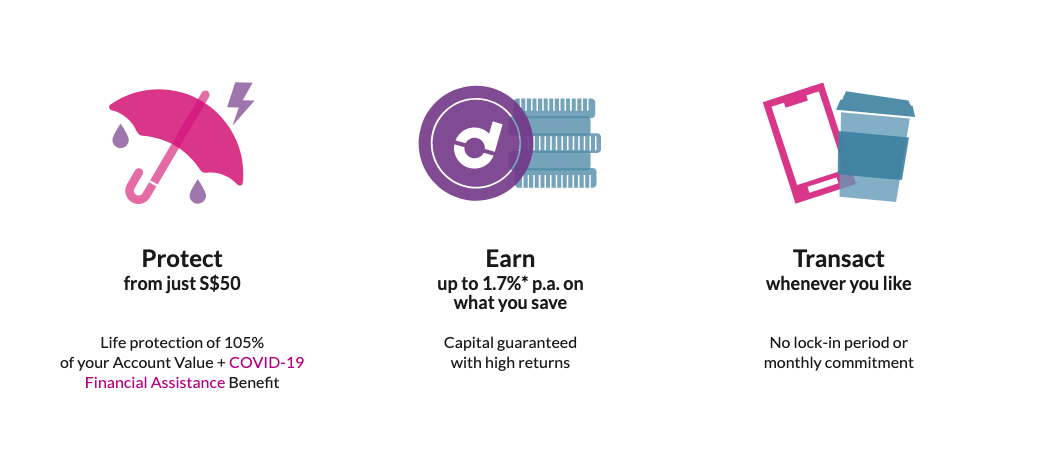
Are you looking for a new insurance savings plan that allows you to Protect, Earn, and Transact (PET)? Then you might be interested in a project called Dash PET. If you’ve read the title and clicked in, you would have known that this policy is not for your pet.

The insurance savings plan is part of a product offered by Etiqa Insurance in collaboration with Singtel Dash. Etiqa Insurance is a licensed life and general insurance company registered in Singapore. They want you to think of Dash PET as the PET that takes care of you.

“We saw a gap we could fill amid the uncertain climate to help our customers grow their money smarter and faster. Using insights gleaned from the success of Dash EasyEarn, our first insurance savings plan, Dash PET is a new product with greater flexibility and a lower entry point,” Singtel’s International Group CEO Arthur Lang said.

To that, Etiqa Insurance Singapore’s CEO Raymond Ong added that they had designed Dash PET to be an innovative all-in-one insurance plan with a savings component and on-demand protection for the end consumer.

Peeps searching for an insurance savings plan where they can take full control of their finances, look no further! We will guide you through what Dash PET can offer you.

What Is Dash PET?

Dash PET on mobile mock-up

Dash PET is as cute and as useful as it sounds. It helps you maximise your money with savings at high returns, gives you guaranteed capital, and full flexibility of funds. As you invest more money into your savings account, your Dash PET will grow and provide a desirable incentive in the long run.

A comprehensive insurance plan focused on achieving simplicity for you; there are no unnoticed loopholes that could cause you problems later. Keep reading to find out the gains of Dash PET.

How can I benefit from it?

Dash PET benefits

Dash PET has an eclectic range of benefits that are solely focused on bettering your financial health. It also provides you with the support you may need through the pandemic. Worry not about a thing if you face challenging times.

Here’s a breakdown of the main benefits:

  • High returns: It allows you to earn up to 1.7% interest every year* on your savings. As such, Dash PET makes a great plan to have as you continue to accrue your savings.
  • Easy starting requirements: Whether you start with S$50 or S$10,000, Dash PET allows you to begin small and build your savings up to S$30,000.
  • Flexibility: The fear of a lock-in period should not stop you. With Dash PET, there is no lock-in period. This means you can withdraw and top up funds anytime you like without the threat of a penalty.

*First S$10,000: 1.7% p.a. for the first year. Above S$10,000: 1.2% p.a. for the first year.

Is it still not enough to sway you towards the multitude of benefits Dash PET can provide you? Maybe the fact that the policy is administered by the Singapore Deposit Insurance Corporation (SDIC) might give you peace of mind.

Everything else is automatic upon sign-up, so you’re covered without having to take any further action (except for the management of your account).

How do I sign up?

Are you a Singtel Dash user?

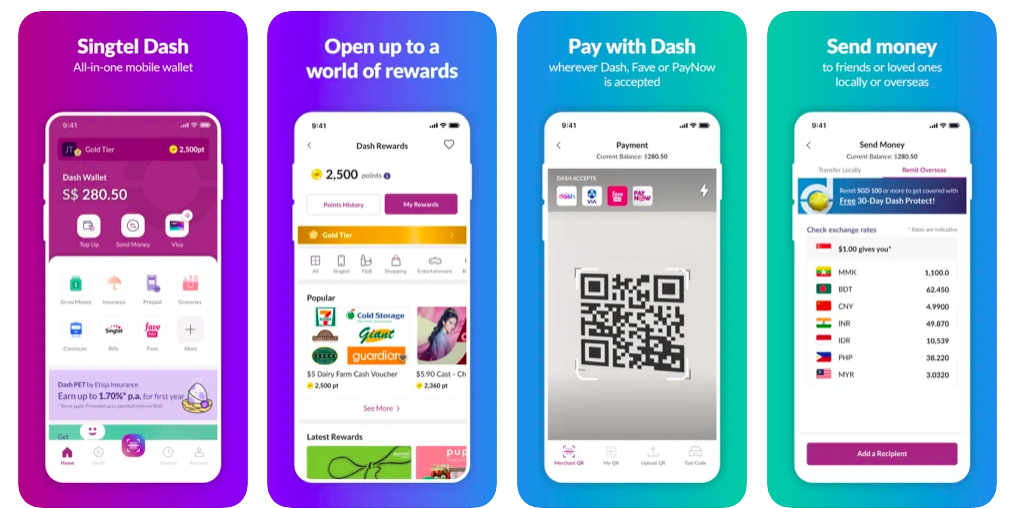
Singtel Dash iPhone Screenshots

Great! If you’re aged between 17 and 75 and have a valid Singapore NRIC or residency/work pass, then you are easily eligible to sign up for Dash PET. You can also check against the eligibility rules set by Etiqa Insurance.

Download the Singtel Dash app right now or click here to kickstart your savings journey today!

Read More...

12 personal money management life lessons to live by

Singapore 50-dollar notes

While we were searching for good reads, we came across Cary Siegel’s “Why Didn’t They Teach Me This in School?: 99 Personal Money Management Principles to Live By”. We’re not even halfway done with the book but already learning so much from the retired business executive.

Here are 12 personal money management life lessons adapted from the book.

#1: Marry someone who has good financial habits
a couple wearing masks for a wedding photo

Image Credits: The Straits Times

If you’re already married, you might agree that money is the top reason why couples fight. It could be very much due to a non-full disclosure during the dating process. Singles planning to tie the knot should learn how to facilitate money conversations to identify each other’s financial habits.

Here are some crucial questions you can ask:

  • How much debt do you have? 
  • At what age do you want to retire?
  • Do you want to have kids? If so, how many and how soon?
  • What is an ideal amount for an emergency fund?
  • Are we ready to leave the workforce to be a full-time parent? If yes, which one of us and for how long?
#2: Stay married to the same person
old asian couple

Image Credits: Pinterest

According to Singapore Legal Advice, divorce fees may cost up to S$3,500 for simplified uncontested divorces and S$10,000 to S$35,000 for contested divorces. Let’s not forget about pre-divorce payments, alimony, and child support charges. Need we say more?

#3: Know the cost of raising kids
asian family with young kids

Image Credits: MindChamps

The obvious expenditures include education, healthcare, clothing, and food. Other costs include moving to a larger HDB flat and getting a new car to shuttle them to school and enrichment classes.

Prudential Singapore has examined various costs involved in the parenting journey. From pregnancy to childbirth and education to recreation, you must plan your finances for the long road ahead.

#4: Buy only when you can afford it
a toy car and car keys

Image Credits: Carsome

When you don’t heed this principle, you will find yourself on a downward spiral to possible bankruptcy. Live below your means, and you will find extra cash to save and invest at the end of the month.

#5: Take care of your stuff
laptop-maintenance

Image Credits: atulhost.com

By stuff, we mean the things you own. It could be your white shirt, your latest mobile device, or even your car. When you learn how to take care of your stuff, you will find them lasting longer over time and requiring fewer repairs or replacements. This equates to more savings!

We wrote an article several months ago with tips to help you apply basic maintenance to your electronic gadgets to help them last longer. Click through the link if you’re keen to find out more details on battery inspection, data clearance, and more.

#6: Build lasting friendships
a group of friends

Image Credits: Visit Singapore

One of the greatest gifts on earth is connecting and learning from people from all walks of life. Whether your secondary school classmates or polytechnic school friends are working within the financial sector or not, there are still personal money management experiences you can tap on from them.

#7: Take away more by giving more
colleagues at work

Image Credits: HealthHub

This applies to your career in the early stages. Do you believe that you take away more from your company by giving more? The extra time and effort you’re donating to a work project can return tenfold because you gain valuable skills, knowledge, and experience by doing. Think of it as getting paid to learn!

With that said, those who are forced to work extra hours, make sure your employer is compliant with the Ministry of Manpower’s (MOM) practices. Click here for some FAQs relating to overtime work and rest days.

#8: Spend an hour per week learning about personal finance
man-reading-on-ipad

Image Credits: ConversionLab

There are tons of free resources online, and a quick Google search can reveal the top-ranking ones. The Straits Times also has an “invest” section you can take advantage of if you’re a subscriber. Don’t underestimate the little hour you spend a week because it’s significant when it adds up over the years.

#9: Enjoy the slow journey to wealth
a man in a suit drinking coffee

Image Credits: unsplash.com

Not all millionaires are made overnight. Do a quick search, and you will probably come across several rags-to-riches stories that will inspire you.

Please note that you don’t have to be exactly like any of the high profiles out there because everyone has their set of money management principles. Find your own and be comfortable in your unique journey to wealth.

#10: Pen down attainable short-term financial goals
a lady writing something with a pen

Image Credits: unsplash.com

Short-term financial goals refer to your quarterly plans or annual ones. This could include the exact amounts for savings and investments. You can also note down personal reward amounts if you’re expecting big purchases. Remember to review your goals frequently and spot the hits and misses.

#11: Set realistic long-term financial goals
person typing on a MacBook

Image Credits: unsplash.com

When you have your short-term plans ready, it’s good to spend some time setting realistic long-term financial goals. If you like it, you may call it “the big picture” or “a bird’s eye view”. Long-term goals could mean you look far ahead in 5 years, 15 years, or even more.

Here’s a look at the author’s long-term financial goals when he was 25:

  • Buy my next car with cash (within 5 years).
  • Pay off all college loans by the age of 30.
  • Own a home by 35.
  • Attain a net worth of $1 million by the age of 40.
  • Own a beach property by age 45.
  • Retire by the age of 50.
#12: Develop a simple net worth statement
Net worth calculator

Image Credits: MoneySense

There are online resources available to help you find out your net worth. It’s nothing too difficult to understand. For example, MoneySense has a net worth calculator you can use. All you have to do is input your total assets and total liabilities and let the webpage work its magic.

So what are your thoughts on a peek at Siegel’s “Why Didn’t They Teach Me This in School?: 99 Personal Money Management Principles to Live By”?

Let us know if you want more insights from his book, and we will prepare them in the coming weeks. If not, you can also grab a copy yourself and be enriched with more personal money management principles to live by. Happy reading!

Read More...