Increasing educational levels is a mark of progress for humankind. In the past, education was considered a luxury enjoyed by a privileged few. Today, higher living standards have empowered the masses to invest in the future of the next generation, leading to the betterment of mankind of epic proportions.
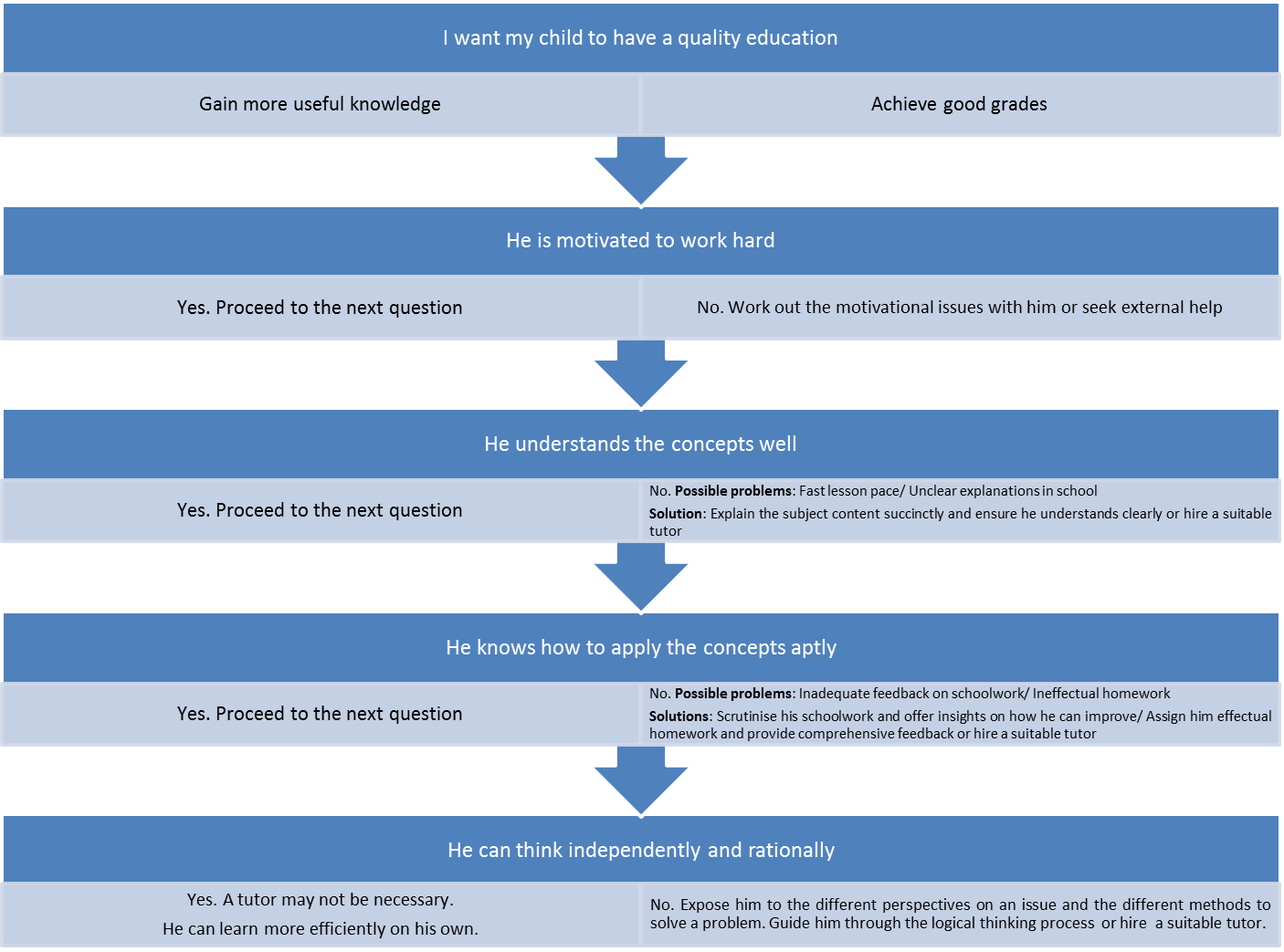
However, this does not necessarily mean that tuition is the only way to gain extra knowledge outside of school. Education can come in different forms, ranging from self-directed learning to facilitated learning. Shown below is an elementary guide for parents who are considering various educational options to improve the competency of their children.
As with purchasing any goods or services, quality should often be emphasized over quantity. Finding a well-suited tutor that caters to the precise needs of your child is of utmost importance.
*For convenience, this article uses “his” and “he” to refer to the child.
Katie Paterson from Flipit.com gives the inside scoop on how to get creative in ensuring you pay the lowest price online. Flipit.com is Singapore’s number one promo code portal and all round money-saving platform.
We all love the fun, flexibility and convenience of shopping online, but the biggest perk has got to be the fact you can pretty much guarantee you’ll always be paying the lowest price possible – that is, if you know how to shop online like a pro! Here are a few sneaky insider tips and tricks to help you score a discount each and every time you spend money online.
Bookmark a good coupon code provider – Discount codes almost always have a limited time span (which makes it all the more rewarding when you catch it in time!). The best way to ensure you keep up to date with all the best codes as soon as they’re available is by bookmarking the homepage of a reputable coupon code provider such as Flipit.com. Homepages are updated daily, so checking this page out regularly will ensure you never miss a beat!
Tease webstores by pretending to abandon your cart – Brands who notice and take offence to this kind of move are likely to get in touch and ask why you didn’t see your purchase through, offering a discount (usually around 10%) to encourage you back and make the final payment. Similarly, brands who are being particularly innovative with understanding customer behaviour have been known to install cursor movement detectors which are triggered when you swipe upwards to close the window, revealing a ‘leaving so soon?’ pop-up window. Give it a try!
Sign up to webstore newsletters – Signing up to newsletters can be really useful for online stores. Of course, some can end up bombarding you with emails on a daily basis, but unsubscribing in these situations is simply a matter of clicking a button. It’s worth signing up to newsletters of brands that you love, as those on the mail list are considered a priority, and are always first to be notified of sales, special events or exclusive discounts.
Use a price comparison site – Price comparison sites are the epitome of everything that’s great about shopping online. Shopping around various stores in person to find the cheapest price is an exhausting and time-consuming task, but with price comparison sites such as Priceme.com.sg you can guarantee you’re always paying the lowest possible price available.
Never pay shipping – Shipping costs are a nuisance. Hopefully soon enough they will become a thing of the past, as more brands begin to realise that making the sale and gaining loyal customers is way more important than covering a few dollars postage cost. Unless you’re seeking certain shipping privileges such as same- or next-day delivery, there are a number of ways that you can avoid paying for the delivery of your purchase. For example, some stores offer free shipping if you reach beyond a certain purchase total, so it might be worth buying more (perhaps two of the same item but in different sizes to ensure a perfect fit) and returning whatever isn’t suitable, free of charge. Alternatively, many stores offer shipping voucher codes, and you can always try chancing your luck and reaching out to the brand to ask for free shipping – sometimes being bold pays off, and what have you got to lose?
It is exactly one month away to mark Singapore’s 50th year of independence .
As this is the Golden Jubilee year, expect a massive celebration you had never experience before. It pays to start planning early if you want create an indelible experience for both your loved ones and yourself – and nothing beats the comfort of being in a hotel room that comes with an exceptional view of the National Day Parade and the magnificent fireworks and aerial displays. A glass of wine to go with it, perhaps?
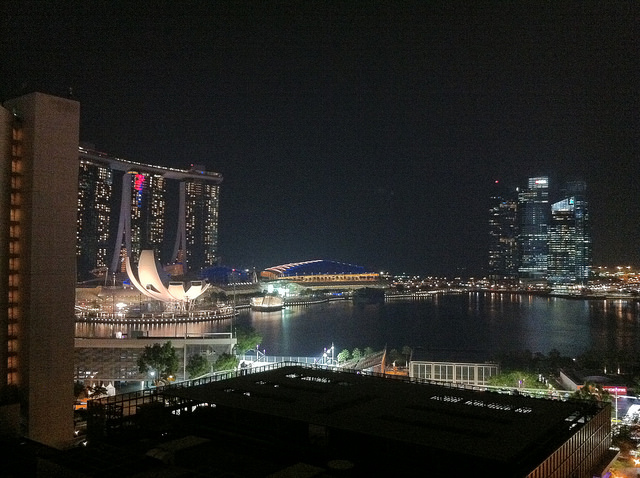
KAYAK.sg has came up with a list of best staycation hotels that offer you the best panoramic view of the Padang and The Float@Marina Bay, where the celebration will take place.
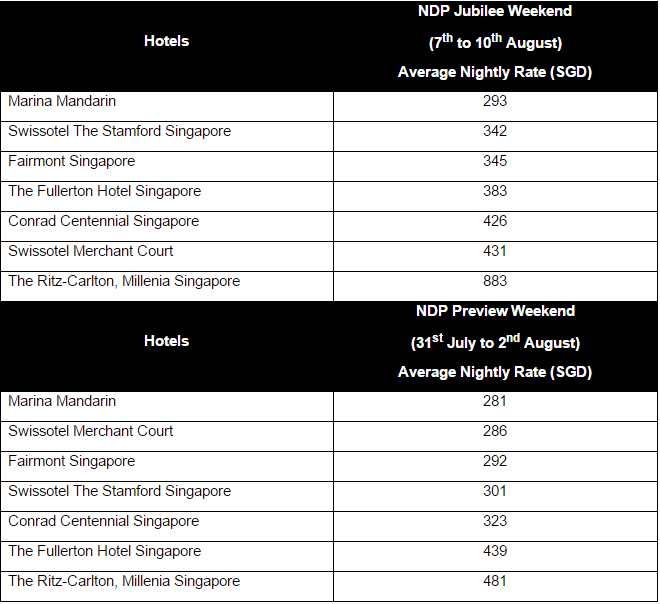
They have ranked the hotels from the lowest to highest price for the National Day Jubilee Weekend from 7th to 10th August 2015. Average Nightly Rate starts from S$293 at Marina Mandarin to S$883 for a night stay at The Ritz-Carlton, Millenia Singapore.
For those who want to enjoy the experience but are not willing to loosen your purse strings can consider a staycation over the National Day Preview weekend (31st July – 2nd August 2015). KAYAK.sg has also ranked the hotels from the lowest priced to the highest.
For spectacular views of the Padang:
This photo of Swissotel The Stamford is courtesy of TripAdvisor
Swissotel The Stamford Singapore
Be treated at one of the tallest hotels in Southeast Asia, Swissotel The Stamford. The thoughtful service, amazing dining options and dazzling views of the Singapore landscape should not be missed! Prices start from $342 a night on average.
For jaw-dropping views of the Marina Bay area:
View from Marina Mandarin (Image credit: tobiwei, via Flickr)
Marina Mandarin
Undeniably plush, the distinguished 5-star Marina Mandarin is known for contemporary elegance and breath-taking views of the Marina bay area. Prices start from just $293 a night on average.
Conrad Centennial Singapore
Feel the pulse of the Marina Bay at Conrad Centennial Singapore. Spectacularly decorated, the hotel boasts local and international art pieces and is home to two awarding winning restaurants more than worthy of a visit. Prices start from $426 a night on average.
The Ritz-Carlton Millenia Singapore
With 608 guest rooms featuring unobstructed views of the Singapore skyline, the award winning Ritz-Carlton Millenia Singapore is home to a 4,200 piece art collection and a seven-acre oasis filled with landscaped gardens and tropical plants. Prices start at $883 a night on average.
The Fullerton Hotel Singapore
Dip into the past at The Fullerton Hotel, a historic landmark known for its elegance and luxury, as well as its amazing panoramic views of the city’s landscape. Prices start from $383 a night on average.
Debby Soo, KAYAK Vice President APAC, said: “Celebrating Singapore’s 50th birthday is an amazing feat and what better way to do it than at the centre of all of the celebrations, in comfort and style, surrounded by your loved ones. KAYAK has put together a list of hotels for a National Day weekend staycation, perfect for individuals and families seeking a special setting to be a part of the celebrations without the hustle and bustle of crowds. What’s more, when using KAYAK.sg or our mobile app, you can have even more control over finding the best deals.”
Singapore has always prided itself on being competitive. We thrive and prosper when we stay ahead of competition. To achieve this, the Singapore government has diligently invested large sums of money and committed significant efforts to various productivity measures and educational initiatives.
One of the noteworthy productivity controls would be the reduction of lean waste, commonly referred to as DOWNTIME, which stands for Defects, Overproduction, Waiting time, Non-utilised or idle people, Transportation time, Inventory surplus, additional Motion to obtain out-of-reach materials and Extra-processing. The practice of lean principles has all along been championed by Toyota, the top-ranking automaker for the third consecutive year.
However, such conventional wisdom seems to have eroded with time when applied to the overall Singapore economy. An inordinate amount of time has been squandered through our increasingly unreliable public transportation system, draining productivity and crippling our competitive economy. Once reputed as an efficient train system in the 1990s, the bread and butter of our economy is no longer a boon but a bane to realising our productivity goals.
Nonetheless, all is not lost. We are still capable of living up to the titles of being the second most competitive city in the world and enjoying the second best quality of life in Asia. All we need is putting the following measures in place to adequately combat the next SMRT crisis, which requires resolve and political will across different agencies.
Yesterday’s disruption of train services on both the green and red lines “stranded” more than a quarter of a million people due to the inadequacies of the existing public transportation system. In particular, the bus and taxi fleets were insufficient to cater to the large crowd of passengers during the peak hours.
This is expected as the bus and cab populations are merely 17,509 and 27,695 respectively according to LTA as of 2013. This means given that the average bus fleet operated is 3,777 and if we assume all the cabs are in commission by individual passengers at a given time, each bus has to accommodate at least 59 passengers, which is not significantly less than the total passenger capacity of a single-deck bus.
Faced with such circumstances, it would thus be wiser for the private car population of 540,063 to pick up the slack. While taxis are profit-driven, private cars are more inclined towards cost-minimisation. Therefore, for the future rail “disaster”, it would be in the shared interests of both private car drivers and commuters to exchange a convenient ride for a nominal fee. Probably $5 to $10, depending on the length of the ride?
The implementation process is simple. It could be as easy as putting up a sign on the windscreen or using a mobile app or a site to indicate the destination and pick up passengers on the way.
Nonetheless, this requires the exemption of legal hurdles stated in the “Road Traffic (Car Pools) (Exemption) Order 2015” as shown below in times of crises:
You cannot solicit passengers on a road, parking place or public stands.
The pick-up points, drop-off points, date and payment must all be agreed between driver and passengers before the start of the carpool ride.
In Japan, passengers board the back door and alight at the front door. This may seem counter-intuitive at first but try thinking again. Japan is well-known for its legendary public transportation system which is uber-efficient and super-punctual. It is way past due to learn from our equally – if not more – developed cousin in Asia.
With the current door orientation, a common vexation in Singapore is that many passengers are reluctant to move to the rear as much as possible to allow more passengers to be able to board the bus. However, if passengers were to board the back door instead of the front door, they would be able to choose between moving to the fore or the back and thus the passenger load is likely to be more evenly spread out. Fortunately, this is a psychological issue that can be expediently rectified with an engineering tweak.
Cardio or aerobic exercises aid increases both your oxygen intake and heart rate. This is why it is no surprise that cardio workouts help in sculpting your belly. According to Duke University study, if you want to burn loads of visceral belly fat, go for cardio or aerobic exercises. Furthermore, it burns 67% more calories than resistance exercises.
Also try aerobic kickboxing indoors, as the arm thrusts and high kicks firm the abs well.
2. WALK MORE
Bring walking to your favor by engaging your abdomen while you walk. To do this, imagine a magnet pulling your belly button backward toward your spine as you walk. Practice this tucking movement until you become comfortable. Then, you may invite an exercise buddy or two.
3. CONSUME MORE OF THESE
Eat more of the fibrous foods such as apples, artichokes, pinto beans, and broccoli because your stomach will carry about 4% less fat for every 10 grams of fiber intake daily. 10 grams is not too much if you ask me!
Image Credits: threelayercake via Flickr with Creative Commons License (ND)
Additionally, eating half a cup of avocado can help flatten your belly. Avocado contains Monounsaturated fatty acids that stop blood sugar spikes to store fat around your belly area. Friendly reminder: consume more of these foods without overdoing it.
4. CONSUME LESS OF THESE
Alcohol intake raises the cortisol levels, which can lead to sending fats straight to your belly. While the bubbles from carbonated drinks including diet sodas accumulate on your belly too. So, it is best to shy away from alcohol and carbonated drinks.
5. SLEEP AWAY THE BELLY FATS
According to a study from University of Chicago, participants who slept for 7 hours or more lost twice as many fats and are less hungry that those who sleep for a brief hours. Having a good night’s sleep is always beneficial. Check out the “Have A Good Night’s Sleep Without Breaking The Bank” article to get quality sleep and to manage the daily challenges ahead.
6. TARGET EVERY ANGLE OF YOUR CORE
Do quick and doable exercises that target every angle of your core namely: Transversus abdominis, Rectus abdominis, Obliques, and Lower back to Glutes. Doing so will not only give you toned abs, but also reduce the risk of injury and improve your overall posture. Choose one move for every angle. Click here for the illustrated guide.
Alternatively, you may follow this “4 Best Exercises for a Flat Stomach” video that takes less than 7 minutes to complete!