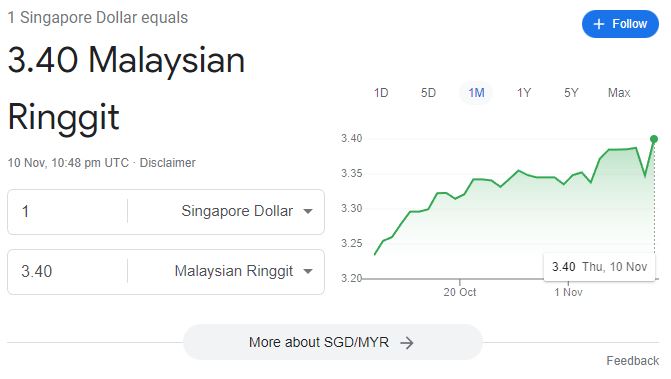
The Singapore dollar has reached a new record high against the ringgit today, 11 November. According to data from Forbes, the Singapore dollar has reached a new high of 1 SGD = RM3.400738.
Last week an article by Straits Times shows that analysts project the ringgit to drop to RM3.35 to RM3.45 range against Singdollar due to the ringgit volatility. With strong economic fundamentals, the Singapore dollar has remained resilient and has been one of the better-performing global currencies as compared to its Southeast Asian peers. Given the outlook for inflation, the Singapore central bank uses the exchange rate rather than interest rates to stabilise prices.
MAS reacts to high inflation by allowing the Singapore dollar to appreciate against peer currencies, thereby driving down the cost of imported goods in local currency terms.
You might think that if you pinch your pennies and save every last dollar, you will be able to amass a fortune in no time.
But being a miser won’t make you a millionaire—it could have the opposite effect. When it comes to getting rich, there is no single path to success.
Just because someone else became a millionaire by being a miser doesn’t mean that you will too. In fact, for most people, being miserly ends up costing them more money in the long run.
So why does being a miser not make you a millionaire? In this post, we will explore the reasons why being a hoarder won’t make you rich and offer some advice on how to create wealth instead.
What is a miser?
What do you think of when you hear the word “miser”?
Probably someone cheap who never spends a dime and is always looking for a way to save a dollar.
Well, while it’s true that being a miser can help you save money in the short term, it’s not a strategy that will help you become a millionaire.
Here’s why: by being miserly, you’re not only missing out on opportunities to make money, but you’re also limiting your potential to invest in things that could grow your wealth over time. And remember, it’s compound interest that turns a modest sum of money into a fortune.
What do millionaires do differently?
It all comes down to two things: They invest their money wisely and they focus on growing their income.
You may be thinking, “Well, I can’t control how my investments perform,” and you’re right, you can’t. But you can control how much you save and invest each month.
And if you want to get rich, you need to start thinking about your income growth potential. There are many ways to do this, but it all comes down to finding a way to make more money than you’re spending. Sooner or later, you will hit your target if you keep at it.
The difference between being frugal and being a miser
Image Credits: sg.news.yahoo.com
Being a miser means you’re always living in fear of not having enough.
You’re never really able to enjoy your money because you’re always worried about what might happen if you run out. And that’s a miserable way to live.
Being frugal, on the other hand, means you’re in control of your money.
You know how to make it work for you, and you’re not afraid to spend it when you need to. You’re also willing to invest in your future, whether that means saving for retirement or putting money away for a rainy day.
How to become a millionaire
You need to invest your time and money in the right things, and you need to be willing to take risks.
You also need to be able to work hard and stay focused on your goals. It’s not easy becoming a millionaire, but it’s doable if you put your mind to it. So start planning now, and don’t give up too soon.
You can be a pinchpenny on the planet, but that’s not going to make you a millionaire. In fact, it’s more likely to have the opposite effect. For one, you will never be able to enjoy the wealth you’ve accumulated if you’re always obsessed over just storing it. So if you’re looking to become a millionaire, forget about being a miser—focus on becoming more frugal and investing your money wisely instead.
Getting ready to buy your own home is a rewarding process. Soon, you will have the comfort that investment in your own piece of real estate will provide.
However, a less comforting part of the process is applying for mortgage loans. The application process is full of stress about how you will afford your mortgage, if you will get approved, and if you are going with the right lender. You can get preapproved, so you know up-front what you are eligible for, but preapproval requires a lot of paperwork.
Putting your paperwork together requires some time, but it will make the rest of the process much easier. Here are the documents you will need.
1. Proof of Identification
The first step is providing proof of identification to your mortgage broker or lender. The entity lending you money wants to know that you are exactly who you say you are and not someone attempting to commit fraud.
Any government-issued ID will help with proof of identification. However, it needs to have your current address on it, so make sure all of your address information is up to date. You will also need to provide your SIN number.
2. Proof of Employment and Income
The next important step in the mortgage process is proving to the lender that you are employed. Mortgage loans are investments by lenders in you, so they want reassurance that you will be able to pay that money back. The most reliable proof is proof of employment.
You have to prove that you are employed at a reliably paying job, preferably one where you have been for a year or two and that your income is enough to afford the mortgage. Documents that fit in this category are pay stubs, tax forms such as a T1 or T4, or even a letter of employment. If you have none of these documents because you are self-employed, you will need to submit detailed proof of income going back several years.
3. Information About Other Debts
When mortgage lenders agree to give you a loan, they want to know that you don’t have too many other debts that will get in the way of your ability to pay your mortgage. If you have regular car loans or student loan payments but can still afford a mortgage, that won’t affect your chances, but you will need to share information about them.
Mortgage lenders will also look at your credit score.
4. Proof That You Can Afford the Down Payment
Besides paying your mortgage, there are other expenses involved in buying a house, such as the down payment and closing costs. You may be able to afford a monthly mortgage payment, but banks want to know if you have the savings to afford a down payment as well.
You can prove that you have the money for a down payment by showing statements from savings accounts or investment accounts or proof that you have sold your existing house and will use that money for a down payment. If this is your first time buying a house in Canada, you can apply for the RRSP Home Buyer’s Plan and use that as proof of down payment.
5. Information About the Property
Finally, your mortgage lender wants to know the details of the property you will be buying to know the value. Documents include the real estate listing and accepted purchase and sale agreement.
Putting together the relevant documents for applying for a mortgage in Canada is difficult, but keep these categories in mind and start gathering paperwork today.
Saving money when you are young and broke can seem like an impossible task. With the right mindset and strategy, you can save money despite the hurdles ahead. Putting your spare cash each month can make a world of difference. All you need to do is be willing to commit to your financial goals! The following hacks can help.
#1: DRINK MORE WATER
You will save more money if you stop buying bottles of soda and cups of take-away coffee. Bottled water is cheap and tap water is cheaper. There are many great options for filtering your water if you are not a fan of water from the tap. Nonetheless, eating out with a family of 3 can easily save you money just by drinking water alone.
#2: GET A PART-TIME JOB
If you just graduated and you are trying to reach a goal that seems to be taking longer than expected, you can get a part-time job. This job can be a temporary solution to get past whatever situation you are in. Moreover, it is a wonderful way to pay off your dues and debt. If you are building an emergency fund, having another source of income can aid your quest. Market your skills online to boost your job search.
#3: CREATE A MEAL PLAN
Whether you are living alone or living with your roommate, you can save more money by planning your meals. It eliminates food wastage and helps you create more affordable meals. Rather than buying what looks good at the grocery store, you can opt for budget-friendly alternatives to complete your dishes.
#4: CANCEL YOUR UNNECESSARY MEMBERSHIPS AND SUBSCRIPTIONS
You are cash-strapped! You do not need your hefty gym membership or subscriptions to different music and entertainment apps. Think about all the wasted money because of not taking the time to cancel the things that you no longer use.
Image Credits: unsplash.com
#5: ALWAYS BRING A SHOPPING LIST
One of the easiest ways to go over budget is going inside the grocery store without a plan! If you do not want to spend too much money in one place, always bring a shopping list with you. Only go down the aisles that you truly need to grab what you need. Skip the rest!
#6: KEEP YOUR SAVINGS ACCOUNT SEPARATE
Are you breaking because of your shopping habits? Keeping this from happening again by having your savings completely separated. Find an online savings account or open a separate checking account. Make it a little more challenging to take money out of your savings. Your future self will thank you.
#7: EMPLOY THE 30-DAY RULE
When you are considering making large purchases, use the 30-day rule. If you still want it just as much after 30 days, consider saving money for it. Having a waiting period eliminates impulsive purchases made out of excitement or other overwhelming emotions.
#8: DO REGULAR CHECK-INS
Before spending a large amount of money on a significant purchase, have your trusted partner or friend assess the situation with you. Have regular check-ins to look into your current financial situation. This might sound silly at first, but it can keep you from spending money impulsively on things that are not in your budget. Find someone that can help make you accountable for your spending.
Financial or money anxiety has become more common than ever. If you have found yourself worrying about cash lately, you are not alone. In the American Psychological Association’s 2022 Stress in America Survey, 87% of the participants listed inflation as a trigger of significant stress.
Moreover, Traveloka found that 51% of Singaporean men respondents named financial stability as the top stressor in its wellness survey. The rise in prices coupled with the effects of the global pandemic has people from all backgrounds worried.
To know whether you are undergoing money anxiety, you must watch out for some signs. A few signs your anxiety surrounding finances is becoming a serious concern include:
a. Avoidance of bills and other important statements
b. Aches and pains such as headache or upset stomach when you look at your financial situation
c. Analysis paralysis when it comes to decision making
d. Lack of work-life balance
e. Rigidity in planning and its outcome
f. Rumination of money matters such as your retirement fund or credit card bills
g. Sleeping problems due to your financial situation
You see, financial anxiety preoccupies your life and can cripple your day-to-day work. It is more than just worrying about having enough money in your bank account as it manifests similarly to the symptoms of generalized anxiety disorder, such as tension and irritability.
Nonetheless, here are some ways you can employ to cope with money anxiety.
Image Credits: pixabay.com
#1: CHANGE YOUR RELATIONSHIP WITH MONEY
We were taught about money during our childhood. If the values and practices you were taught in the past do not match with your own adult financial situation, it can lead to avoidance and isolation. One of the best ways to establish a relationship with money is to treat it as a problem to be solved. Look at your values, behavior, and practices objectively and learn more about yourself.
Creating a money practice or starting a habit of regularly assessing your finances is the simplest way to shape your relationship with money.
#2: DO REGULAR CHECK-INS
In situations where you feel highly stressed and anxious, your body thinks that it needs to react quickly to danger, so it goes into a flight or fight mode. Others tend to freeze and avoid their finances altogether. Thus, it is important to set a time to look at your money. This approach is more focused and safer for your wellbeing.
For instance, you can choose a random weeknight to examine your finances. Rather than waiting for an unfortunate situation, you can decide ahead of time to prevent a certain financial issue.
#3: CONSIDER GETTING SOCIAL SUPPORT
Many Singaporeans hide their financial issues because they feel embarrassed, or they blame themselves for their situation. However, many people undergo financial trouble often. Keep in mind that anyone can experience money anxiety or financial concerns, despite wearing expensive clothes or having prestigious jobs. We do not know how they keep up with their luxe lifestyle!
These issues can be less frightening when you face them with your social support. Your trusted social support may include your friends and loved ones. These people can help by providing a helping hand or by brainstorming solutions with you.
If your money anxiety is interfering with your daily life, seeking help from a professional can provide relief. Search for a mental health practitioner or a financial expert near you.