Searching for that perfect home to buy can be long and stressful. Whether it is for your own stay or investment, you want to make sure you are making the right choice.
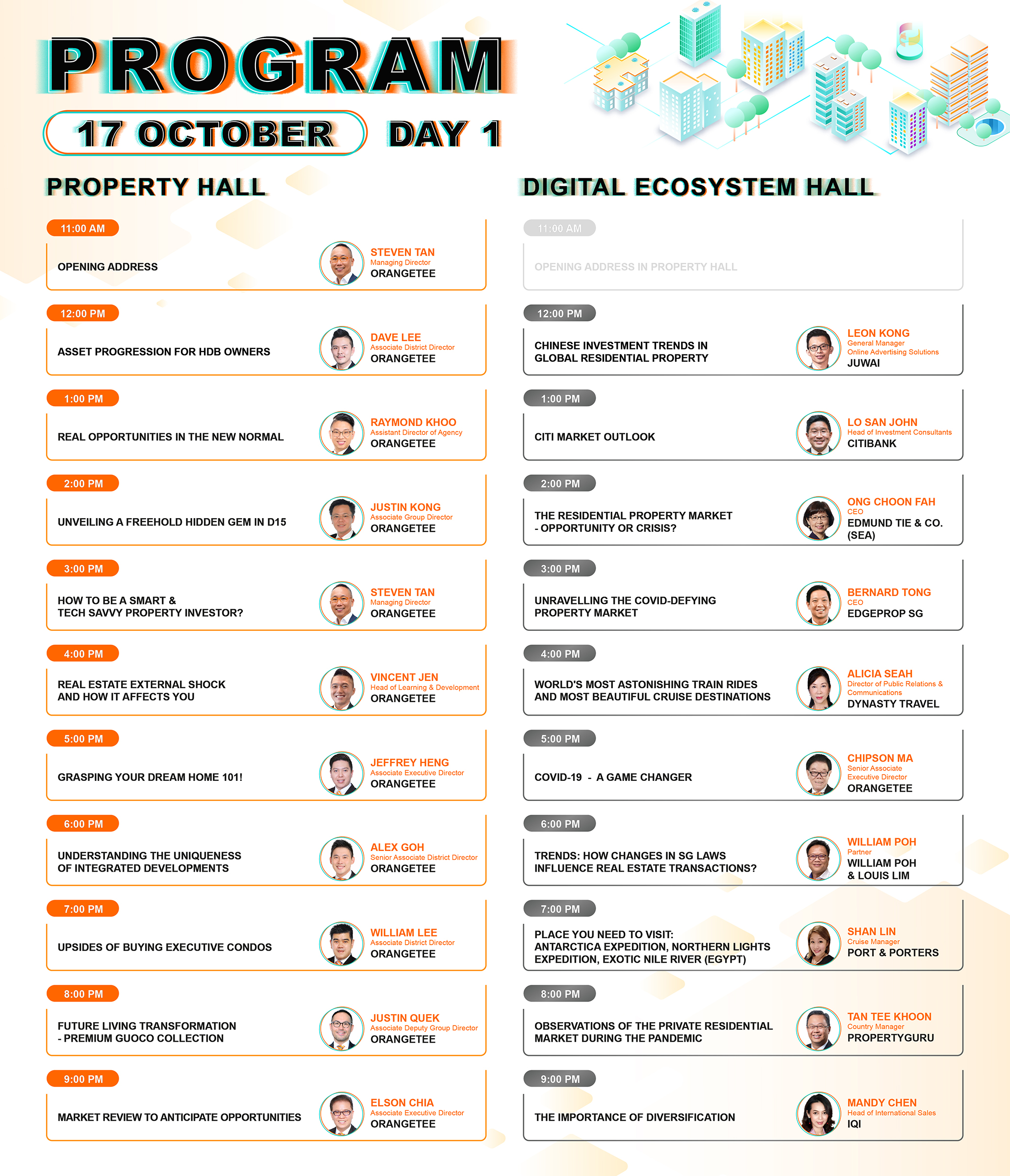
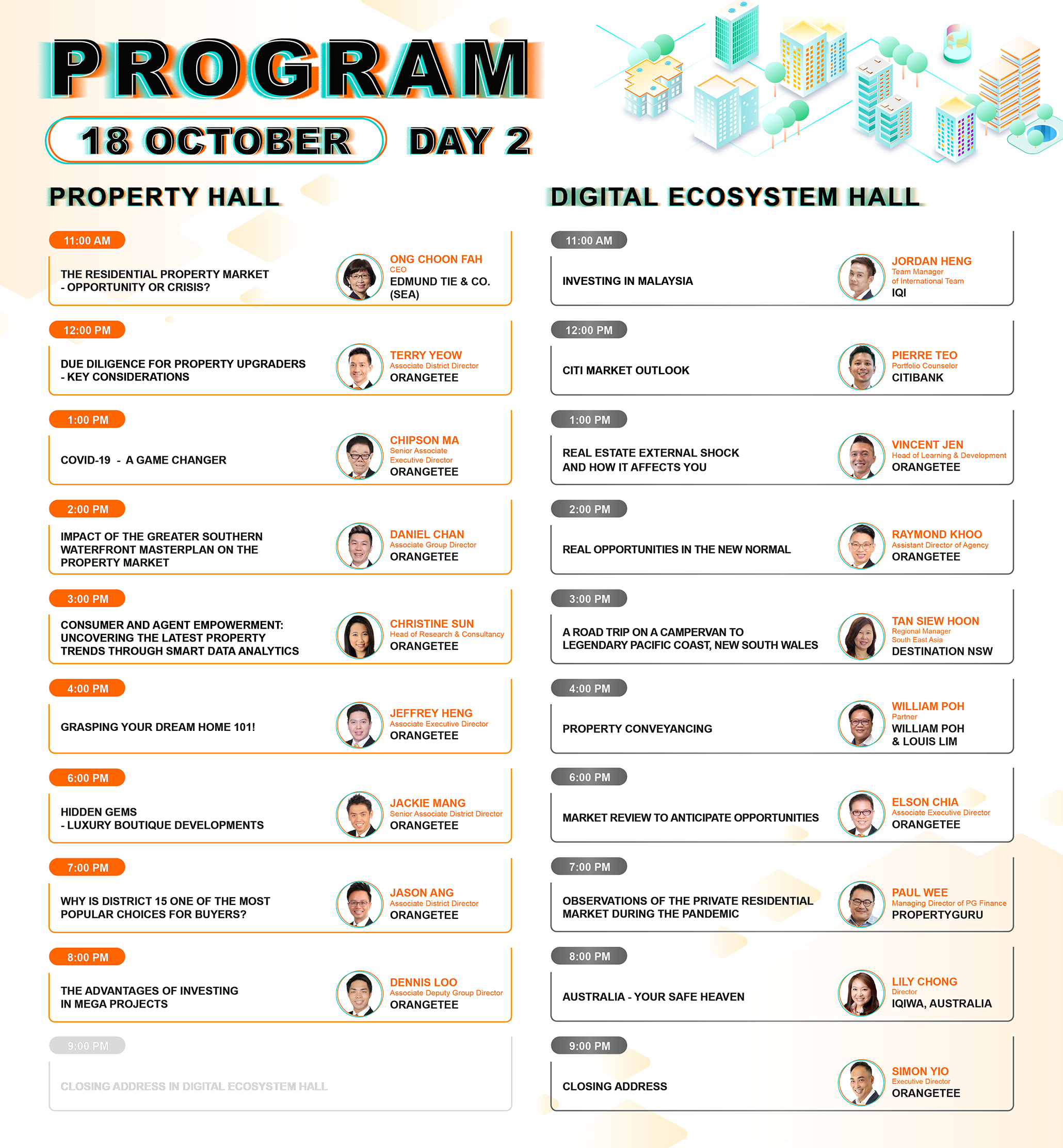
OrangeTee, one of Singapore’s largest real estate agency and advisory group, will be running their first Virtual Property Expo this weekend. From 17 – 18 October, the online event will walk you through with all the tips and skills for property hunting or investment.
Find your dream home with over 60 newly launched projects, 10,000 resale listings and 40 free seminars covering various topics on properties such as “The Importance Of Diversification“, “Australia – Your Safe Haven” and “How To Be A Smart And Tech Savvy Property Investor“.
Much of the world has been given a small portion due to the grave effects of the pandemic. Sickness, unemployment, budget cuts, and other painful transitions can give us a taste of poverty. Being in this situation allows to take a closer look at our finances.
How is your financial health? Before anything else, evaluate your financial objectives and assess your spending and saving patterns. Ask yourself why you want to save and what your priorities are. This is to ensure that you know which path to take to reach your desired goals. Afterwards, review your cashflow and create an allocation plan. Move any excess funds to a bank account to help facilitate discipline against impulsive spending. Choose a bank with a high interest rate.
Other lifestyle changes include automating your finances, shopping smartly in supermarkets, switching to generic products, discussing about household finances, and going on a cash-only diet. Let us start with automating your finances.
Most bills can be paid online and many establishments have the option of setting up automatic payments. Try automating consistent payments for fixed costs such as your telecom, insurance, Netlix, or Spotify bill. This way, you will not miss a billing statement and will not incur late fees. You may also apply automation to your credit-card bills, if you want smoother transactions.
Secondly, you must use savvy shopping strategies in the supermarket such as using a coupon. Coupons can help you save a lot, especially when you are buying in bulk. Grocery tricks such as employing the numbers game – wherein they will put an irrational price of “S$3.99 or S$3.96” (instead of S$4) can trick your mind into saving more. Watch out for this!
If you are grocery shopping, it is best to shop on a full stomach. Shopping on an empty stomach may cost you a lot. Your feelings of hunger can make everything enticing, including junk food and other unnecessary items. Try eating a healthy snack before heading to the store. Your wallet and your tummy will thank you for that.
Thirdly, you may switch to generic products whenever possible. My sister and I recently went to the pharmacy to pick up some antibiotics. Interestingly, the generic brand was three times cheaper than the branded ones. You have to weigh your options and consider generic products for items such as toiletries and pet supplies. What is important to you? What are you willing to sacrifice? Only you can answer these questions.
Fourthly, you must discuss your finances with your spouse or partner. Knowing each other’s spending patterns and financial plans can help you set a life of success. Dealing with financial issues is something that most couples have to do. However, you have to do it as a team. Get comfortable talking about money, because a single conversation will not suffice. Reduce your electric and water bills by conserving water and switching off the lights when not in use. Use money-saving household cleaning hacks that enable you to make your own cleaning products.
Image Credits: pixabay.com
Lastly, you may go on a cash-only diet. This entails that you will ditch you plastic cards for a month or a certain period. It takes a lot of self-control and patience. Buy things that can only be bought through your allocated cash. When your cash runs out, you will be out of funds until your next scheduled withdrawal. Spend and plan wisely!
Time is of the essence. Crippled with all the uncertainties brought by the pandemic, having reserved funds can help cushion the blow of unforeseen events such as pay cuts and layoffs. Saving money is important, especially when your finances are limited. Consider saving money to grow your emergency and retirement fund.
Retirement may seem like a long walk ahead for someone in his or her 20s or 30s. However, it is best to start saving for retirement before you hit 35 years old because your priorities will change at that time. Financial priorities such as spending for a wedding, an education loan, house loan, and other major transitions may occur once you hit your 30s. Typically, you spend more money on yourself during your 20s. Why not consider spending more money for your future?
In your early 20s, you may save at least 5% of your income or sign up for your employer’s Retirement Plan. Avoid debt as much as possible and get educated about your finances. Widen your financial knowledge by reading financial books on investments and business opportunities. Pay off your debt, if necessary. It makes sense to pay off your debts or at least your high-interest debts before you save for your retirement. Not all debts are created the same. Pay off your high-interest debts first followed by the lower-interest debts.
The next step is to set up a budget. Systematically allocate your income onto distinct categories and stick to that budget. Do not spend beyond what your budget is for that month. This allows you to save regularly rather than arbitrarily. Make critical decisions about your expenses and cut down the unnecessary, especially when you hit your late-30s. Ideally, this is when you hit maximum savings. By this time you should have at least S$50,000 to your Retirement Savings.
Image Credits: unsplash.com
The third step is to seek for an employer that supports your goals. If your employer offers Retirement or Pension Plan then embrace this company benefit. As a young adult, you may also invest your money in accordance to your financial goals.
Lastly, you are saving money for your retirement to prepare for the unexpected. Contemplate and reconsider the realistic measures that are suited for you and your lifestyle. Seek the financial experts’ help as much as possible. Then, plan your exit with joy because you are well prepared for it.
Have some idle money sitting around and hoping to invest and secure a rate of return that is higher than your usual bank interest rates? Well don’t we all? Every investment comes with different levels of risk. A guaranteed return on your investments simply means that you are promised, with some levels of certainty, that you will receive a return on your investment in any circumstances.
To learn more about guaranteed returns investments, let’s take a look at 2 effectively guaranteed returns products offered by Funding Societies, Southeast Asia’s largest Peer to Peer lending platform. Peer to Peer Lending or P2P lending is an investment concept where individuals & institutions invest in loans to SMEs and earn returns in the form of interests. Investments on the Funding Societies platform starts from S$20 with a maximum tenor of 12 months and monthly/periodic repayments to investors.
For more information on investing with Funding Societies, join their upcoming webinar on 29th Sept 2020 at 7PM. Register for free here.
How does it work
An effectively guaranteed returns product offered by Funding Societies means that you as an investor are effectively guaranteed to receive both your principal & interests on the investments regardless of the SME’s repayment status. There are currently 2 products available under this line, namely Guaranteed Returns Investments (GRI) andGuaranteed Property-backed Investments (GPI).
Guaranteed Property-backed Investments
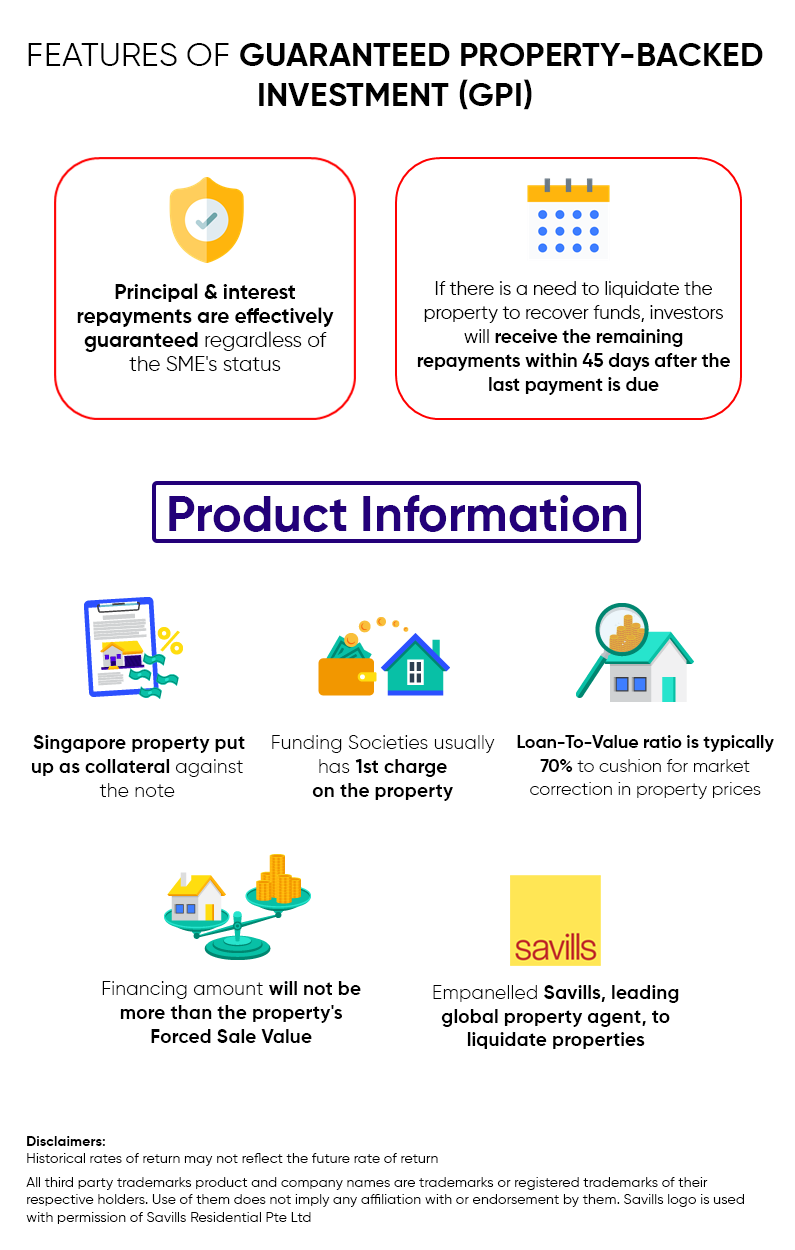
Guaranteed Property-backed Investment (GPI) is an investment into a collateral-backed note with an additional guarantee of repayments to investors. Should the SME fail to fulfil their obligations, Funding Societies has the right to liquidate the property to recover the funds.
Key Investment Information
Minimum Investment Amount – $20 per investment
Interest rates: usually 3% – 8% per annum
Tenor: 6 to 12 months
Repayments: Monthly repayment of interest and principal at the end of tenor
Guarantee: Principal & interest repayments are both effectively guaranteed regardless of the SME’s status
Collateralised property information: Only local Singapore properties owned by the SME or it’s directors are accepted
Sign up and start investing with Funding Societies here
Guaranteed Returns Investments
Guaranteed Returns Investment is an investment into a loan given to a small business in the form of a note with a layer of security whereby the repayments are effectively guaranteed even if the SME does not pay.
These small businesses come from all walks of life and Kaca Coffee House is one of them. See their story here:
Repayments: Usually Monthly repayment of Principal & interest
Guarantee – Principal and Interest are both effectively guaranteed regardless of SME status
Please invest with the knowledge that while returns are effectively guaranteed by FS Capital Pte. Ltd., there may be a chance where they might not be able to fulfil the obligations under this arrangement. To mitigate this risk, a cash reserve buffer is maintained to allow for repayments to be made on time.
Importance of investment diversification
As the saying goes, do not put all your eggs into one basket. Just as how it is important to diversify across asset classes and business types, the same goes for varying risk return investments. Diversifying your investments with guaranteed returns products can be an option to consider to balance out your portfolio.
If you have done your own due diligence and decided to invest with Funding Societies, they currently have a promotion for new investors. Sign up with promo code MONEY20 and make a total investment of S$200 by 31st Oct 2020 to get a S$20 cashback.
Terms and Conditions apply
Investors must sign up with the aforementioned promo code and make a total investment of at least S$200 by 31st Oct 2020 to be eligible for the $20 cashback. Cashback will be credited into the eligible investors’ accounts by the end of November 2020. Funding Societies’ investor T&Cs apply.
Funding Societies is the largest SME digital financing platform in Southeast Asia. It is licensed in Singapore, Indonesia and Malaysia, and backed by Sequoia India and Softbank Ventures Asia Corp amongst many others. It provides business financing to small and medium-sized enterprises (SMEs), which is crowdfunded by individual and institutional investors. Investors can invest from as low as S$20 with a tenor of no more than 12 months. Depending on the investment product, interest rates can range between 2% to 18% per annum.
It got many people thinking about insurance claims, the legality of personal and protection claims, and what one has to do if they were to encounter such an unfortunate accident. If that is you, here’s what you need to know about protecting yourself should you encounter an accident in a public space.
#1: Make an insurance claim immediately
Justin Chan, Head of Dispute Resolution at Tito Isaac and Co, shares that as soon as an accident in a public space happens, an individual should inform their insurer(s) immediately. Also, it’s advisable to engage a solicitor who can point you and your claims in the right direction.
In the case of the injured cinema patrons, lawyers would most probably advise the affected parties to inform the mall. This way, the mall can then inform their respective insurers. Mr Chan adds that a similar letter will be written to the cinema operator, where they would have some sort of policy which would cover accidents within the cinema for their patrons.
#2: Know where accountability lies
Image Credits: AsiaOne
A question to consider is the location where you got the injury. Mr Chan said that in this particular case of the injured cinema patrons, the cinema is the occupier of that particular space. “The occupier owes a duty of care to their cinema-goers,” he adds.
But if you’re at a common public space in the mall like staircases, corridors, or open waiting areas, the responsibility will fall back on the mall.
Mr Chan also stated that every able-bodied person should have insurance at this point in time. “But if you don’t have your own personal insurance, then you would leverage on the occupier’s insurance.”
#3: Other useful actions to take
If you do not need to make a trip to the hospital immediately, Mr Chan advises the public to take pictures of the accident site. Also, see if you can spot any closed-circuit televisions (CCTVs) on the premises.
“Last but not least, get medical attention,” he said. Mr Chan reveals a personal experience where a simple headache experienced by his client grew into a multitude of physical ailments. While you may not feel the health effects immediately, there may be underlying issues so seek advice from a medical professional.
Key takeaways
Inform your insurers, contact the public space’s management, and engage a lawyer.
About Tito Isaac and Co
Image Credits: Tito Isaac and Co
Tito Isaac & Co is a homegrown, Singapore law practice founded in 1999. The law firm advises, plans, and executes legal solutions to help individuals and enterprises preserve, protect, and build on their strategic interests and business positions.
They provide a full suite of services ranging from litigation, arbitration and dispute resolution, specialist & private client interests to corporate advisory and transactional work.
If you need legal advice, phone them at +65 6533 0288 or drop them an email via [email protected].