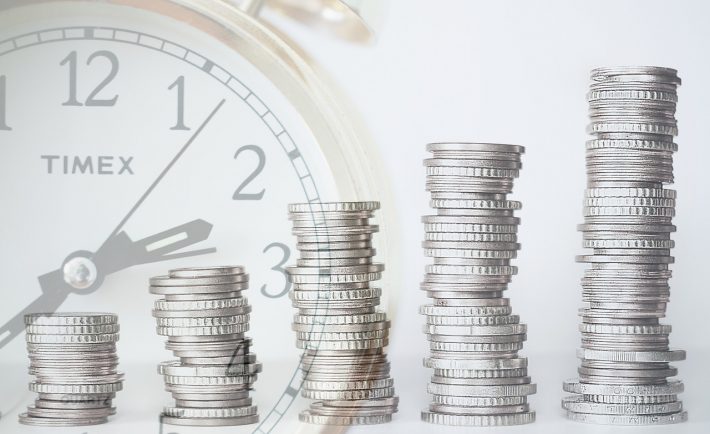
How To Start Investing With S$100 A Month

Oh, adulting! It comes in a slate of responsibilities thrown at a person all at the same time. To survive the challenges of life, one must establish a healthy savings plan. Long-term savings include having an insurance policy, a good credit score, and an emergency fund. Many people grow their savings thru investing.

Investing is an overwhelming idea for many Singaporeans as they perceive it to be expensive. Few people outside the financial industry have thought of investing their money for themselves. However, you do not need to have S$10,000 or more to start investing. You can grow your wealth with just S$100 per month.

Here are some strategies that you may apply.

#1: MAKE SMALL INVESTMENTS REGULARLY

It comes as no surprise that one advantage of making small invest regularly is that you are not trying to time the market. Instead, you are relying on your money’s “time in the market”. This is important because stocks have their ups and downs, but their prices tend to increase as time passes. This is a strategy known as dollar-cost averaging, which will average out the cost of share purchases in a period of time.

For as little as S$100 a month, you may start investing in DBS Invest-Saver as it allows you to buy an Exchange Traded Fund (ETF) that mirrors the performance of the Singapore stock market or a bond ETF.

#2: CONSIDER REGULAR SHARES SAVINGS

One of the most affordable ways to get inside the Singapore Exchange (SGX) is through Regular Shares Savings (RSS) plans. RSS can be opened with the help of a local brokerage firm or bank.

The broker of the financial institution will invest a fixed amount of money every month based on your instructions or financial capabilities. For instance, you may choose to invest S$100 each month into the Straits Times Index (STI) Exchange Traded Fund (ETF).

Control is one of the best parts of RSS plans. If you wish to invest money in different companies each month, you may do so. If you wish to stop investing in a company each month, you may do so. Simply instruct your broker and adjust your monthly investments. Some financial institutions allow you to take control of your RSS plan through online platforms.

#3: APPLY FOR UNIT TRUSTS

If you prefer to have someone else control your investments then, you may choose to invest in unit trusts. Unit trusts work by collecting money from many investors. A professional fund manager will take this pool of money and grow it following a specific investment strategy. It is a collective investment, which is why you do not have personal control over the individual components of the investment portfolio.

A common misconception about investing thru unit trusts is that you do not need to do anything. This is not true! As an investor, you must do your research before deciding which unit trusts you wish to invest in. By doing your research, you will know that both DBS and OCBC unit trusts allow you to either invest a lump sum of S$1,000 or S$100 per month.

Image Credits: pixabay.com

Good luck with your investment journey!

Sources:1 & 2

Read More...

Stocks 101: A Guide For Newbies

Original investments for the next 10 years

Tackle your busy life while earning money on the side by investing your money. Let your money work for you to achieve the future you have always dreamed of. Renowned investor Warren Buffett defines investing as the “the process of laying out money now to receive more money in the future.”

Investing Like Warren Buffett

(Image credit: Fortune Live Media, via Flickr)

To start investing, you must know what is a stock is first.

WHAT IS A STOCK?

Whether you call it security or equity, a share of stock is a legal ownership in a business. Businesses or corporations issue stocks to gain money. It comes in two varieties – preferred and common. Preferred stock comes with a predetermined dividend payment. While, the common stock allows the stockholder an access to a proportionate share of a company’a profits or losses. It is to you to choose whichever suits you best.

HOW DO YOU MAKE MONEY WITH STOCKS?

There are two ways to make money from owning and investing in stocks. You can make money by reaping the increase in stock price or dividends. Because these two accumulate over time, just one year’s investment in a premium can yield a solid return in the next couple of decades. You can look up blue chip companies such as Coca-Cola and Disney.

The Father of Value Investing, Benjamin Graham, once said:

“The real money in investing will have to be made—as most of it has been in the past—not out of buying and selling, but out of owning and holding securities, receiving interest and dividends, and benefiting from their long-term increase in value.”

WHY SHOULD YOU INVEST?

The stock market provides high returns. You should invest to grow your wealth. However, I cannot guarantee how your stocks will perform. You need to understand that strategy application and diversification aids in growing your wealth. Diversifying your investments by including stocks along with your bonds and assets can help protect you from the inherent volatility of the financial markets.

WHAT IS DIVERSIFICATION?

To provide cushion from the risks that come with the stock market, one can apply diversification. Think of it as not putting all your eggs in one basket. In order to diversify your stocks portfolio, you may need a significant amount of money to invest. It is nearly impossible to create a well-diversified portfolio with S$1,000 alone.

This is where mutual funds come into play. Mutual funds tend to have a large number of stocks and other investments whereby it is controlled by a portfolio manager. It is more diversified than a single stock in one company. This is something that you must think about.

Sources: 1 & 2

Read More...

How P2P Lending Works In Singapore

BY DEFINITION

P2P Lending, short for Peer-to-Peer lending, took off in 2005. It sprung due to many companies’ efforts to deviate from the financial institutions that let them borrow money. Borrowing from banks took about two to three years’ worth of records. And, many companies do not have the luxury of time. Instead, they turn to the Internet for help.

P2P websites allowed private people from around the world to lend money to various companies. For instance, you can lend S$100,000 to a company requiring money for an expansion. In return, you will receive repayments with interest from the company. P2P lending is very attractive to lenders due to the extremely high interest, which is up to 20% per annum.

SINGAPORE: THE ASIAN CENTER

Singapore reigns as a the Asian center for P2P lending due to being a regional hub for trading, a safe storage of precious metals, and a well- established economy. Singapore is appreciated for its direct approach to lending and borrowing as supervised by the Monetary Authority of Singapore. It even issues promissory letters.

Moreover, Singapore has a cash-intensive economy where a great deal of lending happens outside of the banking system and inside of the online platforms.

HOW TO START LENDING

Take Part In A Larger Portfolio

A well balanced portfolio has a mix of low-risk assets and high-risk assets. By nature, P2P lending is a high-risk asset that invites high returns. It can be used to offset the low returns from your conservative assets such as fixed deposits or Singapore Savings Bonds (SSBs).

Seek help from a qualified wealth manager to balance out your portfolio. As a rule of thumb, experts suggest that high-risk assets should not take more than 15% of your portfolio.

Invest On What You Can Afford To Lose

One of the leading advantages of investing in P2P lending is that you can take on small amounts. You can have various investors pitch small amounts of S$1,000 to fulfill your business goals.

Limit your potential losses by investing only what you can afford to lose. Do not gamble your savings away! Any amount that you cannot recoup within two months is too much.

Spread Out Your Investments

Try not to bury your eggs in one nest. As much as possible, choose to spread out your investments in a list of companies found in a P2P website.

If one company fails to repay you, the rest can do better for your account. It is less likely that every company you chose will fail to repay you. Furthermore, a company may repay you less for a long period of time. You have to get some cushion.

Sources: 1 & 2

Read More...

Cheap Investment Opportunities In Singapore

Many Singaporeans think that should accumulate a significant amount of wealth before investing in the stock market. Well, let me prove you wrong! You can start investing with as little as S$100.

This seemingly low amount has three investment options. Choose wisely!

OPTION #1: REGULAR SHARES SAVINGS (RSS)

Regular Shares Savings plans (RSS) are also called monthly investment plans. Your mere S$100 can turn into a stock on the Singapore Exchange (SGX) as long as you commit to it monthly. Simply open an RSS plan with one of the four leading banks in Singapore. For instance, you may choose OCBC bluechip investment or POSB Investment-Saver.

The broker for the financial firm will invest your fixed amount based on the instructions you gave. I may instruct the broker to invest to Strait Times (STI) every month or to other bluechip companies. Do your research before spending! The best part about it is that you have full control over your investment decisions. What’s more? Your instructions can be submitted online thru the bank’s platform.

OPTION #2: UNIT TRUSTS

One a scale of risk taking, you may fall under the conservative end. Fortunately for you, you can invest your money in unit trusts. Unit trust works by combining money from a set of investors. The pool of money will then be invested by a professional fund manager. The professional fund manager will have control over your investment.

Nonetheless, you must educate yourself about the type of unit trusts wish to invest in. Unit trusts can be bought for about S$100 in various local banks.

OPTION #3: ROBO-ADVISORS

The future is upon us! Investors can use robo-advisors to allocate their assets in the portfolio. Robo-advisors automatically help investors by tapping on the formulas to manage their assets.

It is a relatively new system in Singapore. Hence, there are only a few brands to choose from. For instance, you may hop to Smartly or AutoWealth. However, the latter has a minimum investment of S$3,000 while the former does not. These two platforms use different algorithms to arrive at optimal solutions. Moreover, these platforms can charge up to 1% per annum for managing your money. The fee is calculate based on the percentage of the total portfolio held in your account.

Source: dollarsandsense

Read More...

What Type of Trader Are You

One of the most important decisions you’ll make in your trading career is deciding how you’re going to trade. You see, that decision will set the tone for the rest of your trading, and it will determine which tools you use, what markets you focus on, how active you have to be, etc.

Now, even though this is an incredibly important decision, it’s something most beginners overlook, and that can be a very costly move. We, together with BullMarketz.com, listed four of the most common types of traders with a description of what sets them apart.

Before we get started, we need to clarify that your trading style isn’t written in stone and you can always change your strategy down the line. Just keep in mind that it’s much easier to trade if you stick with the same type of trading, at least for a few months at a time.

Scalp Trader

Scalping is perhaps the most extreme form of short-term trading there is today. This trading style was designed by day traders that wanted to shorten their trading times in order to benefit from more market movements.

Often times, a position isn’t held open for more than a couple of seconds, and the key to succeeding is to set short-term goals and remain incredibly focused on the smallest price changes. In order to succeed with scalping, you will have to make split-second decisions, and your goal is to make a lot of profit from many small trades.

Many scalp traders focus on volatile instruments such as cryptocurrencies and they often prefer trading with leverage and margins by using CFDs and other derivatives.

Naturally, this type of trading can, at times, be associated with increased risk, but that’s also a part of the attraction.

Day Trader

Day trading is perhaps the most known type of short-trading out there, but it’s also a term that’s often used incorrectly.

Most professional traders that work on their own or handle other people’s’ portfolios are day traders, and the concept revolves around making several well-planned and well-executed trades every day. For you to make it as a day trader, you’ll need an in-depth understanding of the markets you’re trading on, the tools you use, and the analytic strategies needed to place profitable, short-term positions.

What separates scalping from day trading is that day traders often sit around for long periods of time waiting for the perfect market conditions while scalp traders dive headfirst into any potential opportunity. Moreover, day traders need to be incredibly resilient to stress.

Swing Trader

Swing trading is typically perfect for people who don’t have the time or patience to spend all day in front of the computer analyzing assets and markets. Many traders that have regular day jobs are swing traders because it gives them the opportunity to keep their jobs while also trading.

Generally speaking, a swing trader is a position that’s kept open for longer than a day trade. It can range from overnight to a couple of days or even weeks if the conditions are right.

For many beginners, swing trading is the most natural option right at the beginning of their trading journey since it’s considerably less stressful and demanding than both day and swing trading.

Investor

An investor or position trader is someone who buys an instrument with the intention of selling it a few months to several years later. Because of the long time frames, most don’t consider them traders but rather investors, although investing is often combined with short-term trading.

The benefit of long-term investing is that it requires little to no work after the initial investment, and many times the profit is completely passive. Another perk is that long-term investing is suitable for more markets than short-term trading. For example, you can invest in real estate and keep that investment for years, but it’s not as easy to try and day trade on the value of a property.

Read More...