6 Essential Reasons Why You Should Learn To Invest

Investing is the act of allocating your money in the hopes that you will achieve a profit in the future. The money generated from your investments can provide income and fulfillment of long-term financial security.

Now is the ideal time to start investing! Allow me to convince you with these “6 Essential Reasons Why You Should Learn To Invest”.

#1: WORK SMARTER, NOT HARDER

Many people do not think about investments until they are well into their 20s or 30s. Although opportunities to invest may come before that, investing is not something that is automatically embraced by all. Do not panic! You can become an investor at any age.

The sooner you open an investment account, the better it will be for your financial future. Take advantage of the greatest asset of all – time. Investing while you are young gives you the chance to work smarter. Would you rather save a considerable amount of money every year or save a huge amount of money later in life? Think about that.

#2: GET MORE EARNING POTENTIAL

Investing your money allows you to grow your wealth. Most investment vehicles such as stocks and bonds offer returns on your money over the long run. The return allows your money to build over time.

The money you build can be used to create a business or expand your existing one. Many investors support entrepreneurs and contribute to the creation of new products and new jobs. The more successful entities you have backed up, the stronger your returns will be.

#3: SAVE FOR RETIREMENT

Let us face it! You need to be prepared for your retirement. You should save money for retirement as you are working. You can put your retirement savings into a portfolio of diversified assets such as real estate, precious metals, stocks, mutual funds, and bonds. As soon as you retire, you will be able to live off from the funds that you have earned.

Base your personal tolerance of risk on your age and lifestyle. You may employ greater risks to increase your chances of earning greater wealth in your younger years. Becoming more conservative with your investments as you grow older can be wise.

#4: POWER OF COMPOUND INTEREST

Learning about investments will enable you to know the power of compound interest. Compound interest allows your money to make more money for you. It pays to invest early and often. The longer your money can benefit from the power of compound interest, the higher your gains will be as time goes by.

Say you invest S$1,000 this year and you earn a 10% return on that. This means that you will end up having S$1,100. If you do not contribute anything next year, you will still make money through the compound interest. Instead of earning another S$100, you will earn S$110 because you are getting 10% from a balance of S$1,100. You will have S$1,210 by the end of next year.

#5: DIVERSIFY YOUR ASSETS

You need to diversity your assets as your investments make one part of your financial picture – not all of it. You should not keep all your money in cash, in your house, or in your car. Instead, invest in a variety of categories to cushion unforeseen losses. It makes more financial sense to keep your emergency fund, your house (real estate), your hard assets (e.g., car), and your portfolio of investments.

#6: REACH YOUR FINANCIAL GOALS

Image credits: pixabay.com

Learning how to strategically invest your money allows you to reach your financial goals. If your money is earning a higher rate of return than your savings account, you will be able to earn more money within a faster period. This return on your investments can help you reach your financial goals such as buying a car, starting your own business, or putting your children through university.

Sources: 1 & 2


Read More...

Fundamental Differences Between Stocks And Bonds

As a novice in the world of investments, it is important to know the basic differences between stocks and bonds. Stocks provide partial ownership in a corporation, while bonds are loans from an individual to a company or government.

One of the biggest differences between these two is how they generate profit. Stocks must appreciate in value and be sold later on. On the other hand, bonds pay fixed interest over time. Continue reading this article to know other notable differences between stocks and bonds.

STOCK MARKET VERSUS BOND MARKET

A place where investors can trade equity securities such as common stocks is called the stock market. Buying stocks (i.e., equity securities) entails that you are buying a very small ownership stake in a company. Equity holders purchase stocks in a company on a belief that it will perform well and that the value of the shares they purchased will increase. These stocks are traded on stock exchanges.

The key function of the stock market is to bring sellers and buyers together into a regulated, fair, and controlled environment where they can execute their trades. This regulated environment not only helps the investors, but also the corporations whose equity securities are being traded. The economy thrives when the stock market remains its robustness.

Let us move on to the bond market. The bond market is where investors go to trade debt securities (e.g., bonds), which may be issued by the governments or the corporations. The bond market is also known as the credit or debt market. Buying a bond or a debt security entails that you are lending money for a period of time and charging interest. You can compare the process to how banks charge interests to its debtors.

The key function of the bond market is to provide its investors with a steady, albeit nominal, source of regular income. In some cases, investors receive bi-annual interest payments. Many investors choose to hold bonds in their portfolios to save money for long-term needs such as retirement and their child’s education.

WHERE STOCKS AND BONDS ARE TRADED

Stocks are traded on exchanges, which are places where buyers and sellers decide on a price. Some exchanges are carried out on a trading floor or other physical locations. While, other exchanges are carried out virtually and are composed of a network of computers.

In contrast, the bond market does not have a centralized location to trade. Bonds mainly sell over the counter. As such, individual investors do not usually participate in the bond market. Those who participate include large institutional investors like pension funds foundations, asset management firms, and investment banks. Individual investors who wish to invest in bonds do so through a bond fund managed by the asset manager.

RISKS OF STOCKS VERSUS RISKS OF BONDS

Investors of stocks may be exposed to risks such as currency risk, liquidity risk, interest rate risk, and geopolitical risk. Moreover, stocks run the risk that the company could perform poorly or fall into bankruptcy and disappear altogether.

When it comes to bonds, investors are more susceptible to risks such as interest rates and inflation. When the interest rates are high and you need to sell the bond before it matures, you may end up getting less than what you paid for. If you are purchasing a bond from a company that is not financially sound, you are embracing the risks of credit. The bond issuer may not be able to make the interest payments, leaving itself open to default.

BOTTOMLINE

Image Credits: unsplash.com

Many people opt to invest in both stocks and bonds to diversify. The appropriate mixture of stocks and bonds in your portfolio must consider your tolerance for risks, personal timeline, and investment objectives. Typically, stocks and bonds do not fluctuate at the same time. Think about that.

Sources: 1 & 2

Read More...

How Everest Gold Compares Most Favourably Amongst Various Platforms for Gold Investments

Gold prices have been on an amazing run in 2020. It has surged from USD 1,550 to reach USD 1,800  (Source: goldprice.org) in November 2020. Increasingly, investors also recognise the importance of having gold in their portfolios. When it comes to gold investments, investors are spoilt for choice since there are various platforms available in the market.  We researched across the various platforms to determine the most cost-effective and efficient way of investing in gold.

Comparison of Various Platforms for Gold Investments

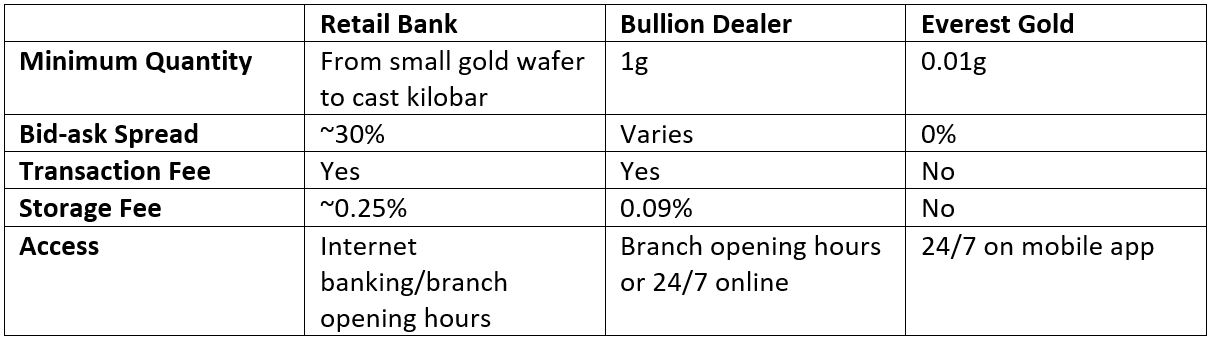
Here is a comparison of the common platforms available for gold investments on key metrics such as transaction fee, storage fee, etc.

Everest Gold

Everest Gold’s digital trading platform is the first-of-its-kind to introduce real gold bullions broken down into digital gold units called Everest Gold Units (EGUs), that allows gold investors to trade from as low as 0.01grams. Every EGU is 100% backed by real gold and matched on a 1:1 basis.  Investors can accumulate their EGUs and exchange them for physical gold.

The minimum capital to trade starts from USD 0.60, the equivalent of 1 EGU, making it highly affordable for everyone. Moreover, its users enjoy fairer prices without paying high premiums commonly levied by retail banks. Fees are non-existent since there is no transaction fee and storage fee. The combination of no fees and fair price offers investors the chance to maximise their profits. This stands in steep contrast to transaction and storage fees typically charged by retail banks and bullion dealers.

Everest Gold platform is also highly accessible and allows investors to trade gold 24/7 on the mobile app. Such instantaneous liquidity is another attribute not usually offered by traditional retail banks and bullion dealers.

Everest Gold is available for download on Android, iOS and accessible from desktop.

For more information, visit https://everestgold.sg


Read More...

Invest Your SRS with MoneyOwl And Get Up To $200 Shopping Vouchers

The Supplementary Retirement Scheme (SRS) is a voluntary scheme to encourage individuals to save for retirement. Unlike the Central Provident Fund (CPF), it is not compulsory to participate in the SRS scheme. A key benefit of SRS is that members can enjoy dollar for dollar tax relief, capped at $15,300 per annum for Singaporeans while saving towards their retirement goals. As a tax deferral scheme, when you subsequently withdraw from your SRS after the statutory retirement age, only 50% of the amounts withdrawn will be subject to tax. Individuals who would like to open an SRS account can do so with either DBS, UOB or OCBC bank.

Don’t leave your funds in SRS un-utilised

After transferring funds into your SRS account, don’t leave it un-utilised! According to Ministry of Finance (2019), over 28% of SRS contributions sit idle as cash balances, earning a low interest rate return of only 0.05% p.a.

There are many ways that you can utilitse your SRS contributions to grow your retirement funds, such as investing in unit trusts, ETFs, stocks, bonds (including Singapore Saving Bonds and Singapore Government Securities) and single premium insurance.  A particular affordable and convenient way is to invest your SRS funds with MoneyOwl to boost your future retirement fund. Here’s why you should do so.

Invest your SRS with MoneyOwl

Investing your SRS funds with MoneyOwl starts from as little as S$50/month or $100 as a lump sum. This means that it is possible to start early without waiting for your SRS funds to accumulate to a substantial level. Besides, there is no platform fee so that more wealth is generated for the you in the long run. With MoneyOwl, you gain access to a globally diversified portfolio of companies with good growth potential at value prices.

Receive up to $200 eCapita shopping vouchers

MoneyOwl is offering a limited time SRS promotion valid till 31 Dec 2020*

Tiers Qualifying Conditions* eCapita voucher
1 S$1,000 to S$10,000 fresh funds invested OR; $50
2 S$10,001 to S$50,000 fresh funds invested OR; $100
3 S$50,001 and above fresh funds invested $200

More details can be found on MoneyOwl’s website

*T&C:

  • This promotion is only valid from 9 November to 31 December 2020.
  • This promotion is only open to the first 500 people who successfully invest their SRS funds with MoneyOwl.
  • Promotion is valid for one-time top ups using SRS funds only. Regular savings plans/ monthly SRS investments are not eligible.
  • Promotion is not valid for cash investments and investments in WiseSaver portfolio.
  • You need to stay invested and not withdraw your funds for at least 2 months after the promotion period is over (i.e. till end-February 2021). Vouchers will be sent to you in March 2021.
  • Only new MoneyOwl clients are eligible for S$50 voucher redemptions.
  • Both existing and new MoneyOwl clients are eligible for the $100 or $200 voucher redemption.
  • MoneyOwl reserves the right to change these terms and conditions from time to time.

About MoneyOwl

MoneyOwl empowers and fulfils lives by helping people make wise decisions to achieve their financial goals. With one of the lowest fees in the market, invest your SRS funds with MoneyOwl today to boost your future retirement income.

Read More...

Bear & Bull Markets: Animals In The Stock Market

For investors, the terms “bull” and “bear” carry distinct weights as they frequently describe the market conditions. These terms are used to describe how the market is doing. It is your responsibility as an investor to know the direction of the stock market, because it will significantly affect your portfolio. Examine how each of these market conditions may impact your investments.

INVESTORS’ ATTITUDES AND THE MARKET

Since the financial markets are greatly influenced by the investors’ attitudes, these terms also denote how they feel about the current economic situations. A bear market occurs in an economy that is receding and where most stocks are depreciating in value. Interestingly, it is named for the way the bear attacks its victims. You see, a bear swipes downward during an attack. Thus, it became a metaphor for the market activity during this condition.

On the other hand, a bull market exists in an economy on the rise. This is where conditions of the economy are generally favorable and positive. Investors usually have faith that the uptrend will continue over a long period of time during the bull market condition. In the case of equity, a bull market denotes a rise in the prices of companies’ shares.

In a bear market, share prices are continuously dropping. This affects the investors’ attitudes negatively, which later perpetuates the downward spiral. During this time, the economy slows down and unemployment rises as companies begin laying off workers. One can only imagine how the investors felt last March 2020 when the U.S. stock market fell into the bear market due to the pandemic!

SUPPLY AND DEMAND FOR SECURITIES

More investors are looking to sell than to buy in a bear market. The demand for securities is significantly lower than the supply. As a result, share prices drop. A bear market can be more dangerous to invest in, because many equities lose value and price.

In contrast, there is a strong demand and weak supply for securities in a bull market. Many investors wish to buy securities, but only few people are willing to sell them in a bull market. As a result, share prices will rise and investors compete to obtain available equity.

SHIFT IN ECONOMIC ACTIVITY

A weak economy is often associated with the bear market. Most businesses and companies are unable to bring in huge profits due to the unwillingness of consumers to spend money. This decline in profits directly affects the way the market values stocks.

In a bull market, the opposite happens. People have more money to spend and are very much willing to spend it. This relationship towards the consumers strengthens the economy.

Image Credits: unsplash.com

THE CONCLUSION

A bear market occurs in an economy that is receding, where more stocks are depreciating in value. While, a bull market exists when the economy is sound. Both of these conditions will have a significant influence on your investments. It is a good idea to determine how the market is doing when making an investment decision.

How long a bear market will last varies wildly due to the situation. Some can last for several weeks, while others last for years. Over the long run, the stock market always has a positive return. A grand comeback, which we all have been waiting for!

Sources: 1 & 2


Read More...