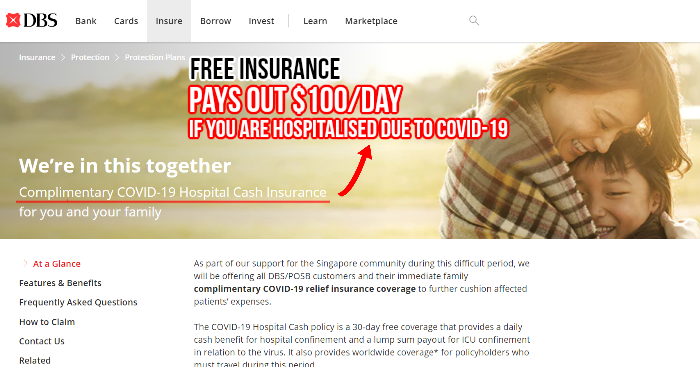
As part of DBS support for the Singapore community during this difficult period, they will be offering all DBS/POSB customers and their immediate familycomplimentary COVID-19 relief insurance coverage to further cushion affected patients’ expenses.
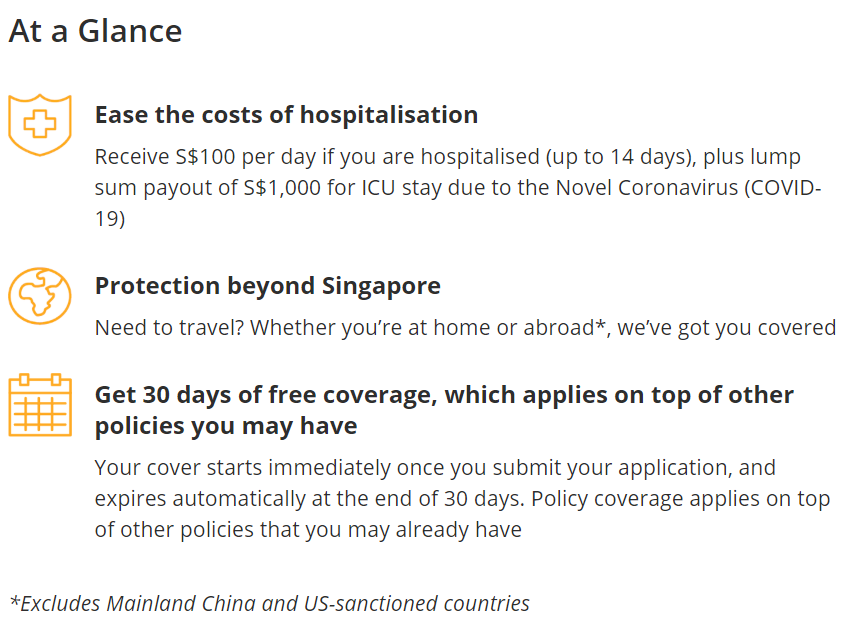
The COVID-19 Hospital Cash policy is a 30-day free coverage that provides a daily cash benefit for hospital confinement and a lump sum payout for ICU confinement in relation to the virus. It also provides worldwide coverage* for policyholders who must travel during this period.
Start your 30 days of free coverage under COVID-19 Hospital Cash by completing this online form by 15 March 2020.
Please note that each person can only be covered under one COVID-19 Hospital Cash policy.
(Note: Clicking on Apply now will redirect you to the DBS’s page)
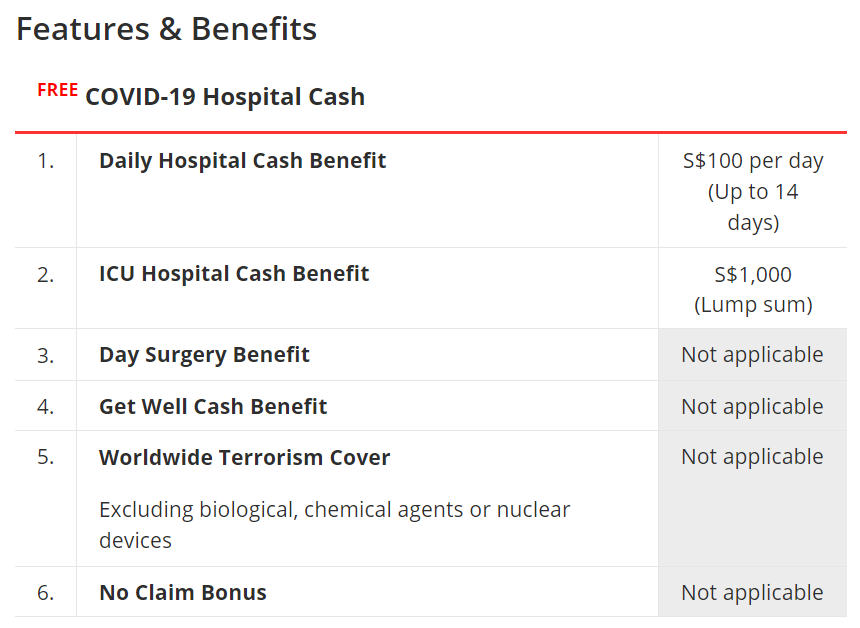
Here’s a table showing the features and benefits:
Click here to find out more about the FAQs. Read the press release here.
As I was searching for a life insurance to protect myself and my family, I came across a type of product through the help of my financial advisor. She recommended getting the Variable Universal Life (VUL) insurance policy. I was drawn by the unique fusion of life insurance and investment.
For those of you who are unfamiliar with VUL, it is a type of life insurance policy with a built-in savings component (cash value). The cash value can be invested into different accounts consisting of mutual funds, bonds, or stocks. Associated with the savings component is a maximum cap and a minimum floor on the investment return.
What’s more? The premium you need to shell out is flexible. Flexibility is one of the advantages of having a VUL. Let us start with that.
FLEXIBLE PREMIUMS
Last week, I invited three experts to host a Financial Literacy Talk in our workplace. These experts discussed about the current economical state of the country as well as the investment and insurance options available in the market. One of the products that they highlighted was the VUL.
We all have different needs and different capabilities. However, that must not stop us to get an insurance. Fortunately, VUL’s premium can go up and down for several reasons. These reasons depend on your lifestyle and needs. For instance, you may consider to raise the death benefit as a breadwinner. Increasing your death benefit may require proof of “insurability”. Nonetheless, the performance of your cash value account may allow you to lower your premium.
BENEFICIAL DEATH
There is a considerable weight on the shoulders of the loved ones who have to go through loss. Money will never be able to replace someone’s presence, but it will help lessen the financial weight when going through a death of a family member. You need to avoid the double-whammy of losing someone and getting sucked into debt.
VUL offers both investment options, death benefits, and critical illness coverage. Study these elements before signing up.
VARIED INVESTMENTS
VUL has varied sub-accounts, which allow the investment of the cash value. Its function is similar to mutual fund with an array of stock and bond accounts along with a money market option. Some policies may restrict the number of transfers into and out of the funds.
Interestingly, VUL got its name from the varying results of investment in the ever-changing market. Keep in mind that exposure to market fluctuations can generate significant returns or substantial losses.
Image Credits: pixabay.com
Let us move on the out-payments. You must ensure that you are insurable before implementing a strategy involving VUL or other life insurance policies. Several factors will affect the availability and cost of your life insurance. These factors include age, health conditions, and amount of insurance purchased. You see, life insurance have other charges attached to it. For instance, if a policy is surrendered prematurely, some policyholders may have income tax implications. Any guarantees associated with the policy are dependent on the ability of the issuing insurance company to continue making claim payments in the long run. Choose wisely.
DISCLAIMER: Please note that this VUL product is most applicable to American and European insurance issuer. Thank you.
As a country whose location is near the Equator, Singapore experiences “dry and wet days” throughout the years. Generally speaking, the dry months last from March to August. While, the wet months typically span from September to February. Its tropical climate makes the weather unpredictable.
The most convenient way to travel while it is raining is through a personal or a public car. There is no denying that hailing a cab becomes difficult when it is raining! What’s more? You may experience surge pricing when hailing a cab or booking a Grab car. Surge pricing is the adjustment of ride prices to match driver supply and rider demand. During periods of excessive demand where there are not enough drivers on the road (i.e., rainy weather), Grab increases its normal fares.
To combat this issue, insurance cooperative NTUC Income launched the product Droplet last October. Droplet is a pioneer when it comes to protecting the commuters against unpredictable surge pricing on ride-hailing platforms. Further down the road, it aims to cover other platforms aside from Grab. Just wait for their announcements by the end of the year.
HOW DOES IT WORK
Reap the benefits of Droplet by purchasing the rainsurance at least a day ahead of your rides. The premium will be no more than S$9.60 for the day. You can submit as many ride receipts for claim and receive a maximum of S$50 in a day. Commuters who buy the Droplet coverage closer to the forecast of rain are likely to pay a higher premium that those who purchase the premium cover in advance.
Image Credits: pixabay.com
To buy the insurance, you must select a date range that you would like to receive coverage. Then, you must send your claims by forwarding your E-Receipt through email (to [email protected]).
As of now, Droplet only covers rides booked on the Grab app. It will pay up to 60% of your trip fare or the cancellation fee should it be raining at the point of pickup.
THE BOTTOM-LINE
This post shall end with a statement from NTUC Income.
“Droplet is a blue-sky response to consumers’ pain point – surge pricing due to rain – when they book a ride on ride-hailing platforms. In Singapore, where an average of 167 days of rainfall can be expected a year, consumers can now meaningfully address this pain point with insurance cover by Droplet.”
It is exciting to see how insurance products sync with the modern times. Hopefully, other insurers will be as innovative as this one for the commuters to enjoy the benefits of having options.
Purchasing health insurance can be a daunting task. It may be a tricky situation if your family member has cancer. Fortunately, you can make different choices that offer the best coverage for prescription drug and medical needs.
These cautions and suggestions will help you to shop for policy for your cancer treatment:
Plan Covers Your Clinics, Hospitals, and Doctors
Evaluate your plan if it includes a cover for doctors, hospitals, and clinics. Plans may change your preferred clinics, hospitals and doctors. If your plan is not covering your clinics and doctors, you have to change this policy. Doctors or hospitals out of network may increase your expense.
Plans like australian health insurance – iSelect offer special benefits to a policyholder. You have to do your homework to find out a reliable plan. Keep it in mind that high-deductible plans need you to pay 100% of medical costs until you mollify your deductibles. Deductibles can be more than out-of-network care.
Plan Cover Costs of Prescription Drugs
Some plans are associated with co-pay that is a fixed rate for the prescription of each patient. Other insurance plans may charge one co-insurance that is ideal for the total charges of a drug. It may be expensive for a cancer patient who undergoes multiple services like radiation therapy and chemotherapy for treatment. For cancer medications, a co-pay can be a cheap option than co-insurances.
Plans often divide medications as per formulary into categories or tier. The medicines in higher tiers can be expensive for you. Cancer medications are placed in the highest tier. You may compare every formulary to see the tiers/categories of your drug.
Effects of Step Therapy
Several insurers follow “fail first” or “step therapy” rules in healthcare policies. They necessitate patients to try cheap medications before offering coverage for drugs the doctors would prescribe. If initial medicines prove useless for a patient, the treatment may progress toward expensive therapies.
Advocates of patient and physicians are concerned that this therapy can delay the access to treatments offering maximum benefits. Therefore, they consider it wrong for patients. Several states have laws that permit doctors to apply or supersede these policies. If your state doesn’t enact this law, you can talk to the insurance company to know about their policies.
Work-based Insurance Plans
Several work-based insurance plans offer open enrollment period almost once in a year. It allows you to evaluate your health plans. You can add a new member of family or change plans to avail this opportunity. You may get an option to keep similar plans without any change. If you get an option to change plans, you must carefully evaluate new prospects and their way to cover the treatment of cancer patients.
Carefully secure copies of paperwork relevant to your claims, such as FMLA (family medical leave, sick leave, receipts, bills, EOBs (explanation of benefits and necessary medical letters. Maintain your records and send reimbursement bills to your insurance provider.
Have you ever wondered how much money do we need in our silver years to be able to afford our desired lifestyles? Most adults would be relying solely on their CPF funds to finance their retirement. Asset-rich but cash poor retirees could be thinking of renting their HDB flats out to supplement their retirement funds. There are indeed several ways to build up our retirement income. However, we must be mindful of avoiding some of the dangerous assumptions when planning for our retirement.
Oversight To Account For Inflation
Inflation can have a big impact on retirees even if they have been historically low. According to Monetary Authority of Singapore, Singapore’s historical core inflation averaged an annual 1.7% since 1990. While 1.7% per annum may not appear alarming, it will compound to a staggering 66% over a span of 30 years! If you are a retiree receiving a fixed amount of stipend, the value of your money will decrease with each passing year. Hence, your retirement funds will be eroded by inflation if they are not carefully managed. Unfortunately, inflation does not stop just because you have stopped working. Therefore, it becomes important that your investment grow at rates that are at least equal or better than the rate of inflation to protect the value of your retirement funds. How do we then continue to enjoy the taste of life at our retirement years without feeling the pinch of inflation, especially when we have stopped working and receiving salaries?
Reliance on Rental Income From Property
Some adults plan to rely on rental income from investment properties to supplement their retirement funds. However, with the recent cooling measures announced in July 2018, investing in a second residential property is increasingly out of reach for most working adults.
Some retirees might be thinking of renting out the vacant rooms in their HDB flat especially as their children gradually might have left the home that they grew up in. However, this option comes with its own set of inconveniences. It could take a couple of months before a tenant can be found. There is also the administrative hassle of providing tenant’s details to HDB for record-keeping. Of course, all these pale in comparison to stories of horror tenants who damage the HDB flat or are tardy in their rental payments. In such circumstances, renting out their HDB flats may not be the best option to supplement your retirement income.
CPF LIFE Alone Might Be Insufficient
For a retiree who sets aside the maximum Enhanced Retirement Sum (S$271,500), the monthly payout from CPF LIFE is expected to be about $2,000 per month. If this amount is sufficient to pay for your daily expenses during your retirement, then this is definitely a good safety net for you to rely upon. However, it is not true that all Singaporeans and Singapore Permanent Residents can depend on their CPF funds to finance their retirement entirely. In fact, it is widely reported that almost 4 in 10 CPF Accounts do not even have enough funds to meet the Basic Retirement Sum. For the group of retirees who do not generate enough funds from their CPF LIFE payouts, it is necessary to generate extra income from alternative sources such as investments.
Future-proof Your Retirement Funds With The AIA Retirement Saver (III)
Given that young professionals lead hectic lifestyles, they may not have the time and energy to plan for their eventual retirement. Yet, planning ahead to future proof our retirement is essential and the AIA Retirement Saver (III) is one of the ways to do that. The AIA Retirement Saver (III) is a simple and hassle-free retirement solution which provides a guaranteed stream of retirement income for 15 years. Your hard-earned savings is safely secured since the capital is guaranteed; you will get back every dollar that you contributed at your desired retirement age. On top of that, you will receive potential monthly dividends which could help to cushion the impact of inflation. Premium payment duration is also flexible; single lump sum, 5 years, 10 years or simply pay till your desired retirement age – 55, 60, 65 or 70. It is easy to get started because no medical underwriting and check-up is required. In essence, the AIA Retirement Saver (III) is truly an easy and stress-free solution tailored to any individual retirement plan.
Conquer The Uncertainty & Plan For Your Desired Retirement
With the AIA Retirement Saver (III) solution, individuals can cast aside their retirement worries as their savings will be in the good hands of professionals. The AIA Retirement Saver (III) can be an additional pillar to supplement your retirement funds. As it can be tailored to maintain the purchasing power of your retirement funds, you can be assured that you will still be able to enjoy your desired lifestyle during your twilight years. Don’t leave your retirement to uncertainty. You can certainly plan for the uncertainty by taking action now.