Overcoming 3 Financial Issues That Young Singaporeans Face

We encounter several new hurdles as young adults. We no longer receive a daily allowance from our parents and we have to pay the bills. Not to mention, our financial capabilities are seemingly low at the start of our careers.

On that note, here are three financial issues that young Singaporeans face and ways to overcome each one…

ISSUE #1: LACK OF FINANCIAL KNOWLEDGE

We cannot deny the fact that personal finance is rarely taught in schools. According to Kevin Gallegos, a consumer finance expert at Freedom Financial Network, the Millennials’ crying need for more financial literacy cannot be overstated. It is never too late! Financial literacy is something you shape through conscious effort, much like learning how to write.

Image Credits: pixabay.com

Image Credits: pixabay.com

Young adults must take the initiative to educate themselves about the important topics surround money. These topics include budgeting monthly expenses, saving for retirement, and managing student loans. Following an online resource like MoneyDigest.sg or MoneySENSE.gov.sg can provide the foundation for you to learn the basics.

ISSUE #2: HAVING A LOW INCOME

Unless you are an heir to a successful company, the start of your career marks the time when your finances will be stretched. Having a low income impacts your ability to fulfill your primary needs such as food and shelter. Proper allocation of funds can help improve your situation.

Young Singaporeans shall distinguish between the needs and wants. If your income is not sufficient to address your primary needs then, you may consider taking a part-time job or freelance projects. Alternatively, you may eliminate unhealthy (and costly) lifestyle choices such as smoking. Imagine how much cash you will exhaust in a week if the price of a package of Marlboro cigarettes is about S$13!

ISSUE #3: CONFUSION BETWEEN SAVING AND INVESTING

Young adults are often experiencing a mix up between saving and investing. The idea behind it is similar, but the “mechanics” are different. Both involves the act of setting money aside for future use. The former is allocated after meeting your fixed and variable expenses. While, the latter is allocated if you want to grow your savings. Maintaining a realistic balance between these two is crucial for wealth cultivation.

Do not be afraid to read about investing as the power of compound interest works in your favor at the present time.

Image Credits: pixabay.com

Image Credits: pixabay.com

To conquer the challenges that young adults face, they must educate themselves about personal finance. This will help them manage their spending habits, repayment of student loans, and so on. This is a great start to your financial journey.

May you have the confidence to overcome each financial issue ahead!

Sources: 1 & 2

Read More...

How To Efficiently Declutter Your Personal And Financial Life

The perfect time to organize your thoughts, to arrange your bills, and to declutter your home is NOW! Here are five strategies that you can start with:

CLEANSE YOUR PHONE

We are constantly glued to our devices. I do not mean to be a bearer of bad news, but your devices are not entirely sanitary. Various researchers have found Escherichia coli bacteria, Streptococcus, and other pathogens living on mobile phones. It is important to employ measures to keep yourself healthy and to minimize medical bills.

One of the first few things that I do upon coming home from work is to cleanse my phone. I grab a couple of cotton pads and spray it with Isopropyl Alcohol. This helps me disinfect my phone as I am constantly in contact with relatively sickly children. You can adopt this habit too!

FLOSS YOUR PEARLY WHITES

Many experts encourage the importance of flossing in one’s daily grooming routine. A floss is designed to reach between the gums and the teeth. It acts as an efficient tool to lower the risk of gum disease, tooth decay, and periodontal disease.

You do not want to go to a job interview with a flaming bad breath!

PURGE YOUR ITEMS

Are you getting trapped under a mountain of rubbish? Tidy your space by practicing the one-item-in and one-item-out policy. This policy works by bringing a new item in and dropping an old item out. You can either donate, sell, or throw the old item. Doing this regularly will improve both your financial and mental health.

ORGANIZE YOUR BILLS

Never forget where you put the bills or when their due dates are by designating one place for them. You read that right! You have to decide whether you are going to file all your bills in a tangible box or in a computer folder.

Some bills arrive by electronic mail while some arrive by postal mail. Printed bills must be kept in a labeled box. While for virtual storage of bills, make scanned copies of those that arrive in the mail and put them into a labeled folder in your laptop.

EASE YOUR MIND

Create a healthy division between your work and personal life to lessen your stress. For instance, my co-worker does not respond to the client’s calls after 7 PM. You may do the same thing, if necessary. Another way to keep your mind at ease is by not checking your email before you go to sleep.

Image Credits: pixabay.com

Image Credits: pixabay.com

It is inevitable to spot a message that will your mind buzzing all throughout the night. Furthermore, it may make you anxious to go to work the next day. Do you want that to happen?

Sources:  1 & 2

Read More...

4 ways to get the most out of your online spending

The beauty of online spending is undeniable – sit comfortably on your couch, browse on online shopping sites, add to your cart and cash out. Then, wait a couple of days for your package to be sent to your doorstep. It’s pretty much like a present you give to yourself.

With such convenience, however, it’s easy to buy things on impulse. I’m sure we are not strangers to buying a shirt that did not fit, or only realising later that you could have gotten it at a cheaper price with a credit card discount or promo code.

Here are 4 tips for you if you are guilty of spending more than you should while online shopping.

  1. Do plenty of research and read reviews

Especially when it comes to clothing apparels and shoes, it would be helpful to research sufficiently before purchasing an item. For instance, a pair of Nike shoes may be cheaper if you buy it from a US-based website, international shipping inclusive, as compared to buying from local stores.

On top of that, do read the sizing guides and what other people are saying about a brand via reviews before making the purchase. They are likely to tell you if the sizing runs smaller or larger, so that you can avoid buying the wrong size and spending even more money to alter it.

  1. Avoid shipping fee

Most online shopping sites offer free shipping when you spend a certain amount. If you’re unable to make up to that amount, get some friends to buy from the same website, and combine your purchases so that you can leverage on the free shipping.

In the event that your friends are unable to help you, you may add random things to your cart so that you make up that amount. When your purchases arrive, simply return the things that you don’t want. However, this tip is only useful if the online merchant offers free returns!

  1. Look out for discount codes or third-party cashback websites.

Do a quick Google search for discount codes and third-party cashback websites before you click the “check out” button. Websites such as ShopBack offer discounts, promo codes and vouchers. The only gripe is that these rebates only apply to participating merchants.

  1. Take note of credit card discounts

Online merchants usually have partnering banks and credit card discounts, so do read the FAQ page before cashing out your purchases.

Whether you caught the travel bug or are simply itching to shop, relax in the comfort of your home and click away on online sites such as Agoda, Expedia, Lazada and ZALORA. Do look out for promo codes for your HSBC credit card and save up to 75% off with these participating merchants! Visit www.hsbc.com.sg/promo for more offers and details. Conditions apply.

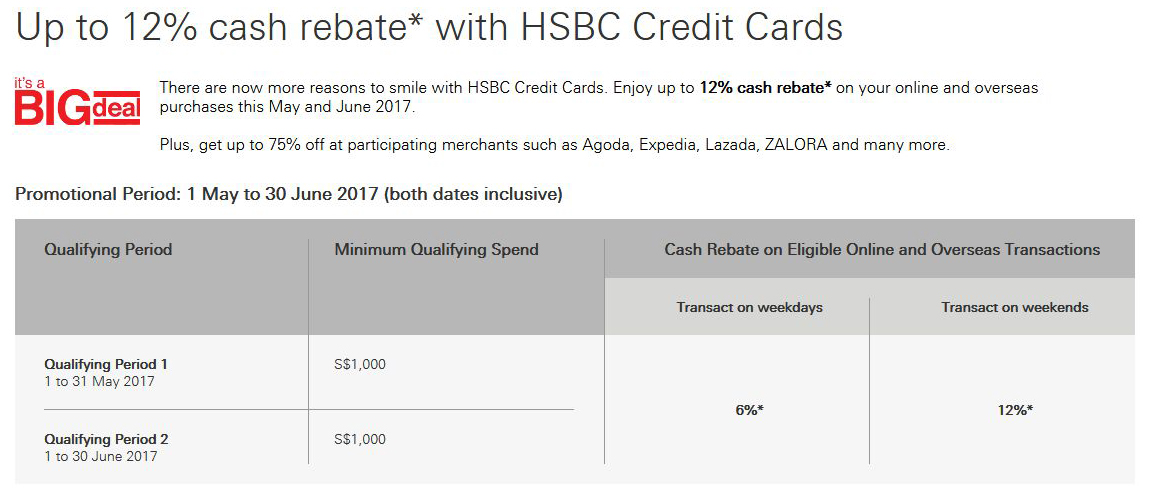
Online and Overseas Rebate Campaign 2017 - Table
In addition, between 1 May to 30 June 2017, be the first 5,000 cardholders to spend a minimum of $1000 on your HSBC credit card and get up to 12% cash rebate on your online and overseas purchases, capped at $200 rebate per month – the more you spend, the more you save!

Furthermore, this offer applies to overseas merchants so you can get that pair of coveted Adidas Yeezys or Colorpop Cosmetics at a fraction of Singapore’s price.

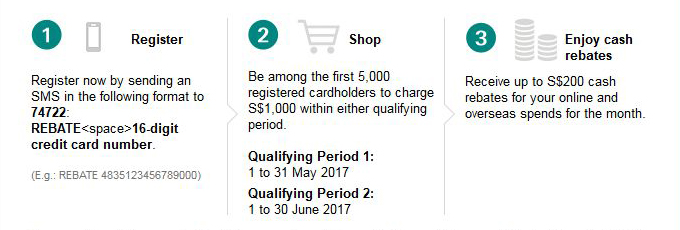
Who knew spending could be so rewarding with HSBC credit cards? Simply follow the steps below and shop away!

Online and Overseas Rebate Campaign 2017 - Register

This post is brought to you in partnership with HSBC Credit Cards

Read More...

5 Cover Letter Mistakes That’ll Hurt Your Chances Of Getting The Job

The premise is simple. Your Cover Letter (CL) is meant to complement and highlight the content of your Curriculum Vitae (CV). You probably written several job applications, so you will have an idea of how a CL should be structured. However, you may make the same mistakes over and over again.

CASE OF MISTAKEN IDENTITY

As a newbie in the workforce, you may think that sending as many job applications as you can will boost your chances of landing an interview. There is just one problem! You forgot to alter the “company’s name”. This may be an obvious thing, but it happens to the best of us.

Putting the wrong company name instantly sends poor impression. Avoid this mistake by asking a trusted friend or family member to proofread your Cover Letter and Curriculum Vitae.

IN THE SEA OF EXCUSES

Tackling the excuses of a co-worker who regularly takes time off work is irritating! Imagine if you applied the same tone to your CL. As CLs generally have a maximum length of one page, you do not have to expand on the reasons why you hop to different occupations, why you left the previous companies, or why you missed some opportunities.

Rationalizing your actions may take away the attention from your valuable assets and transfer it to the things that weigh you down.

PAGES OF A LENGTHY NOVEL

When the interviewer looks at your CL, he or she scans for the keywords. This is why you must keep your document concise and straightforward. Who likes reading a mountain of text, anyway? Not me!

Writing more content does not necessarily mean that your CL is better. As I said above, a single page is enough. Describe how your experience and qualifications fulfill the requirements of the position that you are applying for. Then, wrap things up.

MONEY, MONEY, MONEY

The issue of money is somewhat of a grey area. You shall not reveal your expected salary right away in a CL, unless you are specifically asked to do so. It is not the right place or time to negotiate your salary.

As Lisa Benson, the President and CEO of Mary Kraft Staffing & HR Solutions, once said: “No prospective employer wants to hire someone who is only about the money.”

GENERIC IS THE BRAND

Shy away from cliché phrases, if you want to show your enthusiasm towards the job. The interviewer or the recruiter receives countless applications that merely enumerates their skills (e.g., team player or hardworking). Shine above the rest by backing your unique skills with facts and results.

Image Credits: pixabay.com

Image Credits: pixabay.com

One of the issues that recruiter’s encounter is reading endless generic statements. So, be unique!

Sources: 1, 2, & 3

Read More...

Financial Sacrifices Are Crucial To Send Your Child To A University

HSBC, one of the world’s largest financial institution, conducts its yearly survey series entitled “The Value of Education”. This yearly report examines the parent’ expectations and aspirations for their children’s education.

In 2015, it highlighted that a whopping 90% of Singaporean parents saw undergraduate studies as an essential tool for their children’s success. The interesting part was that majority of these parents (about 83%) were willing to pay more to send their children overseas. The only downside was that some of these parents do not have sufficient money saved. Can you see how much importance was given to university education despite the lack of financial foresight?

Let us move towards the recent 2016 report. Parents in Singapore spend an average of S$21,000 annually on their beloved’s university education. This significant amount is more than twice the global average. Furthermore, majority of these parents (about 52%) were willing to get trapped into debt just to fund their children’s studies. Singaporeans seem to perceive higher education, including overseas studies, as a clincher for future success. Simply ask the billion-dollar tuition or tutorial industry!

The potential issues arise when parents ignore their other financial commitments such as building a savings account for their golden years. Avoid these issues by employing practical steps when planning for your children’s education.

Consider these four steps:

1. ESTABLISH YOUR SAVINGS IN ADVANCE

If you are going to have stellar aspirations for your children, it is only fair that you plan ahead. Open a savings fund for your his or her education during the early development years. Doing so will enable you to have a decent amount of money kept by the time that your child goes to university (i.e., 19 to 21 years old).

2. ENCOURAGE FINANCIAL INDEPENDENCE

Teaching your child the value of money and work opens doors to a brighter financial future. Do not forget about the basics of personal finance including budgeting and investing. Being able to manage their finance is essential to adulthood.

3. ASK FOR PROFESSIONAL GUIDANCE

Seeking professional advice allows you to pinpoint your financial opportunities and potential pitfalls along the way. Need I say more?

4. TAP INTO YOUR CPF ACCOUNT AS A LAST RESORT

Singaporean parents may use their Central Provident Fund Ordinary Account (CPF-OA) savings to cover their children’s diploma or degree courses at approved institutions. If your CPF-OA is insufficient, you can apply for the school’s financial assistance schemes or the Tuition Fee and Study Loan schemes offered by the government.

Image Credits: pixabay.com

Image Credits: pixabay.com

Make this option your last resort as you need your savings for retirement, healthcare, and other emergencies.

Sources: 1 &2

Read More...