
A brief look at debt settlement options in Singapore

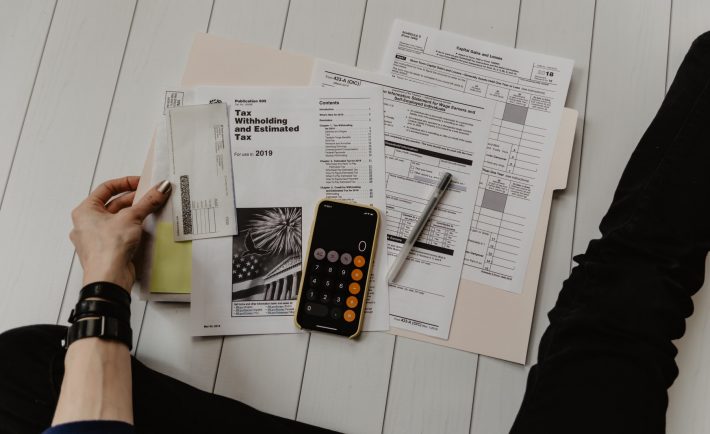
an asian couple stressed while doing calculations

Do you know that the average household debt in Singapore is about S$55,000 per capita?

With a value that high, there’s no doubt that it’s about time to learn how to manage your debt and minimise it as much as you can. Financial freedom is within reach if you’re able to settle your debt in time the right way.

Here’s a brief look at various debt settlement options available on our sunny island.

#1: Self-Administration

One of the easiest ways to manage your debt is to directly discuss with your creditors to see if you can potentially negotiate or appeal for a cheaper instalment repayment plan.

However, you need to approach them with some research done beforehand. In your written appeal, fully flesh out your financial situation and suggest a repayment amount that’s okay for you.

Don’t forget to include documental proof like income and CPF statements whenever applicable to bolster your appeal.

#2: Discounted Lump Sum Settlement

handing in a cheque

Image Credits: business-standard.com

Once you’ve accumulated enough financial capital, you can ask your creditors about repaying your debt in a discounted lump sum.

A quick way to build up your lump sum is to consider selling off several assets or taking a low-interest personal loan from a reputable company or financial institution. Then, pull out those negotiating skills to seek a discount.

#3: Debt Consolidation Plan (DCP)

Under this refinancing program, you’re able to pool together all your unsecured debts using one financial organisation.

You should note that some unsecured debts are not allowed, such as medical loans, joint account debts, and more. Unless you don’t fit the DCP criteria, you’re eligible to apply directly at your participating financial institution.

Once your application passes, your unsecured credit facilities will close, and a revolving credit facility will open to aid you in payments.

#4: Debt Management Program (DMP)
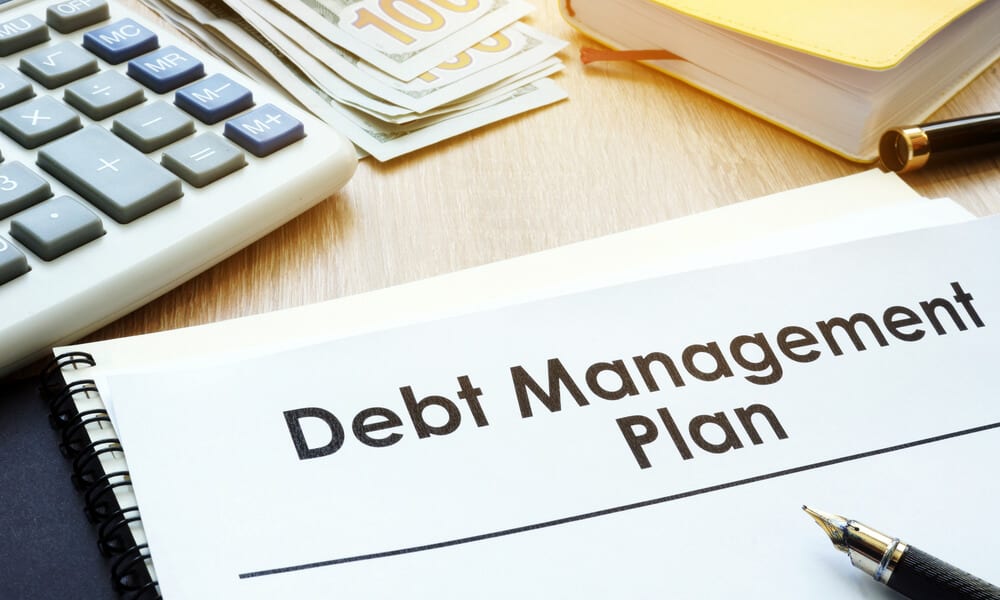
Debt-Management-Plan

Image Credits: incharge.org

Whenever heavy financial stress hits and you’re unable to pay your debt back, not all hope is lost.

The Credit Counseling Singapore (CCS) runs a DMP that provides financial counselling sessions to examine your payback ability and ideally settle your debts in one decade.

The CCS will help create a repayment plan with lower interest rates and more extended repayment periods to enable you to pay back those debts. Among other benefits, the program is perfect for you only if you qualify. 

#5: Bankruptcy

As an individual or a business, you can file for bankruptcy with the High Court if you’re unable to repay a debt. This is commonly the last resort because you will face some strict consequences if you pursue this option.

You will be assigned a Private Trustee-in-Bankruptcy (PTIB) or Official Assignee (OA) who can help assess your situation and figure out a target contribution on your behalf to repay your creditors.

#6: Debt Repayment Scheme (DRS)
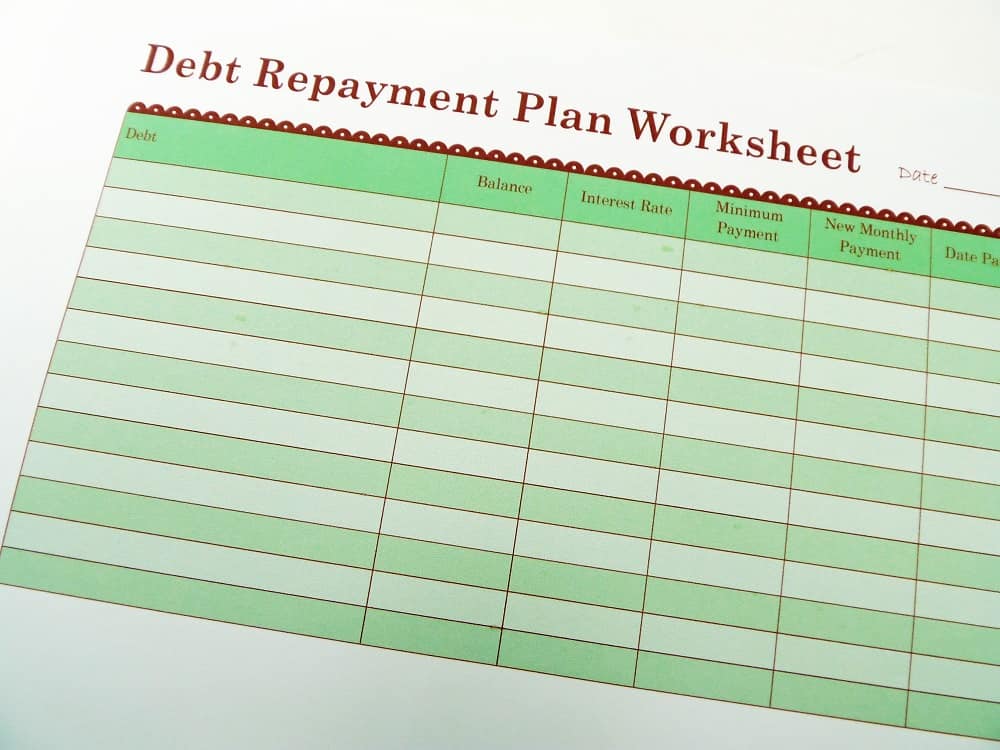
debt repayment plan template

Image Credits: myfrugalhome.com

As we come to a close, there is a way to avoid bankruptcy – your OA can lead you through a DRS.

But because you’re not allowed to apply for this option directly, only your OA can approve you after previewing your bankruptcy application. Upon fulfilling the necessary criteria, you will not be labelled as bankrupt.

However, you must commit to a repayment plan that spans at least five years. For more information on DRS, you may head to the Ministry of Law Insolvency Office’s webpage.

Final thoughts

Debt settlement can be scary if you do not possess sufficient knowledge on the topic. Why not speak to a trained professional if you need help resolving your debt problems?

Folks who need 1-to-1 financial counselling can book an appointment with the CCS. Do note that there’s a one-time fee of S$30, but no further fees required for subsequent meetings (if necessary).

Nothing is impossible to solve. Take heart!
Read More...

Join 200k Investors in SEA to Invest with this Award Winning Investment Platform and Get $20 Cashback

Peer-to-Peer or more commonly known as P2P lending started in the US and UK in 2005, and has since taken the world by storm. Back home in Singapore, P2P lending contributed to approximately USD 207 million in financing offered to businesses here in 2020. Investors on P2P lending platforms can participate in these financing and earn returns in the form of interests. 

Take for example Funding Societies, a popular P2P investment platform amongst Singaporean investors. It is currently licensed in Singapore and has operations in 3 other SEA countries. Backed by Sequoia India, Softbank Ventures Asia, SGInnovate amongst many others, the platform has grown at a rapid pace since launching in Singapore 6 years ago. Here are some things to note when investing with Funding Societies:

  • Low barrier to entry: Investors can invest as low as $20 per loan
  • Short tenor: Investment tenors are quite short ranging from 1 to 12 months
  • Returns on Investment for each Product Type: Interest rates usually range between 
    • 3% – 5% per annum for a Guaranteed Investment product;
    • 6% – 8% per annum for a Property-backed investment product;
    • 8% – 18% per annum for Invoice financing and Working capital related investments products

Risks and Returns of P2P lending in Singapore

Investors are able to invest by crowdfunding the business financing available on the platforms and potentially earn returns in the form of interests typically ranging in the mid to high single digits. The investment amount starts as low as $20 at Funding Societies, which investors can leverage on for their portfolio diversification. Depending on the loan product, payouts can be done monthly so investors get their investments and returns in a shorter time frame. Compounding returns, as well as a rather short learning curve, are also attractive incentives as well.

That said, repayments can be delayed or go completely unpaid. This is why it is imperative for the P2P lending platform to first do a preliminary round of due diligence and present the facts comprehensively to investors, before allowing investors to decide whether or not to proceed. There is also a risk of the P2P lending platform shutting down if it is not financially stable on its own. To mitigate this risk, P2P platforms regulated by MAS can engage an independent escrow agent to handle all investor funds separate from its business account, such that the escrow agent will hold the  funds even if the platform goes under. Funding Societies does just that to provide peace of mind to investors. As such, there is a need to do your due diligence and ensure such investments match your risk appetite.

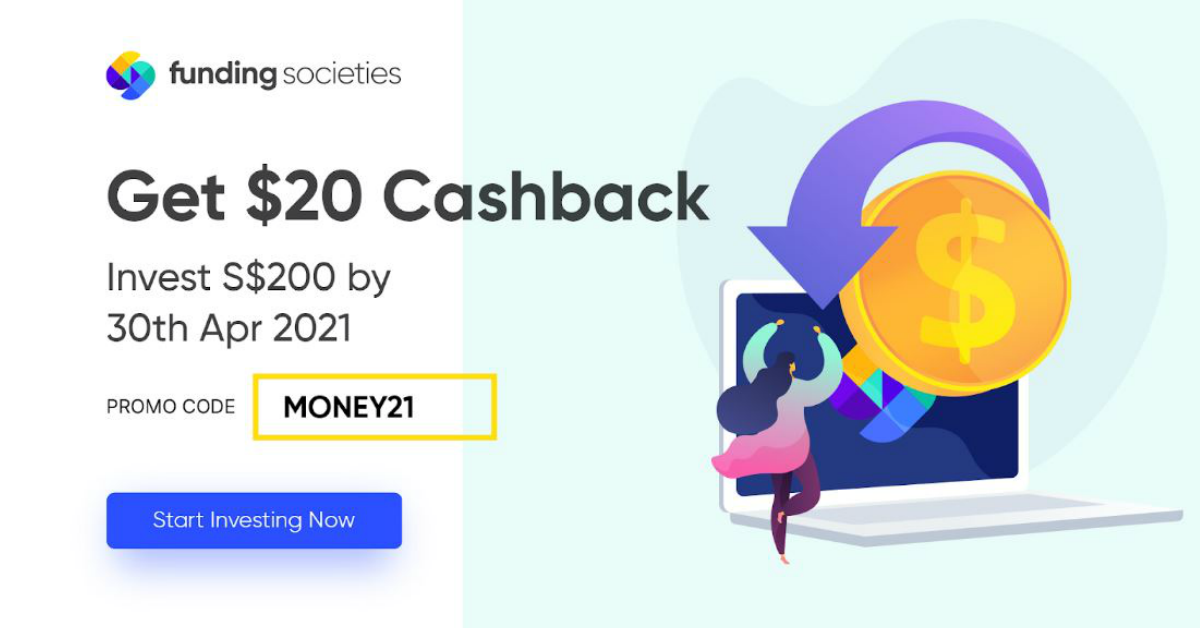
Get a S$20 cashback when you sign up on Funding Societies with the exclusive promo code MONEY21 and make a total investment of S$200 by 30th April 2021. 

How can Diversification help to minimise risks in P2P lending?

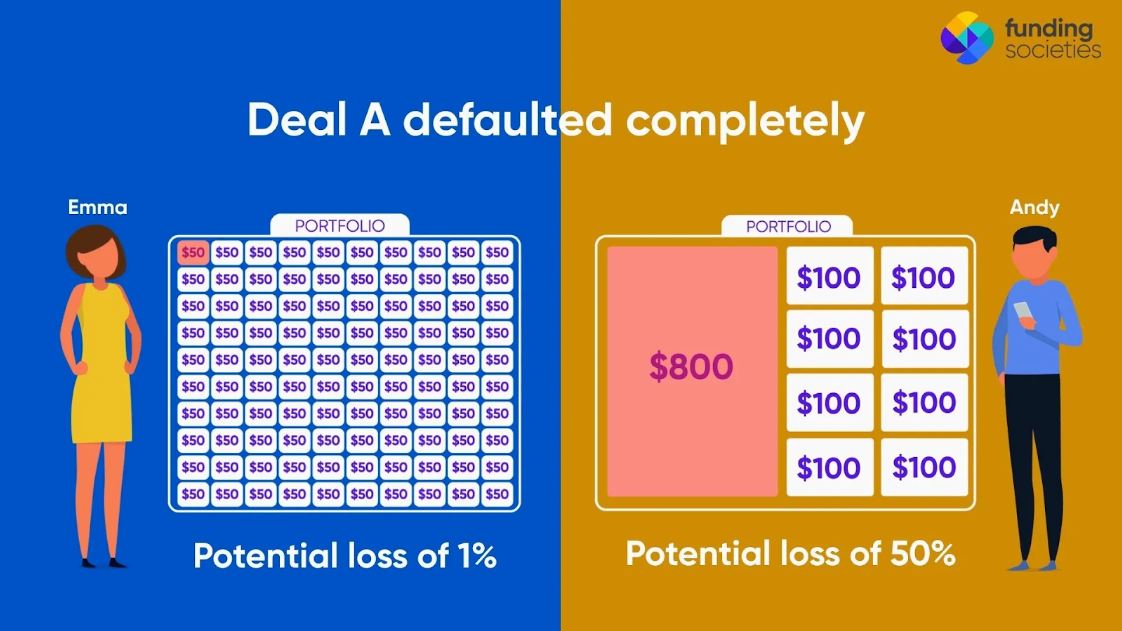
One of the largest risks in investing in a P2P lending platform like Funding Societies is the risk of a SME defaulting. Portfolio diversification by means of investing into a good mix of notes and industries on the platform is one way to mitigate concentration and default risks and optimize your portfolio returns in the long run. 

Taking the above scenario as an example, we see that Andy invested S$800 into a single deal and this single investment makes up 50% of his overall portfolio. Whereas in the other scenario, Emma invested S$50 uniformly across 100 deals, making a single investment just 1% of her overall portfolio. In the event that Deal A defaults, Emma’s potential loss will only be 1% of her overall portfolio whereas Andy might face a potential loss of half of his overall portfolio.

Conclusion

Although P2P lending is still a fairly young industry within Singapore, the demand is ever increasing. Given that 99% of businesses in Singapore are SMEs and that the returns on investments typically range in the mid to high single digits interest rate per annum, P2P lending in Singapore serves both the needs of SMEs and investors. With all that said, it is important for investors to do their own due diligence and measure the risks involved against their own risk appetite. 

Get a S$20 cashback when you sign up on Funding Societies with the exclusive promo code MONEY21 and make a total investment of S$200 by 30th April 2021. 

Terms and Conditions apply

Investors must sign up with the aforementioned promo code and make a total investment of at least S$200 by 30th Apr 2021 to be eligible for the $20 cashback. Cashback will be credited into the eligible investors’ accounts by the end of May 2021. Funding Societies’ investor T&Cs apply.

Funding Societies is the largest SME digital financing platform in Southeast Asia. It is available  in Singapore, Indonesia, Malaysia and Thailand, and backed by Sequoia India, Softbank Ventures Asia Corp and SGInnovate amongst many others. It provides business financing to small and medium-sized enterprises (SMEs), which is crowdfunded by individual and institutional investors. Investors can invest from as low as S$20 with a tenor of no more than 12 months. 


Disclaimers:

This article is contributed by Funding Societies.

It should not be construed that Moneydigest is endorsing this article or any of the products and services provided by Funding Societies.

The content and materials made available are for informational purposes only and should not be relied on without obtaining the necessary independent financial or other advice in connection therewith before making an investment or other decision as may be appropriate.

Actual returns may be lower than the expected rates of return, and historical rates of returns may not reflect future returns. The Product type interest rates indicated in the article are derived from historical rates of returns and are exclusive of service fees.

All information in this article is accurate as of 29th March 2021

Read More...

4 Challenges of Budgeting in 2021

Stating that “2020 has been a tough year” is an understatement. Words cannot describe how much we have been affected by the past year. I, for one, was tasked to let go of employees due to financial constraints. It was not easy! It was one of the hardest decisions that I had to tackle because I have seen these people grow. Moreover, I felt responsible for their well-beings too. However, downsizing was essential for the company to survive.

Our stories may vary, but one thing remains the same. We have all endured the physical, mental, and financial toll that came with the pandemic. As we adapt to the “new normal”, we come to realize how challenging it is to keep a budget. You not only have to fight the urge of spending money, but you also must follow the budget despite unforeseen hurdles.

On that note, here are some of the common challenges that you may experience as you establish your budget.

#1: HIGH COST OF LIVING IN SINGAPORE

The cost of living in Singapore is one of the external factors that you have consider when making your budget. According to the Economist Intelligence Unit’s Worldwide Cost of Living (WCOL) survey conducted in 2020, Singapore ranked fourth in the global list of the most expensive cities. The WCOL is a bi-annual survey that compares more than 400 individual prices across 138 products and services in over 130 cities worldwide. Zurich, Paris, and Hong Kong preceded Singapore.

Whether you are a young working adult or a foreign migrant worker, you must set a realistic amount for your spending each month. Take each financial category into consideration. For instance, you should have at least S$700 to S$1,500 a month if you are renting a space. If you are eligible to purchase an HDB property, you should set aside at least S$1,500 to S$3,000 a month. Your daily expenses and your overall lifestyle may change to fit your budget.

#2: LABOR-INTENSIVE TRACKING SYSTEM

Many people are afraid of establishing a budget due to the labor-intensive tracking system. Tracking your spending and income may seem like a chore at first, but you will be more comfortable as time passes. Start by tracking your receipts and other spending through a notebook or a spreadsheet. The rise of apps paved way for computer programs that are dedicated to tracking your spending. Find an app that works for you!

Being diligent with noting down your expenses takes practice. If you forget to write down important receipts, inaccuracies in your budget may occur. You may notice that your savings account depleted without knowing where your money went.

#3: DIFFERENCES IN CASH FLOW MANAGEMENT

The means of getting your income can affect your budget. What is the frequency of your paycheck? The first company I worked for paid us every end of the month. In contrast, the last company I worked for paid its employees every two weeks. Getting your paycheck once a month can entail different issues.

For some people, they experience stress as they wait for the next paycheck to come. It is hard for them to make ends meet because they see their money disappear in the first two weeks alone. These scenarios highlight an issue of cash flow management.

Waiting for your next paycheck can cause stress and anxiety. If you are paid once a month, consider dividing your income per week. Allocate enough money for the remaining weeks by keeping them in your savings account. Doing this will enable you to create a system that resembles being paid on a weekly basis.

#4: EXPENSES EXCEED INCOME

Many families have been painfully affected with job loss, reduced income, and prolonged unemployment in the past year. Recovery takes time. However, our bills remain the same. The effects of pandemic and the limitations in our income will greatly affect how we budget our money in the year 2021.

Image Credits: pixabay.com

As I leave my full-time job this month, I will need to take serious lifestyle changes at heart. The first step is to eliminate all unnecessary spending. It is important to focus on the necessary expenses such as rent, food, healthcare, and transportation. The next step is to carefully track my expenses with budgeting tools. Lastly, it is important to become flexible when it comes to budgeting and to adjust my spending depending on my needs and income streams.

Cutting down one’s expenses is a sensible solution for the time being. Finding a permanent solution to this…is the challenge.

Sources: 1, 2, & 3

Read More...

Fundamental Rules Of Budgeting

As you gloss over the pages of old personal finance books, you will realize that they stress on the importance of creating a budget and sticking to it. Poof! All your financial problems will be solved in a snap. However, life is not as simple as that.

Budgeting is the process of creating a financial plan based on your estimated revenue and expenses over a period. It is a complex task that takes your entire financial profile into account. It is up to you to embrace the process!

On that note, here are the fundamental rules of budgeting.

#1: BE HONEST WITH YOURSELF

Awareness of how much money comes in and how much you spend will enable you to pinpoint your spending habits. Be honest with yourself! You will be surprised that everything adds up, once you keep track of your money on a regular basis. Start by writing down your expenses for a week and continue. Include your daily coffee runs and Netflix subscription. You can use online budgeting tools to help you monitor your money.

#2: BE PREPARED TO CHANGE

The only permanent thing in this world is change. Your efforts of controlling your environment will be put to waste because change is inevitable. If you reached the end of the month and noticed that you are struggling to pay bills, something needs to change. Alter your budgeting strategies and identify which categories you can cut down on. Fortunately for you, small changes can make a big difference.

Your income, expenses, and priorities will change over time. You must adjust your budget accordingly.

#3: LEARN SELF-CONTROL

Within my immediate social circles, my partner is the primary model for self-control. He steers away from luxury and focuses on strategies that make him a savvy spender. He practices delayed gratification too. Learning self-control can help you accomplish your realistic budget.

If you are lucky, your parents or teachers taught you this skill when you were a child. If not, you will learn the importance of delaying gratification. Despite the tempting nature of credit cards, it is better to wait until you have saved up the money for a purchase. You do not want to spend the rest of your years paying for your credit cards alone!

#4: USE CASH WHEN NEEDED

Notice your spending habits. If you are constantly overspending on a budget category, consider having an envelope system. Use the allocated cash from the envelop and stop spending once it runs out. It is the ultimate accountability strategy.

#5: CREATE GOALS

Be realistic when it comes to your budget and your priorities. Whether you are paying off student loans or building an emergency fund, you need to focus on the goal. Knowing the reasons behind why you are saving and why you are making sacrifices will help you sustain your budget.

#6: PROTECT YOUR WEALTH

Ensure that your hard-earned money does not vanish by taking some safety measures. IF you are renting a flat, consider getting an insurance to protect your belongings from fire or burglary. If you just bought a laptop, sign-up for the warranty. This will help you cushion the costs of repairs.

Image Credits: unsplash.com

You must educate yourself on budgeting and handling money. The more you learn about handling money wisely, the more concrete your reasons for budgeting will be. Good luck!

Sources: 1 & 2

Read More...

Foundations of bankruptcy in Singapore

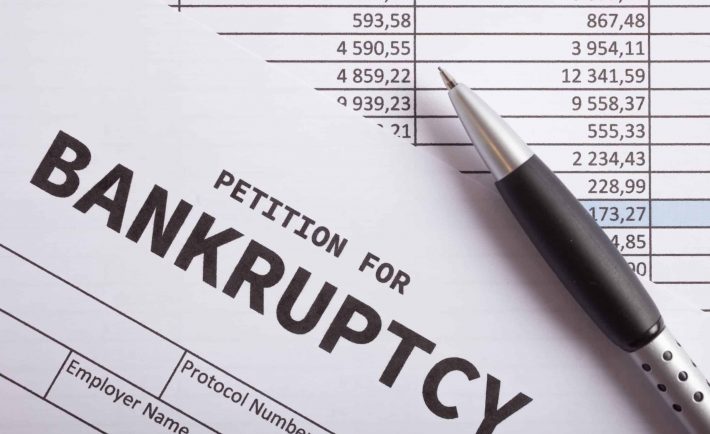
petition for bankruptcy form

Bankruptcy is a big word, and some people fear it. But if one were to be familiar with its foundations, maybe it wouldn’t be that terrifying.

According to Investopedia, bankruptcy is a legal proceeding in which a debtor and a creditor resolve debts through the court system. The debtor has its debt resolved while the creditor obtains repayment based on the debtor’s available assets.

In Singapore, section 61 of the Bankruptcy Act states that debtors may be declared bankrupt when a debt has fallen due and is worth at least S$15,000.

For folks considering bankruptcy, here are the basics you should be aware of.

After declaring bankrupt

Once you are declared bankrupt, you gain exemption from your creditors’ legal actions intended to reclaim debt from you. A public servant called an Official Assignee (OA) would examine your financial capabilities and design a suitable repayment plan.

Think of it as your bankruptcy supervisor.

Your OA will ensure that you make monthly contributions on your road to being discharged. They will set up this monthly plan after evaluating your financial resources, income and credentials, household expenses, and the economy’s overall status.

Wave goodbye to your assets
car and private house

Image Credits: EdgeProp

During the bankruptcy proceedings, your OA will sell any assets you possess to pay off your creditors. This can include items from artworks to furniture and even sentimental gifts.

The OA will not sell off any “protected assets”, which include:

  • HDB flats if the owner is a Singaporean
  • Central Provident Fund (CPF) contributions
  • Life insurance policies if it benefits the bankrupt’s immediate family members
  • Compensation awarded legally due to personal injuries or wrongful acts against the bankrupt

While it may be tempting to hide or dispose of your possessions quietly, lying to your OA or evading the procedure on purpose can lead to fines of up to S$10,000 and/or up to 3 years in prison.

Not worth it, ladies and gentlemen.

Ready for restrictions on daily activities

Bankrupt persons in Singapore are subject to various duties and responsibilities. Gambling, travelling, seeking credit, or managing businesses while involved in bankruptcy proceedings can lead to monetary fines or jail time.

These restrictions exist to prevent bankrupts from exploiting corporate structures, concealing income, hiding assets, or generally cheating the system. However, the OA can ease or accommodate these restrictions.

Their willingness to do this is based on your level of cooperation. If you are engaged in the bankruptcy process and consistently settling your debts on time, the OA is more likely to view you as reliable and ease those limitations.

Especially so in the business realm, full cooperation, including the provision of requested documents promptly, is the single best strategy for getting those restraints lifted as soon as possible.

If you feel that the OA is not treating you fairly or is imposing ridiculous restrictions, the ideal course of action is to seek the court’s review. Simply ignoring the limits is likely to end with criminal charges against you.

Look forward to the discharge
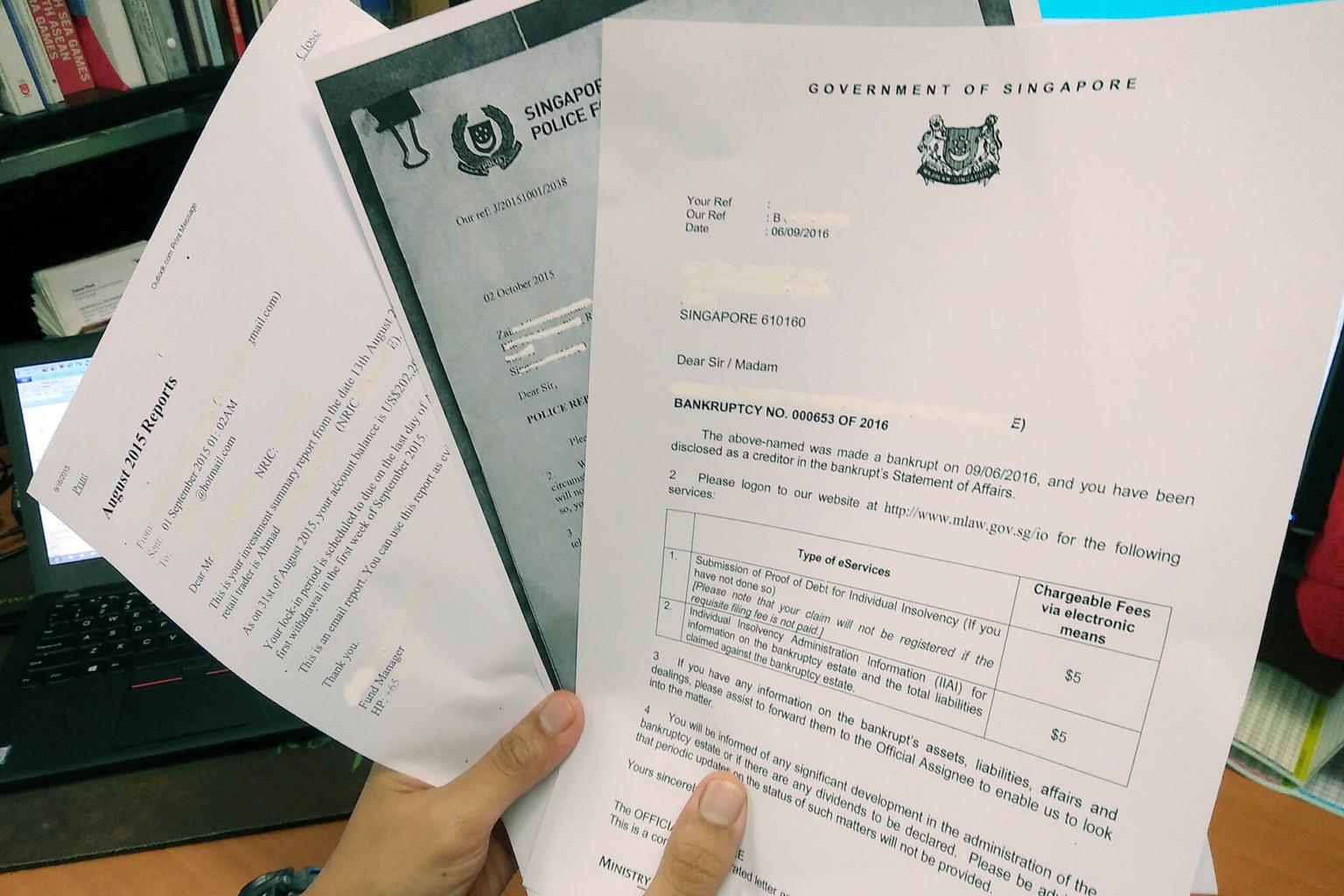
bankruptcy documents in Singapore

Image Credits: The Straits Times

Bankruptcy is not forever. Eventually, your debts will be paid, and you will be discharged from them. However, a discharge is dependent on the fulfilment of specific conditions and approval from either the OA or the High Court. 

First-time bankrupts with debts of less than S$500,000 may be discharged after 3 to 7 years. For repeat offenders, it will take between five and nine years.

There is a well-known belief that a bankrupt is automatically released after three years, but this is not true. To speed up the process, cooperate fully with the OA and make sure you’re keeping up with your monthly repayment amount.

Bankrupts who have debts exceeding S$500,000 will need to apply to the High Court to seek an Order of Discharge. However, the courts will examine the interests of all involved parties before making a decision.

Noncompliance with the OA or any violation of behavioural restrictions will make the court reluctant to dismiss your bankruptcy.

Resume life after bankruptcy

Being discharged from bankruptcy is not necessarily a return to normal. At least not immediately. Depending on the circumstances of your bankruptcy, the courts may require you to entrust any new properties to the OA if debts remain after discharge.

Should the owed amount be repaid, bankruptcy can only be removed from your records after five years. If not, the bankruptcy status will remain in your public record permanently. Employers and creditors will have access to this information, so this should be a huge red flag for concern.

Final thoughts
Empty wallet

Image Credits: AsiaOne

Bankruptcy is not a walk in the park, but it is not the end of the world too. The Bankruptcy Act is designed to be fair to both debtors and creditors and focuses on providing rehabilitative measures to the bankrupt.

For the severely indebted, bankruptcy can provide a mechanism to help recover financial health and gain a second chance at life. Be sure to cooperate fully with the courts, and the OA and the law will likely give you more space to breathe.

Read More...