Travel Insurance vs International Health Insurance with selected Covid-19 Coverage

Are you unsure about the difference between travel insurance with selected Covid-19 cover and international health insurance? Here we look at the key differences between the two types of cover.

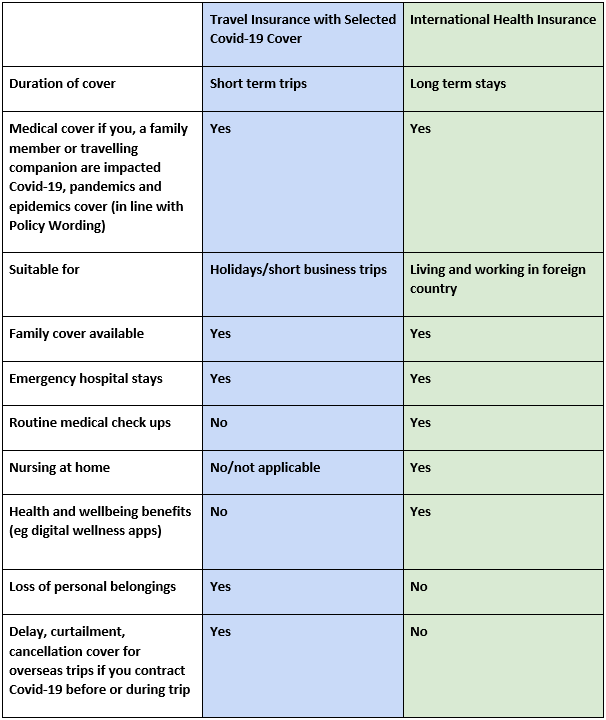
In short, travel insurance with Covid-19 cover is designed for holidaymakers and those on short business trips to cover things like emergency medical treatment (including covered events related to Covid-19), cancellations and personal belongings. International health insurance provides multi-country cover and is designed for those living and working overseas who need cover for in-patient medical check-ups, medical emergencies and ongoing treatment of chronic conditions.

Below is a general comparison of travel Insurance with selected Covid-19 cover and international health insurance. Exact coverage will depend on the chosen policy.

What about lockdowns and other kinds of general travel disruption?

It’s important to remember that travel insurance doesn’t cover you for everything*. For instance, it does not generally cover against lockdowns, border closures and other kinds of general travel disruption.

*It’s important to remember that travel insurance doesn’t cover everything. Your policy will be subject to the terms, conditions, exclusions, and benefits limits of the policy wording

Travel insurance (with selected Covid-19 cover*) – in more detail

Travel insurance with selected Covid-19 cover is travel insurance that covers you for things like trip cancellations / trip interruptions / trip delay , loss/theft of personal belongings and emergency medical treatment, and includes selected coverage for Covid-19, pandemics and epidemics before or during your trip (in line with the Policy Wording of your chosen policy).

For example:

  • If you or a travelling companion/family member are diagnosed with Covid-19 before your trip and need to cancel, you can make a claim for things like travel and accommodation costs.
  • If you or a travelling companion/family member are diagnosed with Covid-19 during your trip, you can make a claim for things like medical care and quarantine costs.

In terms of medical coverage, travel insurance is intended to provide short-term emergency medical treatment within your specified area or period of cover. The aim of this is to get you well enough to return home. Travel insurance rarely covers long term medical treatment.

Selected Covid-19 coverage* with Allianz Travel

Travel insurance from Allianz Travel Singapore includes selected Covid-19 coverage*, plus cover for epidemics and pandemics in general (when diagnosed with a disease). The Medical and Dental cover limit is S$1,000,000 (Comprehensive Bronze and Silver) and unlimited for Comprehensive Platinum.

Travel insurance in general is designed to cover you for trips of limited duration. It is intended for holidaymakers and short term trips abroad, and also offers protection against other travel related issues.

For example, Allianz Travel insurance benefits include:

  • Selected Covid-19, pandemic and epidemic cover*
  • Medical/dental cover of up to $1,000,000
  • 24/7 Medical Assistance
  • Cancellation, Delay, Curtailment
  • Loss/theft/damage of valuables
  • Rental Excess cover (Silver & Platinum Plans only)

If further treatment is required, you will be expected to return to your home country. Cover ceases once you are back in your country of residence.

*It’s important to remember that travel insurance doesn’t cover everything. Your policy will be subject to the terms, conditions, exclusions, and benefits limits of the policy wording. For more information please click on the Allianz Travel Policy Wording

Buy Travel Insurance Now

Get exclusive 40% off for MoneyDigest readers.
Use promo code: moneydigest40 until 28 March 2022

International health insurance – in more detail

International health insurance is designed for individuals and families living and working overseas for prolonged periods. It is designed to cover things like in-patient care, out-patient GP visits, emergency treatment, specialist consultations, maternity and dental. International health insurance is multi-country and provides members with flexibility in terms of choice of doctor and treatment facility, and with the ability to receive treatment anywhere within their region of cover.

For individuals or families who are unfamiliar with a country’s health system and/or language, international health insurance can make it easier and simpler to obtain medical care. Depending on which country you are moving to, it may also save you significant sums of money compared to ad hoc care if you are not entitled to local free or subsidised medical care.

International health insurance plans vary, but often include:

  • Hospital stay
  • Routine check-ups
  • Cover for pre-existing conditions
  • Cover for chronic conditions
  • Choice of medical providers

Some international health insurers make it possible to build a plan that suits specific needs. For example, Allianz offers a standard Core plan to which modules can be added, including:

  • Out-patient treatment
  • Maternity care
  • Dental care
  • Repatriation

If you choose international health insurance from Allianz, benefits include:

  • A range of treatments, inclusive of specialist fees and diagnostic tests, plus generous cover for alternative treatments and physiotherapy
  • Health and wellbeing benefits, including digital health apps
  • Cover for emergency treatment overseas, medical evacuation and nursing-at-home
  • Choice of supplemental cover including Maternity, Dental and Repatriation Plans
  • A growing network of over 900,000 quality medical providers
  • Cover for Covid-19, pandemics and epidemics

Get 10% off until 28 February 2022

Discover More

Read More...

6 Money Lessons To Avoid Being Broke

Nobody ever wakes up one morning and thinks, “I want to be broke.” A hefty loan here, a bad investment there, and a long credit card statement later – you have no idea how you landed in this state. You are living paycheck to paycheck without savings intact.

What can you do to turn the tide? Start by reading this article and applying these lessons into your life.

#1: THE POWER OF SETTING CLEAR FINANCIAL GOALS

Goals mark your direction in life. If you do not have a clear destination to work towards, it can be difficult to find the passion or motivation to save. Whether you are eyeing on purchasing a flat or figuring out how to pay off your debts, crafting a plan can get you there.

As you set your financial goals, consider making them SMART. Financial goals need to be specific, measurable, attainable, realistic, and time bound. Creating goals using the SMART method can help you ensure that you are working on an achievable goal within the timeline that you set. Stay on course!

#2: DON’T BUY WHAT YOU CAN’T AFFORD

Spending less than you make and buying what you can afford seem like simple personal finance rules. However, these are easier said than done. You can get distracted with the consumer-driven society that tempts you to live beyond your means. When this happens, a good rule of thumb is to save at least 15% of your income.

If you find it hard to save money, try paying for groceries and clothes with cash instead of a credit card. Take it one step further by using a budget per month. Withdrawing a fixed amount every month can help you to become more aware of your spending choices.

#3: EMBRACE THE FINANCIAL WORLD

The majority of personal finance lessons do not center around financial education, but on financial behavior. If you can modify your behavior with money, you can alter your financial future. Remember that you do not need to be a financial expert to prepare an emergency fund or to save for retirement. Start by building a solid financial plan and committing to it.

#4: THE IMPORTANCE OF INCREASING YOUR INCOME

Search for part-time jobs such as freelancing or dog walking to grow your income. You can take on other positions in the same company too. If you feel like you have reached the glass ceiling in your field, consider looking for new career paths to generate more income. Increasing your income can help your financial future.

#5: INVEST SMARTLY, AND NOT IMPULSIVELY

Investing is a good way to protect and grow your assets. However, the talent of wise investing does not come to us all. You may be succumbing to emotions and invest impulsively, hence you win big or lose big.

As a precaution, have an advisor who is trustworthy and credible. Research on your part is vital as well. It will give you the knowledge and confidence you need to make smart investments.

#6: BUDGET YOUR MONEY

It is understood that budgeting plays an essential role in controlling your spending, paying off debts, and staying on track with your financial goals. Creating a budget starts with adding up all your expenses for the month and subtracting that amount from your total income.

Image Credits: unsplash.com

Set monthly and daily spending limits to adjust and make up for any oversights. You can create a budget using a notebook, a spreadsheet, or a budgeting app. Use a tool with which you are most comfortable.

Sources: 1 & 2

Read More...

7 Financial Resolutions That You Can Fulfill This 2022

For the lack of a better term, the period between 2020 to 2021 was “rubbish”. People all over the world had to deal with the adverse effects of the pandemic. Unexpected economic and social shifts occurred. Nonetheless, most of us are ready to bid farewell to the yesteryears.

While many Singaporeans are committing to eat healthy and to exercise more, here are seven financial resolutions that you can consider for a more prosperous year.

1. BROADEN YOUR FINANCIAL KNOWLEDGE

Books and audiobooks provide opportunities to broaden one’s financial knowledge. You can enter the inner workings of great entrepreneurs and investors by reading though the pages of books such as “The Intelligent Investor” by Benjamin Graham, “The Psychology of Money” by Morgan Housel, “Rich Dad Poor Dad” by Robert Kiyosaki, “Think and Grow Rich” by Napoleon Hill, “Raising Financially Fit Kids” by Joline Godfrey, and “The Richest Man in Babylon” by George S. Clason.

Create an achievable list of all the financial books that you want to finish within the year. Set a realistic goal for the number of pages that you can accomplish each week. Start now!

2. CUT DOWN YOUR WATER CONSUMPTION

Singaporeans do not typically worry about clean and fresh water. However, the global supply of consumable water is getting scarce with each passing year.

Consider reducing your water consumption by turning off the tap while brushing your teeth, using less water while gardening, installing a water-saving shower head, and only washing your clothes when necessary. Minimize your expenses and help save the Earth.

3. COOK MORE MEALS AT HOME

Increase your savings by cooking from scratch. Find recipes online or ask your loved ones for their specialties. Cooking more meals at home can reduce your restaurant or take-out expenses.

Calculate your food savings and consider putting the extra cash to your emergency fund or to pay off your debts.

4. BE PROMPT AT ALL TIMES

Time is a valuable resource. There is a reason why it goes hand in hand with money. As the job market becomes increasingly competitive, most companies have minimum tolerance for employee tardiness. Keep your source of livelihood by always being on time.

You do not need to exhaust your resources or skills to remain prompt. Simply set an appropriate alarm and adhere to your organization’s schedule.

5. UPDATE YOUR BENEFICIARIES

With the uncertainties of the modern world, it is important to revisit your beneficiary designations. Adding a beneficiary to your accounts and policies can help ensure that your assets will go to your desired people. Align your will (i.e., last will and testament) to your accounts and insurance policies.

6. SEARCH YOUR HOME FIRST

Search the contents of your home, before committing to a major purchase. There are many ways to use your resources. You just need to be creative and hands-on!

For instance, you may use your old drawer as your baby’s diaper changing table. You can also spruce up your walls by purchasing Very Peri wallpaper online.

Related Post: 2022’s Pantone Color of the Year is Here — Decorate Your Home with Very Peri

7. MAKE THINGS SIMPLER

All of us are drained because of the massive chaos that recent years have brought. Reduce your worries by cancelling or closing the accounts or cards that you no longer use. Then, set up automatic transfers.

Image Credits: pixabay.com

Some financial institutions allow the employer to automate your salary in your bank account. Patronizing this method will lessen the temptation of immediate spending.


Read More...

Make A Personal Budget In 6 Easy Steps

A personal budget is a financial summary that tracks your income and expenses for a certain period, which is typically a month. The word “budget” is often associated with limited spending, but a budget does not have to be restrictive to be effective.

Having a personal budget that you can review on a regular basis enables you to prevent overspending. Start with these six simple steps.

#1: GATHER ALL YOUR FINANCIAL STATEMENTS

Get a bird’s-eye view of your financial situation by gathering all your financial statements. Include your bank statements, investment accounts, recent utility bills, credit card statements, receipts from the previous months, loan statements, and other receipts. The more information you can retrieve, the better.

#2: DETERMINE YOUR MONTHLY INCOME

Determine how much you make in a month. If you have a fixed salary, you will find information in your pay slip. If you get paid bi-monthly, you simply need to multiply your pay slip into two.

If you have more than one job or you are self-employed, you must determine your net income differently. Calculate your net income by examining your two most recently filed tax accounts. Add the two figures of your net profit together. Then, divide the total by twenty-four. The definitive answer is your average monthly income.

#3: CREATE A LIST OF YOUR MONTHLY EXPENSES

There are two types of monthly expenses – fixed and variable expenses. Fixed expenses are expenses that you encounter every month such as rent, car payments, and utility bills. While variable expenses change from month to month. Variable expenses include groceries, gifts, and shopping.

Write down a list of all the expenses you expect to have during a month. Do not forget about the childcare, transportation, and entertainment costs.

#4: TOTAL YOUR MONTHLY INCOME AND EXPENSES

Get the total of your monthly income and monthly expenses. If your income is higher than your expenses, you are off to a good start. You will have extra funds that you can put aside for retirement savings or debt repayments.

If your expenses are higher than your income, you need to make some changes. Find out which categories you are overspending on.

#5: EVALUATE YOUR SPENDING HABITS

Add up your total spending per expense category. Which category do you overspend on? You can get the percentages per category to understand how much of your income is going where.

#6: MAKE NECESSARY ADJUSTMENTS

After covering steps one to five, you will be able to highlight the spending areas that you need to eliminate or reduce. For instance, you can cancel your gym membership or lower your handphone’s postpaid plan.

Image Credits: pixabay.com

Amend your budget and align these changes to your financial goals.

Sources: 1 & 2

Read More...

Apple Nears the US$3 Trillion Market Cap

Apple, the American tech giant, is inches away from reaching a market capitalization of US$3 trillion dollars just over a year after it surpassed the two-trillion mark. This incredible milestone is as big as the equity markets of the United Kingdom or Germany.

After a decades-long run as one of the world’s best performing stocks, shares of Apple were up at 1.6% at US$174. The company needs to trade at US$182.85 to hit the goal. Nonetheless, the stock risen to about 30% this year on top of an 80% jump in 2020.

Oanda’s Senior Market Analyst Craig Erlam said: “There’s so much still to come from Apple, which makes you wonder what milestone they’ll pass next and how big they can become.”

Back in 2018, Apple reached the US$1 trillion in market capitalization and it took the company two years to double that valuation. Reaching the three-trillion mark will establish a strong rally that has been fueled by investors betting on its brand. Moreover, its peers in the trillion-dollar club include Microsoft, Amazon, and Tesla.

“Apple does seem to be more immune to the ebb and flow of economic forces just because of this really strong brand. Its new product pipeline is pretty strong too,” according to Hargreaves Lansdown’s Senior Investment and Market Analyst Susannah Streeter.

QUICK TRIP DOWN MEMORY LANE

Image Credits: pixabay.com

Owing it to the steady stream of products that attracted a loyal following, Apple became the world’s most valuable business. In late 2000, the company had a market value of merely US$4.5 billion and the investors were fleeing the stock. Nowadays, investors cannot get enough of the stock. The stock has breached Wall Street’s median price target by US$4, with most experts and analysts covering the stock rating it buy or higher.

Despite the wobbling status of markets because of higher interest rates and the effects of the coronavirus pandemic, investors view Apple as a relatively safe place to keep their money due to its consistent sales growth.

You see, Apple is “kind of in that sweet spot of not being too expensive, having a nice mix of products and services, and being a great innovator across its entire product line,” said Ingalls & Snyder’s Senior Portfolio Strategist Tim Ghriskey.

Sources: 1 & 2

Read More...