DIYInsurance: Compare Life Insurance and Save with 30% Commission Rebates

DIYInsurance Featured Banner

DIYInsurance (Do It Your way Insurance) is Singapore’s First Life Insurance Comparison Web Portal launched in June 2014.

An insurance resource that exists for one sole purpose: to empower you to make informed decisions about your insurance purchases based on no one’s agenda except your own.

Here’s how they stood out from the rest:

30rebate

30% Commission Rebates

In addition to promotions, you will receive 30% commission rebates back in cash when you purchase any product through DIYInsurance for greater cost savings to you. Learn more about commissions rebate here.

 

independence

Independence

All staff from DIYInsurance are paid a fixed salary and do not participate in sales-based compensation or incentives of any kind. Not being remunerated on a commission-basis means DIYInsurance is independent and are able to focus on doing our best to fulfill your needs. There is no hard-selling and no over-selling.

excellent

DIYInsurance Rating

The DIYInsurance rating system helps you find the product which is of the best value that suits your needs. The Specialist Consulting Group with expertise insurance knowledge, compiles, analyses,       compares, updates and research products distributed by insurance companies based on features and price. Based on the product’s value, it is converted to the number of stars as displayed in the comparison platform.

You are able to compare the value of a wide range of products for your Protection needs (term, whole life, critical illness, disability income, long term care and mortgage), Savings needs (child’s education-endowment and SRS-approved savings) and Retirement Income needs from different insurance companies.

diyinsurance banner

DIYInsurance has been featured on The Straits Times, The Edge, Lianhe Zaobao, Gold 90.5 FM and Kiss 92 FM.

Compare & Save with DIYInsurance today!

Like DIYInsurance on Facebook at https://www.facebook.com/diyinsurance.com.sg

(This post is brought to you by DIYInsurance, Singapore’s First Life Insurance Comparison Web Portal)

Read More...

Details of 2015 GST Vouchers Benefits To Be Sent Out in First Week of July

GST Voucher Featured

The Ministry of Finance has announced in a press release that 1.6million Singaporeans will receive a letter in the first week of July with details about the 2015 GST Voucher Benefits (GSTV), as well as information on other Budget benefits such as Service and Conservancy Charges (S&CC) rebates, U-Save and Medisave Top-ups.

If you are eligible, you will receive the payout in the month of August.

To find out how much you are eligible for, you can log on to https://www.gstvoucher.gov.sg with your SingPass. *Make sure you check your payment mode is correct.

1. Cash Payouts

a. GST Vouchers – Cash payout (Age: 21 and above)

GSTV11

This applies to most Singaporeans if you have an assessable income (YA 2014) of less than or equal to $26,000 with Annual Value of Home less than $21,000.

More info on Assessable Income and Annual Value: http://bit.ly/1LFbylE

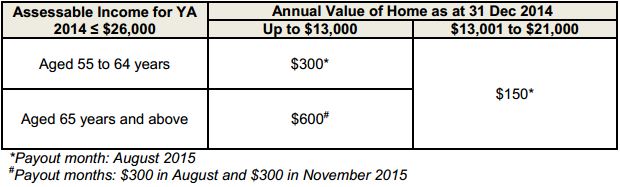
b. GST Vouchers – Additional Cash Payouts as Seniors’ Bonus (Age: 55 and above)

GSTV2

In addition, those aged 55 and above can receive payouts of up to $600 to help with their daily expenses. (Note: This means up to $900 in cash per person when you include the previous payout in 1a.)

2. Medisave Payouts

a. GST Vouchers – Medisave Top-up (Age: 65 and above)

Medisave 1

Those aged 65 and above can receive GSTV – Medisave top-up of up to $450.

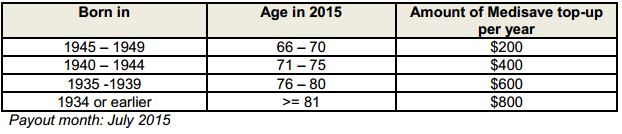
b. Pioneer Generation Medisave Top-up (Age 66 and above)

Medisave 2

In addition, those that belong to the Pioneer Generation can receive top-up that ranges from $200 to $800 annually. (i.e a 76yo retiree Pioneer that lives in a HDB flat and do not own a second property will receive $600 + $350 (from 2a.))

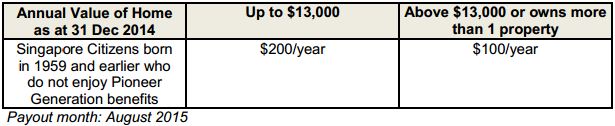
c. 5-year Medisave Top-up (Age: 56 and above who do not enjoy PG benefits)

5Y Medisave

Singaporeans born on or before 31 Dec 1959 (i.e. aged 56 years and above in 2015), who do not enjoy Pioneer Generation benefits, will receive Medisave top-ups of $100 or $200 annually from 2014 to 2018, as announced in Budget 2014. This will benefit about 528,000 Singaporeans. The vast majority (i.e. those living in HDB flats who do not own more than one property) will get the higher top-up of $200 a year.

3. Other Budget Benefits

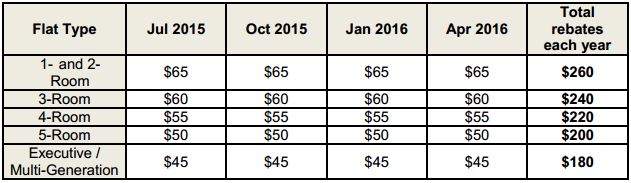
a. GSTV – U-Save

usave

The regular GST Voucher – U-Save is given out quarterly to help offset utilities directly, and costs $180 million annually. This July, over 800,000 eligible households will each receive up to $65, depending on their HDB flat type.

b. S&CC Rebates

S&CC rebates

The S&CC rebate is given out in April, July, and October this year, and costs $80 million in 2015. This July, around 800,000 eligible households will receive the S&CC rebate which will offset half a month to one month of charges, depending on their HDB flat type.

Additional Information

Most Singaporeans will automatically receive their GSTV payouts and 5-Year Medisave top-ups. For the small number of citizens who have not signed up for past Government payouts and/or are not CPF members, the letters they receive will inform them of the actions they need to take by 31 December 2015 to receive their benefits.

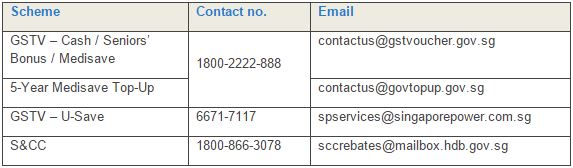
More details on the GST Voucher can be found at www.gstvoucher.gov.sg, and information on the other Budget benefits can be found at www.singaporebudget.gov.sg. If you require more information, the contact details are as follows:

Contact Info

Source: Ministry of Finance

Read More...

Be Financially Smart With These Incredibly Free And Useful Websites

Money Saving Website

Educating yourself on your finances is just a keystroke away with these incredibly Free and Useful Websites…

1. SPENDING WISELY

Spend wisely by budgeting your money and saving more through the awesome money management website called Mint.com. Mint.com, accompanied its free mobile Apps, allows its users to track their spending, develop a monthly budget, receive bill reminders, and take control of their financial life. What’s more? It sends online alerts if you had gone over your budget.

2. MAKING MONEY

Whether you have a special knack in writing, engineering, administrative work, advertising, legal work, marketing, illustrating, and web design…there are secure websites that provide opportunities for online freelance work.

Searching through various freelance websites, the two most globally popular are Fiverr and Upwork. Fiverr.com enables its users to earn money through Paypal payment services. However, the company keeps a small portion of your earnings before handing it out to you.

On the other hand, a similar platform called Upwork.com (previously called Odesk.com), captures the work-in-progress and snapshots your screen. Payment is painless because Credit Cards, PayPal accounts, and Bank Accounts are accepted.

Image Credits: SEOPlanter via Flickr

Image Credits: SEOPlanter via Flickr

3. USING FINANCIAL PLANNING TOOLS

Financial planning is an active choice to take charge of your finances and to ensure your financial well-being is in top shape. Among others, Bankrate.com and CCS.org.sg are two websites you can use to support your financial plans.

Bankrate.com aids with the consumer’s debts, loans, and taxes. It was crafted in 1976 for a print publisher in a banking industry. These long years of experience had them frequently referenced on major news outlets such as CNN, ABC News, and FOX Business News. As Bankrate.com allows publishing of personal financial stories, you can make more informed monetary decisions.

And, if you are looking for an in-depth plan to repay your debts, you can avail the resources and services of Credit Counselling Singapore at CCS.org.sg. Credit Counselling Singapore is a non-government and charity organization driven to help people to overcome their debt dilemma. Unlike some debt advisors, they are not driven by profit.

4. BOOSTING FINANCIAL LITERACY

Increase your financial literacy by regularly browsing through Money Digest‘s totally free and user-friendly website. As you may know, MoneyDigest.sg is dedicated daily news, tips, and guides relating to money and financial issues. But, beyond that, it focuses on the localized view so as to support the financial literacy of any individual living in sunny Singapore.

Image Credits: facebook.com/MoneyDigest

Image Credits: facebook.com/MoneyDigest

Read More...

Is Property A Viable Investment Tool?

A place where you can securely reside with your loving family – that is what you call a home.

Since land is scarce in Singapore, properties had always been a go-to investment tool for many. The majority of these investors have strategies limited to purchasing, reselling, and renting flats or condominiums. But, in order for higher returns to generate, one must consider investing to a range of other properties such as using the Real Estate Investment Trust (REIT).

And for a beginner with merely S$10,000 on hand, is property a viable and smart investment tool?

PROS

1. GETTING MORE LEVERAGE

With the banks help, you can have the ability to leverage your capital, make a down payment, and increase your overall return. Simply, more leverage enables you to pay less money upfront (e.g., 30% down payment and 70% from the bank) while making more money in the process.

2. CAN BE A SHIELD AGAINST INFLATION

Inflation occurs when there is a spike in prices and fall in the purchasing value of the dollar. As the miscellaneous for the property increases, the rent, and its value also increases. This is why property investing can be a good shield against inflation.

Image Credits: .Martin. via Flickr

Image Credits: .Martin. via Flickr

CONS

1. CAN BE TIME CONSUMING

Finding a property in a decent location, building a good relationship with the tenants, and maintaining the condition of the property can be time consuming. Time that may not be in the good side of most.

2. THE RISKS ARE HIGH

A two-bedroom HDB flat can cost about S$250,000. That is a huge sum of money you may be willing to risk if you are serious in property investing. The risks only increase when the investor does not understand how the property market works or when and where to invest. Hurrying up without analyzing the situation thoroughly can only bring about more damage (e.g., bankruptcy) than good.

ULTIMATELY

You can lower the risk of property investing by diligently researching and analyzing reports, tests, and the current situation. Furthermore, investing in below market value properties backed up with insurance can help manage the risk. You would not know all these things unless you are well informed!

A buyer with an in-depth financial knowledge is important to the success of a property investment. So, if you lack sufficient knowledge, seek advice from a financial consultant or other professional advisers. And, when you find the “right property”, ensure that you keep your expectations realistic and keep your finances in tact.

Sources: 1, 2, & 3

Image Credits: Mark Moz via Flickr

Image Credits: Mark Moz via Flickr

 DISCLAIMER: THIS ARTICLE DOES NOT FORM PART OF ANY OFFER OR RECOMMENDATION, OR HAVE ANY REGARD TO THE INVESTMENT OBJECTIVES, FINANCIAL SITUATION, OR NEEDS OF ANY SPECIFIC PERSON. BEFORE COMMITTING TO AN INVESTMENT, PLEASE SEEK ADVICE FROM A FINANCIAL CONSULTANT OR OTHER PROFESSIONAL ADVISER.

Read More...

5 Things You Must Know About Microfinance In Singapore And Beyond

As majority of people in developing countries are economically disadvantaged, Microfinance proved to be a viable source of capital. In fact nearly 15% are living below S$1.68 a day, according to the World Bank. Fueled by hope and excitement towards success, both public and private sectors are willing to accept the risks of working with numerous borrowers. The only factor in the way are tightened financial regulations across the world. That said, here are 5 Things You Must Know About Microfinance In Singapore And Beyond…

1. DEFINITION OF MICROFINANCE

Microfinance refer to a diverse group of services that specifically target people who are low-income earners and who are often denied access to banking loans. Microfinance services include loans, savings, remittances, and insurances. Interestingly, Microfinance gave women the biggest economic boost.

2. RISE OF MICROFINANCE

Muhammad Yunus, founder of Grameen Bank, developed Microfinance in 1974 to promote self-sustaining social businesses in Bangladesh. Since then, millions of people around the world have opened Microfinance institutions that allowed Microcredits. With Yunus’ valued efforts to impact many and improve global economy, he was awarded the Nobel Peace Prize in 2006.

3. TECHNOLOGIES AND MICROFINANCE

Funding more than millions of people, Microfinance aided by technology became a perfect match in helping to eradicate poverty. Hatton National Bank’s Chandula Abeywickrema highlighted that Sri Lanka had been experiencing relatively high mobile technology tap. For instance, mobile technology allows rural residents to perform transactions through mobile platforms. This will surely bring newfound opportunities.

4. INTEREST RATES OF MICROFINANCE

The interest rates of Microfinance services vary across the board. In 2010, several organizations and websites have sited the rate to be about 37% in average. Borrowers are required to pay these rates to receive the money they need. Certainly, the rates are still cheaper than that of the banks’.

5. SINGAPORE MICROFINANCE NETWORKS, ORGANIZATIONS, AND COMPANIES

Open a small business or help others to be entrepreneurs with these networks, organizations, and companies:

a. Microfinance Society (Singapore)

b. MILAAP

c. Kiva Lending Team: Singapore

Image Credits: Dean Meyers via Flickr

Image Credits: Dean Meyers via Flickr

Through Microfinance, may we not only show care to the underprivileged sector but also show immediate action toward activities that promote social welfare. 🙂

Sources: 1, 2, 3, & 4

Read More...