How To Make Safe Investments In Uncertain Times

The world is seemingly getting smaller every day. Online platforms, newspapers and financial television stations usually monitor events happening in one country that can have effect on other countries worldwide. People are now updated and interconnected compared to any other time in the history. It is without doubt that globalization has its own advantages, but when economic crisis, global recession, war and trade imbalances occur, it suddenly leads to the idea of making safer investments and working on government deficits. The occurrence of such uncertainties can even confuse experienced investors.

Uncertainty

Every time an individual risks his money for a chance to make profit, there is always a level of uncertainty. When fresh threats such as political unrest, recession and war arise, levels of uncertainty increase rapidly as organizations can no longer correctly predict future trends and earnings. As a result, influential investors will cut their holding in stocks significantly where they consider it unsafe and transfer their funds to other sectors such as government bonds, precious metals and money –markets ventures. The results of the sell-off when large portfolios are repositioning themselves, causes the stock market to be unattractive for both small and big investors.

Effects of uncertainty

Uncertainty can be termed as the inability to predict future trends and events. Investors cannot be able to predict the possibility of a recession, how much it will cost, when it going to start or end or which organizations will be able to make it through without being affected. Most organizations usually make predictions of productions and sales trends to give public the confidence to invest in normal market conditions, but changing uncertainty levels can result in inaccurate prediction. Uncertainty can affect economic situations both at macro and micro levels. At micro level, uncertainty focuses on particular companies within an economy that is faced with recession or war, whereas on the other hand, uncertainty on the macro level focuses on the economy as a whole.

On a micro- level company perspective, uncertainty is a major concern for companies that deal with consumer goods and services on daily basis. Consumption can fall rapidly if there is a threat of recession as customers refrain from buying goods and services. As a result, uncertainty can cause organizations to lay off some of its employees in certain sectors to reduce the effects of lower sales. Uncertainty levels that surround company sales also affect the stock market.

On macro level perspective, uncertainty is expanded when the countries at recession or war are major consumers or suppliers of goods and services. For example, a country that supplies huge amounts of oils goes to war, uncertainty concerning the levels of globe oil reserves would increase significantly.

Another macro- level event that brings in uncertainty is the devaluation of exchange rates. Countries that are faced with recession and war are deemed to be unstable. Therefore, investors tend to move their currency and investments away from these countries.

How to react

When uncertainty situations heighten, the best weapon is to be well informed about all the events occurring worldwide. One can research individual companies, read newspapers and watch financial televisions to keep updated. It is also critical to analyse sectors that are likely to gain more and the ones that are going to lose during the crisis and choose a long term plan to invest. In addition, uncertainty times are also a good opportunity for investors who position themselves to take advantage of the situation. Brilliant investors will search for companies that provide goods and services that will be in high demand when the situation normalizes. However, it is very hard to commit investments in uncertainty situations, but one can reap huge benefits in the long run.

Online Forex traders such as CMC markets and their clients are good example of investors who should be updated about uncertainty. CMC markets operate in many currencies and therefore it is critical to monitor the performance of every currency. When a certain currency becomes weak because of a various uncertainties, it is advisable for traders to change and trade with other stronger currencies. Where a possibility of situations normalizing, traders can take the risk and hang on to reap the huge benefit that’s come along with such situations.

Read More...

Robo-Advisors: The New Wave Of Wealth Managers

Wealth Management Services used to be exclusive to the people who are insanely rich. These people were expected to pay at least 1% of the value of their assets as fees. Many wealth managers charge more than this! This is why these services leave no room for small-time investors.

Traditional wealth managers provide tailorized advice on financial matters such as investments, retirement, taxes, and estate planning. You must keep up with your annual fees to reap these benefits. However, a new wave just hit the country! Several FinTech (i.e., Financial Technology) companies have digitalized wealth management services.

These digitalized wealth managament services make use of “robo-advisors”, which allow all sorts of clients to build a portfolio at a cheaper rate. Robo-advisors measure your risk appetite and diversify accordingly. The gradual growth of robo-advisors is seen around the globe.

Know more about robo-advisors by watching this short video:

The local FinTech companies that I mentioned above include Bambu and Smartly. Let me kick off with Bambu. Bambu chose the B2B (i.e., Business to Business) route in marketing their robo-advisory platform. This means that they offer their services to the financial institutions themselves.

Ned Philips, the brainchild and CEO of Bambu, believes that the quick rise of digital adaption will greatly benefit the consumers. He explained that it may cost his company US$1 million (S$1.45 million approximately) to acquire 3,000 customers. The low fees that robo-advisors charge make it possible for him to sustain the business.

Smartly, on the other hand, allows its clients to invest in internationally diversified portfolios. The company offers ETFs or Exchange-Traded Funds. You can invest for as low as S$50 per month. You read that right! Their fees are very affordable!

Clients or investors are mandated to provide basic information about themselves. Then, Smartly’s proprietary algorithms will suggest a personalized portfolio based on the profile. It is possible to change the allocations of the funds if the client does not agree with it. Its mere slogan will say it all: “Anyone can be an investor – an investment service built for you.”

In summary, robo-advisors allow you to create a portfolio on autopilot. The digital algorithms access your tolerance to risks and your preferred timeline. Afterwards, a portfolio will be built. It is undeniably cheaper than the traditional wealth management services. This is why it welcomes more and more small-time investors to open their accounts.

Image Credits: pixabay.com

Image Credits: pixabay.com

Do you think that this will benefit the Singapore market? Well, I hope so!

Sources: 1 & 2

Read More...

The Basics of Technical Analysis

A technical analyst’s best friends are charts and patterns. But to the uninitiated, these are hard to make sense of. Once you get a hang of the basics however, your new-found knowledge can be used to search for potential investment opportunities.

The Assumptions

Before we get ahead of ourselves, let’s start from the beginning. What is technical analysis anyway?

Simply put, it is a study of past price movement patterns and market data to forecast future price movement directions that is built on 3 key assumptions:

1) Key factors are accounted for
The company’s fundamentals, broader economic factors and market psychology, are all priced into the stock, removing the need to consider these factors separately.

2) Prices follow trends
After a trend has been established, prices tend to move in the same direction.

3) History tends to repeat itself
This is because market participants tend to react consistently to similar market events over time.

However, it is important to remember that past performance is not necessarily indicative of future results. New factors or market conditions may arise which deviate from past trends and patterns.

Candlesticks as Building Blocks

You can’t think about technical analysis without picturing a candlestick chart. It may surprise you to know that candlestick charts are not a modern-day invention. They have been used since the 1700s, having been introduced by Homma Munehisa, a rice merchant in Japan.

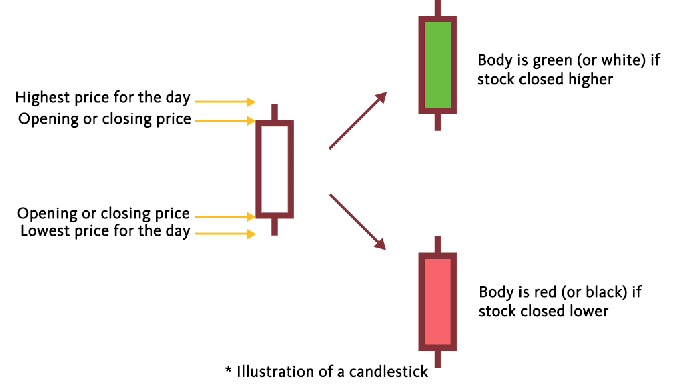
There must be something to candlesticks if they have been able to stand the test of time. And indeed, a single candlestick holds invaluable information which investors can distil at a glance:

ke1

Spotting Patterns

Individual candlesticks can be strung together to form charts which technical analysts pour over, looking for patterns which give them trading ideas. However, you will have to understand how to spot these patterns and what they mean before you can capitalise.

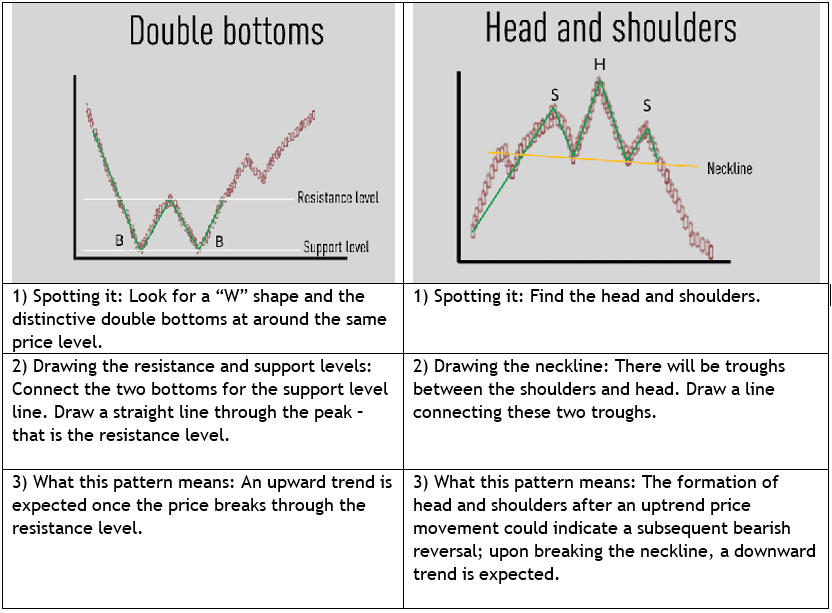
Here are two simple patterns to ease you into things:

ke2Putting It Into Practice

These two patterns are just the tip of the iceberg. There are many other technical analysis patterns that you can learn about that may help you spot potential trading opportunities.

But even if you know what patterns to look out for, there is an entire universe of stocks to choose from. If you have no prior interest in any stock, it would be hard to know where to begin. It simply wouldn’t be efficient to look at charts of every single stock and find actionable patterns within.

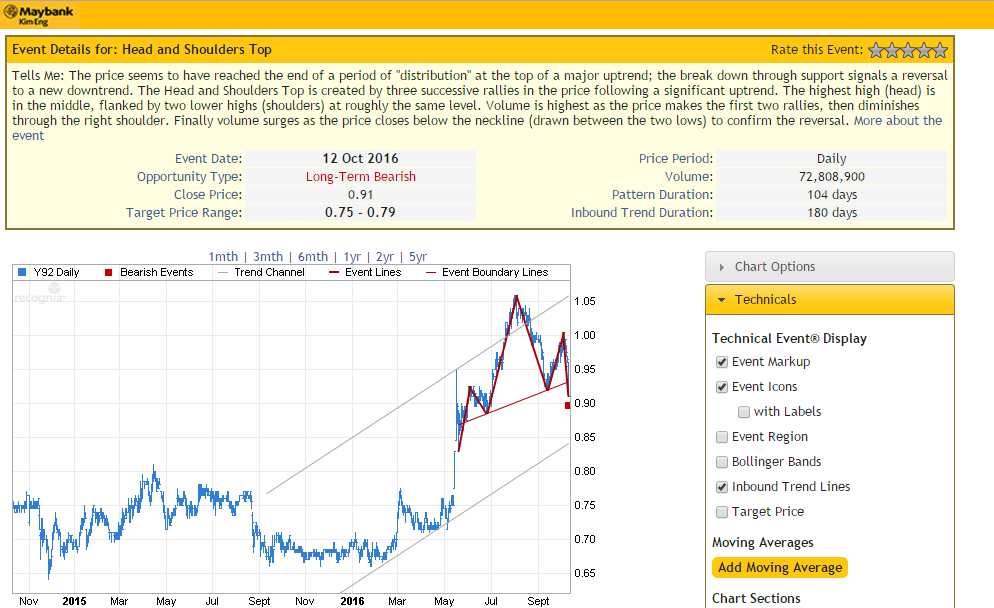
One possible option is to use stock screeners to identify stocks that meet your own criteria. For example, a stock screener can help you find stocks like the one below that exhibited a head and shoulders pattern, during a specified period of time.

Source: Technical Insight on Maybank Kim Eng's KE Trade platform

Source: Technical Insight on Maybank Kim Eng’s KE Trade platform

Technical analysis is useful for investors to understand. But like we highlighted earlier, it isn’t infallible and is built on several assumptions. Therefore, it is best to use technical analysis along with other tools in your investment toolkit, like fundamental analysis, and to practice often in order to gain a better understanding of how these strategies could help you meet your investment goals.

Disclaimer: This message is for general knowledge or information only. It is not an offer or invitation to buy or sell securities, futures or other products or services. Our products or services vary in different jurisdictions, subject to their respective terms and conditions and the licences our affiliates and us hold. This message is not an advice or recommendation for any financial planning, investment, legal, tax or other purposes and, accordingly, no responsibility or liability is assumed by us or our affiliates, whether directly or indirectly, from any person taking or not taking action

Read More...

A Dividend Investing Strategy

Singapore investors love their dividend stocks. According to the Investment Trends Singapore Broking Report 2015, 75% of investors polled stated that they usually invest in dividend stocks when trading on the Singapore market. And they are spoilt for choice! Many companies that list on SGX pay dividends. But with so many dividend-paying stocks out there, which stock would you consider?

A High Dividend Yield Stock: Better than a Low Dividend Yield Stock or?

That is the question. The stock with the highest dividend yield in the industry may look attractive now, but is a stock with 10% dividend yield better than one with 3% in the long run? Does a high yield stock always outperform a low yield stock?

High dividend yield should not be taken at face value. It always pays to dig deeper and find out the real story behind certain attractive numbers before deciding to invest.

Companies with a high dividend yield compared to the market average may not necessarily equate to companies with good financial performance. The high dividend yield could be the result of declining share price due to weak fundamental such as inconsistent earnings, high debt etc. Besides, high dividend yield may not be sustainable. If earnings fall, the management may cut dividends or eliminate the pay-out altogether. Hence, investors should also look at companies with consistent dividend payouts and with the cash flows coming from actual core operations.

A Dividend Growth Strategy

If a stock with a high dividend yield is not necessarily the best choice for long-term investors, then what other strategies are there? A dividend growth strategy for one, is something you might want to learn more about.

To clarify, dividend yield is the dividend amount divided by the share price. Dividend growth meanwhile is how much the dollar-amount of dividends given out increases each year.

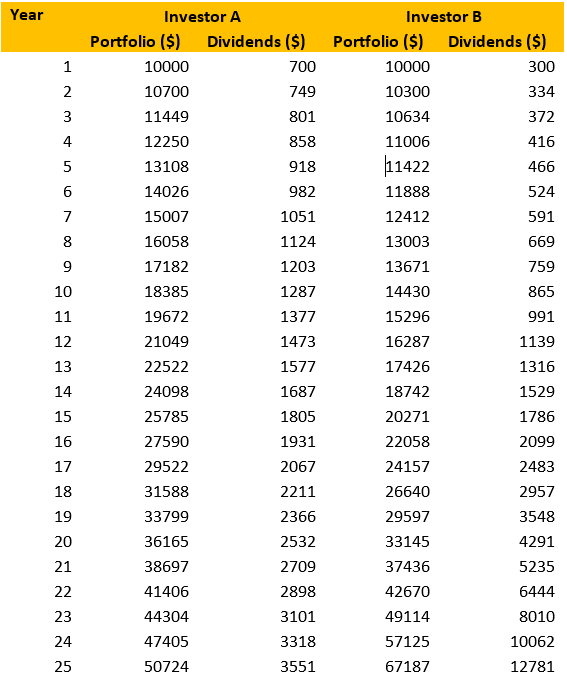
Take this hypothetical example which compares the performance of two investors (based on certain assumptions where indicated).

Investor A: Invests in ABC Company which pays 7% dividend yield at the outset and every year after that.

Investor B: Invests in XYZ Company which pays 3% dividend yield at the outset.

XYZ Company has a lower dividend yield because they choose to reinvest some of their earnings into the business. The business grows, and so does their dividend pay-out – to the tune of 8% every year (e.g. $0.03 dividend per share in year 1, $0.032 in year 2).

Assume that the share prices for both of these companies remain unchanged for 25 years and both investors reinvested their dividends every year. Their performance can be found in the table below.

divi

The Results
Investor A, the high yield investor, beats Investor B during the beginning years but the dividend pay-out and portfolio value of Investor B caught up in year 16 and 22 respectively. In the end, the total dividends received by Investor B are more than 3 times that of Investor A.

So, while Investor B received low pay-outs initially, he was rewarded with future growth. This is the underlying principle of the dividend growth investing strategy. Length of the period of investment would also affect the total dividends received.

Finding Dividend Growth Stocks

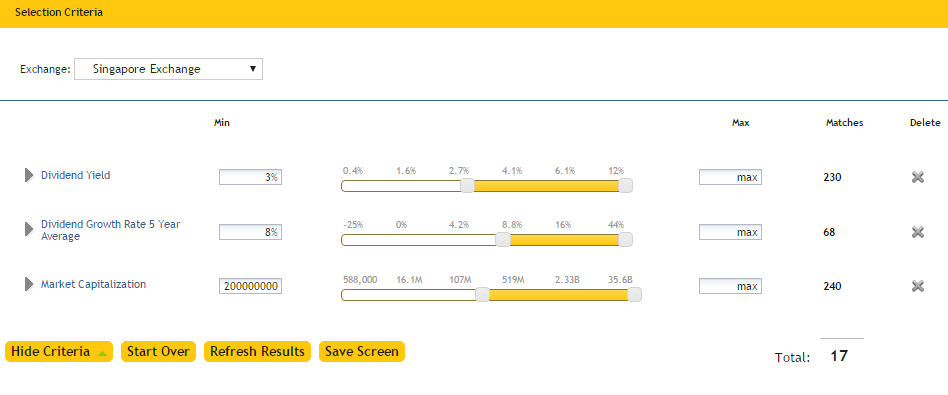
That will be the next question on your mind if you want to explore using a dividend growth strategy. Stock screeners come in useful here. A stock screener allows you to choose certain criteria, and to find stocks that fit the criteria you have selected.

Here is a set of criteria that could be used to pull dividend growth stocks:

  • Dividend yield>3%
  • Market capitalisation>200 million
  • Dividend growth rate (5-year average)>8%.

The stock screener below, for example, has found 17 stocks that match the above criteria. This provides a good starting point for investors to do further research into these specific stocks. Try to come up with your own set of criteria and see how it works.

divi2

Source: Recognia Strategy Builder on Maybank Kim Eng’s KE Trade platform as at March 2016

Disclaimer: This message is for general knowledge or information only. It is not an offer or invitation to buy or sell securities, futures or other products or services. Our products or services vary in different jurisdictions, subject to their respective terms and conditions and the licences our affiliates and us hold. This message is not an advice or recommendation for any financial planning, investment, legal, tax or other purposes and, accordingly, no responsibility or liability is assumed by us or our affiliates, whether directly or indirectly, from any person taking or not taking action

Read More...

What Exactly Is Short Selling?

In the dynamic world of the investments, you will encounter the term “short selling”. How does it work and what are the rules behind it?

The age-old practice in investing is that you will profit by purchasing stocks in a low price and selling them for a higher price. Although you have invested in a seemingly good performing economy, some stocks or securities may go down. You cannot earn money by “buying low and selling high” in this circumstance. Fortunately for you, there is another way to make money! That is short selling.

Short selling plays a soothing music to the risk-taker’s ears. Its concept is relatively simple. It takes advantage of the market transitions from higher to lower prices. It occurs when an individual borrows a stock, sells it for a higher price, and purchases the stock again at a cheaper price. Watch this short video to grasp its essence:

Most local brokerage firms let you experience the ease of selling short. Just place an order to sell the stock and communicate with the broker. The brokerage firm will borrow the shares for you to sell. Then, it loans the shares to your account and conducts the sell order.

As with everything, rules shall apply. Here are just some of the common rules in short selling:

1. The “Uptick Rule” is one of the key edicts that short sellers abide. It refers to selling a stock short only when the last trade was a move up. You cannot short a stock that is moving down.

2. The odds may not be in your favor if you heard that a flock of investors are shorting the same stocks that you are shorting. There are so many risks if you short a stock that everyone else does. They can simply abandon their shorts if things do not go as planned. Doing so will drive the price to hike.

3. Short selling during seasonal holidays or during “options expiration week” may attract painful losses because those circumstances do not follow the natural or normal supply and demand.

Short selling takes advantage of the market transitions from higher to lower prices. The steep learning curve intimidates some investors, leading to avoiding it entirely. It is undoubtedly a skill that experienced investors develop!

Sources: 1, 2, & 3

Read More...