Alibaba’s Sales Soared High Months After Singapore Bought A Billion In Stocks

My uncle is a proud owner of several holistic spas. Whether his branches are in need of a new machine (e.g., IPL or Laser Hair Removal Machine), he visits Alibaba first. Alibaba is a global marketplace that is relatively prompt and reliable. It is reigns supreme in the world of Chinese e-commerce. Its broad prevalence in Asia is comparable to United States’ Amazon or eBay.

It comes as no surprise that its sales soared up to 55% in the last quarter due to cloud computing. As Chief Executive Daniel Zhang once said: “Our results reflect our increasing ability to monetise our 450 million mobile users through new and innovative social
commerce experiences.” You can expect that this number of users will grow positively each year.

Image Credits: Global Panorama via Flickr Creative Commons (Attribution-ShareAlike 2.0 Generic)

Image Credits: Global Panorama via Flickr Creative Commons (Attribution-ShareAlike 2.0 Generic)

You see, cloud computing is the practice of utilizing a network of remote servers hosted on the Internet instead of using a local server. It manages, stores, and processes data in that manner. Basically, cloud computing allows the users to store and access data online without needing a computer’s hard drive. It allows Alibaba to operate conveniently and swiftly.

What is interesting is the fact that the Government of Singapore purchased a total of US$1 billion (about S$1.38 billion) last June. GIC Private and Temasek Holdings each signed to US$500 million (S$692.15 million) of Alibaba shares, which were priced at US$74 (S$102.44) a piece thru subsidiaries. These shares were a part of the US$8.9 billion (S$12.32 billion) sale by Japan’s SoftBank. SoftBank remains to be Alibaba’s biggest shareholder. The elevated sales of Alibaba showed that the decision to acquire the shares was beneficial – at least for now.

You may think that Alibaba’s local competitors called RedMart and Lazada were shaken by these news, but you are wrong! Alibaba had recently invested in these two companies due to their financial constraints.

Image Credits: pixabay.com

Image Credits: pixabay.com

We can only hope that these circumstances will improve Singapore’s e-commerce platform in the future.

Sources: 1, 2, & 3

Read More...

The Buzz Around U.S. Interest Rates: 3 Things You Should Know

It has been a story of “will they or won’t they” this entire year.

We are talking of course, about interest rates. The last rate hike in December 2015 was the first since 2006, and gradual hikes were expected in 2016 but the Federal Open Market Committee (FOMC) has ended every meeting so far with the decision to maintain interest rates. Market watchers are at the edge of their seats. The consensus is that a rate hike is looming and it could come as soon as November or December, when the FOMC next convenes.

In preparation for that, here are three things that you should know about a potential interest rate hike.

Will Markets Cheer or Jeer?

Here is a look at how the market has reacted to FOMC decisions lately:

io1

*Prices plotted based on the adjusted close price of the last day of each month

Lately, markets seem to breathe a sigh of relief whenever rates remain unchanged but it is really anyone’s guess as to how the market will react to the next rate hike.

There are reasons why the market could react positively or negatively. Markets could jeer, as higher interest rates mean heftier borrowing costs for companies and consumers. In other words, it could be a drag on the economy. But markets could cheer as well because a hike may mean that the US economy is back on track and that the FOMC is confident enough to remove its crutches.

How Did We Get Here in the First Place?

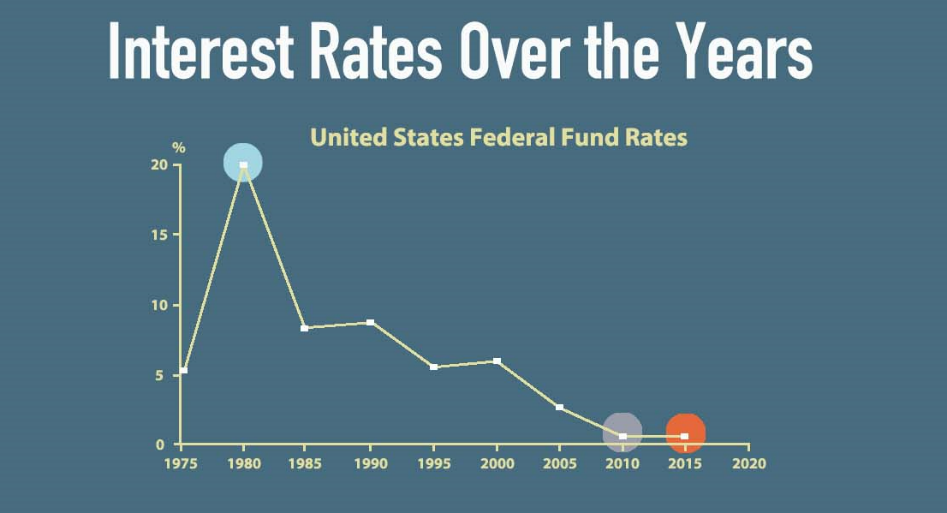
Interest rates are practically zero as of this moment. The graph below shows how interest rates have fallen to this point over the years:

io2

In the 1980s, to combat double digit inflation and the residual effects of the 1980 energy crisis, interest rates were hiked to about 20%. It stands in stark contrast to our current low interest rate environment. This low rate was a result of the global financial crisis; the US economy was hit hard by the crash in the housing market and banking sector from 2007 – 2009 and interest rates were reduced so that consumers and businesses could continue to spend and boost the economy. Interest rates have been kept low ever since as the FOMC has adopted a wait-and-see approach.

What Investors Should Take Note Of

There are two sectors that investors should keep an eye on – property and financial institutions.

It is easy to see why financial institutions will be affected. Their core business revolves around loans and their performance varies with interest rate levels. As for the property sector, it could go both ways. Higher mortgage rates make home buying more expensive, but the FOMC’s decision to raise rates could signal a healthy economy and a healthier economy could buoy the housing market.

And it isn’t just the US market we are talking about here. As money moves back to the US seeking higher interest rates, in a bid to stay competitive, interest rates in other countries may be increased as well. So do your research and pencil in these dates: 1-2 November 2016 and 13-14 December 2016. The market will be holding its breath as the FOMC convenes to decide whether the time has come to finally hike interest rates.

Disclaimer: This message is for general knowledge or information only. It is not an offer or invitation to buy or sell securities, futures or other products or services. Our products or services vary in different jurisdictions, subject to their respective terms and conditions and the licences our affiliates and us hold. This message is not an advice or recommendation for any financial planning, investment, legal, tax or other purposes and, accordingly, no responsibility or liability is assumed by us or our affiliates, whether directly or indirectly, from any person taking or not taking action


Read More...

4 Must-Read Books On Real Estate Investing

Books will always serve as a clever investment. Books will offer you the chance to learn new strategies to become a better real estate investor. Furthermore, you can save a substantial amount of money by avoiding the expensive mistakes of other authors.

On that note, here are the must-read publications if you are looking for ways to make the most of your property investments:

1. REAL ESTATE INVESTING FOR DUMMIES BY ERIC TYSON AND ROBERT GRISWOLD

Buy it here.

The preconceive notion of purchasing a “For Dummies” guide is that you are utterly clueless about a certain topic. Do not mind this! This book is a good resource for newbies in the Real Estate scene, especially made for those who have no prior experience. It elaborates difficult concepts in simpler terms.

The authors do not promise an overnight success story. Instead, they offer practical and realistic advice for its readers. These advice will help you conquer the challenges and take advantage of the opportunities ahead.

2. LANDLORD ON AUTOPILOT BY MIKE BUTLER

Buy it here.

The rich wisdom of this book grew from the author’s experiences after he managed 75 rental properties while he still committed to a full-time job as a police detective. It may seem impossible to juggle the two worlds but, it is doable.

Landlording on AutoPilot features useful information on dealing with the dynamics between the tenants and the landlord. It can dramatically improve your rental business and its surrounding relationships. If you are afraid to jump in this field or if you are struggling as a landlord, you must give this book a shot!

3. RICH DAD POOR DAD BY ROBERT KIYOSAKI

Buy it here.

As you dive in the world of investments, feed your mind with the philosophy of the renowned author and lecturer Robert Kiyosaki. I was intrigued about his teachings after I watched the book summary video by Evan Carmichael. See it for yourself.

What you can expect from this book is a lot of motivational talk. It is one of the library staples among investors because it contains a massive amount of thought-provoking content. He created two unique perspectives about money that emerged from two of his fathers – the rich and the poor. While the poor dad will tell you to work for your money, the rich dad will tell you to let the money work for you. The author did a great job in encapsulating the what I had been feeling for a long time.

4. THE ULTIMATE GUIDE TO REAL ESTATE INVESTMENT IN SINGAPORE BY ISMAIL GAFOOR

Buy it here.

When it comes to the big players in the Singapore real estate industry, Ismail Gafoor leads the wolf-pack. This book is the culmination of his passion and hardwork. Let us begin with his inspiring life story.

Mr. Gafoor and his family struggled with money when he was young. At the prime age of 7, he was tasked to deliver newspapers with his dad. This means that he was constantly late for school. As a young adult, he began a career with the Singapore Armed Forces. His cumulative salary led to his brave decision to buy his first property at Normanton Park. Because he saw the potential of real estate investments as a decade passed, he decided to open his own property agency with his wife. Nowadays, we know this leading agency by the name of PropNex Pte Ltd.

Image Credits: pixabay.com

Image Credits: pixabay.com

Enclosed in this book are answers to various questions that investors ask. It is hard to go wrong with this book knowing that its contents came straight from the workings of a top real estate pioneer.

Sources: 1 & 2

Read More...

4 Benefits of a Monthly Investment Plan

Based on a Worldwide Cost of Living survey conducted by the Economist Intelligence Unit, Singapore has been ranked as the world’s most expensive city to live in for the third consecutive year. Indeed, many living in Singapore have to contend with the high property and car prices. Healthcare and education costs are also not far from people’s minds.

Investment is seen as a way to potentially amplify one’s wealth to better fulfil these life goals. But what if you do not have a substantial amount of capital or time set aside for investing? A Monthly Investment Plan or what’s also known as a Regular Savings Plan, could be something for you to consider.

  1. Affordable

There’s a common misconception that you need to have sizeable capital in order to start building a nest egg through investing. However, with a Monthly Investment Plan, you can decide how much to invest based on your personal financial situation. You can even set aside just $100 a month, and put that money into blue chip stocks, exchange traded funds (ETFs) and Real Estate Investment Trusts (REITs) listed on global markets to build your portfolio.

  1. Takes Advantage of Dollar Cost Averaging

Monthly Investment Plans follow the principle of dollar cost averaging. By investing regularly every month instead of trying to time the market and find the best time to buy and sell shares, the risk of investing a large amount in a single investment at the wrong time is reduced.

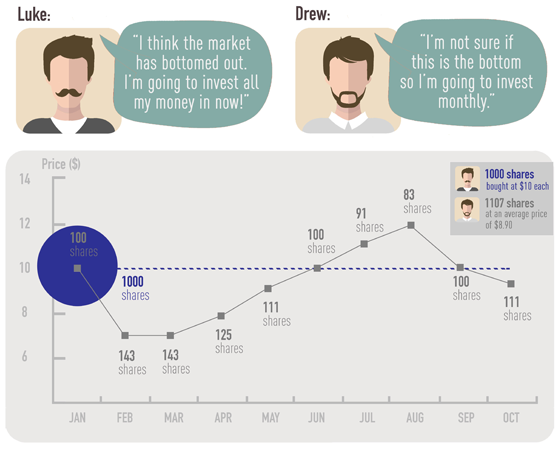
To gain a better understanding of dollar cost averaging, consider this example where two siblings are given $10,000 each, but choose to invest it in different ways.

Luke used the money to buy 1000 shares at $10. Drew, on the other hand, invested a predetermined amount each month, and he ended up buying more shares when the price was low and fewer shares when the price was high.

monthly-investment-plans-graph

Drew’s average price per share ($8.90) is therefore lower compared to Luke’s ($10) – this is how dollar cost averaging works and by extension, how Monthly Investment Plans can help you achieve your investment goals.

  1. Automated and Hassle-Free

No one can exactly foresee and predict the behaviour of the stock market. Instead of trying to time the market and finding the right time to enter and exit, Monthly Investment Plans focus instead on long-term gains, and build your portfolio by automatically buying your shares for you every month. Your work is done at the outset. All you need to do is choose your desired shares and set your monthly investment amount. From that point on, you can sit back and watch as your portfolio grows and your shares accumulate.

  1. Diversification

Monthly Investment Plans enable you to diversify your investment portfolio in a couple of ways.

Most of these plans allow you to invest in ETFs like SPDR STI ETF or Nikko AM STI ETF which are funds that invest in the 30 largest companies listed on Singapore Stock Exchange. More conservative investors can go for these ETFs. In addition to these ETFs, your Monthly Investment Plan may allow for investments into REITs. If you are interested in investing in property, then this is something to look out for; REITs don’t just give you exposure to one property – they give you exposure to a whole portfolio of properties. Some Monthly Investment Plans will also allow you to access stocks listed in markets like the US, Hong Kong, Malaysia and Thailand. Expanding your horizons and looking at offerings listed on these global markets is another way to diversify your portfolio.

If any of these four benefits sound appealing to you, then you should find out more about how Monthly Investment Plans can help you along your investment journey.

Read More...

Advantages of Forex Trading for SMEs

The forex market is the largest and most liquid in the world, with around $5.3 trillion traded every day on average. This makes it highly attractive for individuals to begin trading in an attempt to make a good profit, yet trading forex also holds many advantages for small businesses. There is an element of risk involved, and many companies won’t want to put some of their profits on the line, yet if your businesses does and has worked out how much it can afford to trade, there are various reasons for doing so.

Flexible Ways to Profit

There are many different ways to trade on the forex market, meaning you can make a profit whether a currency is rising or falling, depending on the type of trades your business makes. With much more flexible ways to trade than other markets, such as the stock market where you can only profit if they increase in value, it provides more opportunities to be successful. As a highly volatile market it can therefore be better to place trades on the assumption of some currencies weakening.

Simplified Choice

For beginners, the forex market appeals due to its more simplified nature and lack of choice compared to others. There are around seven major currency pairs that provide a good starting place, with a lot of information, news and analysis surrounding all of them to keep you well informed when making trades. Then it is simply the decision of whether you think a currency will increase or decrease in value.

Diversified and Expanded Portfolio

Trading forex with Oanda offers the opportunity to diversify the company’s existing portfolio. All SMEs need to expand and grow to be a success, and widening forex trading capabilities is a good start. Spreading your small company’s investments into more places reduces volatility and means if something goes wrong in one area, it may hopefully be offset by successes in another.

Tax Incentives

The first 40% of profits made from forex trading are taxed at short-term capital gains rates, whether they are made in the first minute or month after you enter a trade. The remaining 60% is then taxed at long-term capital gains rates, but this is still a lot better for SMEs than other options available. There are also no commissions involved either, offering more financial advantages. Consider these points before your SME begins trading forex.

(This post is brought to you by Oanda Europe Limited.)

Read More...