
6 Simple & Legit Ways To Earn Money In Singapore

As we abide to the social distancing protocols and the restrictions brought by the pandemic, many of us began relying on delivery services to get household essentials such as food and grocery. Due to the high demand for delivery services, it has become a lucrative sideline for many locals. If you are not able to drive a vehicle and are looking for ways to make money, you may try these legitimate alternatives.

#1: SELL USED ITEMS ONLINE

You can earn money by selling your used or unused clothes and other items online. Firstly, you may swap your belongings with your friends and loved ones. Secondly, you may offer your repairing services to others. Lastly, you may sell your clothes and other items online. You can sell virtually anything these days. From footwear to figurines as well as bags to plants, you can easily spot an item or two that someone else might want. Try selling these to numerous platforms such as Carousell, Shopee, Lazada, and Etsy.

#2: REDUCE YOUR FOOD WASTE

Consider making money by saving it. A major category that consumes most of your budget is food. Reduce your food expenses by cutting down your restaurant trips and by budgeting your groceries. An environmentally-conscious group called SG Food Rescue started a movement that aims to reduce food waste. This group rescues “unsellable” and edible food from vegetable and fruit sellers and brings them to charitable organizations. Being a part of the group means being able to consume fruits and vegetables that would otherwise get thrown away because they do not look aesthetically pleasing. It can save you about S$200 per month on groceries.

#3: OFFER TUTORIAL SERVICES

As a tutor, your rate will vary depending on your qualifications. If you have graduated with a Bachelor’s degree at a local university, you will likely enjoy higher rates for subjects such as Maths and English. Students may get the benefit of flexibility when hiring a freelance tutor. You can teach a student at their own pace. Tutoring from home means you can conduct your sessions via Google Meet or Zoom.

#4: TRANSLATE A MESSAGE

It is time to put your mother tongue lessons to good use! Consider translating a document or two for people online. This job can earn you about S$5 to S$100 per assignment. The quicker you clear out the assignments, the more you can earn. Find assignments from freelancing platforms such as Fiverr, Gengo, and Upwork. You may be asked to set up a PayPal account to receive your pay.

#5: BECOME AN INSTAGRAM INFLUENCER

Do you enjoy taking selfies and going live on Instagram? If you have a strong following, you can become an influencer. Share your interests with your content and build an audience as you become a paid influencer. You can earn money through ads and through linking back to an online store. You can earn about S$5 to S$150 per post through Partipost. Individual retailers may approach you for promotional posts too. This can range from S$50 to S$100.

#6: CONSIDER DROPSHIPPING

One of the simplest ways to venture into the e-commerce world without investing too much upfront is through dropshipping. Dropshipping is a retail fulfillment method where a store does not keep the products it sells in stock. Instead, it transfers the customer’s orders to the manufacturer or wholesaler who then ships the goods directly to the customer. The only downside is the upfront starting fees. However, you can earn more than S$3000 per month with the right strategy.

Image Credits: unsplash.com

Making money online does not have to be an unreachable dream. It is feasible to generate income online with the right tools and strategies. Use the above tips as inspiration. Then, feel free to choose which route to take.


Sources: 1 & 2

Read More...

How To Master The Art Of Giving Speeches

For some people, merely thinking about public speaking can cause their palms to sweat. It is one of the most common fears out there. However, there are many ways to overcome your fear and deliver a memorable speech. Here are some useful tips.

#1: DO YOU KNOW YOUR AUDIENCE?

Know the reason why you are asked to talk in a room full of people. Identify your audience. It is important to identify your audience to know what they want or need to take away from your speech. If you are speaking in front of your friends at a wedding, entertain them. If you are speaking in front of your co-workers, inspire them.

#2: HAVE YOU REHEARSED?

Make time to practice your speech. Write down your goals and the content of your speech ahead of time. This will ensure that your muscle memory will work while you deliver your speech. Try practicing despite having different distractions to mimic real-life situations.

#3: WHICH STYLE WORKS FOR YOU?

While others may benefit from having their script memorized, some may perform better with a few notes on a paper. Different events will usually require a different style. Know which style works for you.

#4: HAVE YOU TESTED ALL THE EQUIPMENT?

Nothing is more frustrating than last-minute technical difficulties. Avoid adding more stress to your day by testing all the equipment and audio visual presentations ahead of time. It is best to have backups too.

#5: HOW DID YOU USE YOUR BODY LANGUAGE?

The right physical or non-verbal communication can have a profound impact on how your message is interpreted and received. Be aware of your body language! For instance, you must make eye contact. Face your audience and stand straight. Avoid crossing your arms or putting your hands in your pockets.

#6: DID YOU GRAB ATTENTION?

Grab attention by refraining from starting a speech with what today’s talk is about. Instead, use an interesting anecdote or a shocking statistic to kick things off. Conclude your speech with a summary and a strong statement that your audience will remember.

#7: HAVE YOU TRIED ENJOYING THE EXPERIENCE?

Image credits: unsplash.com

Fake it until you make it. If you look bored, then the audience will think that you not interesting. Exude confidence by adding a little humor (i.e., as long as it is appropriate) and interesting anecdotes. This will help you and your audience relax. Remember to eliminate sentences that does not clearly support your purpose. Remember that it is not about you, it is about your audience.

Sources: 1 & 2


Read More...

Steer clear of these 4 resume mistakes if you want to score yourself an interview

resumes on a desk

We trust that you’ve had a well-rested weekend. For some, it might be a busy one since we’re just less than two weeks to Christmas! Good times or bad times, there’s power in the season of giving so we hope you’ve gotten your Christmas gifting plans all sorted out.

Now, back to serious business. Yes, it’s the most dreaded Monday, and we’ve new additions to our usual career-related tips. Job seekers who have yet to score yourself an interview despite the number of resume sent-outs, the problem might be due to some resume blunders you’re making.

Read on to find out how you can avoid these four resume mistakes to score yourself an interview soon.

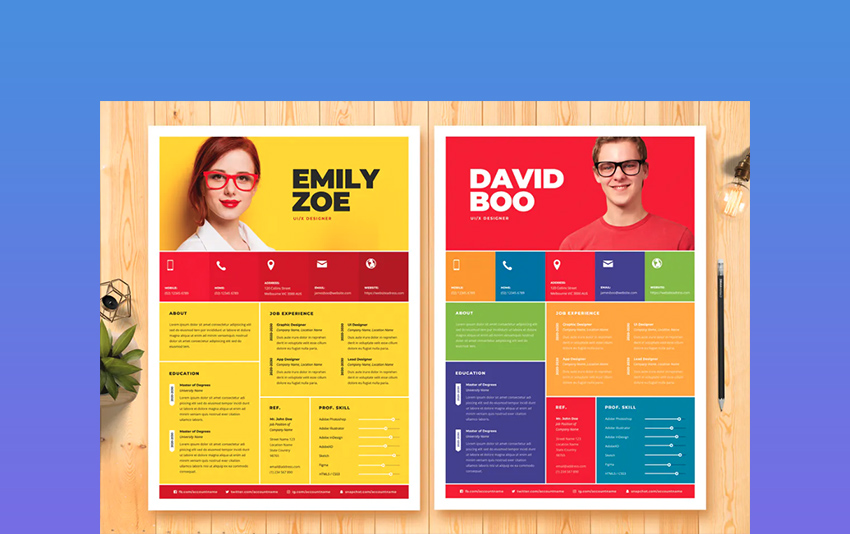
#1: Placing too much focus on the design
colourful resumes

Image Credits: business.tutsplus.com

If you’re a designer and applying for a position in the creative industry, probably it would make sense for you to want to spend some time on the visual outlook of your resume. But the main point here is that some people tend to overdo it.

You’ve heard the saying, “less is more”, and in this context, it accurately sums up what you should do. Think about the functionality of your resume, including the audience and purpose. Busy recruiters do not have all the time in the world to admire your stylish resume.

Instead, it would be best if you depicted your resume in a way that helps the hiring manager:

  • Read with ease
  • Sift out your skills and suitability
  • Apply your in-demand skills to the job vacancy

A border design and some coloured text may appear lovely in your eyes, but it may not be for the head hunter looking at tons of resumes a day to pick out the right candidates with crucial competencies.

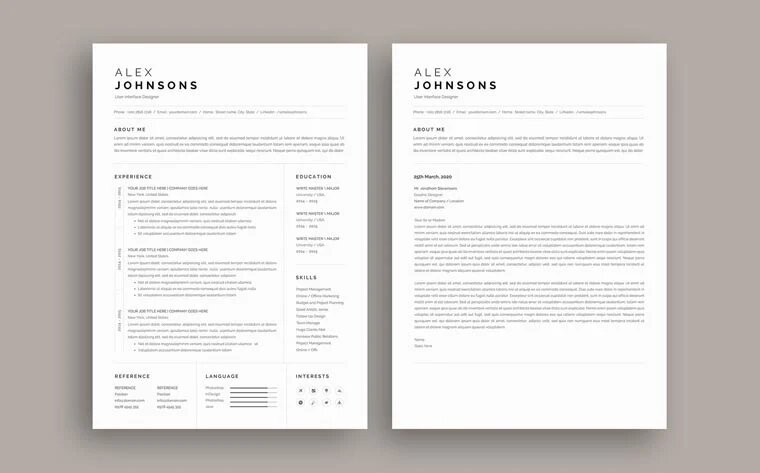
#2: Having chunks of lengthy texts
sample resume

Image Credits: TemplateMonster

Even if we do not apply this mistake in this particular context, having vast chunks of unbroken texts can cause a headache for any modern readers out there.

You might have seen before in the news that some recruiters spend only around six seconds to read a resume. Six seconds?! In that short period, you will need to impress your recruiter as he or she scans through your resume.

To put yourself in the shoes of an HR personnel, think back on the amount of content you mindlessly scroll through your social media feed daily. Recall on what caught your attention and what did not. Even a well-written article can have a low readership count purely because of its formatting.

To assist the recruiter in shortlisting yours among the sea of resumes out there, breaking up texts into proper paragraphs and being fully aware of run-on sentences without punctuations can help. If it makes sense, use bullet points to grab the reader’s attention at first glance.

Also, section the content into headings and subheadings and bold them where necessary. This is to allow the hiring manager to locate essential information effortlessly.

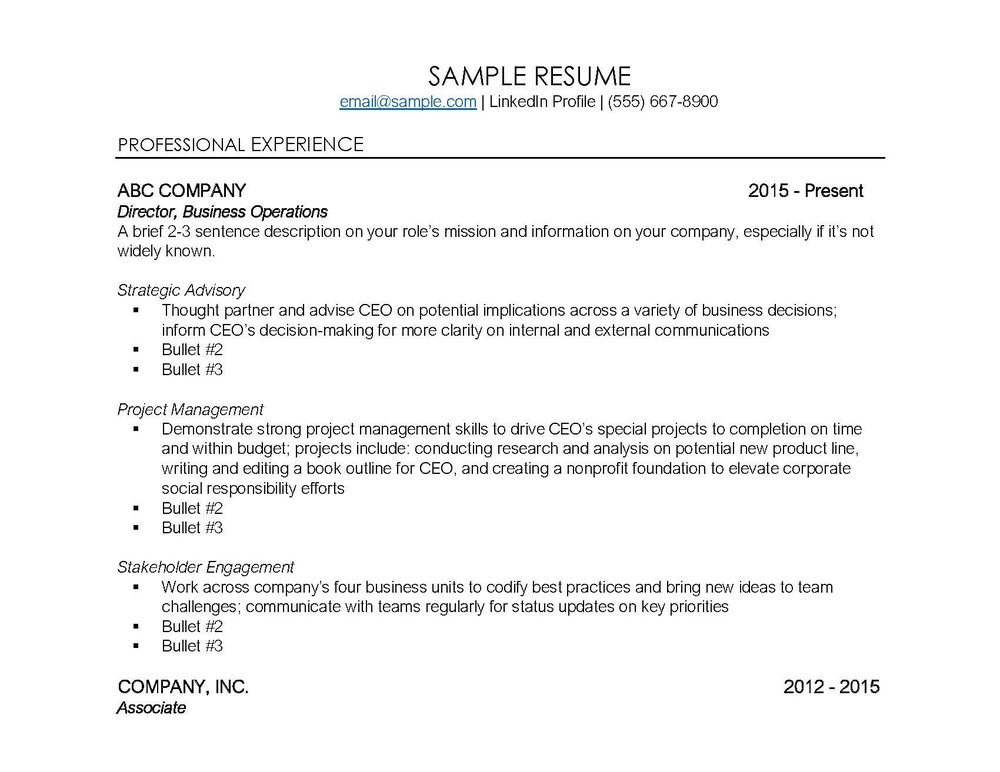
#3: Missing out on brief role descriptions
brief job role descriptions

Image Credits: Prime Advice

Wanting to fit all your achievements in a one- or two-page word document is understandable. While some things like designs are better left as simple, an outline for your role descriptions is necessary.

Think of it as a summary section to give the recruiter some background on these:

  • Who you’ve worked for
  • Nature of the said business
  • Where you fit into the organisation

Those who have worked for widely known global brands may not have to explain the nature of the business, but it’s still important to include some pointers about your department and your contributions to the company’s success.

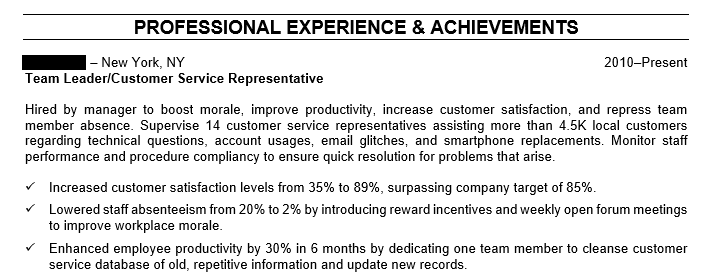
#4: Not including facts and figures
facts and figures on a resume

Image Credits: iHire

One massive takeaway I’ve had while doing marketing is that numbers matter. Putting this lesson to practical use, it’s the same as trying to market yourself to land an interview with the HR department. As such, don’t leave out facts and figures.

To prove your worth, you want to use some numbers to convey the scale of your impact. Those who’ve led departments before, don’t just stop at “managed a team”. Insert the relevant numbers on the size of your team, the locations they cover, and clients or customers under their servicing.

This is especially useful if you’ve led massive teams across several locations and want to transfer this experience to a regional management position you’re applying for. With that said, even penning down that if you’ve led a small group of five can open doors and put you at the forefront compared to applicants who’ve no such experiences.

Spending some quality time to right the common resume mistakes pointed out in this article could lead to better results in your job applications. If you want the right response from your potential employers, then make sure you have a resume powerful enough to assist you. The last thing you want is to have a substandard resume as a stumbling block to your job search success.

And one last tip before you go, do customise your resume to the specific role you’re applying for and ditch the one-for-all cookie-cutter content!

Read More...

How To Increase Motivation At Work

With the multitude of global issues that we are facing right now, it is normal to experience burnout. Motivation is the drive that conquers burnout. Self-motivation is having the initiative to do a task without being supervised or being told to do it.

Think of two things you like doing and two things you do not like doing. From this simple exercise, you will realize which activities motivate you. Motivation drives our behaviors and there are two primary types of it. These are external and internal motivation.

With external motivation, you are doing something because the activity will bring some reward or benefit at the end of it.

For instance, you may visualize the act of job hunting. It is not something you do to pastime. People job hunt because they want an outcome – a job. The motivation for actually working is also usually external. We are motivated to go to work because we are paid to do so.

In contrast, internal motivation entails doing something purely because you love doing it. The more internally motivated an action is, the more enjoyable it usually is. So from the point of view of happiness, it makes sense to have more internally motivated activities in your life. People who are internally motivated show more interest and excitement over what they do. You are usually better at internally motivated actions too. You show more persistence and creativity. You are likely to have increased happiness and self-esteem by pursuing what internally motivates you.

Think about some of the things you do on a regular basis. Are you mostly externally motivated, acting in for the rewards? Or are you mostly internally motivated? It is important to know which type of motivation is strongest for you. If you follow this, your performance will likely improve and you will generally be happier.

DEVELOPING INTERNAL MOTIVATION

With the bulk of tasks we have to finish in a day, do not expect everything to be internally motivated. Internal motivation is developed and maintained when we are autonomous, competent, and supported.

We feel autonomous when we can make our own choices and decisions.
We feel competent when we know that we can do things.
We feel supported when we are connected to others.

BECOMING MORE COMPETENT

1. Practice what you need to do or perform beforehand.

2. Look for positive feedback, but value constructive criticisms. Your motivation will become stronger if you can find some way of getting positive feedback on your progress.

3. Break down your tasks and goals. If a task is very complex and challenging, breaking it down can help you stay motivated. It makes things more sustainable and attainable.

4. Make sure the difficulty level matches your ability. You want your goals and activities to be reasonable. It should not be too easy, because you will get bored. It should not be too difficult, because you will get frustrated.

KNOWING THE PITFALL OF EXCUSES

Unsuccessful people often have good reasons for not hitting their goals. Successful people use those same reasons as their motivation. Practice transforming your excuses into motivations. Here are some examples:

1. I can not give up. I have to do this for my children.

2. I have to study harder, so that I can properly teach my students.

Image Credits: unsplash.com

What are you hustling for? Motivation is strongest when it comes from within. Let me close by highlighting what Don Wilder once said: “Excuses are the nails used to build a house of failure.” Build a house that you deserve.

Read More...

A psychologist reveals 4 key ways you can use to embrace critical feedback

two woman having a meting

Critical feedback can be daunting for some. Since we’re talking about criticisms here, it’s easy to get defensive over it. But take a more profound examination, and you will probably agree that constructive feedback is the ‘true friend’ that identifies the gaps between who you are and the improved version of who you want to be.

Dr Tomas Chamorro-Premuzic, a psychologist, author, and entrepreneur, points this out as a paradox. He shares that most people are happy to receive positive feedback, but it is the negative ones that enable us to be better.

This is because if you think you are already on the right path, then there would be a lesser desire to brush up on your current skills. To avoid potential conflicts, some companies have even attempted to remove negative feedback from performance reviews.

So the question is, do you want an upgrade? Or are you happy with where you are right now with all the compliments flooding your way? If it’s the former, we’re so glad for your willingness to change.

We’re not going to promise that you will leave this article feeling like you’re ready for a self-improvement journey. Criticisms hurt and we’re not going to lie. But it’s something to embrace if you want to tackle your weaknesses and bridge the gaps.

Want to walk out of your self-protective instincts now? Take it from Dr Tomas on the four key ways you can use to embrace critical feedback.

#1: Search for a right mentor
two persons having a discussion

Image Credits: unsplash.com

Don’t be alarmed by the word ‘mentor’. Dr Tomas points out that the right person should be someone with experience in the area you’re keen to make a change in. He or she could be someone who knows you well, has seen your growth, or aware of the skillsets or talents you want to build.

In our current prosocial society, it’s getting difficult to find someone willing to provide critical feedback. “For all the talk of authenticity, if you go about telling everyone what you really think, you will have no friends and your colleagues will hate you,” said Dr Tomas.

That’s like hitting the bull’s eye, isn’t it? What you need is someone who is fearlessly psyched to tell you what you need to hear. Note the difference between what you want to hear and what you need to hear.

#2: Find proper questions to ask
a man asking a question

Image Credits: unsplash.com

Finding the right mentor to receive feedback is already not a simple task. If you want to make it easier for your mentor to give you an appropriate assessment, ask pertinent questions.

Avoid asking short questions like these:

  • “How did I do?”
  • “Was this okay?”
  • “Did I do a good job?”
  • “Did you like what I did?”

Instead, ask:

  • “What would you have done differently?”
  • “What are the two things that they didn’t like so much?”
  • “If you can change one thing about X going forward, what would that be?”

Also, mean what you say. If you’ve made known that you wouldn’t take it to heart, then don’t take it personally. Value their honest response and see it as a way to help you get better, even if you don’t immediately agree due to a defensive stance.

Dr Tomas states that the right mentors should help improve your ability to identify blind spots and critical areas for improvement. As a mentee, always be thankful.

“Feedback is always a gift, and there is no bigger gift than constructive critical feedback because it is daunting and risky to provide it. There is a higher cost to honest negative feedback than fake positive feedback, but the former makes you much better than the latter,” he adds.

#3: Receive comments and act on it
Take action

Image Credits: unsplash.com

Have you ever advised upon a request only to find out that the other party has turned a deaf ear? If you understand how frustrating it feels, don’t do the same to your mentor. 

Receive critical feedback and reciprocate the time and effort spent by committing to change. Then, share your action plans with your mentor to involve them in the process. Knowing that you’re taking their constructive comments seriously is also a form of motivation for your mentors to provide you with more guidance going forward.

“When someone asks you for help, and you offer your honest views, even though you know it may hurt them, there is nothing more rewarding than seeing them make a positive change based on what they heard. Making others better is a wonderful achievement,” Dr Tomas remarked.

#4: Get more feedback to monitor progress
portrait-of-confident-young-asian-woman-calling-by-mobile-phone

Image Credits: HealthHub

If you’ve followed through the strategies so far and managed to gain and act on the criticisms given to you, don’t just stop there. Politely ask your mentors for more valuable critiques so you can track your progress.

To put it simply, Dr Tomas says the process should look like this:

  • Get critical feedback
  • Make an effort to change
  • Get more feedback to monitor progress

He also illustrates this strategy using a weighing scale. When you think you’ve put on weight recently thanks to the work-from-home routine, you put yourself up on a weighing scale. Seeing the figures got you motivated on losing weight, so you change up your diet or start exercising more often.

But do you stop there? No. To measure your success, you go up on the scale again to track your weight. The idea here is that you don’t just repeat the process once or twice, but as often as you can to monitor your development.

In conclusion, be aware that even the most talented people are a work in progress. Yes, criticisms are painful; nonetheless, it is also a positive force for change and the fuel to be better. Those who are seeking growth should learn to welcome useful negative feedback with open arms.

Read More...