
4 Highest Paying Jobs That Extroverts Can Excel On

Generally, extroverts have an advantage in the professional scene due to their approachable and outgoing nature. They flow through life in search of interpersonal interactions, leadership opportunities, and new experiences.

That said, here are some of the highest paying jobs that extroverts can excel on:

4. FINANCIAL ADVISOR/FINANCIAL CONSULTANT

Average of S$48,834 per year

Financial Advisors or Financial Consultants (FA) are professionals who guide their clients to manage their money, investment options, and asset relocation. But, they do more than that!

They socialize with the clients directly to learn more about their personal goals and financial situations. Furthermore, they face rejection on a regular basis. A circumstance that introverts feel uncomfortable with.

It is an excellent job for extroverts as FAs are constantly exposed to long-term establishment of good relationships between various clients. Yes! The relationship does not diminish after the “sale” is done.

3. PUBLIC RELATIONS MANAGER

Average of S$59,700 per year

As the name suggests, working in public relations enables you to manage and represent the client’s public image by maintaining quality relationships with others. Especially with the popularity of social media, everyone has the power to share their views on any subject. This is something that the Public Relations Manager should take care of.

Public Relations Managers must have strong interpersonal skills to nurture a network of relevant media contacts and develop a desirable corporate image. They are responsible for directing publicity programs and for clarifying the company’s stand in important issues.

If public speaking, strategizing, and socializing is your thing then, a career in public relations is perfect for you!

2. MARKETING MANAGER

Average of S$69,121 per year

Marketing Managers are responsible for supervising advertising, marketing, and promotional staff as well as supervising the organization’s activities. Confidence is necessary as they prepare marketing strategies alongside people with higher positions such as company executives.

Creativity, communication skills, leadership skills, and desire for new challenges are needed as a Marketing Manager. Interestingly, extroverts usually have these amazing qualities!

1. LAWYER/ATTORNEY

Average of S$77,698 per year

Lawyers or attorneys represent different individuals, organizations, and government agencies in range of legal matters. Contrary to popular belief, most of their time are spent away from the court. Instead, they communicate directly with the clients and other key people to investigate matters, collect evidence, and draft legal documents.

When in trial, he or she must present the facts and argue legal matters in court while in front of a sea of people. Lawyers must use their wit and communication skills to make the arguments convincing and compelling. That is why this career appeals more to extroverts!

So, how does one become a Singaporean lawyer and earn about S$6,474.83 a month?

Image Credits: pixabay.com (License: CC0 Public Domain)

Image Credits: pixabay.com (License: CC0 Public Domain)

You must complete a 4-year Bachelor of Law program and succeed in the Bar Examination that includes a 5-month practical Law course. Persevere as most people only move up from their position after 20 years in this field!


Sources: 1 , 2 , 3 , 4 , 5 ,& 6

Read More...

6 Essential Life Lessons I Got From My First Job

A couple of weeks after I graduated, I immediately landed my first full-time job. I was overwhelmed with how fast everything went! I know that there were going to be challenges ahead from workplace drama to workplace etiquette yet deep inside me, I felt excited and ready to transition to the working life.

In the beginning, my goal was to make enough money to save up for my graduate studies and to help my parents in the household expenses. I did so.

Aside from following my long-term goals, here were the essential lessons I realized from my first job experience after graduating from university…

1. LEARN AS MUCH AS YOU CAN

As I transitioned to the working scene, everyday was a constant process of development and learning. Learn as much as you can from the experienced people around you who had been working for years. They are the ones whom you can turn to if you have concerns or worries.

I was very lucky to have an open relationship with my colleagues. They taught me how to properly address complaints and how to not take everything personally. This open relationship eventually blossomed to treasured friendships.

2. SHOW INITIATIVE AND ENTHUSIASM

Initiative and enthusiasm are charming qualities good employees possess. Showing your bosses that your are eager to learn, are dedicated to do every task, and are taking control of your responsibilities would make them feel that you are an asset to the company. I made it a point to exude enthusiasm, give my best, and work as quickly as possible.

Even as I left my first job, my superiors considered me as an invaluable part of the team. It made me realize that my efforts were all worth it.

3. MONEY IS VALUABLE

When I was younger, I worked part-time to buy clothes, movie tickets, and more materialistic things. I never saw the true value of money until I had my first full-time job. It is very hard to spend the money you worked hard for! This is because you know the exact amount of time and how much sweat you pour just to earn your month’s salary.

Being independent with my finances made me realize how important it is to practice budgeting and tracking your expenses.

4. REWARD YOURSELF

As much as you work hard, you must also play hard. Reward yourself with a responsible amount of 5-8% of your monthly salary. Find interests outside of work such as dancing, swimming, or cooking to cushion your daily stress.

Also, rewarding yourself with a hobby is a good way to keep you motivated. Personally, I found blogging as a passionate pastime. Shockingly, it become my career in the present.

5. PRACTICE HANDLING CONFLICTS

Facing conflicts such as customer complaints are probably one of the nerve wrecking things I encountered as a newbie in the working scene. At first I prefer to hide in my senior employee’s shadow but then a friend told me that it was better to practice conflicts while young. Not only because people are able to forgive you easier, but also because you are able to build conflict resolution skills that you will benefit from in the long run.

Image Credits: pixabay.com (License: CC0 Public Domain)

Image Credits: pixabay.com (License: CC0 Public Domain)

Be firm and polite when dealing with conflicts.

6. BE BRAVE TO SUGGEST CHANGE

My previous boss encouraged us to propose changes and to outwardly speak our opinions in order to improve the business and the workplace relationships. Although some of your colleagues have more experience than you, keep in mind that your opinion is equally valuable.

Be brave enough to propose change if you think it serves others well.

Nothing good will ever happen unless you try! 🙂

Source: Miss Psychobabble

Read More...

5 Highest Paying Jobs In Singapore’s Healthcare Sector

Singapore’s Healthcare Sector consists of the private healthcare systems, public healthcare systems, and voluntary organizations. A job at this sector entails hard work, long hours, dedication to studies, and attractive pay.

JobStreet.com, a premier online recruitment company in Asia, conducted a nationwide study in 2013 and found that the highest paid fresh graduates were doctors. With an average starting pay of over S$3,000 a month, entry-level doctors even surpassed the starting pay of corporate finance’s fresh graduates!

Salary.sg, a website dedicated to relay information on career and jobs, used the Ministry of Manpower Wage Data (2014) and excluded the bonuses and profit-sharing to generate the monthly gross wages of over a hundred jobs in Singapore.

Applying that information with your desire to earn big, you may consider these five jobs:

Image Credits: pixabay.com (License: CC0 Public Domain)

Image Credits: pixabay.com (License: CC0 Public Domain)

5. MEDICAL RESEARCH SCIENTISTS

Medical Research Scientists can be found in universities, research institutions, and hospitals. They make and conduct experiments in order to increase our scientific knowledge in areas such as treatments or drugs. They earn a median monthly wage of S$6,489.

4. HEALTH SERVICE MANAGER

The Health Service Manager is responsible for the daily running of the hospital or the community health center. Managers liaise with clinical and non-clinical staff while considering the demands of the local laws and local situations. Interestingly, they earn about S$7,848 a month.

3. GENERAL PRACTITIONERS

General Practitioners (GP) give primary and continuing care for patients by taking physical, emotional, and social factors into account when diagnosing disorders and prescribing the appropriate treatments. GP’s in Singapore earn an average of S$16,354 per month.

2. CLINICAL DIRECTORS

A Clinical Director’s responsibilities include the management and quality assurance of clinical services as well as the training and supervision of all the healthcare staff. They earn a median monthly salary of S$25,000.

1. SPECIALIST MEDICAL PRACTITIONERS

Specialist Medical Practitioners diagnose and treat the disorders of patients in a wide range of areas including anaesthesiology, pathology, internal medicine, ophthalmology, pediatrics, dermatology, surgery, and radiology. Depending on the area of specialization, Specialist Medical Practitioners can have demanding and irregular shifts. But, all is compensated as they earn an average monthly salary of up to S$30,250!

Image Credits: pixabay.com (License: CC0 Public Domain)

Image Credits: pixabay.com (License: CC0 Public Domain)

Sources:1, 2, 3, & 4

Read More...

When to Ask Your Boss for your First Raise

Business Man Pondering

Asking for a raise is like breaking up. There really isn’t a “best time” for it, and a lot of awkwardness will be involved. Unfortunately, our success in life corresponds to the number of awkward conversations we’re willing to have. So if you want to climb out of that low income rut, you’re going to have to bite the bullet and ask–but do it the right way:

The Three Rules of Asking for Money from Your Boss

The first thing you have to do is make sure you don’t break any of these. If you do, the chances of failure are not only exponentially higher, but the consequences will also be steep. Even if you do win your raise while breaking these rules, you will incur the resentment of your employer and could pay for it throughout your career.

  • Always signal your intentions. Always give your boss forewarning. Drop a polite note saying you would like to set a time to discuss how you’re being compensated. If you corner your boss at the water cooler and ask for a raise, 99% of the time the answer will be “no”, or a polite brush-off.
  • Prepare justifications based on results, not on how hard you worked. You will need to make a list of achievements before negotiating. “Achievements” are not the number of hours you worked, or the personal time you’ve given up (we hate to tell you this, but most employers don’t care). Achievements are how much money you’ve made for the company, how you improved a product or service.
  • Always have help. Find a team or department leader whose schedule would be badly affected by your departure, and tell them about it first. If someone relies on you for budget reports, for example, tell them your plans to leave if you can’t get a raise. And then ask them to back your credentials when you negotiate with your boss. Here’s a secret: whether you get a raise is often dependent on how hard team leaders fight for you, not just how hard you fight for yourself.

Timing the Moment

Obviously, the best times should be just after a good performance review, or after a successful project. But things are seldom so convenient, so look for the following times instead:

  1. Wait About Three Working Days after Informing Your Boss of Your Intentions

As mentioned above, never corner your boss and discuss your raise on the spot. Send a short e-mail or, even better, meet her face to face and ask if you can talk about your compensation “later this week”.

Three days is a good interval, which will also give you time to prepare what you need. It will also give your boss time to reflect on your contributions.

  1. Ask about Two Weeks after a Big Win

Use the “halo effect”. When your department or you have performed well, you are in a good position to negotiate a raise. However, don’t do it immediately, as it will be too obvious that you are trying to capitalise on it.

  1. You’ve Just Heard the Report on Your Employer’s Financial Health

If you just heard a rah-rah report about your company doing better, try to time your request close to date you heard it. You can also obtain this information from a prospectus or annual report.

It is better if you make the request after it has been announced however, since it’s harder for your employer to use lack of money as an excuse.

  1. You’ve Checked and Compared Your Earnings

Use sites like Payscale to check your earnings compared to your peers. You might even want to go so far as interview for positions in other companies, to see how much they are willing to offer. In general, you are right to ask for a raise if you are on the low end of the pay scale (bottom 50%). If you are already on the high end of the scale, you had better have some kind of massive achievement of late to justify the request.

If the timing is right and you’ve prepared the right details, then go ahead and make your move.

Just remember though, if you do get a raise, don’t go crazy with it.  Your first priority should be to pay down any credit card debts that you have. Your credit card should be saving you money, not costing you money. If that’s not the case, drop by SingSaver.com.sg to compare and find the best credit card for your needs.

(This article is brought to you by Singsaver.com.sg)

Read More...

How do you bargain for a higher salary?

The Straits Times recently published an article on “Why a safe job is risky business for Singapore”, which urged young job seekers to change their mindset about the risk and remuneration issues apparent in local Small and Medium Enterprises (SMEs). While these are common issues faced by SMEs which often have limited resources to offer competitive salaries that may inevitably compromise their company’s growth, it is time to rethink the prevailing practices surrounding employment and compensation. Indeed, considerable funding support from SPRING such as the SME Talent Programme for SMEs should provide a strong impetus for SMEs to strengthen their competitive edge in today’s dynamic and rapidly evolving world by offering pay packages commensurate with each individual’s qualifications, experience and competence.  

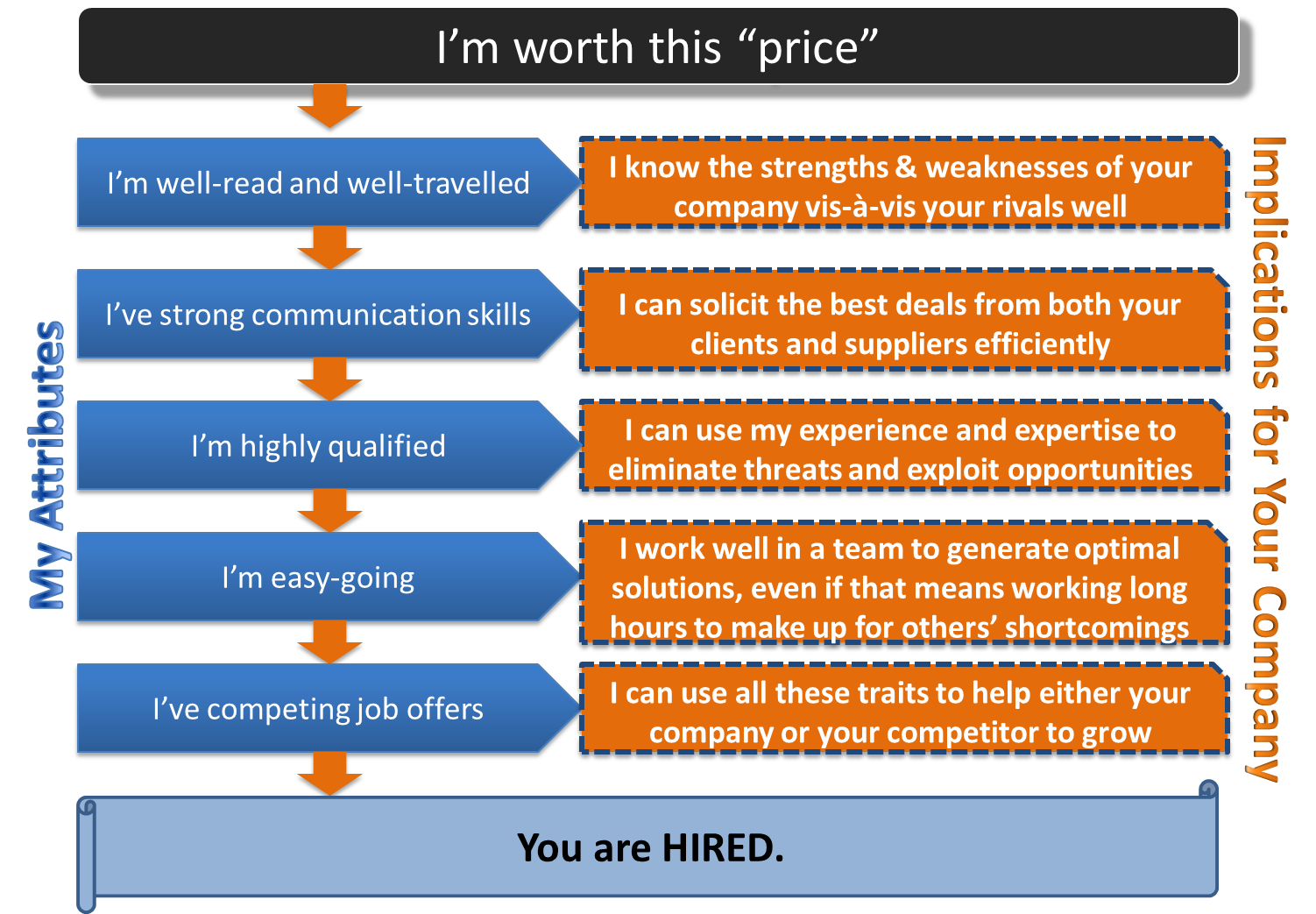
To all job applicants: It is not too late to “flaunt” your attributes, but please convey your gifts in a measured way. The diagram below just serves as a reference guide.

To the employers: It is never too late to start appreciating your potential hires’ talents that may prove invaluable to your company’s development and progress.

Picture1

Read More...