

In UK, Oil is Cheaper than Packed Water

Can there be an economy where oil is cheaper than water? If yes, how will it affect its countrymen?

According to United Kingdom’s The Independent, a British national newspaper publication, Oil by barrel is now cheaper than the 6 packed bottles (1.5 liter each) of Evian Natural Mineral Water.

A liter of bottled water costs about 42 Pence (S$87 or US$0.66), while it costs about 24 Pence (S$0.49 or US$0.38) a liter for gas…that is 40 percent cheaper!

The price of oil has notably collapsed, affecting every single person in the country. A market analyst for Reuters named John Kemp, highlighted the bizarre state of economy on Twitter saying that not only that the current oil price represented “an unsustainable low level” – but that it was “impossible to predict how low prices might fall”.
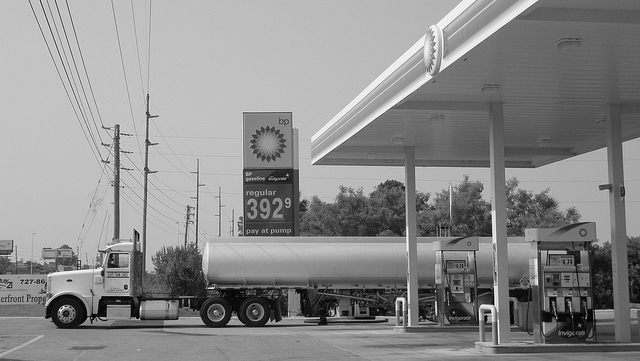
Image Credits: Daniel Oines via Flickr

Image Credits: Daniel Oines via Flickr

This is not the first time it has happened globally.

In 2011, Saudi Arabia’s petrol costs about 0.45 Saudi Arabian Riyal or 0.16 Singapore Dollars and 0.12 United States Dollars, which is absolutely much cheaper than bottled water. Saudi’s government spends SAR26 Billion on water subsidies every year to keep down their citizens’ water bills (Finfacts, 2011). That is equal to S$26 Billion.

An interesting thought is that unlike any other countries in Southeast Asia, the tap water in Singapore is safe to drink. We can just get a glass of tap water then refill it for free. But, a liter of bottled water in the supermarket is still more expensive than United Kingdom’s liter of oil today.
Image Credits: Luis via Flickr

Image Credits: Luis via Flickr

Although this economic state in UK may cause lower annual prices of other goods easing the cost of living of the citizens…the falling energy prices may result to inflation and threaten the financial stability of the whole country. The Bank of England backs up this statement of warning.

Read More...

Singaporean execs struggle to make ends meet

Singapore's execs struggle to make ends meet

In an article published by Singapore Business Review, it was found that almost half of the Singaporeans holding executive position struggle to make ends meet every month.

The statistic was first published on Jobstreet and it’s surprising to know that 44% of the Singaporean executive does not have excess saving after paying off their mortgage, car loan and credit card.

25% of them claimed that paying for insurance premium was their biggest monthly commitment.

That is a worrying trend for Singapore’s ageing population.

What this also means is that half of these executives will not be able invest or grow their savings to the effect of compounding interest. Without adequate savings to supplement their CPF payouts at their retirement age, this group of people at are the risk of outliving their retirement funds.

A study conducted by NUS draws the conclusion that the CPF is sufficient for the current group of young income earners of the 30th to 70th income percentile based on three important caveats: choice of HDB flats must be within their means, any CPF above the Minimum Sum they withdraw must be invested and they must continue to remain in the workforce for as long as possible.

The few key issues surface here are:

Carrying too much debts

For most of us, it’s impossible to live debt-free as we need to purchase our house and support our family. But before it gets out of hand, it is important to differentiate between good and bad debts.

Good debts are debts that create value to you and getting you what you need. Mortgage loan, for example, is a good debt to take on as it create value to you, considering the low interest rate. It can be bad if you leverage too much and cost you to be unable to afford the monthly mortgage payments.

Whereas, credit card and vehicle loan is a bad debt as the interest is exorbitant and the item you bought is of depreciating value – take car, for example.

Of course, it is not smart either to avoid debts at all cost if it means using up all your cash reserves for emergencies.

Not saving enough

As compared to our parents, the younger generation is simply not saving enough. For what Singapore has become today and being bred in a society where everything is provided for has denied them the opportunities to understand the importance of money.

We spend all that we earn, often lacking restraint in spending money.

As the saying goes:

A dollar saved is a dollar earned.

Save the extra dollar so that you can multiply them into many folds.

Making wrong financial decisions

Many young working adults are not savvy enough to manage their own finances. Taking on too much debts without knowing the long term effect, speculate in the stock market and dumping all their savings to purchase a car are some of the mistakes made by these group of people.

A quarter of these people spent too much on insurance. Insurance should be used as tool to hedge your risk of financial liabilities to you and your dependants – should untoward events happen to you. It should not be used as a tool to grow your money, as it is inefficient due to the high cost and fees charged. Being insured for around 10 years of your income using term insurance should be sufficient for most people and it will cost you only less than 5% of your income.

Read More...