Want to Invest in REITs but Don’t Know How? Use the FREE Seedly REITs Tool and Start Collecting Dividends Like a Bo$$

.
.

Interested in investing in REITs but don’t know where to start?

For starters, it’s going to take a lot of work.

Like. A LOT.

Imagine this.

You just got home after a long day at work.

All you want is a shower, dinner, and to relax.

You wouldn’t want to waste time cooking a meal when you could be catching the latest episode of that new Netflix series that everyone’s talking about.

Source: American Dad | Giphy

And the last thing you would want to do is pore through pages of financial statements or do your own valuation of data just to pick the best Singapore REITs to invest in.

Not that there’s anything wrong with doing that… but wouldn’t you want to spend your time doing something else that you REALLY like?

I mean, why isn’t there a magical resource or tool that can help people start their REITs investing journey?

Enter: The Seedly REITs Tool

With up-to-date data, sound analyses, and tonnes of information just a click or tap away.
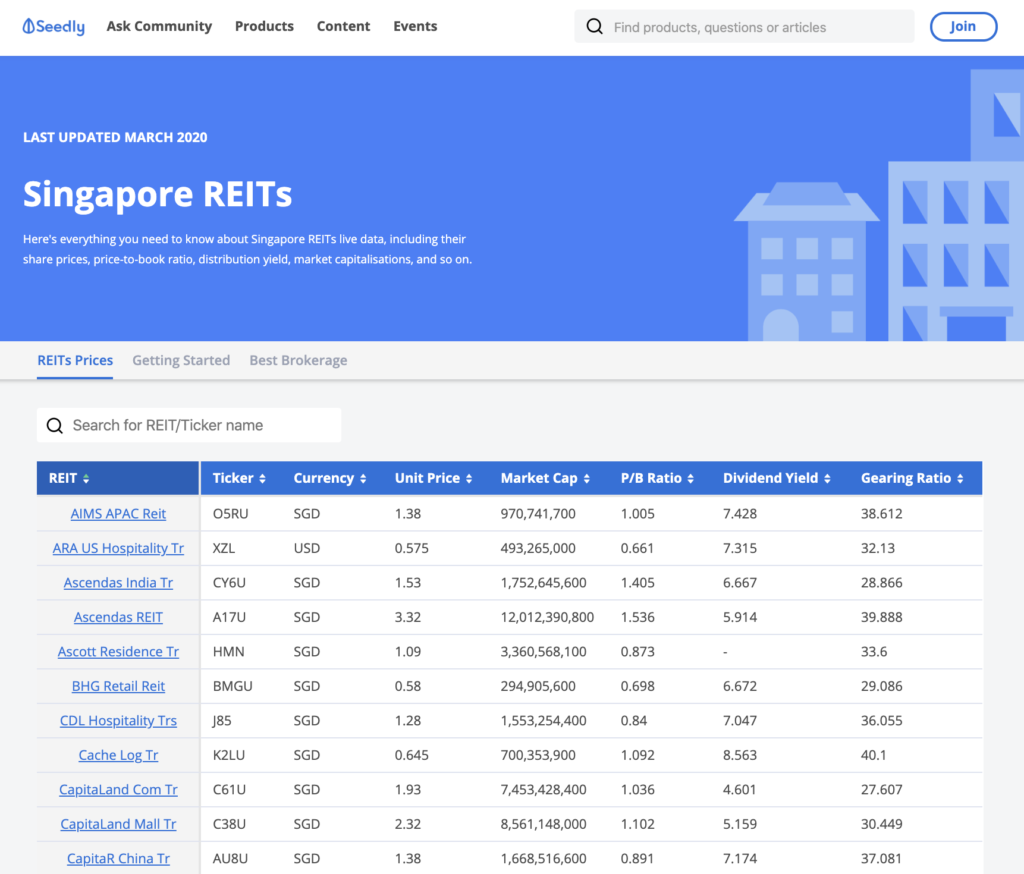
The Seedly REITs Tool is a REITs investor’s best friend — no matter whether you’re a noob or a pro at REITs.

Best of all?

It’s FREE TO USE.

If You’re a REITs Investing Noob

If you’re just starting out, you’re probably feeling lost and have no idea where to start when it comes to REITs investing.

With the Seedly REITs Tool, you have a one-stop resource where you can get useful information like:

  • What are REITs?
  • What are the types of REITs which you can invest in?
  • A simple 10-step checklist to pick the best Singapore REITs

Feeling more confident now that you know what you’re getting yourself into?

Great!

The next step is opening a Central Depository Account (CDP) and an online brokerage account — if you don’t already have them.

Instead of heading out into the vast wilderness of the internet to do your research…

Simply scroll down to discover what are the best online brokerages available!
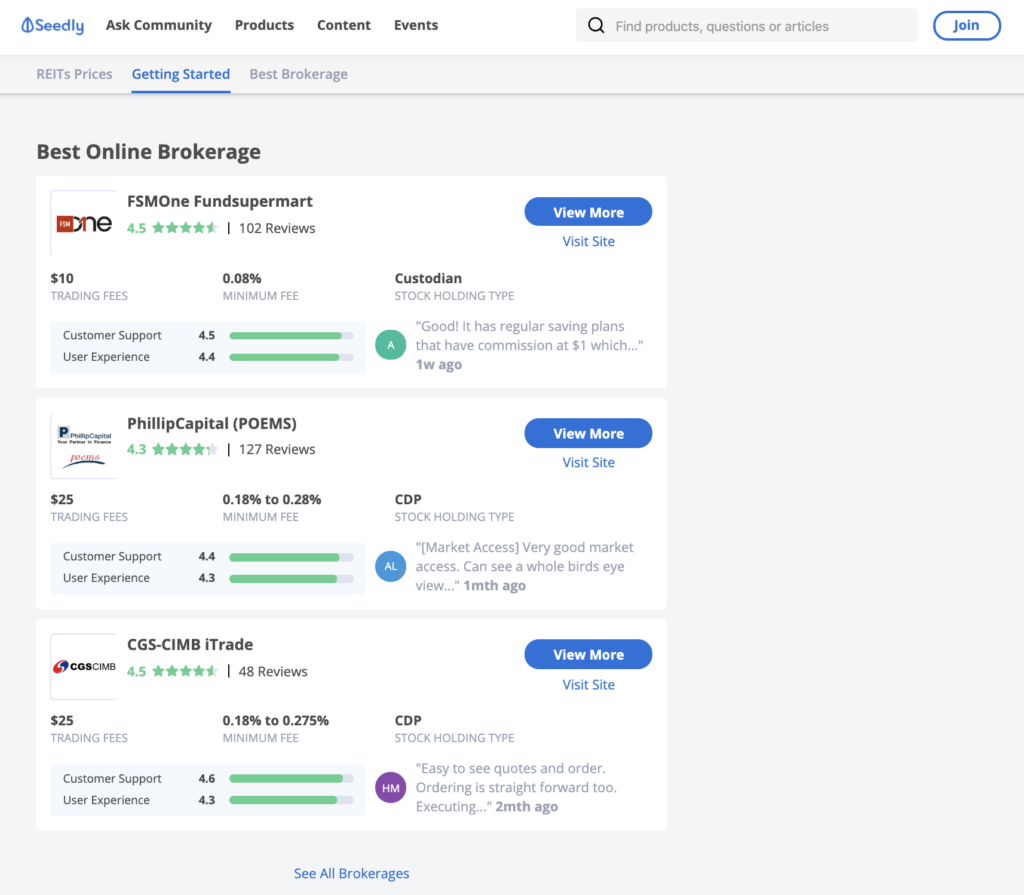
In order to make an informed decision, important information like:

  • Trading fees charged
  • Minimum fees charged
  • Stock holding type (if you’d prefer not to use a custodian account)

are all available at a glance!

Prefer to find out what others have to say about their personal experience with these online brokerages?

You can also read real-user reviews to get insights like:

  • Customer support
  • Market access (in case you want to invest in global markets)
  • Products on offer (in case you wish to invest in more than REITs)
  • User experience (because you’re allergic to lousy user interfaces)

This way you know for sure what you’re getting yourself into when you sign up with your choice of brokerage.

Made up your mind?

Just click on ‘Visit Site’ to sign up and you can begin investing in REITs!

If You Already Know About REITs Investing

The first thing you’ll probably want to do is check up on the fundamentals of the REITs you’re interested in.

While you could go about your standard routine of going to the individual REITs website or SGX to look for the REIT’s financial statements or annual reports.

Why not use the Seedly REITs Tool to find what you need without going all over the place?

Just search for the REIT you want, click on it and…
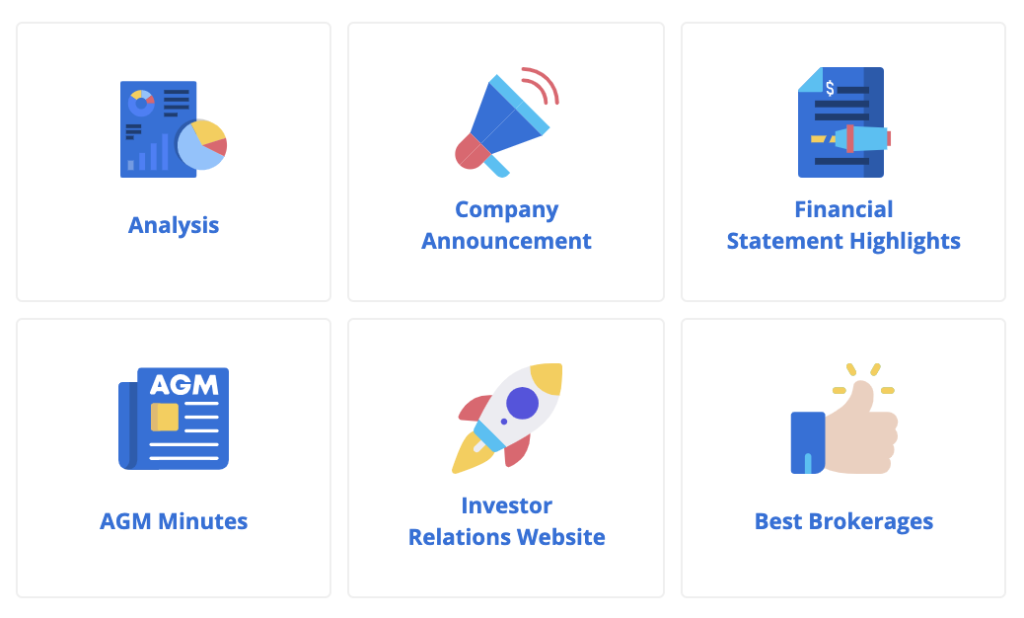
You’ll have immediate access to:

  • Sound and in-depth REITs Analyses (researched and written by Seedly’s very own content team; we aren’t paid by anyone to write about them so you know that our analyses are objective!)
  • Company Announcements
  • Financial Statements
  • AGM Minutes
  • Investor Relations website (just in case you need more information about the REIT)
  • Best brokerages available

“How about REITs valuation data? Do I have to calculate that myself?”
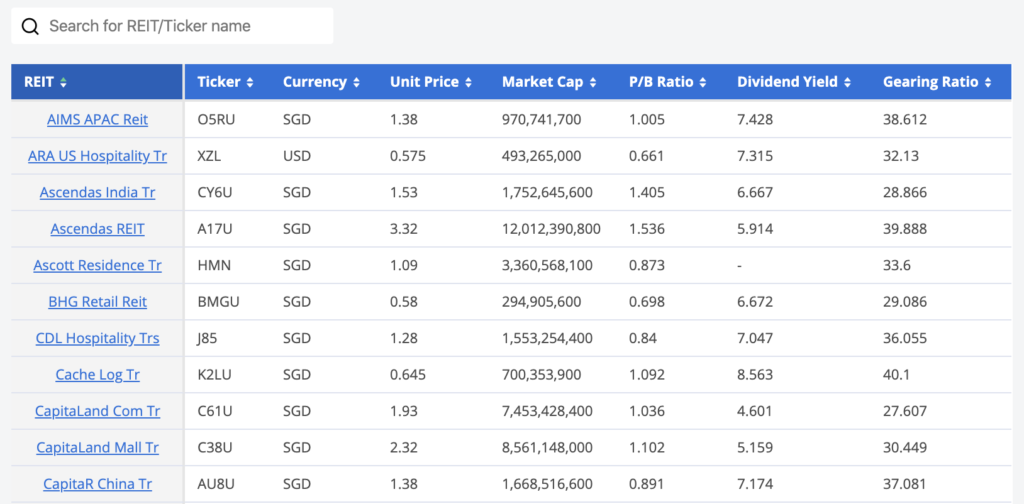
The Seedly REITs tool gives you easy access to data like:

  • Unit Price
  • Market Capitalisation
  • P/B Ratio
  • Dividend Yield
  • Gearing Ratio

that is updated daily at the end of every day.

And because the information is readily available on the same page.

You can do your comparisons easily without having to navigate back and forth or go through multiple pages on different sites!

The Seedly REITs Tool Sounds Great and All… but Why Is Seedly Doing This?

The Seedly team believes that everyone deserves to achieve financial independence and freedom.

And the reason why so many people don’t start investing is that they lack the knowledge and guidance to take the first step.

This is why they created the Seedly REITs Tool and made it free for any and everyone to use.

If you understand what REITs can do for you and believe that they can play an important part in your investment portfolio.

Then the Seedly REITs Tool is the perfect accompaniment to help you start or make your REITs investment journey a little easier.

So when you come home from work…

Source: American Dad | Giphy

you can focus more on relaxing and collecting dividends.

Read More...

How To Choose The Best Stock Broker For You

Money does not come from trees! Choosing what is best for you should be influenced by strategic research on the available brokerage firms in the country. Consider these factors…

STICK TO THE BUDGET

It goes without saying that your performance in the stock market depends on your budget. If you want to start investing, but do not have thousands of dollars in your arsenal then, you can start with as little as S$1,000.

Say that you want to own stocks through the CDP (The Central Depository) then, you will have to set up a CDP securities account. The CDP account is operated by the Singapore Exchange. It provides integrated clearing, settlement, and depository facilities for customers in the Singapore securities market.

To be eligible to open an account, you must at least 18 years old and not an undischarged bankrupt. You can deal with as many brokerage firms as you want with one CDP account.

COMPARE THE BROKERAGE FEES

Brokerage firms allow you to buy and sell shares on the stock market. It is important to note that they charge you brokerage or commission fees for every transaction you make. When you buy shares, you get charged. When you sell shares, you get charged. These fees add up!

Most investors want to buy low and sell high. Expect to be charged commission fees multiple times by doing so. On the other hand, commission fees won’t make much difference to your if you just want to “park” your money.

KNOW THE DIFFERENCES ONLINE

Kids, there was a time when investors where required to call their brokers to deal with them directly. Do not get me started with how stock prices and other information were passed down! Those days are gone!

Nowadays, investors are blessed with online trading platforms that allow them to check stock prices and complete deals on the go. Some brokerage firms even have mobile applications.

Image Credits: pixabay.com

It is good to familiarize yourself with these online features before you open an account. For instance, day traders need to have a live and streaming data to get started. Choose a broker whose online features (e.g., daily news, company reports, or strategy guides) are suited to your lifestyle. Consider opening several trial accounts with many online brokers to immerse yourself with their service before signing up.

Sources: 1 & 2

Read More...

How To Start Investing With S$100 A Month

Oh, adulting! It comes in a slate of responsibilities thrown at a person all at the same time. To survive the challenges of life, one must establish a healthy savings plan. Long-term savings include having an insurance policy, a good credit score, and an emergency fund. Many people grow their savings thru investing.

Investing is an overwhelming idea for many Singaporeans as they perceive it to be expensive. Few people outside the financial industry have thought of investing their money for themselves. However, you do not need to have S$10,000 or more to start investing. You can grow your wealth with just S$100 per month.

Here are some strategies that you may apply.

#1: MAKE SMALL INVESTMENTS REGULARLY

It comes as no surprise that one advantage of making small invest regularly is that you are not trying to time the market. Instead, you are relying on your money’s “time in the market”. This is important because stocks have their ups and downs, but their prices tend to increase as time passes. This is a strategy known as dollar-cost averaging, which will average out the cost of share purchases in a period of time.

For as little as S$100 a month, you may start investing in DBS Invest-Saver as it allows you to buy an Exchange Traded Fund (ETF) that mirrors the performance of the Singapore stock market or a bond ETF.

#2: CONSIDER REGULAR SHARES SAVINGS

One of the most affordable ways to get inside the Singapore Exchange (SGX) is through Regular Shares Savings (RSS) plans. RSS can be opened with the help of a local brokerage firm or bank.

The broker of the financial institution will invest a fixed amount of money every month based on your instructions or financial capabilities. For instance, you may choose to invest S$100 each month into the Straits Times Index (STI) Exchange Traded Fund (ETF).

Control is one of the best parts of RSS plans. If you wish to invest money in different companies each month, you may do so. If you wish to stop investing in a company each month, you may do so. Simply instruct your broker and adjust your monthly investments. Some financial institutions allow you to take control of your RSS plan through online platforms.

#3: APPLY FOR UNIT TRUSTS

If you prefer to have someone else control your investments then, you may choose to invest in unit trusts. Unit trusts work by collecting money from many investors. A professional fund manager will take this pool of money and grow it following a specific investment strategy. It is a collective investment, which is why you do not have personal control over the individual components of the investment portfolio.

A common misconception about investing thru unit trusts is that you do not need to do anything. This is not true! As an investor, you must do your research before deciding which unit trusts you wish to invest in. By doing your research, you will know that both DBS and OCBC unit trusts allow you to either invest a lump sum of S$1,000 or S$100 per month.

Image Credits: pixabay.com

Good luck with your investment journey!

Sources:1 & 2

Read More...

Stocks 101: A Guide For Newbies

Original investments for the next 10 years

Tackle your busy life while earning money on the side by investing your money. Let your money work for you to achieve the future you have always dreamed of. Renowned investor Warren Buffett defines investing as the “the process of laying out money now to receive more money in the future.”

Investing Like Warren Buffett

(Image credit: Fortune Live Media, via Flickr)

To start investing, you must know what is a stock is first.

WHAT IS A STOCK?

Whether you call it security or equity, a share of stock is a legal ownership in a business. Businesses or corporations issue stocks to gain money. It comes in two varieties – preferred and common. Preferred stock comes with a predetermined dividend payment. While, the common stock allows the stockholder an access to a proportionate share of a company’a profits or losses. It is to you to choose whichever suits you best.

HOW DO YOU MAKE MONEY WITH STOCKS?

There are two ways to make money from owning and investing in stocks. You can make money by reaping the increase in stock price or dividends. Because these two accumulate over time, just one year’s investment in a premium can yield a solid return in the next couple of decades. You can look up blue chip companies such as Coca-Cola and Disney.

The Father of Value Investing, Benjamin Graham, once said:

“The real money in investing will have to be made—as most of it has been in the past—not out of buying and selling, but out of owning and holding securities, receiving interest and dividends, and benefiting from their long-term increase in value.”

WHY SHOULD YOU INVEST?

The stock market provides high returns. You should invest to grow your wealth. However, I cannot guarantee how your stocks will perform. You need to understand that strategy application and diversification aids in growing your wealth. Diversifying your investments by including stocks along with your bonds and assets can help protect you from the inherent volatility of the financial markets.

WHAT IS DIVERSIFICATION?

To provide cushion from the risks that come with the stock market, one can apply diversification. Think of it as not putting all your eggs in one basket. In order to diversify your stocks portfolio, you may need a significant amount of money to invest. It is nearly impossible to create a well-diversified portfolio with S$1,000 alone.

This is where mutual funds come into play. Mutual funds tend to have a large number of stocks and other investments whereby it is controlled by a portfolio manager. It is more diversified than a single stock in one company. This is something that you must think about.

Sources: 1 & 2

Read More...

6 Financial Resolutions For Every Singaporean

As I receive my annual bank statements and credit card summaries, I realize how my financial year went by. January is a fantastic time to review your financial strengths and weaknesses. Where did you fall short? Not only is it a good way to reflect on your spending habits, but it is also a good way to craft your financial goals.

Use your year-end resources to establish your financial resolutions for the year 2020!

1: IDENTIFY YOUR FINANCIAL GOALS

Several articles from Money Digest highlighted how helpful it is to determine your financial goals. Start your journey by identifying both your short-term and your long-term financial goals. Are you hoping to earn a degree or to expand your retirement fund? Do you see yourself purchasing a new flat with your spouse? Or, do you want a to lead a different career?

To illustrate your path in a detailed manner, you may create a Financial Vision Board. Take some time to think about how to achieve your financial goals this year. Consider your outlook before your plan of attack.

2: SAVE MORE MONEY

How many times have you heard about “saving more money” as a resolution? This is a common financial resolution for many Singaporeans. However, most people do not know how to start. It is recommended to be specific to increase the chances of success. Increase the percentage of your monthly income that goes into your savings.

Save at least 15% or your monthly income and increase the percentage whenever you feel more comfortable. If you are already saving 20% of your income then, you are in good place. A person who is earning S$4,000 per month can reap the benefits of having S$9,600 by the end of the year. Raising the percentage to 30% will equate to having S$14,400 by December 2020. Saving more money gets you closer to achieving your financial goals.

3: PAY OFF YOUR DEBTS IN FULL

Two years ago, MAS estimated that there are 9 million credit cards in circulation in Singapore, with Singaporeans charging an average of S$555 per card. Imagine how much these numbers have grown since? Credit card debt is rising in the country as convenience is hard to resist.

Many credit card holders enjoy the attractive benefits or the good rewards programs of several issuers. While there is nothing wrong with paying using cashless methods, you need to be responsible with paying the hefty interest rates and balances. Commit to paying the full amount of your monthly debts this 2020!

4: GROW YOUR INVESTMENTS

Aside from increasing your savings, you can make your money work for you by investing each month. There are many ways to invest your money such as putting it in high-interest savings account. This can increase your earnings by 2% per annum.

Another approach is to sign-up for investment-linked insurance policy where a portion of your premiums will be invested in specific investment funds. Review your insurance policies and ask your financial adviser about this option.

5: GO ON A CASH-ONLY DIET

You have endured the back-to-back expenses brought by the Holiday season. Chances are, your credit card got exhausted due to the year-end sales and other Christmastime delights you spent for your beloved ones.

Cushion these expenses by going on a “cash-only” diet for a few weeks or a couple of months. Begin by allocating a monthly budget based on the money you have. Give yourself a specific cash amount per week and work your way around it. Doing this will challenge your self-control and your resourcefulness.

6: AUTOMATE YOUR SAVINGS

Transform your new year enthusiasm into something productive by automating your savings. Commit to this new habit by researching on the available services of the local bank institutions. For instance, I recently came across with the UOB Stash Account.

UOB Stash Account allows you to accumulate your savings for up up to 1% p.a. interest, simply by maintaining or increasing your previous month’s Monthly Average Balance. An initial deposit of S$1,000 is needed to open the account, which is open for all. You can apply for your Stash Account and get an approval within minutes by simply going to the website. Terms and conditions apply.

Sources: 1 & 2

Read More...