The Risky Assumptions When Planning Your Retirement

Have you ever wondered how much money do we need in our silver years to be able to afford our desired lifestyles? Most adults would be relying solely on their CPF funds to finance their retirement. Asset-rich but cash poor retirees could be thinking of renting their HDB flats out to supplement their retirement funds. There are indeed several ways to build up our retirement income. However, we must be mindful of avoiding some of the dangerous assumptions when planning for our retirement.

Oversight To Account For Inflation

Inflation can have a big impact on retirees even if they have been historically low. According to Monetary Authority of Singapore, Singapore’s historical core inflation averaged an annual 1.7% since 1990. While 1.7% per annum may not appear alarming, it will compound to a staggering 66% over a span of 30 years! If you are a retiree receiving a fixed amount of stipend, the value of your money will decrease with each passing year. Hence, your retirement funds will be eroded by inflation if they are not carefully managed. Unfortunately, inflation does not stop just because you have stopped working. Therefore, it becomes important that your investment grow at rates that are at least equal or better than the rate of inflation to protect the value of your retirement funds. How do we then continue to enjoy the taste of life at our retirement years without feeling the pinch of inflation, especially when we have stopped working and receiving salaries?

Reliance on Rental Income From Property

Some adults plan to rely on rental income from investment properties to supplement their retirement funds. However, with the recent cooling measures announced in July 2018, investing in a second residential property is increasingly out of reach for most working adults.

Some retirees might be thinking of renting out the vacant rooms in their HDB flat especially as their children gradually might have left the home that they grew up in. However, this option comes with its own set of inconveniences. It could take a couple of months before a tenant can be found. There is also the administrative hassle of providing tenant’s details to HDB for record-keeping. Of course, all these pale in comparison to stories of horror tenants who damage the HDB flat or are tardy in their rental payments. In such circumstances, renting out their HDB flats may not be the best option to supplement your retirement income.

CPF LIFE Alone Might Be Insufficient

For a retiree who sets aside the maximum Enhanced Retirement Sum (S$271,500), the monthly payout from CPF LIFE is expected to be about $2,000 per month. If this amount is sufficient to pay for your daily expenses during your retirement, then this is definitely a good safety net for you to rely upon. However, it is not true that all Singaporeans and Singapore Permanent Residents can depend on their CPF funds to finance their retirement entirely. In fact, it is widely reported that almost 4 in 10 CPF Accounts do not even have enough funds to meet the Basic Retirement Sum. For the group of retirees who do not generate enough funds from their CPF LIFE payouts, it is necessary to generate extra income from alternative sources such as investments.

Future-proof Your Retirement Funds With The AIA Retirement Saver (III)

Given that young professionals lead hectic lifestyles, they may not have the time and energy to plan for their eventual retirement. Yet, planning ahead to future proof our retirement is essential and the AIA Retirement Saver (III) is one of the ways to do that. The AIA Retirement Saver (III) is a simple and hassle-free retirement solution which provides a guaranteed stream of retirement income for 15 years. Your hard-earned savings is safely secured since the capital is guaranteed; you will get back every dollar that you contributed at your desired retirement age. On top of that, you will receive potential monthly dividends which could help to cushion the impact of inflation. Premium payment duration is also flexible; single lump sum, 5 years, 10 years or simply pay till your desired retirement age – 55, 60, 65 or 70. It is easy to get started because no medical underwriting and check-up is required. In essence, the AIA Retirement Saver (III) is truly an easy and stress-free solution tailored to any individual retirement plan.

Conquer The Uncertainty & Plan For Your Desired Retirement

With the AIA Retirement Saver (III) solution, individuals can cast aside their retirement worries as their savings will be in the good hands of professionals. The AIA Retirement Saver (III) can be an additional pillar to supplement your retirement funds. As it can be tailored to maintain the purchasing power of your retirement funds, you can be assured that you will still be able to enjoy your desired lifestyle during your twilight years. Don’t leave your retirement to uncertainty. You can certainly plan for the uncertainty by taking action now.


 

Read More...

How To Grow Your Nest Against Future Healthcare Costs

Singapore’s public and private hospitals offer some of the world’s most exceptional healthcare services. The only drawback is the rising healthcare costs of about 8-9% each year. Other countries are embracing this upward trend due to the global inflation.

The question now is: “How will you save for future healthcare costs?”

CREATE A SEPARATE SAVINGS ACCOUNT

If you have a trusted financial advisor in your network, discuss about the feasibility of opening a separate savings account for your healthcare costs. You may choose to categorize this under your emergency fund for fuss-free budgeting. Otherwise, you will have to adjust your budget to accomplish this.

EVALUATE YOUR OPTIONS

Whether we are purchasing a plane ticket or a small furniture, we are constantly on the hunt for the good deals. However, we can easily spend thousands of dollars on medical costs without comparing the hospital prices. Avoid sinking in a pile of debt by not jumping into the first offer.

For instance, you have a substantial amount of time to evaluate your options for an elective surgery. Maximize your time by shopping around.

Image Credits: pixabay.com

Image Credits: pixabay.com

PREVENTION IS BETTER THAN CURE

A surefire way to manage overwhelming healthcare expenses is to prevent them from happening. Your road to wellness starts today! Make healthier choices by eliminating your unhealthy vices including your indulgence on junk food. Afterwards, commit to eating a balanced diet and to cultivating an active lifestyle.

COMPARE THE INSURANCE POLICIES

Get the best health insurance that your money can afford! Frame your current situation and compare the insurance coverages that will suit your medical needs. For instance, some insurance policies cover long-term care. This only make sense if you plan to retain the policy throughout your retirement years.

Perform a quick cost-benefit analysis by check it out Singapore’s first health insurance comparison website: gobear.com.sg. It provides basic information such as the premium amount per month as well as the maximum payout per year.

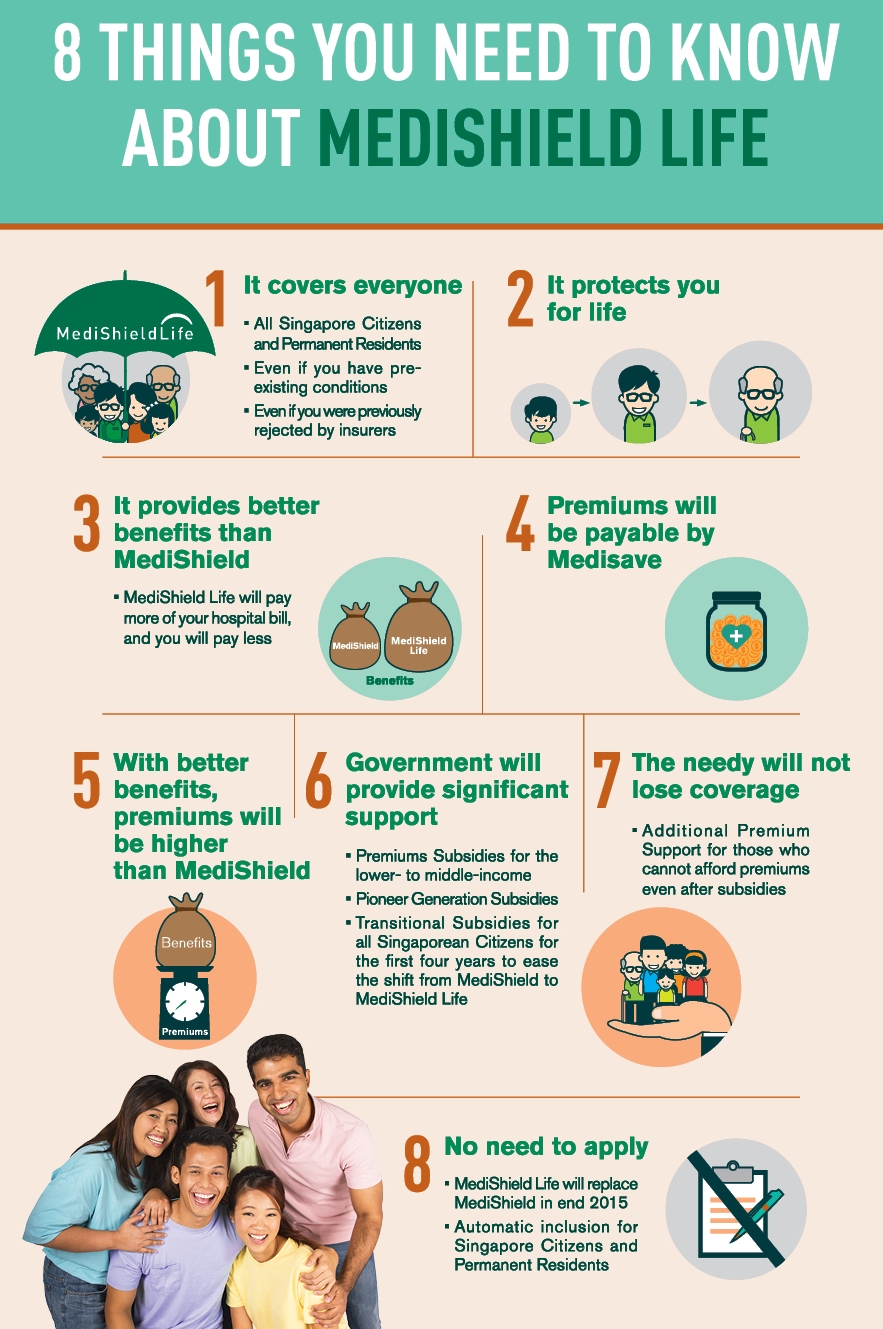
FAMILIARIZE YOURSELF ABOUT MEDISHIELD LIFE

Central Provident Fund administers a health insurance plan called MediShield Life. It aids in paying out huge hospital bills and certain outpatient treatments such as dialysis and chemotherapy. MediShield Life’s coverage is ideally for Class B2/C wards at public hospitals.

You may choose to stay in a Class A ward or a private hospital, but the payout will only make up a small proportion of your bill. You will have to fork out cash or pay from your Medisave.

1426860875422No one is entirely certain about what the future holds. Preparing now can help you manage the financial pain of later years!

Read More...

Beginner’s Essential Guide To Unit Trusts


WHAT IS UNIT TRUST EXACTLY?

A Unit Trust follows an unincorporated mutual fund or trust structure that allows funds to hold assets and pass profits thru the individual owners. Money is pooled with the money from other investors and it is managed by a fund manager. The portfolio of assets is set according to the fund’s investment strategy and objective. Hence the success of a unit trust depends on the capabilities, expertise, and experience of the management company.

In Singapore, local and foreign unit trusts offered are regulated as collective investment schemes.

WHY MUST YOU INVEST ON UNIT TRUSTS?

Since funds are invested in an array of assets, one advantage of investing in unit trusts is diversification. In the current unpredictable market, this potency helps investors to adjust with the ups and downs without having to worry too much about the performance of a single stock. Generally, unit trusts provide you with more safety in terms of the performance of your investment.

WHAT SHALL YOU CONSIDER BEFORE AND AFTER INVESTING?

Before investing on unit trusts, you must assess the type offered as well as its fees. Also, you must examine the fund manager himself. Determine if the fund manager has the sufficient experience, skills, and resources to lead you to success. Look beyond the short-term performance and look into one’s long-term track record.

After investing on unit trusts, you must regularly monitor if its performance meet your expectations. Then monitor the economic and political risks of the markets you invested in.

WHAT IS ITS NET ASSET VALUE?

The price of each unit is based on the net asset value divided by the number of units outstanding. It is typically calculated daily to reflect changes in the prices of the investments maintained by the fund.

HOW CAN YOU BUY THE UNIT TRUSTS?

Aside from cash, you can purchase unit trusts by the CPF Investment Scheme (CPFIS) and the Supplementary Retirement Scheme (SRS). Furthermore, some insurance companies offer investment-linked insurance policies.

Image Credits: Ken Teegardin via Flickr (CC Licence Attribution-ShareAlike 2.0 Generic)

Image Credits: Ken Teegardin via Flickr (CC Licence Attribution-ShareAlike 2.0 Generic)

Sources: 1,  2, & 3

Read More...

5 Noticeable Differences Between Public And Private Housing In Singapore

As most of you may know, public housings (excluding the executive condominiums) are usually built without the amenities of the private condominiums such as swimming pools, tennis courts, and playgrounds.

Aside from these varied amenities, there are other noticeable differences you must take into consideration when purchasing a home in Singapore. Here are some of them:

1. FINANCIAL GAINS

Whether the purpose of your purchase is solely for your occupation or for your investment, you are surely hoping that your property will increase in value as years go by. According to recent evidence, private condominiums surpassed HDBs (Housing and Development Board) in terms of capital gains. This is observed in almost every locations.

Why is this so?

Well, since HDBs are subsidized by the government, foreigners are not allowed to purchase them. So the higher gains of private condominiums in a period of time may be due to the broader range of buyers it cater to. In contrast with HDBs, you can rent out your private flat with no limitations and no minimum years of stay! These things make private condominiums a better choice for property investment alone.

2. RESTRICTIONS FOR FOREIGNERS

Landed properties are stricter to foreigners too as they need the government’s permission from the Land Dealings Approval Unit. Quoting the Singapore Land Authority:

“The ownership of such properties (landed residential properties) by foreigners is restricted to those who make adequate economic contribution to Singapore. The ownership restrictions are provided in the Residential Property Act.”

While private condominiums are more flexible to foreigners as they just need to pay the Additional Buyer’s Stamp Duty.

Image Credits: pixabay.com (License: CC0 Public Domain

Image Credits: pixabay.com (License: CC0 Public Domain

3. OCCUPANCY REGULATIONS

If you are going to sell your home, there are notable differences between private and public flats. For public housing, in order to rent out your entire flat or sell it, you must first occupy the property for at least 5 years. While for private housing, there is no minimum amount of occupancy. Your only main concern is the Seller Stamp Duty that you are selling your private flat within the first four years of purchase.

4. CPF SCHEMES

The Central Provident Fund (CPF) has two distinct schemes for private and public housing. For buying new or resale HDBs, you can avail the Public Housing Scheme (PHS) wherein you can use your CPF Ordinary Account. Use the PHS to finance the flat’s purchase price, housing loan instalments, stamp duty, legal fees, and other upgrading costs. But this comes with two catches: valuation and withdrawal limits.

On the other hand, Private Properties Scheme (PPS) to buy or build private properties for either personal or investment purposes. Use the PPS to pay the flat’s purchase price, housing loan instalments, construction loan, stamp duty, legal fees, and other upgrading costs. As the PHS, PPS comes with valuation and withdrawal limits.

Image Credits: pixabay.com (License: CC0 Public Domain

Image Credits: pixabay.com (License: CC0 Public Domain

May this guide help you to decide the housing type that suits you best! 🙂

Sources:  1, 2, 3, 4, & 5

Read More...