
5 Ways To Grind Like A Boss Even When You Are Not

You may not be a boss yet but if you start acting like one, you can just snag a chance at a beaming promotion!

I am not encouraging you to point fingers and demand orders to everyone at the office. Instead, I suggest that you act like the boss that you wish to work for. Not only are you serving as an inspiring role model for your own boss but you are also giving your colleagues a glimpse of what it about to happen when you climb up the ladder.

On that note, here are some tips to act like a good boss:

1. GIVE ATTENTION TO ISSUES

Always channel your inner boss by asking yourself if there are current issues that the management needs to address.

I remember a friend of mine who started as a receptionist at a fitness studio. She used to do the attendance by typing the names of each participant in the room. Imagine doing this for a class of more than 30 people. You can easily lose count! Then she discovered a faster way doing things by assigning each participant with a bar code, which they can scan before they enter the room. The management was really pleased. A year after that, she became the manager of the studio for more than 4 years.

2. TAKE THE INITIATIVE

Good bosses have initiative and enthusiasm. Showing that you are dedicated to do every task and are taking control of your responsibilities would make people feel that you are an asset to the company.

Even without the guidance of the management, there are some simple things that you can solve by yourself. Do not waste time and get things in motion.

3. HANDLE PRIORITIES WELL

Business owners and supervisors have lots of things on their plates. Because of our competitive environment, several things pull them on different directions every single day. This is why they must handle the significant priorities first before moving on to the non-essential tasks. Do the same thing!

Start by keeping a list of all your daily tasks. Move the items up if they are really important. When a new project comes along, ask yourself about its importance and organize accordingly.

4. MANAGE YOUR MONEY

It is essential for a boss to understand the fundamentals of managing money including budgeting. A budget is your understanding of the materials needed as well as its costs – be it in the currency of money, time, and people.

Practice the basics of money management by budgeting your personal household expenses. Also, make sure that this is aligned to your financial goals.

5. EVALUATE YOURSELF

Performance appraisals help the management decide whether or not they shall give you a pay raise or a career advancement. Go inside the mind of your boss by reflecting upon your previous feedback or review. Know which areas you need to improve on and which areas are your strengths.

Do a self-assessment every few months to remind yourself about the changes that you shall make.

Image Credits: pixabay.com

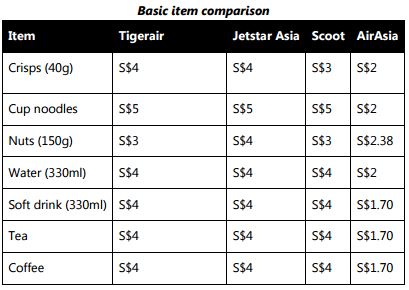
Image Credits: pixabay.com

Read More...

KAYAK.sg reveals sky-high prices of in-flight refreshments on board of low-cost carriers

Travel search engine KAYAK.sg reveals the extent to which low-cost airlines are marking up prices

  • Travelers who want to enjoy a cup of coffee on board will have to pay on average 900% more than at the supermarket
  • The mark-up on the in-flight cup noodles is between 222% and 317% as compared to the cost at supermarkets
  • Airlines charge 562% more for a simple bottle of mineral water than a supermarket does

Singapore, 10 June 2016 – Travellers often expect to pay a little more than usual for snacks and drinks while flying on low-cost carriers, but new KAYAK.sg research reveals that some airlines are going overboard with mark-ups on the prices of snacks and drinks. For example, a simple cup of instant coffee costs, on average, 900% more up in the air than it would at a supermarket.

A cup of hot tea was revealed to be the worst offender. A single tea sachet can be bought in a supermarket for as little as six cents, but the mark-up for providing the same bag plus some boiling water while onboard is astonishing. Tigerair, Jetstar Asia and Scoot all charge S$4, while AirAsia charges a slightly more reasonable price of S$1.70 for a cup of tea, an average markup of 4,344%, compared to standard supermarket costs.

Breaking the bank for a sweet bite

Sky-high prices were also uncovered on everyday snack items; Scoot charges S$4 for a 40g chocolate bar – 74% higher than one would pay for the same item in a supermarket. A serving of cup noodles varies between S$2 and S$5 depending on the airline and brand, a mark-up of between 222% and 317% over the average supermarket price.

Cashing in on beverages

The price of alcoholic drinks on board is anything but relaxing. A small 330ml can of beer costs up to S$8 on low-cost carriers, compared to S$3 or under in most supermarkets. Interestingly, JetStar Asia, Tigerair and Scoot charge S$6, S$7 and S$8, respectively, for the same popular brand of Japanese beer, a mark-up of over S$160% on average, when compared to purchasing the same can at the supermarket.

Getting overboard with drinks prices

Even non-alcoholic drink prices are sure to give fliers a financial hangover. An identical bottle of water (330ml) costs up to S$4 on board compared to just S$1.40 at a supermarket, representing a 562% mark-up on average. A 330ml can of cola or a sports drink will also set travellers back; costing S$4 on each of the four major low-cost carriers flying from Singapore – a 433% mark-up, on average, over supermarket prices on the ground.

Debby Soo, KAYAK Vice President APAC said, “Low-cost carriers are providing a service when it comes to food and drink on board, which accounts for some of the mark-ups we see. However, it pays off to plan ahead and eat before you board, especially for short flights. Also, travellers should bring empty plastic bottles through security, into the boarding gates at Changi Airport, and then fill them up at the water fountains in order to stay hydrated economically while flying.”

Some of other largest mark-ups

  • Chocolate powder drink – S$4 (Tigerair/ JetStar Asia) vs S$0.40 – 770%
  • Crisps (40g) – S$4 (Tigerair/JetStar Asia) vs S$0.90 – 344%
  • Pretzel sticks – S$4 on (JetStar Asia) vs S$0.95 – 300%
  • Pulpy Juice (350ml) – S$4 (Tigerair/ JetStar Asia) vs S$1.15 – 247%

item comparison

Notes to Editors:

Airline F&B prices are correct as of 16 May 2016 and are based on inflight menus on the airlines’ websites. AirAsia prices were supplied in Malaysian Ringgit and converted into Singapore dollars on 16 May 2016. Supermarket prices are based on the best prices found in three main supermarkets in Singapore and were correct as of 16 May 2016. In some cases, prices are based on multi-pack purchases.

Read More...

How To Recognize And Beat Work-Related Burnout

The national values instilled as a society coupled by the relatively high cost of living in Singapore led to the “hardworking” culture that is embedded in almost everyone’s veins. With the amount of commitment that most people have towards their jobs, they can occasionally experience an unpleasant consequence called Burnout.

Coined in the ’70s by the American Psychologist Herbert Freudenberger, Burnout refers to the outcomes of relentless work stress and high ideals. Work-related burnout and its co-morbid problems commonly lead to absenteeism due to sickness. For instance, you have been spending more time at the office to get more things done but ended up being physically and mentally unwell. Going beyond the limits of your body is just counterproductive to your well being and finances. This is why you must recognize the telltale signs of work-related burnout. Here are some of them…

4 SIGNS OF BURNOUT

Image Credits: pixabay.com

Image Credits: pixabay.com

1. LACK OF MOTIVATION

Have you been fantasizing about swimming on the beautiful Bondi Beach? Or are you wishing that tomorrow is a “newly proclaimed” non-working holiday? Well, wanting to run away from your work is a common sign of burnout.

2. COGNITIVE PROBLEMS

Burnout can cause cognitive problems in memory and attention. You can experience slip-ups such as messing up on normally easy tasks, forgetting to remember simple things, and having a hard time focusing.

3. FATIGUE

You are always tired. Need I say more?

4. NEGATIVE EMOTIONS

If you are wondering about whether what your doing is appropriately compensated and if it has any significance, you are experiencing “reduced accomplishment”. It is a common symptom of burnout that can affect anyone who has been working too hard including elite athletes and renowned surgeons.

4 WAYS TO HANDLE STRESS

Image Credits: pixabay.com

Image Credits: pixabay.com

1. SEE YOUR FRIENDS

Sometimes, changes in the working environment and tangible support from others can help with the problems brought by the workplace stress. Consider spending some time with your friends or the people who make you smile. You may be putting off some of your tasks (for the meantime) by doing so but is it not the whole point of destressing?

2. HAVE A “ME” TIME

Since burnout is influenced by mental clutter, learning to relax and removing the distractions for an ample period of time can ease your negative feelings. Put your work assignments or projects down and do something you really enjoy. Set aside at least 10 minutes of the day to yourself.

Listen to your favorite love song, book a spa appointment, eat your favorite dessert, purchase new video games or try on different shades of lipsticks. You deserve it!

3. EXERCISE MORE

Exercise has physical and psychological benefits such as reducing stress, anxiety and depression. It can also improve one’s quality of life, self-concept and self-efficacy. So get pumping! Run outside the house or gather a group of friends to start a regular exercise routine.

4. GET QUALITY SLEEP

When you are tired and sleep deprived, you are less patient, less concentrated and easily irritated. As sleep deprivation can increase your stress, it is advisable to get quality sleep.

Nothing beats the feeling of waking up refreshed and rejuvenated after a good night’s rest. It does give you the boost you need to deal with the hurdles that the new day can bring. Give your body the restorative rest craves for. At least 6-8 hrs of sleep is ideal for working adults.

Sources: 1, 2, 3, & 4

Read More...

Budget-Friendly Ways To Make People Notice Your Business

As a small business or a startup, you are likely to experience some financial set-backs whilst trying to get more people to notice your brand. The constraint placed on your budget only means that you must be strategic in managing the pillars of your presence.

Fortunately, it is not that complicated! 🙂

1. POST ADS FOR FREE

Online Classifieds are a good choice as these are cost-effective, convenient to relay contact, visible to a large-scale of consumers, and the advertisers are able to edit a listing anytime. If you are a promising entrepreneur working on a minimum budget, look for free yet established classifieds such as these:

a. STClassifieds had been a favorite of many Singaporeans since 2007. It allows its users to post an add for free in a wide variety of categories. Furthermore, you can upload up to 10 images so you can really get the best angle of your product.

b. Renowned as Singapore’s Number 1 Free Classifieds Site, Gumtree Singapore is well known for providing good classified services with one of the largest visibility. Their ads let you show the description, photos, date listed, price, condition, address, and your contact information.

2. GET A CATCHY DOMAIN

Once you settled the costs of the products or services that you are planning to sell, you can start creating your own website. Go Daddy sells website domain names for as low as $2.26 per year.

Focus on getting a website domain that represents your business well leave a lasting impact to your target market. For example, you can use “xxx.flowers” instead of “xxx.com” if you are selling beautifully arranged blooms.

3. STAY SOCIAL

Because of the emergence of social media, your marketing must create and showcase a credible online persona for your brand and its products or services. A great online persona will attract more people to the website, boost the brand’s loyal consumers, and increase the number of new consumers.

The efficiency of this social influence is due to the Bandwagon Effect. Bandwagon Effect is a phenomenon that occurs when people do something predominantly because others are doing it. Social media allows the consumers to talk about a brand and its competitors. Using this tool to your advantage can help boost your sales.

4. HOST A GIVEAWAY

A surefire way to make people notice you is to sponsor a giveaway on various social media platforms. In fact, that is one of the early strategies of Money Digest. As much as possible, do this on websites that receive tons of traffic regularly such as Facebook and Instagram.

Get more traffic by incorporating the number of “likes” and “shares” to the mechanics. Also, there are several apps on Facebook that will help you send a message to your followers and help you choose a random winner.

Image Credits: pixabay.com

Image Credits: pixabay.com

Read More...

Debunking The 5 Money Myths In Singapore

There is a whole lot of misinformation and mistaken beliefs surrounding personal finance. It is about time that we debunk some of it!

MYTH #1: TYPE OF SAVINGS ACCOUNT DOES NOT MATTER

Most savings account in Singapore reward you with only 0.05% interest rate per year. So if you left S$10,000 untouched in your account for a whole year, your interest will earn you $5 or less than 42 cents a month. With that amount of money per month, you cannot even buy a slice of watermelon at the hawker center!

Banks realized the importance of having competitive rates for its clients. As a result, big player banks introduced savings accounts such as DBS Multiplier Account (up to 2.08% per annum), CIMB StarSaver Savings Account (up to 0.8% per year), and OCBC 360 Account (up to 3.25% per year).

Know more about the most profitable savings account in Singapore by visiting this link.

MYTH #2: CPF SAVINGS IS ENOUGH FOR RETIREMENT

Contrary to the popular myth, your Central Provident Fund (CPF) savings may not be enough to sustain the lifestyle you desire during retirement. Keep in mind that your CPF savings depends on how much you earn during your working years. If your income is relatively low throughout the years then you can expect to receive lesser payouts than your “higher earning” friends. So your CPF savings may not be enough.

Plus if you exhaust your account earlier on to pay for your HDB flat, then you shall expect to receive lesser payouts than those who bought flats within their “means”.

MYTH #3: DEPENDENCY IS OKAY

Growing up in the Asian culture made us realize that we have a responsibility to take care of others especially to those in need. Having someone to depend on is a good thing but when it comes to finances, it can get pretty rough. If you believe that it is okay to spend since your spouse, parent, or children (based on the Maintenance of Parents Act) will take care of your expenses then you are putting the financial responsibilities outside from yourself. Thus resulting to inattention towards managing money and careless spending.

MYTH #4: ONE SIZE FITS ALL

Everybody’s financial situation is unique so be wary of the “one-size-fits-all” money tips from media’s financial gurus. Many factors such as your consumer personality, financial goals, and age should be considered. Thus, it is more beneficial to listen to your personal financial advisor. Ask your friends to recommend a good financial advisor.

MYTH #5: FINANCIAL ADVISORS CANNOT BE TRUSTED

I had met some financial advisors with HSBC and Prudential before. Can they be trusted?

In a study done by Scratch, nearly 3 quarters of Millennials said that they would rather go to the dentist than hear the financial advice of a banker. Part of their reluctance to financial advisors stems from the lack of services targeted to people like them. As you may notice, Millennials are highly self-reliant and that translates with how they handle their money. Most of them are not comfortable with trusting someone else with their money.

The truth is, financial advisors are knowledgeable and trained professionals whose job is to guide their clients to manage their money, investment options, and asset relocation. You have nothing to worry about as long as your money is in capable and honest hands.

Sources: 1, 2, 3, & 4

Read More...