They say time is money but when it comes to investing, time is actually wealth. In Singapore’s fast-paced economy, understanding the magic of compound interest can be the key to financial freedom. So, how does it work?
POWER OF COMPOUNDING
Think of compound interest as a snowball rolling down Bukit Timah Hill small at first, but growing bigger as it gains momentum. In finance, this means your initial investment earns interest, and that interest starts earning more interest over time. The longer you leave your money to grow, the bigger the effect.
Let’s say you invest S$10,000 at an annual return of 5%. In a year, you’ll have S$10,500. But in the second year, you’re earning interest not just on your original S$10,000, but also on the extra S$500, bringing your total to S$11,025. Fast forward 20 years, and your initial sum has nearly doubled without you lifting a finger!
WHY START NOW?
Singapore’s CPF system already takes advantage of compounding, but you can supercharge your wealth with investments in ETFs, stocks, or savings plans. The trick? Start early and stay consistent. The longer you let your money grow, the more time does the heavy lifting for you.
Image Credits: unsplash.com
So, whether you’re saving for your first BTO or early retirement, remember: wealth isn’t just about how much you earn it’s about how wisely you let time work for you.
I’ve been on the lookout for a credit card with the best rewards and after some research, I stumbled on this combo:
UOB Lady’s Credit Card x UOB Lady’s Savings Account
I’m excited to make the most out of my savings and spending, knowing that signing up for both can earn me up to an impressive 25X UNI$ per S$5 spent, equivalent to 10 miles per S$1!
How It Works for Me:
UOB Lady’s Credit Card: I earn 10X UNI$ per S$5 spent on up to two of my preferred rewards category(ies). That’s 4 miles for every S$1 I spend.
UOB Lady’s Savings Account: I boost my rewards with up to an additional 15X UNI$ per S$5 spent on my preferred rewards category(ies), adding up to 6 more miles per S$1.
Plus, there’s no lock-in period, giving me the flexibility to choose and change my preferred rewards category(ies) every quarter.
And the best part? There’s no minimum spend required, allowing me to earn rewards on my terms!
Painting the Picture:
I have plans to maintain a S$50,000 Monthly Average Balance (MAB) in my UOB Lady’s Savings Account and spend S$800 each month on my preferred rewards category(ies) with my UOB Lady’s Credit Card.
For me, a monthly S$800 spend is easily attainable since I spend the bulk on the Beauty & Wellness and Dining categories.
Here’s the rough breakdown if you’re interested:
Gym membership ($100)
Beauty/cosmetic buys ($100)
Personal grooming such as hairdressing, facial treatment/hair removal, nails/lash/eyebrows, etc. ($300)
Dining at my favourite restaurant and ordering food via foodpanda ($300)
This means in just one month, I could rack up 3,200 UNI$.
Keeping this up for 12 months means I could gather a whopping 38,400 UNI$ in a year!
Redeeming My Rewards:
I can convert these UNI$ into 76,800 KrisFlyer miles (1 UNI$ = 2 miles).
With that, I could snag my round-trip business class ticket to Hong Kong* within a year! It would be my first-ever business class experience.
But if I decide not to spend all my UNI$ on flying, I have plenty of other options too.
I can redeem my UNI$ for rewards from a variety of dining, shopping, and travel merchants on UOB Rewards+.
In essence, whether I’m aiming for luxury travel or indulging in simple everyday perks, the benefits add up quickly!
*Based on Singapore Airline’s Saver Awards Chart as of October 2023, excluding taxes, charges, and fees.
Maximizing Your Rewards:
You can choose and change your preferred rewards category(ies) every quarter. These include:
Dining
Travel
Fashion
Beauty & Wellness
Family
Transport
Entertainment
This flexibility means you can adapt as your spending habits and priorities shift.
Switch to whatever categories you deem fit quarterly to maximize your UNI$ and get the best rewards for your spending and savings!
For example, during the year-end holiday season, I can switch my rewards category to Travel. This allows me to book air tickets and easily hit the S$800 spending target in a single transaction!
By consistently managing my spending, I can easily accumulate a significant amount of UNI$ annually. During travel months, I can reach the monthly spending target even faster by booking air tickets and covering other travel expenses.
If you have more savings to park aside and can maintain at least a S$100,000 MAB, you can earn an additional 15X Lady’s Savings Bonus UNI$ on your preferred rewards category(ies).
So, it’s smart to consolidate your purchases with the Lady’s Credit Card to maximize your Lady’s Savings Bonus UNI$.
Curious About Your Rewards?
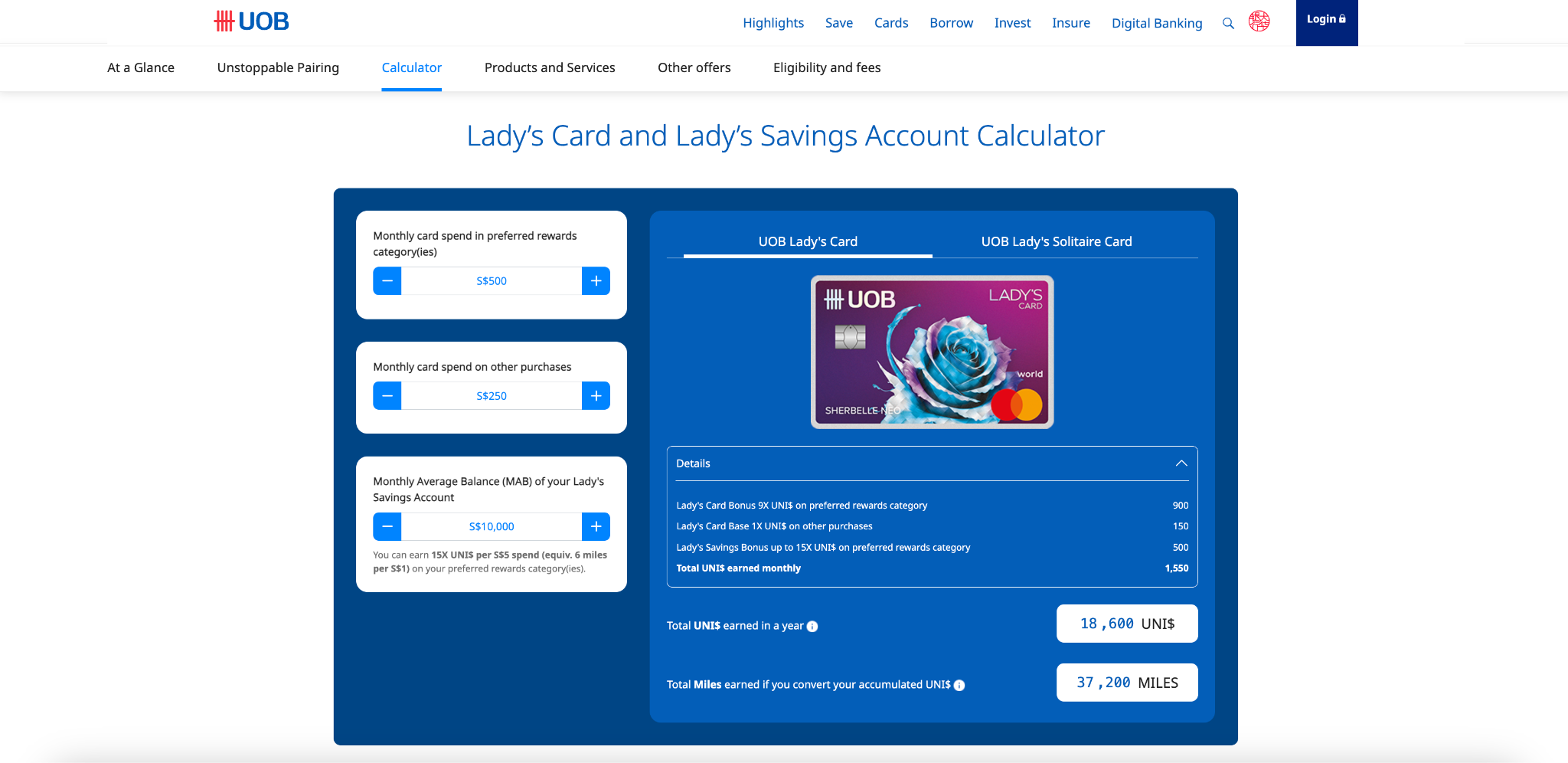
Wondering how many UNI$ and miles YOU can rack up based on YOUR spending and savings?
Simply click this link to UOB’s official website and click on ‘Calculator’ to access the ‘Lady’s Card and Lady’s Savings Account Calculator’ to enter your details and see your potential rewards in a flash!
Just like this:
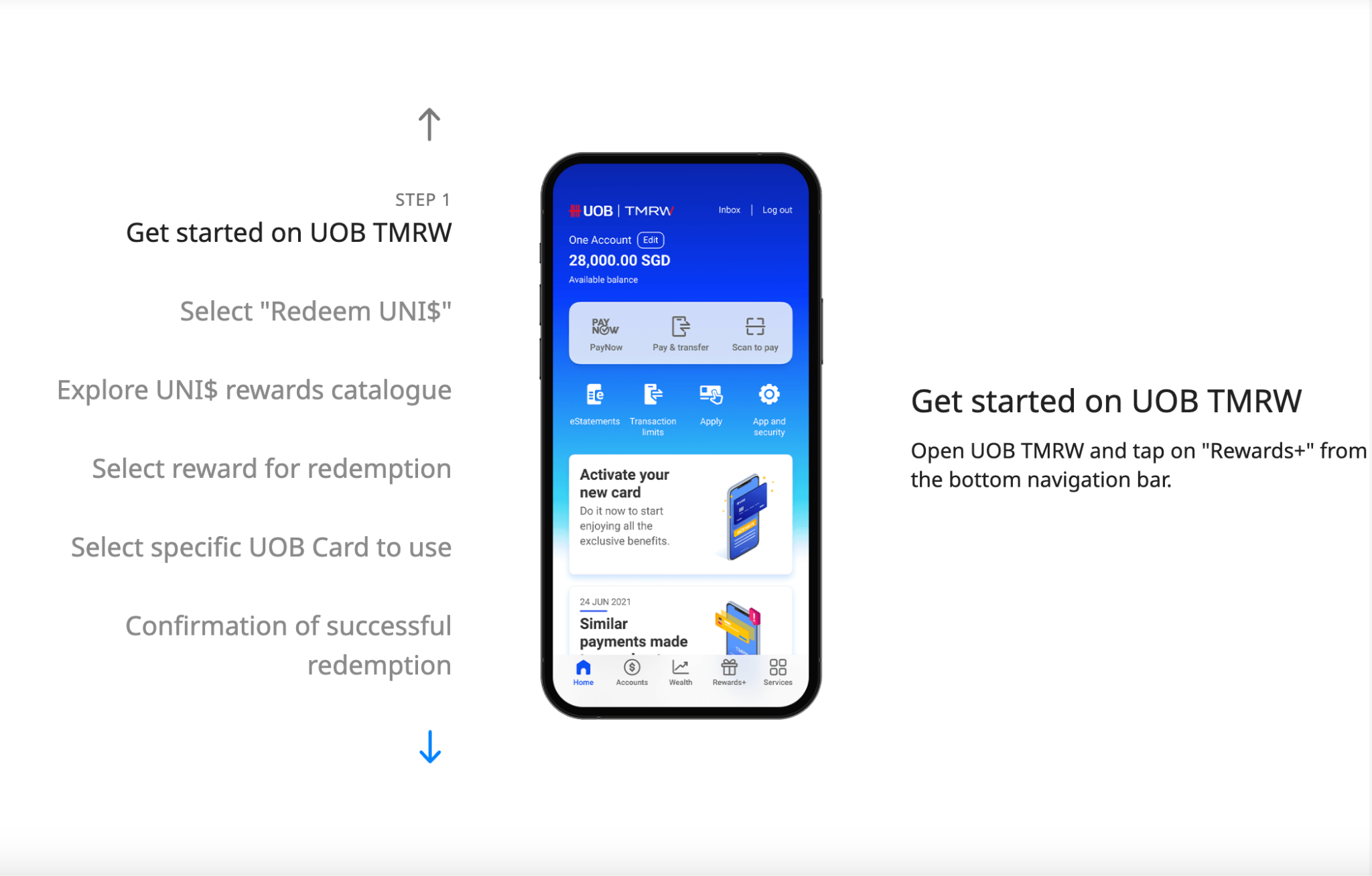
Subsequently, as a card member, you can easily view, track and redeem your UNI$ rewards all on the UOB TMRW app.
0% LuxePay Interest-Free Payment Plan over 6 or 12 months on your luxury purchase (shoes or bags)
Exclusive Birthday Treats during your birthday month
e-Commerce Protection for your online purchases
Complimentary Travel Insurance covering up to 100,000 USD
Receive a S$250 Sephora Gift Card when you spend a min. of S$6,000 on your UOB Lady’s Credit Card. Limited to the first 280 eligible cardmembers.
For the UOB Lady’s Savings Account:
Receive a Bespoke Puffy Bag with Rose Leather Charm worth S$98 by reBynd, an eco-conscious brand by Bynd Artisan, when you apply for the account online and deposits S$5,000 new funds into the account. Limited to the first 150 customers in each calendar month from 8 March to 30 April 2025 only.
That’s not all. UOB is also rewarding ALL customers who hold both the UOB Lady’s Credit Card and UOB Lady’s Savings Account as of 30 Apr 2025 with a lucky draw chance to win an Éclat KNOT Alone® Double Pave Bangle worth S$520 or Gentle Monster sunglasses worth S$490.
T&Cs apply, of course. Insured up to S$100k by SDIC.
So stop waiting and join me right away by signing up now here.
Learn how forward contracts, which lock in exchange rates for future payments and provide protection against market swings, assist firms in managing currency risk.
Currency risk may be a substantial issue for organizations doing cross-border transactions. An abrupt change in currency rates may impact the profitability and predictability of foreign businesses. A currency forward contract is a valuable instrument for companies to reduce this risk. Businesses may prevent unexpected market volatility by locking in exchange rates for future payments, resulting in better financial stability.
What’s a Forward Contract?
One kind of financial agreement is a forward contract, in which two parties commit to exchanging a certain sum of money at a predefined exchange rate at a later time. As a buffer against potential market volatility, businesses often utilize this contract to lock in currency rates for upcoming foreign payments. WorldFirst offers businesses the ability to enter into a currency forward, enabling them to plan ahead with confidence.
How Forward Contracts Help Manage Currency Risk
The ability of enterprises to obtain an exchange rate for future transactions is one of the most important functions that currency forward contracts provide in the context of currency risk management. Particularly useful in turbulent markets, where currency rates are prone to unpredictable fluctuations, this protection is particularly beneficial. By securing a rate immediately, companies are able to prevent the adverse effects that currency fluctuations have on their cash flow and profitability, so guaranteeing that their activities across international boundaries run more smoothly.
Securing Exchange Rates for Future Payments
The practice of getting exchange rates in advance may be of great use to businesses that need to conduct their operations in foreign currencies. Businesses have the ability to secure a rate of exchange for a period of up to twenty-four months via the use of a currency forward contract. This guarantees that future payments will be made at predictable rates. Especially for companies that have clients or suppliers from other countries, this is crucial for the management of budgeting and financial forecasting.
How Forward Contracts Work in Business Transactions
Currency forward contracts are often used in the context of commercial transactions to secure payments for products or services that are scheduled to be delivered at a later date. As an example, a business may want to sign a forward contract in order to guarantee the exchange rate for an invoice from an international supplier that is due in six months. As a result, this guarantees that the organization will not be impacted by any negative shifts in the exchange rate that may occur between now and the time of payment.
Key Benefits of Forward Contracts for Currency Risk Management
H3: Locking in Exchange Rates for Predictable Cash Flow
Businesses have the ability to lock in exchange rates by virtue of engaging in a currency-forward contract, which contributes to the creation of a more predictable cash flow. Because of this, businesses are able to steer clear of the unpredictability that is associated with shifting foreign exchange rates, which helps them to make more precise financial planning and decisions. Businesses can get a fixed rate via a forward contract from WorldFirst. This ensures that they are aware of the precise amount that they will pay in their own currency for transactions that take place in other countries.
Budgeting and Planning with Secured Exchange Rates
Businesses benefit from the assurance that forward contracts provide, which enables them to efficiently budget and prepare for the future. Through the establishment of a predetermined exchange rate, businesses are able to more precisely predict their expenditures and guarantee that their financial plans are in accordance with the real costs. There is no longer any confusion about the shifting currency rates, which is especially useful for businesses that deal with overseas payments on a regular basis.
Reducing Exposure to Currency Fluctuations
There are several reasons why businesses use currency-forward contracts, but one of the most significant is to protect themselves against fluctuations in currency prices. Even little changes in exchange rates may have a big effect on a company’s bottom line, and it is hard to predict how currency markets will behave. Businesses may hedge their bets against potentially disastrous market swings using forward contracts, which lock in an exchange rate for a certain future date. Forward contracts describe these agreements.
How to Effectively Book a Forward Contract for Currency Risk Management
Steps for New Customers Booking a Forward Contract
Please contact WorldFirst’s staff at your earliest convenience if you are a new customer interested in booking a currency forward contract. They would be happy to discuss your needs. They will explain everything step-by-step and make sure you understand all the key terms, such as the currencies involved, the contract rate, and the length of the contract. In addition to thinking about the initial margin needs, you should think about whether you want a flexible, variable, or window-forward contract.
Essential Terms to Understand Before Booking a Forward Contract
Before entering into a currency forward contract, it is critical to have a solid understanding of a number of important concepts. The currencies that are involved in the transaction, the rate of the contract, and the term (duration) of the contract are components that fall under this category. It is also necessary for companies to establish if they need a window forward contract, a flexible contract, or a permanent contract. Additionally, it is important to be aware of the margin requirements, which amount to a percentage of the notional value of the contract and must be paid in advance in order to guarantee your commitment.
How Existing Customers Can Leverage Forward Contracts
Customers who are already receiving services from WorldFirst may simply take advantage of currency-forward contracts by getting in touch with their team to discuss their individual requirements. When it comes to returning customers, the procedure has been simplified, and they will be provided with comprehensive information on margin calculations. If there are considerable fluctuations in the currency rate throughout the duration of the contract, which may need further margin payments, this transparency is particularly helpful since it allows for the possibility of such fluctuations.
Conclusion
Currency forward contracts are an essential instrument for companies that want to reduce their exposure to currency risk and ensure that they have access to exchange rates that are predictable for future transactions. Businesses are able to significantly enhance their financial planning, decrease their exposure to currency volatility, and lock in rates via the use of forward contracts. WorldFirst provides a streamlined method for companies to book currency forward contracts, regardless of whether they are new or current clients. This enables businesses to confidently manage their exposure to foreign exchange.
As we enter our golden years, financial planning becomes more critical than ever. With evolving healthcare needs, lifestyle changes, and estate management considerations, staying on top of your finances ensures a comfortable and stress-free retirement.
Consider these six essential financial tips tailored for seniors.
#1: UPDATE YOUR FINANCIAL GOALS
Your financial priorities will likely shift once you retire. This stage of life may involve:
Traveling more frequently
Retiring abroad in a lower-cost country
Pursuing new hobbies and interests
Providing financial support to children or grandchildren, such as funding education or helping them start a business
Start by clarifying your financial goals and estimating their costs. From there, create a strategic withdrawal plan that maximizes your savings and CPF payouts to sustain your desired lifestyle.
#2: ESTABLISH YOUR EXPENSES
Most retirees rely on a fixed income, making it crucial to understand and plan for both essential and discretionary spending:
Fixed expenses: Housing (HDB loan payments or rental), utilities, food, insurance, phone bills, and transportation.
Variable expenses: Leisure activities, dining out, shopping, travel, and entertainment.
Image Credits: unsplash.com
Additionally, factor in future expenses, such as rising medical costs and potential long-term care needs. If your savings seem stretched, consider adjusting your budget or lifestyle to ensure financial security.
#3: PLAN FOR HEALTHCARE FEES
Healthcare is one of the most significant expenses in retirement, especially with the aging population. Be proactive by:
Reviewing your MediSave and MediShield Life coverage to ensure it meets your healthcare needs.
Exploring ElderShield or its enhanced version, CareShield Life, for long-term care protection.
Setting aside a medical fund for out-of-pocket expenses such as specialist consultations, medication, and home care services.
#4: REVIEW YOUR ESTATE PLAN
Estate planning is essential for ensuring your assets are distributed according to your wishes. Key actions include:
Updating your will: This legal document specifies how your assets will be distributed.
Assigning a Lasting Power of Attorney (LPA): This enables a trusted person to make financial and healthcare decisions on your behalf if you become incapacitated.
Making a CPF nomination: Unlike other assets, CPF savings are not covered in a will, so nominating beneficiaries ensures smooth distribution.
#5: BEWARE OF SCAMS
Elderly individuals are often prime targets for scams, ranging from phishing emails to fake investment schemes. Protect yourself by:
Never sharing personal or banking details over the phone or online.
Verifying the identity of callers claiming to be government or bank representatives.
Enabling multi-factor authentication for online banking and financial transactions.
Staying informed about the latest scams through advisories from the Monetary Authority of Singapore (MAS) and Singapore Police Force.
#6: REVIEW YOUR FINANCIAL PLAN
Retirement planning isn’t a one-time event as it requires ongoing review. Optimize your financial strategy by:
Regularly assessing your CPF LIFE payouts, investments, and passive income sources.
Understanding how different income streams (such as rental income, dividends, and annuities) contribute to your financial stability.
Consulting a Certified Financial Planner (CFP) to help align your portfolio with your risk appetite and retirement goals.
IN A NUTSHELL
Image Credits: unsplash.com
Financial security in your senior years is about careful planning, smart spending, and protecting your assets. By staying informed and proactive, you can enjoy a fulfilling and worry-free retirement in Singapore.
Stepping into adulthood comes with its share of firsts—your first paycheck, first apartment, and yes, the dreaded first experience of paying bills. Don’t worry, though. With a little organization and some smart strategies, you can manage this like a pro.
Let’s break it down step by step, with some relatable tips along the way!
#1: ORGANIZE YOUR BILLS
When Marcus and his wife got their first flat, they found himself drowning in unopened envelopes and emails about utilities, rent, and more. Their solution? A master list of all the bills, split into two categories: automatic payments and those that needed manual attention.
Take a leaf out of their book. Start by listing out your recurring expenses including rent or mortgage, utilities, car loans, insurance, and even those sneaky subscription services. Next, prioritize them by due dates and importance. Not only will this save you from late fees, but it also keeps your finances in check.
Pro Tip: Create a “paid” folder (i.e., physical or digital) to file receipts and proof of payment.
#2: MARK PAYMENT DATES
Ever forgotten a birthday and scrambled for a last-minute gift? Missing a bill deadline feels worse, except it comes with late fees. Avoid this by setting up a payment calendar.
Image Credits: unsplash.com
Whether you prefer a physical planner or your phone’s calendar app, having due dates marked makes it easier to plan your finances and avoid the dreaded Oh no, I forgot! moment.
#3: KNOW WHAT YOU CAN AFFORD
When it’s payday, it’s tempting to splurge on a new gadget or that café-hopping adventure with friends. But adulting also means setting limits. Take some time to understand your monthly income and expenses.
Break your expenses into fixed (like rent) and variable (like dining out). Allocate a portion of your income to bills, and don’t forget to build an emergency fund for those unexpected surprises, like a burst water pipe.
#4: AUTOMATE EXPENSES WHENEVER POSSIBLE
Automation is the magic wand for forgetfulness. If it’s an option, set up automatic payments to avoid missed deadlines. For instance, paying your SP Utilities bill is as easy as using PayNow QR in the SP app or through eGIRO. Not into apps? No problem as you can head to an SP customer service center for a hands-on walkthrough.
Remember, automation doesn’t mean you stop checking. Always review statements for any discrepancies. You wouldn’t want to pay for something you didn’t use!
Image Credits: unsplash.com
Taking control of your bills might seem overwhelming at first, but it’s a skill that grows with time. Start small, stay consistent, and celebrate the wins (i.e., like making your first on-time payment). Because let’s face it, mastering bills is just one more step toward owning your adulting game.