There’s a new insurance savings plan called “Dash PET” that is not for your pet

Dash PET cover image

Are you looking for a new insurance savings plan that allows you to Protect, Earn, and Transact (PET)? Then you might be interested in a project called Dash PET. If you’ve read the title and clicked in, you would have known that this policy is not for your pet.

The insurance savings plan is part of a product offered by Etiqa Insurance in collaboration with Singtel Dash. Etiqa Insurance is a licensed life and general insurance company registered in Singapore. They want you to think of Dash PET as the PET that takes care of you.

“We saw a gap we could fill amid the uncertain climate to help our customers grow their money smarter and faster. Using insights gleaned from the success of Dash EasyEarn, our first insurance savings plan, Dash PET is a new product with greater flexibility and a lower entry point,” Singtel’s International Group CEO Arthur Lang said.

To that, Etiqa Insurance Singapore’s CEO Raymond Ong added that they had designed Dash PET to be an innovative all-in-one insurance plan with a savings component and on-demand protection for the end consumer.

Peeps searching for an insurance savings plan where they can take full control of their finances, look no further! We will guide you through what Dash PET can offer you.

What Is Dash PET?
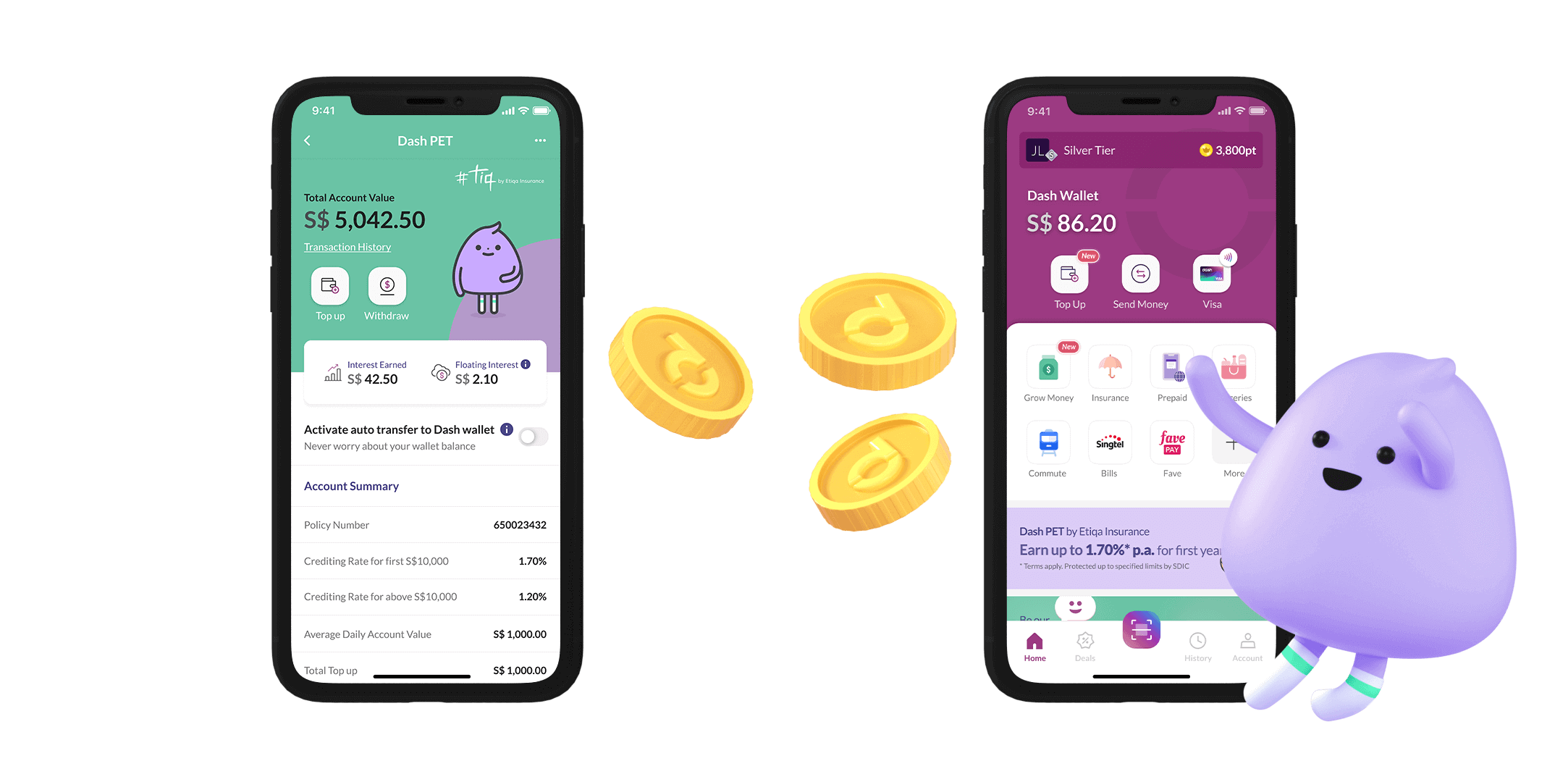
Dash PET on mobile mock-up

Dash PET is as cute and as useful as it sounds. It helps you maximise your money with savings at high returns, gives you guaranteed capital, and full flexibility of funds. As you invest more money into your savings account, your Dash PET will grow and provide a desirable incentive in the long run.

A comprehensive insurance plan focused on achieving simplicity for you; there are no unnoticed loopholes that could cause you problems later. Keep reading to find out the gains of Dash PET.

How can I benefit from it?
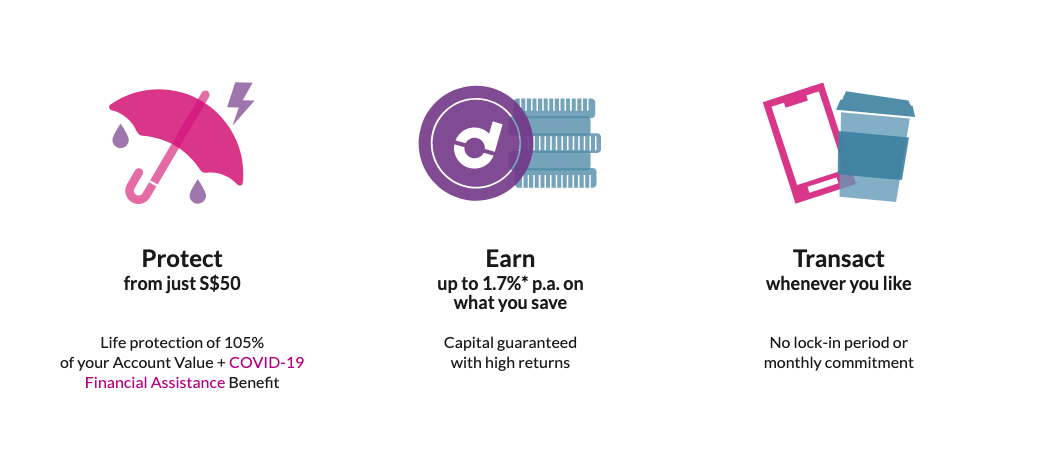
Dash PET benefits

Dash PET has an eclectic range of benefits that are solely focused on bettering your financial health. It also provides you with the support you may need through the pandemic. Worry not about a thing if you face challenging times.

Here’s a breakdown of the main benefits:

  • High returns: It allows you to earn up to 1.7% interest every year* on your savings. As such, Dash PET makes a great plan to have as you continue to accrue your savings.
  • Easy starting requirements: Whether you start with S$50 or S$10,000, Dash PET allows you to begin small and build your savings up to S$30,000.
  • Flexibility: The fear of a lock-in period should not stop you. With Dash PET, there is no lock-in period. This means you can withdraw and top up funds anytime you like without the threat of a penalty.

*First S$10,000: 1.7% p.a. for the first year. Above S$10,000: 1.2% p.a. for the first year.

Is it still not enough to sway you towards the multitude of benefits Dash PET can provide you? Maybe the fact that the policy is administered by the Singapore Deposit Insurance Corporation (SDIC) might give you peace of mind.

Everything else is automatic upon sign-up, so you’re covered without having to take any further action (except for the management of your account).

How do I sign up?

Are you a Singtel Dash user?
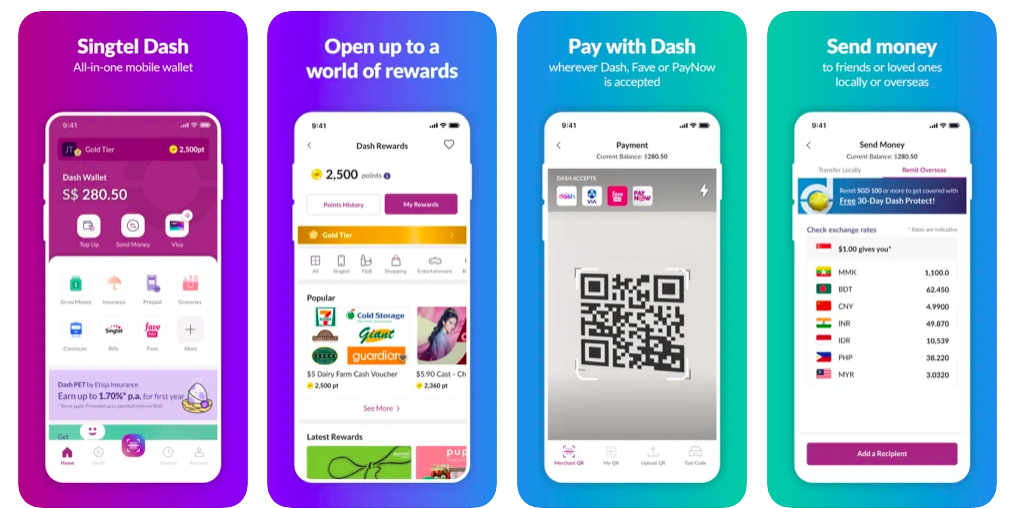
Singtel Dash iPhone Screenshots

Great! If you’re aged between 17 and 75 and have a valid Singapore NRIC or residency/work pass, then you are easily eligible to sign up for Dash PET. You can also check against the eligibility rules set by Etiqa Insurance.

Download the Singtel Dash app right now or click here to kickstart your savings journey today!

Read More...

12 personal money management life lessons to live by

Singapore 50-dollar notes

While we were searching for good reads, we came across Cary Siegel’s “Why Didn’t They Teach Me This in School?: 99 Personal Money Management Principles to Live By”. We’re not even halfway done with the book but already learning so much from the retired business executive.

Here are 12 personal money management life lessons adapted from the book.

#1: Marry someone who has good financial habits
a couple wearing masks for a wedding photo

Image Credits: The Straits Times

If you’re already married, you might agree that money is the top reason why couples fight. It could be very much due to a non-full disclosure during the dating process. Singles planning to tie the knot should learn how to facilitate money conversations to identify each other’s financial habits.

Here are some crucial questions you can ask:

  • How much debt do you have? 
  • At what age do you want to retire?
  • Do you want to have kids? If so, how many and how soon?
  • What is an ideal amount for an emergency fund?
  • Are we ready to leave the workforce to be a full-time parent? If yes, which one of us and for how long?
#2: Stay married to the same person
old asian couple

Image Credits: Pinterest

According to Singapore Legal Advice, divorce fees may cost up to S$3,500 for simplified uncontested divorces and S$10,000 to S$35,000 for contested divorces. Let’s not forget about pre-divorce payments, alimony, and child support charges. Need we say more?

#3: Know the cost of raising kids
asian family with young kids

Image Credits: MindChamps

The obvious expenditures include education, healthcare, clothing, and food. Other costs include moving to a larger HDB flat and getting a new car to shuttle them to school and enrichment classes.

Prudential Singapore has examined various costs involved in the parenting journey. From pregnancy to childbirth and education to recreation, you must plan your finances for the long road ahead.

#4: Buy only when you can afford it
a toy car and car keys

Image Credits: Carsome

When you don’t heed this principle, you will find yourself on a downward spiral to possible bankruptcy. Live below your means, and you will find extra cash to save and invest at the end of the month.

#5: Take care of your stuff
laptop-maintenance

Image Credits: atulhost.com

By stuff, we mean the things you own. It could be your white shirt, your latest mobile device, or even your car. When you learn how to take care of your stuff, you will find them lasting longer over time and requiring fewer repairs or replacements. This equates to more savings!

We wrote an article several months ago with tips to help you apply basic maintenance to your electronic gadgets to help them last longer. Click through the link if you’re keen to find out more details on battery inspection, data clearance, and more.

#6: Build lasting friendships
a group of friends

Image Credits: Visit Singapore

One of the greatest gifts on earth is connecting and learning from people from all walks of life. Whether your secondary school classmates or polytechnic school friends are working within the financial sector or not, there are still personal money management experiences you can tap on from them.

#7: Take away more by giving more
colleagues at work

Image Credits: HealthHub

This applies to your career in the early stages. Do you believe that you take away more from your company by giving more? The extra time and effort you’re donating to a work project can return tenfold because you gain valuable skills, knowledge, and experience by doing. Think of it as getting paid to learn!

With that said, those who are forced to work extra hours, make sure your employer is compliant with the Ministry of Manpower’s (MOM) practices. Click here for some FAQs relating to overtime work and rest days.

#8: Spend an hour per week learning about personal finance
man-reading-on-ipad

Image Credits: ConversionLab

There are tons of free resources online, and a quick Google search can reveal the top-ranking ones. The Straits Times also has an “invest” section you can take advantage of if you’re a subscriber. Don’t underestimate the little hour you spend a week because it’s significant when it adds up over the years.

#9: Enjoy the slow journey to wealth
a man in a suit drinking coffee

Image Credits: unsplash.com

Not all millionaires are made overnight. Do a quick search, and you will probably come across several rags-to-riches stories that will inspire you.

Please note that you don’t have to be exactly like any of the high profiles out there because everyone has their set of money management principles. Find your own and be comfortable in your unique journey to wealth.

#10: Pen down attainable short-term financial goals
a lady writing something with a pen

Image Credits: unsplash.com

Short-term financial goals refer to your quarterly plans or annual ones. This could include the exact amounts for savings and investments. You can also note down personal reward amounts if you’re expecting big purchases. Remember to review your goals frequently and spot the hits and misses.

#11: Set realistic long-term financial goals
person typing on a MacBook

Image Credits: unsplash.com

When you have your short-term plans ready, it’s good to spend some time setting realistic long-term financial goals. If you like it, you may call it “the big picture” or “a bird’s eye view”. Long-term goals could mean you look far ahead in 5 years, 15 years, or even more.

Here’s a look at the author’s long-term financial goals when he was 25:

  • Buy my next car with cash (within 5 years).
  • Pay off all college loans by the age of 30.
  • Own a home by 35.
  • Attain a net worth of $1 million by the age of 40.
  • Own a beach property by age 45.
  • Retire by the age of 50.
#12: Develop a simple net worth statement
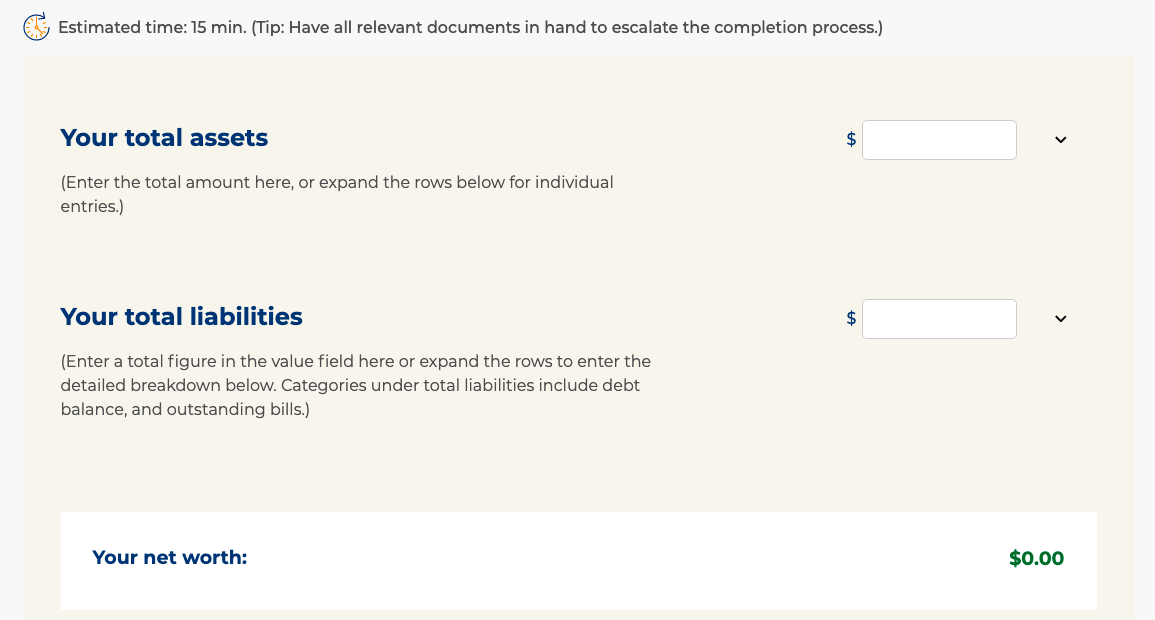
Net worth calculator

Image Credits: MoneySense

There are online resources available to help you find out your net worth. It’s nothing too difficult to understand. For example, MoneySense has a net worth calculator you can use. All you have to do is input your total assets and total liabilities and let the webpage work its magic.

So what are your thoughts on a peek at Siegel’s “Why Didn’t They Teach Me This in School?: 99 Personal Money Management Principles to Live By”?

Let us know if you want more insights from his book, and we will prepare them in the coming weeks. If not, you can also grab a copy yourself and be enriched with more personal money management principles to live by. Happy reading!

Read More...

Financial Missteps Many Experienced Due To COVID-19

The global pandemic has caused recession in many parts of the world. Unfortunately, many Singaporeans found themselves in uncomfortable financial situations. We are slowly recovering with a hopeful heart this 2021. Despite the optimism, it does not erase the effects of the past year.

The economic turmoil exposed most of our financial mistakes and vulnerabilities. Here are just some of the missteps that many of us faced in the past several months.

#1: DIFFICULTY IN BUILDING AN EMERGENCY FUND

Say you did not build an emergency fund before the crisis hit. While we could not have predicted a pandemic, it is always crucial to have an emergency savings to cushion large expenses. A good rule of thumb is to keep up to six months of living expenses in an easy-to-access account. Start now!

#2: INABILITY TO SAVE MORE MONEY

Apart from having an emergency fund, one of the lessons that we learned during the pandemic is the importance of savings. Putting this knowledge into practice is harder than it seems. In a local survey, 55% of the respondents said they reduced their savings over the past months. This may be due to job loss, reduction in income, and other financial struggles due to the situation. Creating opportunities for other streams of income can help widen the savings.

#3: PUTTING A PAUSE ON THE RETIREMENT PLAN

Retirement may not be the first thing most people think about when they are still young, but it is a part of our financial plan that we cannot afford to ignore. Like it or not, there will come a time when you are no longer able to work. Your retirement plan must not stop due to a recession.

However, many Singaporeans found it hard to continue investing for their future due to the current climate. In fact, 27% of those with financial plans said they have stopped setting aside or even reduced their funds for retirement.

#4: MAKING EMOTIONAL FINANCIAL DECISIONS

Volatility has abounded lately. When you see your balance go down, do not allow yourself to make an emotionally driven decision. View it pragmatically as you are in it for the long haul. Remember how and why you originally structured the portfolio. If your circumstance have changed or your allocation no longer aligns with your goals, you should consider making risk changes.

Image credits: pixabay.com

It is crucial to stay engaged in the financial world. Take this uncertain times positively by creating more awareness around your financial health and goals. Talk to a financial professional to help you implement these goals.

Sources: 1 & 2


Read More...

4 Reasons You Need an Estate Plan in Singapore

You live in a leasehold HDB flat, and you don’t possess millions of dollars in assets. By all accounts, you don’t really have much in terms of fortune—the type that is possessed by the crazy-rich scions of wealthy families and the kind that is romanticised in movies and TV shows. So why exactly should you have an estate plan when it looks like it’s going to be a walk in the park disposing of your assets anyway when the time finally comes for you to bite the dust?

There are several important benefits to having an estate plan in Singapore. In this short guide, we’ll quickly go through some of them.

Estate Planning Will Allow You to Dispose of Your Assets According to Your Wishes

The quick answer to the question of why estate planning is important is quite simple: it is a legal and effective method of making arrangements to manage your estate and financial affairs when you pass on. If you don’t have a will, a trust, or a lasting power of attorney, your assets will be distributed according to Singapore’s intestacy laws, supplanting your actual wishes on how you may have wanted them disposed of.

Imagine the amount of frustration and heartache your loved ones may have to go through when it is the state that gets to have the final say about what to do with the assets you leave behind. Designating your beneficiaries and appointing “attorneys” who can act on your behalf can save your family members the time, money, and aggravation while ensuring that your estate is distributed exactly in the manner that you desire.

An Estate Plan Takes Care of Your Dependents

We’ve already established that estate planning benefits not only the rich; it also benefits just about every other person of legal age in Singapore. However, it’s most especially advantageous to those with dependants, like children, elderly parents, or family members with disabilities.

This is the most important element of estate planning: designating your heirs no matter how much or how little you might have. You get to have a say what happens to your savings, investments, and real properties should something happen to you. You’re able to make sure that your loved ones are taken care of and that they will benefit from the wealth you’ve accumulated specifically for the purpose of providing for them in the first place.

Estate planning will also allow you to determine what happens to your CPF savings after your death. Because CPF savings—like the balances you might leave behind in your Ordinary, Medisave and Special or Retirement Accounts—are not considered part of your estate, it is important for you to make a CPF nomination. Otherwise, your CPF savings will be transferred to the Public Trustee’s Office (PTO), which will then distribute your assets to your family depending on how they see fit. This will be done according to the Intestate Succession Act Singapore citizens abide by.

Creating an Estate Plan Also Helps You Prepare for Your Own Needs

It’s true that an estate plan allows you to elect your heirs when you pass away, but did you know that estate planning can also help you prepare for your own needs in the event that you lose your mental capacity or become unable to make decisions for yourself?

Estate planning can help you appoint people you trust to act on your behalf through a legal document called a Lasting Power of Attorney (LPA). Doing so will allow you to safeguard your interests and give you peace of mind, knowing that your loved ones can make decisions for you should you ever lose your ability to make financial and legal decisions while you are still alive.

Take note that members of your family are not automatically given the right to legally act on your behalf, a fact that can hinder their ability to look after your needs. Only an LPA can make sure that they will be able to manage your estate legally and make arrangements for your everyday care.

Estate Planning Will Prevent Conflicts from Erupting within Your Family

What’s worse than dying and not having a say in whether or not the people you love will benefit from the estate you leave behind? It’s probably dying and having members of your family fight over your money and properties. It’s the kind of drama that you’ve probably seen somewhere on television before, one that can get really ugly and leave you rolling over in your grave.

Creating an estate plan allows you to preemptively terminate such conflicts. By designating who is legally responsible for your assets when you become mentally incapcitated, or by deciding how much each of your heirs will get when you pass away, there will be no room for strife to occur. You’ll also be able to prevent any relatives you might hate with a passion from even attempting to get a share of the pie, which is probably one of the most desireable benefits of protecting your assets with an estate plan.

Estate planning is not just the domain of the rich and the powerful in Singapore. Anyone with any amount of assets will benefit from the protection that a well-thought-out and well-executed estate plan brings. It can be a complex and challenging process, but it’s a necessary one that will make your family more ready to face the uncertainties of a future without you.


Read More...

Businessman loses litigation against kids over gold bars passed on to them

gold bars

A retired Indonesian-Chinese businessman, Mr Soemarto Sulistio, challenged four of his children to return his wife’s 122 gold bars but lost his lawsuit here in the High Court.

The story goes something like that. In 1989, Mr Sulistio and his wife Soemiati purchased gold bars using their joint account at the United Overseas Bank in Singapore.

At first, the couples kept the gold bars under both their names. But Mr Sulistio, now 87, signed documents to pass possession to his wife in 2016. In 2017, she passed away. He later learned that she had willed the gold bars to four of their five children.

Sued his children following an unsuccessful challenge to the will
sued in court

Image Credits: The Australian

He sued the four after a failed appeal to her will in Hong Kong. The signing of the documents did not modify the original intention to preserve the gold bars as joint possessions, Mr Sulistio said.

He asserted that he was the rightful owner of the gold bars, as the sole survivor. But Justice Valerie Thean rejected his claims.

The judge claimed in a written decision that there was no doubt that the pair originally had a collective goal of possessing the gold bars for their mutual good. However, she noticed that there was enough convincing evidence of a shift in their aim in 2016.

Signing of certificates as part of a wider agreement

Justice Thean discovered that as a component of a larger deal between the pair, Mr Sulistio endorsed the documents. It turns out that Madam Soemiati had requested for the gold bars in return for having their son Rudy to handle their Indonesian territory.

Mr Rudy was left out of the will of Madam Soemiati and came to the defence of his father in the lawsuit.

According to the judge, Madam Soemiati wanted to possess the gold bars for her interests. That is, if she were to pass on without using the gold bars, she would like to favour the defendants.

The couple’s marriage broke down in 2012
rose gold wedding bands

Image Credits: The Wedding Vow

In the 1950s, Mr Sulistio and Madam Soemiati were married and had three daughters and two sons. They stayed in Hong Kong as a couple.

Their daughters said their parents’ relationship deteriorated in 2012. It was partly because of the strained relationship between Madam Soemiati and Mr Sulistio’s nurse. Their eldest daughter suggested that Madam Soemiati was disappointed that the nurse bullied her, but Mr Sulistio did little to rectify the issue.

An attempt to guarantee her financial security

The court acknowledged the defendants’ allegation that the gold bars’ legal movement was part of an arrangement under which Madam Soemiati sought to ensure her financial stability.

Madam Soemiati, who was severely ill with increasing medical costs, was worried that her savings were depleted. This was due to vast amounts of money moved from joint accounts with her spouse to Mr Rudy.

Mr Rudy also did not dispute the acquisition of roughly US$7.2 million (S$9.5 million) between 2010 and 2016. Furthermore, according to the verdict, at least US$1 million remains unsubstantiated for.

Read More...