

7 challenges to help you save more money

Singapore currency

Are you beginning to plan for your financial future? Or are you hoping to make a down payment on a big purchase or preparing to start a family?

Saving money is an integral part of personal finances, but it can be hard to refine and practice. For some, saving money can feel downright impossible! However, with practice and patience, you can turn a new leaf on your money-saving journey.

Need some motivation? Building up your savings account can be easier if you take on these money-saving challenges that are sure to guide you to more excellent financial health in the near future.

#1: Introduce a “no extra spend” week

One of the hardest things to do when saving money is figuring out where in your budget that extra cash will come from.

Cutting out excess spending can be a great way to create more cash flow, but it’s important to ease into it so you don’t become overwhelmed and give up too quickly. Try setting aside a single week and limit all your spending to absolute essentials: bills, groceries, and any necessary transport costs.

#2: Exercise the 1% trial

1 per cent

Image Credits: blackthorn.io

The 1% challenge is a well-known financial trend to help get in the habit of automatically setting aside a portion of your income every month for your savings.

Determine a small percentage of your monthly income (be it 1%, 5%, or even 10%) and arrange an automatic transfer that pulls that money into your savings account as soon as your paycheck lands. Over time, that will build up into some substantial added savings!

#3: Clear out your food pantry

Especially since the pandemic has made food delivery so inviting, it can be hard to remember what’s left in your food pantry. We know just how it feels like as foodpanda-ing or dapao-ing something is much faster and convenient.

But still, you want to force yourself to clean out all the food in your cupboards and intentionally cook or use up everything you have been storing for too long. This will aid you to save money and make more space in your kitchen!

#4: Borrow, don’t buy

a lady asking if she can borrow a dress

Image Credits: thespruce.com

Are you struggling with the need to bring in new items but don’t want to spend the cash? Try swapping out buying for borrowing for a month.

Every time you feel the urge to purchase something new, see if a friend or coworker (or even a close neighbour) has a version you can borrow. You would be surprised by how much money you save just by sticking to this principle!

#5: Set aside your spare change

Do you use a lot of cash daily? Start saving even more of that money by designating a certain amount as your spare.

For example, it can be a simple S$1 coin. Every time you receive S$1 from your favourite aunty at the Kopitiam, drop it into a piggy bank. These spare change can add up!

Check out a range of visually appealing piggy banks from Lazada here if you need help getting started.

#6: Give yourself 52 weeks

white and gold calendar template

Image Credits: unsplash.com

Other than the 1% challenge introduced earlier, the 52-week challenge is also one of the most famous money-saving techniques.

It has you begin setting aside a small (and increasingly growing) amount of money every week. That money sits in a jar or drawer and increases with every new week when you add to it. The best thing is that you just need to start with a dollar from the first week.

Keep increasing a dollar as you go (S$2 in the second week, S$3 in the third, and so on), and by the end of your 52-week challenge, you would have saved a little less than S$1,400!

Or if you think you can raise your game, why not go for the 365-day difficulty instead? This means rather than saving an amount each week; you do it for every single day of the year. But do set a realistic amount lest you backslide and abandon the whole challenge altogether.

#7: Sell your stuff online

There are several platforms to sell your stuff online. Ladies with neverending piles of clothes can try selling their clothes with Refash. Simply pack, send, and receive cash or credit in 30 days! Click here for more information.

For more general kinds of stuff, you can check out Carousell if you haven’t already. I’ve personally sold a couple of items on the Singapore-based app and think it’s a rather innovative platform for buyers and sellers to interact.

Or since most of us own a Facebook account, why not try Facebook Marketplace? You can easily create a listing under various categories, including home goods, pet supplies, and even properties for rent/sale.

Beware of scammers, though.

Final thoughts

a woman standing in front of a kitchen cupboard

Image Credits: ediblecommunities.com

You don’t have to take on the abovementioned challenges all at once since that would be overwhelming. Pick and partake in the ones you think are interesting and feasible. For example, after reading this article, why not put down your phone and start emptying your food pantry?

Little actions can lead to unexpected outcomes. Keep at it!
Read More...

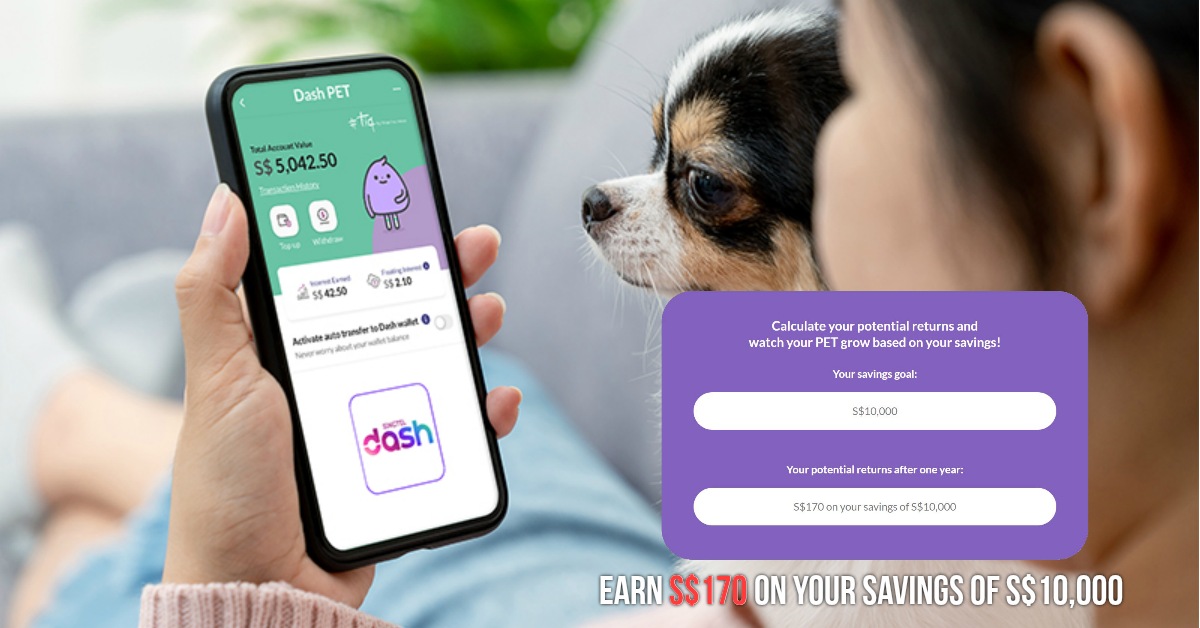
New Insurance Savings Product: Dash PET offers 1.7% p.a.* on the first $10,000!

* Update 27 April 2021: The crediting rates for new Dash PET sign ups with effect from 27 April 2021 will be 1.3%* p.a. for the first year for the first $10,000, and 0.3%* p.a. for the first year for amount more than $10,000. Crediting rate is non-guaranteed.

Dash PET by Etiqa Insurance, the latest insurance savings plan available on Singtel Dash, allows users to Protect, Earn and Transact – basically taking care of you! You can earn up to 1.7% p.a.* with no additional criteria required, making it absolutely hassle-free! At 1.7% p.a.*, this makes Dash PET highly attractive especially given the current climate of uncertainty and falling bank savings interest rates. Here’s how Dash PET can take care of you.

Singtel Dash is an all-in-one mobile wallet for your everyday needs, from your commute to paying at your favourite hawkers, supermarkets and restaurants, and even for your online purchases.

Enjoy attractive returns with capital guaranteed

Earn 1.7% p.a.* for your first S$50 – $10,000, and 1.2%* for amounts above S$10,000! This means that up to the first S$30,000 earn attractive returns of $410 (1.37%) per year. Ensure that you maintain a minimum account value of S$50 to start earning these high interest rates on your funds. You will be glad to know that your capital in Dash PET is guaranteed.  It also comes with SDIC protection.

You won’t be kept on a tight leash with Dash PET (pardon the pun)

This insurance savings product offers the ultimate flexibility by having no lock-in period. Once your account is active, you can top up your funds anytime! This can be done at your convenience via Dash wallet or PayNow from S$1, or via eNets (minimum S$50 top up).

If you wish to use your money, you may withdraw anytime from S$1 to your Dash wallet (free) or to your bank account via PayNow (S$0.70 transaction fee applies for each transaction).

Highly accessible given low entry barriers

Some financial instruments in the market may require hefty contributions or long lock-in periods, which may not fit into some people’s financial needs. With Dash PET, all you need is S$50 to start saving and insuring. For instance, students can save their allowance or internship pay into Dash PET first to earn attractive returns. They can then withdraw via their Dash wallets to pay for their everyday expenses like their favourite bubble teas and even hawker meals.

Self-employed or gig economy workers who may not have regular monthly income can take advantage of Dash PET to save as it does not require them to complete the myriad of tasks required (e.g. meeting monthly salary crediting, minimum spends, etc) to unlock bonus interest rates.

Finally, there is no fall-below fee if the account runs low, so savers are not penalised when they have higher expenses for the month. One thing to note though, you’ll need to maintain at least S$50 average daily Account Value for the calendar month to enjoy the rates of return and Dash PET benefits.

Takes Care of You

The value provided by Dash PET is immense. It allows your capital to grow at an attractive rate, offers the flexibility for you to withdraw funds for everyday expenses and protects you by offering insurance coverage. Furthermore, the Protect element comes from the layer of insurance coverage of up to 105% of account value in case of death as well as financial assistance benefit for Covid-19.

As demonstrated, Dash PET is the PET that takes care of you by helping you to save and insure better!

All it takes are 3 simple steps to start your savings journey with Dash PET:

  1. Download the Dash mobile app (if you are not an existing user)
  2. Sign up for Dash PET through the Dash mobile app
  3. Top up your Dash PET account from either Dash Wallet, eNets or PayNow

In these uncertain times, it is prudent to consider safe and flexible options to start saving smarter and allow your hard-earned savings to work harder. With Dash PET, Singtel Dash aims to be the companion app for saving, insurance, payments and more!

Disclaimers

  • The information is meant purely for informational purposes and should not be relied upon as financial advice.
  • Dash PET is not a bank account or a fixed deposit. It is an insurance savings plan that earns a crediting interest rate.
  • * Guaranteed 1% p.a. + 0.7% p.a. bonus on first S$10,000 for first policy year. Guaranteed 1% p.a. + 0.2% p.a. bonus on above first S$10,000 for first policy year.
  • This policy is underwritten by Etiqa Insurance Pte. Ltd. (Company Reg. No. 201331905K). This advertisement is for general information only. Terms apply. Full details of the policy terms and conditions can be found in the policy contract on dash.com.sg/dashpet. Protected up to specified limits by SDIC. As buying a life insurance policy is a long-term commitment, an early termination of the policy usually involves high costs and the surrender value, if any, that is payable to you may be zero or less than the total premiums paid. You should seek advice from a financial adviser before deciding to purchase the policy. If you choose not to seek advice, you should consider if the policy is suitable for you. This advertisement has not been reviewed by the Monetary Authority of Singapore. Information is accurate as at 1 February 2021.

Read More...

Things to contemplate when your parents ask you for money

dad and son talking

As your parents grow older, they may require extra money. Medical bills, unexpected repairs, or lifestyle needs may drive them to ask you for financial help.

It could also be due to the instability in financial markets affecting their retirement funds. Or they may be concurrently facing many of these problems. As their beloved child, you want to help – but the question is – is it a good idea to give them money?

Here are some things to contemplate before you decide if you should or should not.

#1: Their reasons for needing more money
an old woman staring in the blank

Image Credits: mtalvernia.sg

When you’re considering giving your parents money, it is essential to understand why they need the money. Understanding the reasons will help you determine the best way to assist them. 

Maybe it could be a loss of income or savings? Or it could be a hike in sudden expenses related to home/car repairs or medical spendings that exceed your parents’ financial means. These situations are relatively straightforward, and it would be appropriate for you to extend a hand.

On the other hand, if they need money because of bad financial choices – gambling or alcoholism – you should rethink the situation. In such circumstances, financial assistance might be enabling your parents, not supporting them.

So what’s the difference?

#2: Contrast between supporting and enabling
a woman holding an elderly's hand

Image Credits: SIM GE

There’s a subtle difference between ​supporting and enabling​ your parents. Supporting someone is providing them access to a need they are not able to meet. While enabling someone is when you are doing something for them that they should be doing on their own (or should not indulge in at all). 

Giving money to your parents to help them pay bills, maintain their home, or go through a minor surgery are examples of supporting them. But if your mum or dad bust the month’s budget on Toto and beer, lending them money may reinforce their negative behaviours and be harmful in the long run.

#3: Is it within your means?
budget-calculation

Image Credits: wallpaperflare.com

Once you have understood the nature of their problem and decided to help, you must evaluate if it’s within your means. Consider these questions now:

  • What are your financial resources?
  • Do you have surplus income or cash at hand?
  • Do you have liquid assets available, or can you sell surplus possessions or investments?
  • Can your brothers and sisters help, and if so, to what degree?

No matter the need, you should not overextend your finances or jeopardise your financial future. Putting yourself deep into debt to support your parents, or putting off a significant life event such as buying a home or having a child, is unwise.

Straining yourself by giving more than you can afford can lead to feelings of bitterness and resentment. Trust us; this will become ​a major source of stress in your life​ as you age and face your own set of money problems later.

#4: Have you talked with your partner?
a couple having a serious conversation

Image Credits: Everypixel

If you are married or in a long-term committed relationship, you must include your partner in your financial decision-making.

It is likely that your spouse doesn’t feel comfortable or render the situation feasible to give your parents money. That’s why having a dialogue is a basic form of respect for each other.

Should your partner be welcoming of the idea, you should establish in clear terms how much money you are giving or lending your parents and what the agreements are. You should also evaluate the likely needs of your partner’s family needing financial aid soon.

Factoring all the above can aid you in making better money calculations.

#5: Do you have a set of terms?
writing something on a notebook

Image Credits: unsplash.com

Before writing your parents a cheque or handing them a stack of cash, you must put forth a definite set of terms. Here are some questions to guide you:

  • Is this sum a gift or a loan?
  • Have you agreed to a one-time loan, or is it an ongoing disbursement?
  • Where will this money be immediately spent?
  • Will they repay you – and if so, when and how?

Having a detailed conversation with your parents is essential. If your parents are okay with it, ask them to put the agreement in writing. This could minimise potential conflicts and finger-pointing as time goes by.

Find other ways to help

Those who do not have the financial means to assist their parents should not worry too much. There may be other ways to offer a hand.

For example, you can hands-on the minor home or automotive repairs or get them their weekly groceries. You can also work with them to find less expensive solutions to the problems that led them to need money in the first place. Or maybe you can offer some advice on planning a budget.

The help your parents need may not always be in the form of cold hard cash. Take some time to contemplate the points mentioned in this article to determine whether it is good to give your parents money. We hope you will settle on a suitable approach to the issue soon!

Read More...

Why Rewarding Yourself Is Important

John Maxwell once said: “Everybody wants money, yet seldom will anyone budget or control their spending.”

Setting financial goals is an easy task! Reaching these goals is another story. You may intend to purchase your first designer bag or to go back to school this year, but you are still building your funds for it. Moreover, you may have set some financial goals that are harder than you anticipated. Putting these goals into action is the first hurdle that you have to pass.

The second hurdle is reaching the finish line without losing your motivation. The solution to your problem is placing an efficient reward system. Rewards and actions have close association. Think about it! You perform an action expecting an outcome or a reward in the end. Though rewards do now always show up as a trophy, you can expect some form of return. Every time you receive a reward, your body releases a neurotransmitter called the dopamine. It plays important roles in executive functions, motor control, motivation, arousal, reinforcement, and reward. It also plays a role in lower-level functions including lactation, sexual gratification, and nausea. Simply put, it affects how we feel pleasure.

Dopamine spikes in your brain when something important is about to happen. It gives you a surge of pleasure as you finish a task. In turn, it increases your motivation and productivity. Use this knowledge to your advantage. Give yourself small rewards along the way to achieve a bigger goal. You may indulge at the end of the month by rewarding yourself with 5% of your hard-earned savings. Use this money to get a well-deserved treat after the whole month’s work. It will surely keep you going!

As long as you set aside a responsible amount of money, take your mind off the expenses that come with your small reward. Relax! Take these suggestions:

1. Take yourself out to breakfast or brunch.
2. Read a book for 15–30 minutes.
3. Watch an episode of your favorite Netflix series.
4. Listen to your favorite playlist for 15 minutes.
5. Buy a delicious dessert.
6. Enjoy an at-home spa day.
7. Paint, sew, or knit something.
8. Turn off your devices for an hour.
9. Indulge in a long shower.
10. Diffuse your favorite essential oils.
11. Write in your journal.
12. Watch the sunset.
13. Jog for 15-30 minutes.
14. Get a new water bottle.
15. Get a manicure or a pedicure.

Every action is tied to some outcome. The problem is, the result is not always immediate. You will not lose weight overnight. You will lose body fat over time. While waiting, you may lose the motivation to keep going. Hence, putting a simple reward system may help.

Rewards can act as psychological enforcers when you use it as a means of motivation to reach a particular goal. When done right, the natural process in the brain can be used to help you stay on track with your financial goals. The magnitude of the reward is not directly proportional to motivation. Even the smallest treats can get you pumped up for the rest of the month. Use the abovementioned list as a guide to help you put your reward system in place.

Sources: 1 & 2

Read More...

Tips on overcoming analysis paralysis in investments

investment risks

Many people face analysis paralysis when making decisions. Do you know what the term means?

According to Healthline, analysis paralysis is a type of overthinking which results in a neverending loop of “what if this, what if that” scenarios.

Vicki Botnick, a therapist from California, shares that our decision-making process usually involves a list of options. As we progress, we begin narrowing this list down, removing choices that are unfeasible. But a person with analysis paralysis will often find themselves trapped.

“They feel ever-expanding, endless, and all equally probable,” she adds.

What is analysis paralysis in investments?
a stressed man in front of a laptop

Image Credits: esquireme.com

Putting things into perspective in the financial realm, analysis paralysis makes perfect sense too. In this case, it refers to a situation where you overanalyse investments so much that your ultimate decision becomes paralysed. You end up freezing and are not able to make a move.

Sounds familiar? Do you find yourself not acting on the plan you have made after all those time spent in planning? If you are stuck on making a decision, then it is about time you stop being in a state of analysis paralysis.

Investing is not that difficult if you’ve done your due research. The only thing you probably need right now is the courage to jump in and start! While it’s not guaranteed that you will make money or succeed, take heart if you have a promising investment strategy.

For those who are still sitting on the fence and waiting for the right moment to take the first step, this article will help you. It’s time to hold back no more and get your head in the game.

#1: Don’t be a perfectionist

via GIPHY

Those undergoing analysis paralysis often end up waiting for the perfect scenario. You need to know that such occasions don’t come by often, and you will only end up wasting time and effort.

For example, some investors were sitting on the fence of Netflix Inc (NASDAQ: NFLX). Yes, while it’s true that they have burnt billions to build the business, with many questioning their business model, 2021 might be their year to becoming self-sustainable.

If you’d trusted your guts with Netflix against what other investors thought, then maybe you wouldn’t have to deal with their recent share price spike of over 10%. Be a perfectionist in investing, and we assure you there will be a slow success.

#2: Narrow down on what matters
priorities

Image Credits: romania2019.eu

Many time, overthinking happens when you don’t have an idea of what to focus on. That is why we’re suggesting that you narrow down on what matters. In other words, prioritise the main objectives regarding your investment strategy.

Let’s say you’re considering between these three:

  • ETFs that track benchmarks
  • Growth technology companies
  • Value consumer discretionary companies

Rather than going with all at one go, it would be wise to start investing with just one or two to get your engine moving.

This perfectly leads us to the next point.

#3: Scale as you go

via GIPHY

Whenever you are thinking about investing, try to start with a small amount. Don’t get fooled by “experts” who advise you to go big or go home.

So, what is the right amount to start with? We think a few hundred dollars is an ideal sum if you’re new to the venture. Once you’re comfortable dealing with the market fluctuations, you can gradually increase the stakes with higher-risk investments.

Starting small is a direction that works not just in investments but life in general too. This is especially true if you’re entering as a greenhorn.

#4: Cut out neighbouring negativity
two-business-people-having-serious-discussion-in-the-office

Image Credits: The Balance Careers

It also pays to not dwell too much into the negative news about losing your money.

The main point here is that if you have a sound strategy, then all is well. You don’t need to listen to friends or neighbours who are discouraging your idea of investing money in the stock market.

While other people’s pitfalls are good to know, shut it out if you know it will only hold you back. Ultimately, it’s your money you’re playing with, and you possess the key to unlocking the door of investments.

#5: Welcome a little impulsivity

via GIPHY

Don’t get us wrong when we say to welcome a little impulsivity. We assume that you’ve spent a considerable amount of time crafting a solid investment strategy. If so, then maybe what you need is that little nudge of impulsivity to get started.

Research done by automated investment firm Stashaway revealed that impulsive investors who withdrew their money during a market correction lost about 2.2% on average. That’s why we want to reiterate that hasty investments will do you no good in a general sense.

Please don’t take this piece of advice out of context.

Final thoughts

The stock market will not stop for you. As Professor Karyl Leggio of Loyola University Maryland rightly points out, “The reality is you aren’t able to time the market. Over time, you miss more opportunities than you save by trying to time the market.”

Continue letting analysis paralysis grab hold of you, and you will be missing out on several golden investment chances. Recognise that you don’t have to be a perfectionist to begin. Focus on what matters, start small, and don’t get buried in negativity.

Take that little spontaneous step forward, and good luck!

Read More...