2025 GSTV Payout Guide: What You Get & When

The GST Voucher (GSTV) Scheme for 2025 continues to provide vital financial support to help Singaporeans handle everyday costs arising from rising prices. It’s part of the larger Assurance Package, alongside Community Development Council (CDC) vouchers. The scheme comprises four key components designed to benefit different needs: GSTV Cash, U‑Save utility rebates, MediSave top‑ups, and Service & Conservancy Charges (S&CC) rebates.

Let us start with GSTV Cash. It is available to Singapore citizens aged 21 and above with an assessable income of S$39,000 or less and who own at most one property with an annual value (AV) of S$31,000 or less. Applicants in homes with AV up to S$21,000 receive S$850, while those with AV between S$21,001 and S$31,000 receive S$450. 

Next, MediSave top‑ups are offered to Singaporeans aged 65 and above, subject to the same AV and property criteria . Recipients aged 65–74 receive S$250 (AV ≤ S$21,000) or S$150 (AV up to S$31,000); those aged 75–84 receive S$350 or S$250; and those 85+ are awarded S$450 or S$350.

Thirdly, U‑Save rebates are provided quarterly to eligible HDB households that have at least one Singapore citizen and must not own more than one property. These rebates are automatically credited to SP utilities accounts in January, April, July, and October 2025. The quarterly amounts are S$95 for 1‑ and 2‑room flats, S$85 for 3‑room, S$75 for 4‑room, S$65 for 5‑room, and S$55 for executive or multi‑generation flats.

Lastly, S&CC rebates offset town council charges and are similarly credited quarterly. Depending on flat type, households receive between 1.5 and 3.5 months’ worth over the year, including a bonus half-month rebate in January 2025.

PAYOUT PROCESS

To receive GSTV Cash, register for PayNow‑NRIC by 27 July 2025 or update your bank details by 28 July. Payouts begin on 6 August via PayNow‑NRIC, 15 August via direct bank credit, and 22 August via GovCash for those without bank accounts. MediSave top‑ups are credited from 11 August 2025 for those already signed up or who sign up by 13 July 2025. Later registrants (14 July 2025 to 20 June 2026) will receive their top-up within two months of signing up. On the other hand, no action is needed for U‑Save or S&CC rebates as they’re automatically applied.

You can check eligibility, update payment details, or review payout statuses through Singpass or at govbenefits.gov.sg.
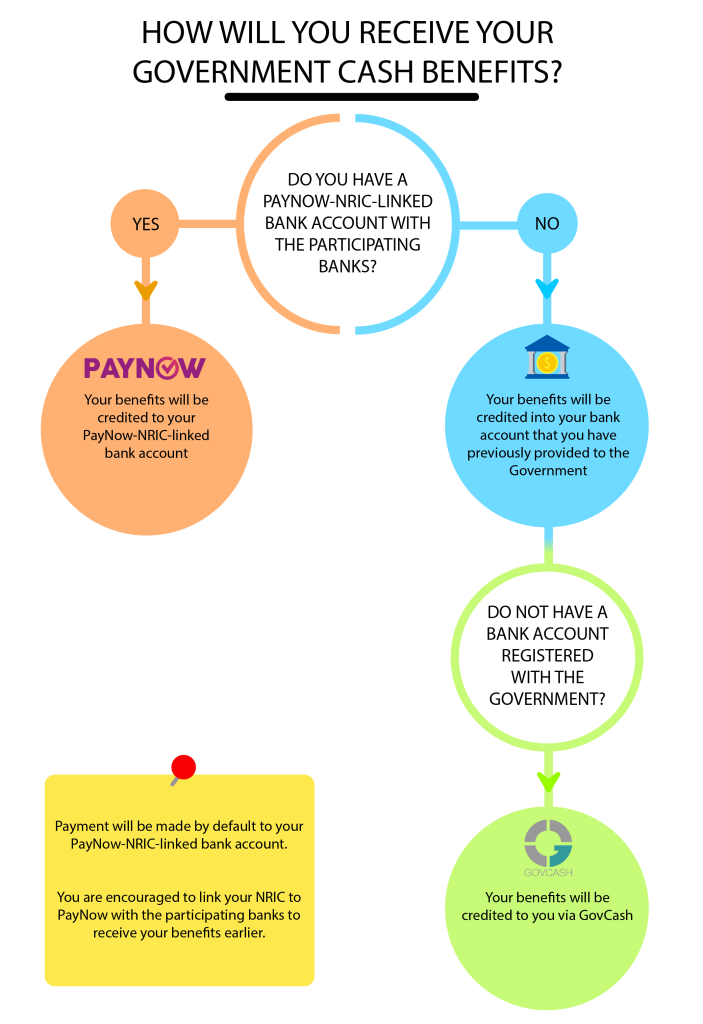
Image Credits: govbenefits.gov.sg

IN SUMMARY

The following is a quick summary of the key details above to help you better understand the 2025 GST Voucher benefits. Do check govbenefits.gov.sg regularly for the latest updates, as details may change.

GSTV Cash

  • S$850 for AV ≤ S$21,000
  • S$450 for AV between S$21,001–31,000
  • Income limit: S$39,000 or less (YA 2024)

MediSave Top‑ups (age 65+)

  • S$250 (AV ≤ S$21,000) or S$150 (AV S$21,001–31,000) for ages 65-74
  • S$350 / S$250 for ages 75–84
  • S$450 / S$350 for ages age 85+

U‑Save Rebates (quarterly)

  • S$95 (1–2 room)
  • S$85 (3‑room)
  • S$75 (4‑room)
  • S$65 (5‑room)
  • S$55 (executive/multi‑gen)

S&CC Rebates (quarterly)

  • 1.5 to 3.5 months’ worth based on flat type (+0.5 month in January 2025)

Payment Dates

  • GSTV Cash via PayNow‑NRIC: From 6 August 2025
  • Bank crediting: From 15 August 2025
  • GovCash: From 22 August 2025
  • MediSave: From 11 August 2025

Actions Required

Image Credits: unsplash.com

  • Link PayNow‑NRIC by 27 July 2025
  • Update bank details by 28 July 2025 (if needed)
  • Register for MediSave by 13 July 2025; later registrations processed in ~2 months 
    Sources: 1 & 2

Read More...

July 2025 BTO Launch: Price Estimates, Hot Estates, & What to Expect

BTO VS RESALE

If you are planning to buy a flat in Singapore, chances are you are considering an HDB Build To Order (BTO) flat. These are brand new homes that are only built once demand reaches about 70%, with a waiting period of around three and a half years. The appeal? A fresh, never-before-lived-in home at subsidized prices.

Unlike resale flats, which are ready for immediate move-in, BTO flats require some patience. But for many Singaporeans, they offer better long-term value and appreciation potential.

JULY 2025 BTO LAUNCH

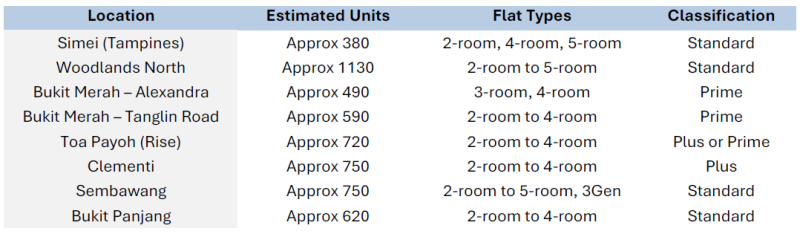
The July 2025 BTO launch is one of the largest in recent years, with about 5400 flats across 7 locations, offering a range from 2-room Flexi to 5-room units, including 3Gen options for multigenerational families. Both mature estates like Bukit Merah and Toa Payoh and non-mature towns like Woodlands and Sembawang are in the lineup.

And yes, Simei is finally back on the map after over a decade! For East-side fans, that is big news.

WHERE ARE THESE FLATS LOCATED?
PRICE ESTIMATES?

While official prices for the July 2025 BTO launch have yet to be released, past launches offer useful benchmarks. In Toa Payoh during the February 2023 exercise, prices started at around s$90,000 for a 2-room Flexi flat, approximately S$351,000 for a 3-room unit, and from S$395,000 for a 4-room flat.

Over at Tanjong Rhu Parc, which was classified under the Prime model, a 3-room flat was estimated to start from S$309,000, while a 4-room unit began at roughly S$493,000. In Yishun, buyers could expect lower entry prices, with 3-room flats from about S$140,000, 4-room flats from S$236,000, and 5-room units starting from S$392,000.

These figures are based on previous exercises and should be viewed as general guides. Final prices for the July 2025 BTO launch may differ, so always check the official HDB website for the latest information.

WHAT DRIVES BTO PRICES?

Common factors that affect pricing include:

a. Location: Mature estates like Bukit Merah, Clementi, and Toa Payoh tend to cost more due to their amenities, transport links, and schools.

b. Flat Size: Bigger flats like 5-room units come with higher price tags.

c. Lease Length: This applies more to resale flats as shorter leases typically mean lower prices.

d. Grants: First-time buyers can qualify for schemes like the Enhanced CPF Housing Grant, which can shave off a significant amount from the total cost.

WHICH ESTATES STAND OUT?

a. Bukit Merah and Toa Payoh
Expect high demand here. These mature estates offer great access to the city, popular schools, and public transport. Projects in these areas may fall under the Prime or Plus classification, which means longer minimum occupation periods and stricter resale conditions.

b. Simei
After over a decade without a launch, Simei is back. Located near Upper Changi MRT, SUTD, and Changi General Hospital, it is ideal for families and East-siders looking to stay in a familiar zone.

c. Woodlands and Bukit Panjang
More affordable, with room for growth. These estates are increasingly attractive to younger buyers who want value and space.

d. Clementi and Sembawang
Clementi continues to appeal to families due to top schools and mature estate convenience. Sembawang, meanwhile, offers rare 3Gen flats, perfect for bigger households.

CHECK THESE OFF BEFORE YOU APPLY

Image Credits: unsplash.com

  • Confirm your eligibility: citizenship, income ceiling, and household structure
  • Understand the classification of your preferred project: Standard, Plus, or Prime
  • Look into transport, schools, and workplace distance
  • Sort out your finances: CPF Ordinary Account, HDB loan eligibility, and housing budget
  • Stay tuned to HDB announcements for application dates and official price lists

IN A NUTSHELL

Whether you are looking for your very first home or aiming to move closer to family, the July 2025 BTO launch is packed with potential. From familiar mature estates to under-the-radar growth towns, now is the time to shortlist your picks and prepare for the ballot.

Sources: 1,2,3 & 4

Read More...

Why Singapore’s New Luxury Condos Are Becoming the Go-To Investment Amid Global Uncertainty

Singapore private property

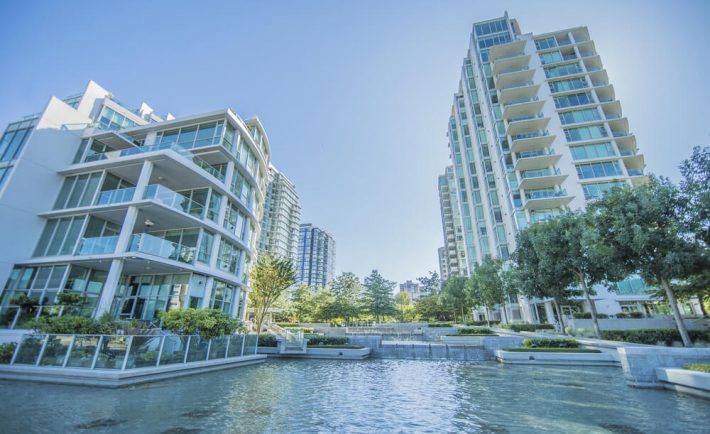
As global markets reel from inflation, rising interest rates, and geopolitical tensions, investors are increasingly turning to real estate as a safe harbour. In particular, Singapore’s new wave of luxury condominiums is capturing attention from both local and international buyers looking for stable returns and long-term capital appreciation. Flagship developments such as One Marina Gardens condo and The Myst Condo are leading this surge, offering not just high-end living but also powerful investment potential. Here’s why luxury condos in Singapore are quickly becoming the preferred asset for savvy investors navigating uncertain times.

Singapore’s Political and Economic Stability Is a Major Draw

Amid global volatility, Singapore’s reputation for stability makes it a natural magnet for capital. The city-state consistently ranks among the safest and most well-governed countries in the world, with low corruption, a strong legal system, and prudent fiscal policies. For investors seeking asset preservation, this matters. When paired with strict urban planning and limited land availability, high-end developments such as One Marina Gardens condo gain even more desirability. The political environment supports consistent property value appreciation, especially in premium districts.

Luxury Condos Offer Built-In Resilience to Market Shocks

Not all real estate is equal in times of crisis. Luxury condos in Singapore have shown remarkable resilience during past economic downturns, largely because of their exclusivity and enduring demand from ultra-high-net-worth individuals. The Myst Condo, for instance, combines rare greenery-facing views with premium amenities, attracting long-term buyers who are less affected by economic cycles. Unlike mass-market properties, luxury condos tend to maintain their value better and recover faster after financial disruptions.

Foreign Buyer Interest Continues Despite Cooling Measures

Even with cooling measures in place, Singapore’s luxury property market continues to attract international interest. Wealthy buyers from China, India, Indonesia, and even Europe are still investing, viewing Singapore as a stable wealth haven. New launches such as One Marina Gardens condo are designed with global tastes in mind, blending opulent interiors with iconic skyline views. As regulations tighten elsewhere or volatility increases, Singapore’s predictability becomes more attractive—especially to those looking to park funds in hard assets.

Smart Design and Prime Locations Maximise Rental Potential

Today’s luxury condos are not just homes—they’re designed investment vehicles. Developments such as The Myst Condo are strategically located near transport hubs, business districts, and reputable schools, enhancing both lifestyle appeal and rental yields. This combination of design intelligence and location ensures that even in fluctuating markets, owners can command premium rents. Moreover, with Singapore’s growing expatriate population, demand for luxury rentals remains high, particularly in central and green-adjacent zones.

Conclusion: Luxury Condos Are the New Safe-Haven Asset Class

While stocks waver and currencies fluctuate, Singapore’s luxury condo market continues to rise above the noise. Developments such as One Marina Gardens condo and The Myst Condo offer more than just upscale living—they offer strategic, tangible investments rooted in stability, exclusivity, and long-term value. For investors looking to hedge against global uncertainty, Singapore’s latest high-end residential launches are proving to be the smart bet in an increasingly unpredictable world.


Read More...

Singaporeans Are Borrowing More Than Ever

Singaporean households are taking on more debt than before, yet the broader financial landscape tells a reassuring story. Household balance sheet numbers from the recent Singapore Department of Statistics (SingStat) release showed that liabilities grew for the sixth consecutive quarter, rising 5.2% in the first quarter of 2025 compared with the same period a year ago and reaching $384.1 billion. This marks the sixth consecutive quarter of rising debt, driven mainly by increased borrowing for property purchases and other major expenses.

But don’t mistake rising debt for financial distress. For many Singaporeans, taking on long-term loans to finance big-ticket items such as homes is a sensible strategy, especially when balanced with careful cash management for everyday costs. In a city where the cost of living never sleeps, spreading payments over time helps families better manage their cash flow.

Image Credits: unsplash.com

Meanwhile, household financial assets have grown even faster, increasing by around 7.5% compared with a year ago to an estimated S$670.1 billion. This means that the liquid assets Singaporeans hold, including cash and bank deposits, comfortably cover their debts. With assets outpacing liabilities, overall household net worth remains healthy, climbing 8.1% in the first quarter compared to a year earlier, reaching $3.1 trillion. This marks a slight slowdown from the previous quarter’s 8.5% growth, but the momentum is unmistakable.

Image Credits: unsplash.com

Experts point out that housing loans continue to dominate household debt portfolios. Mortgage loans now represent more than 70% of total liabilities. Yet, resilient property values have provided a sturdy cushion, shielding households from overexposure and bolstering their net worth.

In essence, borrowing when paired with strong asset growth and responsible repayment can be a sign of financial strength rather than vulnerability.

Sources: 1 & 2

Read More...

Beginner’s Guide to Saving Money in Singapore

Living in Singapore isn’t cheap. With rising costs and temptations everywhere, it can feel tough to set money aside. But whether you’re saving for a rainy day, your BTO, or a well-deserved holiday, getting into the habit now can make a big difference.

Read this simple guide to help you get started.

#1: SET A CLEAR GOAL

Don’t just say “I want to save more.” Be specific! Are you saving for an emergency fund, a new laptop, or a holiday?

Once you have a clear goal, break it into monthly targets. Open a separate savings account to track progress. Naming it something fun like Japan Trip Fund can keep you motivated.

#2: LET YOUR MONEY WORK

Put your savings in an account that earns interest. Local banks like DBS, OCBC, and UOB offer savings accounts that reward you for crediting your salary or paying bills.

Every little bit of interest adds up, and your money grows even while you sleep.

#3: EAT OUT LESS

Eating out often can burn a hole in your pocket quickly. Cooking at home a few times a week can save you serious cash and help you eat healthier.

Image Credits: unsplash.com

Even simple home-cooked meals cost less than most hawker or café food. Plus, you’ll waste less and stretch your grocery dollar further.

#4: USE THE SAVINGS BUCKETS

Organize your savings into three buckets namely:

a. Emergency fund: For unexpected expenses like medical bills or home repairs

b. Short- to mid-term goals: For things like education, weddings or travel

c. Long-term goals: Retirement or financial independence

Having separate goals helps you stay focused and on track.

#5: BE CAREFUL WITH CREDIT CARDS

Credit cards can be useful for rewards, but only if you pay off the full amount every month. Otherwise, interest charges add up fast.

If you find yourself carrying a balance, switch to cash or debit to stay in control of your spending.

#6: PAY BILLS ON TIME

Late payments lead to extra fees and can hurt your credit score. Set reminders or automate payments to avoid unnecessary charges.

If you can’t pay on time, contact the provider early. They might offer an extension or payment plan.

IN A NUTSHELL

Image Credits: unsplash.com

Saving money doesn’t mean you have to give up fun. Start small, stay consistent and track your progress. Even saving an extra S$50 a month puts you on the right path. Small habits today build a more secure future tomorrow.

Sources:1,2, & 3

Read More...