Are Watches Good Investments in Singapore?

In a city where wealth and taste often go hand-in-hand, watches have become more than mere instruments of time. They are symbols of achievement, status, and a discreet yet powerful way to showcase success. Some wear them for the satisfaction of being noticed, others see them as treasured collectibles, while serious investors treat them as tangible assets with the potential to grow in value.

Knight Frank’s Attitudes Survey 2021 highlighted just how strong this sentiment is. Among ultra-high-net-worth families in Singapore, watches ranked as the most popular passion investment. Nearly eight in ten families surveyed expressed a preference for collecting timepieces over art, cars, or wine. Auction houses have taken note. According to Alexandre Bigler, VP and Head of Watches at Christie’s Asia Pacific, Singaporean buyers have been a steady and vital part of the market over the past five years.

Local tastes reflect both tradition and innovation. Legendary names such as Patek Philippe and Rolex remain dominant with models like the Nautilus, Daytona, and Submariner continuing to command long waiting lists and impressive resale premiums. At the same time, watch collectors grew interest in independent makers such as MB&F, F P Journe, and Richard Mille.

Image Credits: unsplash.com

From an investment perspective, watches have a unique appeal. Their value is not tied closely to stock market swings, and high demand models have historically held firm even in downturns. A luxury watch is also a portable asset that can easily be carried or even passed on as a family heirloom. Market figures reinforce this confidence. The global luxury watch market was valued at S$53 billion in 2022 and is projected to expand to S$80 billion by 2030.

However, investors must be cautious. You see, the secondary market is crowded with counterfeits, making authentication essential. Liquidity is also uneven. A Rolex Submariner might attract buyers within days, while a lesser known watch could take years to sell at the right price. Maintenance and servicing costs can also reduce profits. For used watches, factors such as brand reputation, condition, rarity, and model popularity play a decisive role in long term value.

Image Credits: unsplash.com

So, are watches good investments in Singapore? The short answer is yes. For those with expertise and appreciation for fine craftsmanship, a carefully chosen timepiece is not only a marker of success but also one of the smartest investments you can wear.

Sources:1,2, & 3


Read More...

CPF Changes in 2025: What Young Singaporeans Should Know

As Central Provident Fund (CPF) marks its 70th anniversary, several key policy changes are being rolled out in 2025 to strengthen long-term financial security for Singaporeans. While many of these updates target older workers and retirees, younger adults are encouraged to understand these changes early to plan effectively for the future.

CPF CONTRIBUTIONS FOR SENIOR WORKERS INCREASED

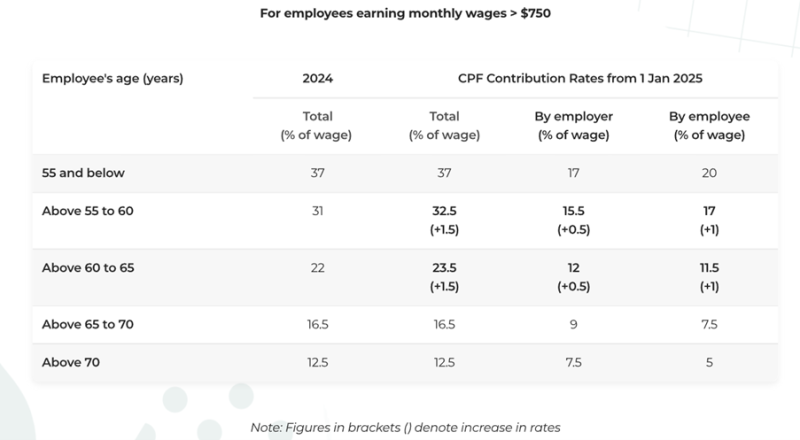
Since earlier this year, CPF contribution rates for employees aged above 55 to 65 have gone up by a total of 1.5 percentage points. This includes an additional 1% from employees and 0.5% from employers. The aim is to help senior workers build stronger retirement savings as more choose to work beyond age 55. For younger workers, this underscores CPF’s commitment to retirement adequacy for all age groups.

Image Credits: cpf.gov.sg

CPF SALARY CEILING HAS INCREASED

The CPF monthly salary ceiling has increased to S$7,400, up from S$6,800 previously. This change means that a larger portion of higher earners’ wages is now subject to CPF contributions. The ceiling will be raised again to S$8,000 in 2026. Although this change primarily affects those with higher salaries, it benefits long-term savings by increasing CPF contributions over time. This is something younger professionals can factor into their career and income growth.

SPECIAL ACCOUNT CLOSURE AT AGE 55

CPF members turning 55 this year will see their Special Account (SA) automatically closed. Funds are first transferred to the Retirement Account (RA), up to the Full Retirement Sum (FRS), where they continue to earn attractive long-term interest. Any remaining withdrawable balance is moved to the Ordinary Account (OA) and earns a lower interest rate.

Members can still transfer OA savings to their RA, up to the Enhanced Retirement Sum (ERS), to enjoy higher CPF LIFE payouts. Investments under the CPF Investment Scheme-Special Account are not affected and can be retained. Upon maturity or sale, the proceeds will first go to the RA, and any excess will be credited to the OA.

ENHANCED RETIREMENT SUM NOW S$426,000

The Enhanced Retirement Sum (ERS) has been increased to S$426,000, or four times the Basic Retirement Sum. Members who top up to this new limit at age 55 could receive CPF LIFE payouts of approximately S$3,300 per month from age 65, compared to around S$2,500 previously.

Even for those still far from retirement, it’s useful to understand how topping up early can maximize compound interest. CPF’s online tools like the Retirement Payout Estimator and Retirement Dashboard help members plan based on their age and financial goals.

EXPANDED MATCHED RETIREMENT SAVINGS SCHEME

Improvements have also been made to the Matched Retirement Savings Scheme (MRSS). There is no longer an age cap, and eligible members can receive government matching grants of up to S$600 per year for five years, totaling S$2,000.

Young adults can also support older family members by topping up their RA, helping them qualify for these matching grants while enjoying personal tax relief.

70TH CELEBRATION OF CPF

At CPF’s 70th anniversary celebration on July 5 and the launch of its commemorative book “Save & Sound: 70 Years of CPF”, Senior Minister Lee Hsien Loong reflected on CPF’s key role in every Singaporean’s life (i.e., from home ownership and family support to retirement). He also noted that Singapore’s CPF system is internationally recognized as one of the most effective in the world.

Image Credits: unsplash.com

For younger Singaporeans, this is the time to stay informed, track contribution limits, plan top-ups early, and help family members maximize their CPF benefits. To learn more, visit cpf.gov.sg or follow CPF’s official platforms.

Sources: 1 & 2

Read More...

How Singaporeans Are Redefining Financial Strategy in 2025

In a country known for its efficiency and fast-paced urban living, the way Singaporeans approach personal finance is undergoing a quiet yet powerful transformation. With inflation still a concern and financial aspirations shifting from mere survival to long-term security, 2025 marks a turning point in how budgeting is viewed.

According to the latest data from YouGov, nearly half (45%) of Singaporeans believe the global economy will fall into a recession within the next six months. This cautious sentiment is mirrored at home, with 25% anticipating a local recession. Although 30% expect the economy to remain stable and 18% are optimistic about growth, the broader mood remains conservative. These views come against the backdrop of rising inflation, global political instability, and persistent energy cost concerns. As households brace for possible turbulence, many are reassessing their spending priorities. Already, 25% of respondents say they are cutting back on dining out, 23% on indulgent food and drink, and 20% on food delivery.

Amid these shifting expectations, the very idea of budgeting is also evolving. Gone are the days when budgeting was synonymous with cutting back. Increasingly, individuals are leveraging their budgets to build wealth, channeling funds toward investments through robo advisors, topping up retirement accounts, and using SkillsFuture credits to future-proof their careers. This shift reflects a deeper mindset change: budgeting is no longer reactive, but strategic. It is less about frugality for its own sake and more about using every dollar with intention.

Moreover, technology is playing a central role in this financial evolution. AI-powered tools are rapidly gaining ground, offering users more than just spreadsheets or transaction logs. These platforms now analyze spending patterns, forecast future cash flow, and provide highly personalized savings strategies. Apps like Seedly and DBS NAV Planner have become more than financial dashboards. They are decision-making companions. Even ChatGPT is being adopted as a budget coach, helping users create custom plans tailored to lifestyle and goals.

Automation has emerged as another critical enabler. Much like CPF contributions that happen quietly in the background, more individuals are setting up auto transfers via GIRO or savings apps to consistently build up emergency funds or investment portfolios. The principle is simple yet effective: when savings become automatic, wealth accumulation becomes inevitable.

At the same time, a renewed interest in accountability is reshaping spending habits. Subscription fatigue is now prompting deeper reflection. Consumers are reevaluating what they truly use and value by cancelling unused streaming services, trimming digital subscriptions, and rediscovering public resources like the National Library Board’s digital app. Even traditional ideas like carpooling or buying in bulk at retailers such as NTUC FairPrice Warehouse Club and Mustafa Centre are regaining traction, seen less as compromise and more as smart financial choices.

Reward-based spending is also becoming more deliberate. Cashback programs, once treated as perks, are now actively factored into purchase decisions. Consumers are seeking out the best credit cards, rewards apps like ShopBack, and promotional deals to turn everyday transactions into small returns. However, the savvy Singaporean spender recognizes the fine line between strategic spending and lifestyle creep. The cashback only counts if the purchase was truly necessary.

Another evolving practice is the return to meal prepping, driven by the rising cost of eating out. Rather than giving up convenience entirely, households are striking a balance by cooking in batches and reducing reliance on food delivery platforms. These seemingly modest changes contribute to significantly leaner monthly expenses.

Even lifestyle indulgences are being approached with greater mindfulness. With outbound travel making a full comeback, more people are relying on apps like Klook and Traveloka to unlock hidden promotions and stretch their leisure budgets. Whether it is discounted theme park tickets or staycation bundles, travel is no longer spontaneous; it is thoughtfully planned.

Image Credits: unsplash.com

What ties all these trends together is a growing financial maturity, a recognition that budgeting is not about restriction, but empowerment. The focus is shifting from saving what is left after spending to spending what is left after saving.

As 2025 passes its halfway mark, this recalibrated approach to money may not only help households navigate economic uncertainty but also shape the next chapter of our financial story.

Sources: 1,2,3,& 4

Read More...

2025 GSTV Payout Guide: What You Get & When

The GST Voucher (GSTV) Scheme for 2025 continues to provide vital financial support to help Singaporeans handle everyday costs arising from rising prices. It’s part of the larger Assurance Package, alongside Community Development Council (CDC) vouchers. The scheme comprises four key components designed to benefit different needs: GSTV Cash, U‑Save utility rebates, MediSave top‑ups, and Service & Conservancy Charges (S&CC) rebates.

Let us start with GSTV Cash. It is available to Singapore citizens aged 21 and above with an assessable income of S$39,000 or less and who own at most one property with an annual value (AV) of S$31,000 or less. Applicants in homes with AV up to S$21,000 receive S$850, while those with AV between S$21,001 and S$31,000 receive S$450. 

Next, MediSave top‑ups are offered to Singaporeans aged 65 and above, subject to the same AV and property criteria . Recipients aged 65–74 receive S$250 (AV ≤ S$21,000) or S$150 (AV up to S$31,000); those aged 75–84 receive S$350 or S$250; and those 85+ are awarded S$450 or S$350.

Thirdly, U‑Save rebates are provided quarterly to eligible HDB households that have at least one Singapore citizen and must not own more than one property. These rebates are automatically credited to SP utilities accounts in January, April, July, and October 2025. The quarterly amounts are S$95 for 1‑ and 2‑room flats, S$85 for 3‑room, S$75 for 4‑room, S$65 for 5‑room, and S$55 for executive or multi‑generation flats.

Lastly, S&CC rebates offset town council charges and are similarly credited quarterly. Depending on flat type, households receive between 1.5 and 3.5 months’ worth over the year, including a bonus half-month rebate in January 2025.

PAYOUT PROCESS

To receive GSTV Cash, register for PayNow‑NRIC by 27 July 2025 or update your bank details by 28 July. Payouts begin on 6 August via PayNow‑NRIC, 15 August via direct bank credit, and 22 August via GovCash for those without bank accounts. MediSave top‑ups are credited from 11 August 2025 for those already signed up or who sign up by 13 July 2025. Later registrants (14 July 2025 to 20 June 2026) will receive their top-up within two months of signing up. On the other hand, no action is needed for U‑Save or S&CC rebates as they’re automatically applied.

You can check eligibility, update payment details, or review payout statuses through Singpass or at govbenefits.gov.sg.

Image Credits: govbenefits.gov.sg

IN SUMMARY

The following is a quick summary of the key details above to help you better understand the 2025 GST Voucher benefits. Do check govbenefits.gov.sg regularly for the latest updates, as details may change.

GSTV Cash

  • S$850 for AV ≤ S$21,000
  • S$450 for AV between S$21,001–31,000
  • Income limit: S$39,000 or less (YA 2024)

MediSave Top‑ups (age 65+)

  • S$250 (AV ≤ S$21,000) or S$150 (AV S$21,001–31,000) for ages 65-74
  • S$350 / S$250 for ages 75–84
  • S$450 / S$350 for ages age 85+

U‑Save Rebates (quarterly)

  • S$95 (1–2 room)
  • S$85 (3‑room)
  • S$75 (4‑room)
  • S$65 (5‑room)
  • S$55 (executive/multi‑gen)

S&CC Rebates (quarterly)

  • 1.5 to 3.5 months’ worth based on flat type (+0.5 month in January 2025)

Payment Dates

  • GSTV Cash via PayNow‑NRIC: From 6 August 2025
  • Bank crediting: From 15 August 2025
  • GovCash: From 22 August 2025
  • MediSave: From 11 August 2025

Actions Required

Image Credits: unsplash.com

  • Link PayNow‑NRIC by 27 July 2025
  • Update bank details by 28 July 2025 (if needed)
  • Register for MediSave by 13 July 2025; later registrations processed in ~2 months 

    Sources: 1 & 2

Read More...

July 2025 BTO Launch: Price Estimates, Hot Estates, & What to Expect

BTO VS RESALE

If you are planning to buy a flat in Singapore, chances are you are considering an HDB Build To Order (BTO) flat. These are brand new homes that are only built once demand reaches about 70%, with a waiting period of around three and a half years. The appeal? A fresh, never-before-lived-in home at subsidized prices.

Unlike resale flats, which are ready for immediate move-in, BTO flats require some patience. But for many Singaporeans, they offer better long-term value and appreciation potential.

JULY 2025 BTO LAUNCH

The July 2025 BTO launch is one of the largest in recent years, with about 5400 flats across 7 locations, offering a range from 2-room Flexi to 5-room units, including 3Gen options for multigenerational families. Both mature estates like Bukit Merah and Toa Payoh and non-mature towns like Woodlands and Sembawang are in the lineup.

And yes, Simei is finally back on the map after over a decade! For East-side fans, that is big news.

WHERE ARE THESE FLATS LOCATED?
PRICE ESTIMATES?

While official prices for the July 2025 BTO launch have yet to be released, past launches offer useful benchmarks. In Toa Payoh during the February 2023 exercise, prices started at around s$90,000 for a 2-room Flexi flat, approximately S$351,000 for a 3-room unit, and from S$395,000 for a 4-room flat.

Over at Tanjong Rhu Parc, which was classified under the Prime model, a 3-room flat was estimated to start from S$309,000, while a 4-room unit began at roughly S$493,000. In Yishun, buyers could expect lower entry prices, with 3-room flats from about S$140,000, 4-room flats from S$236,000, and 5-room units starting from S$392,000.

These figures are based on previous exercises and should be viewed as general guides. Final prices for the July 2025 BTO launch may differ, so always check the official HDB website for the latest information.

WHAT DRIVES BTO PRICES?

Common factors that affect pricing include:

a. Location: Mature estates like Bukit Merah, Clementi, and Toa Payoh tend to cost more due to their amenities, transport links, and schools.

b. Flat Size: Bigger flats like 5-room units come with higher price tags.

c. Lease Length: This applies more to resale flats as shorter leases typically mean lower prices.

d. Grants: First-time buyers can qualify for schemes like the Enhanced CPF Housing Grant, which can shave off a significant amount from the total cost.

WHICH ESTATES STAND OUT?

a. Bukit Merah and Toa Payoh
Expect high demand here. These mature estates offer great access to the city, popular schools, and public transport. Projects in these areas may fall under the Prime or Plus classification, which means longer minimum occupation periods and stricter resale conditions.

b. Simei
After over a decade without a launch, Simei is back. Located near Upper Changi MRT, SUTD, and Changi General Hospital, it is ideal for families and East-siders looking to stay in a familiar zone.

c. Woodlands and Bukit Panjang
More affordable, with room for growth. These estates are increasingly attractive to younger buyers who want value and space.

d. Clementi and Sembawang
Clementi continues to appeal to families due to top schools and mature estate convenience. Sembawang, meanwhile, offers rare 3Gen flats, perfect for bigger households.

CHECK THESE OFF BEFORE YOU APPLY

Image Credits: unsplash.com

  • Confirm your eligibility: citizenship, income ceiling, and household structure
  • Understand the classification of your preferred project: Standard, Plus, or Prime
  • Look into transport, schools, and workplace distance
  • Sort out your finances: CPF Ordinary Account, HDB loan eligibility, and housing budget
  • Stay tuned to HDB announcements for application dates and official price lists

IN A NUTSHELL

Whether you are looking for your very first home or aiming to move closer to family, the July 2025 BTO launch is packed with potential. From familiar mature estates to under-the-radar growth towns, now is the time to shortlist your picks and prepare for the ballot.

Sources: 1,2,3 & 4

Read More...