Why you’re better off with a debit card over a credit card

credit cards in Singapore

We’re sure you’ve seen the ads on those credit card offers.

They make it seem so appealing, like free money!

But before you get blinded by the “rewards,” ask yourself if you’re really ready for a credit card. 

Sure, they can be useful if used properly, but for most people, especially those still building financial stability, it’s probably not that wise.

So allow us to share with you why you’re better off with a debit card over a credit card.

Helps you avoid debt

A debit card is linked directly to your bank account, so you’re only spending money you actually have.

This means there’s zero chance of racking up debt or late fees since the funds are deducted right away.

Using a debit card also helps you budget better since you have a fixed amount of money to work with each week or month.

You can allocate funds accordingly and once it’s gone, it’s gone—so you avoid impulsive big purchases.

With credit, it’s easy to swipe now and worry about the bill later, so you’re less likely to feel the impact of each purchase immediately.

Encourages responsible spending
  • Keep within your budget

Using a debit card helps ensure you don’t go over budget since you have to keep track of your balances to avoid overdrawing.

This makes you think through each purchase and whether it’s necessary.

Credit cards, on the other hand, allow you to spend now and worry about paying for it later which often leads to poor spending decisions.

With a debit card, you develop better budgeting habits and financial discipline since overspending has immediate consequences.

  • Pay in full
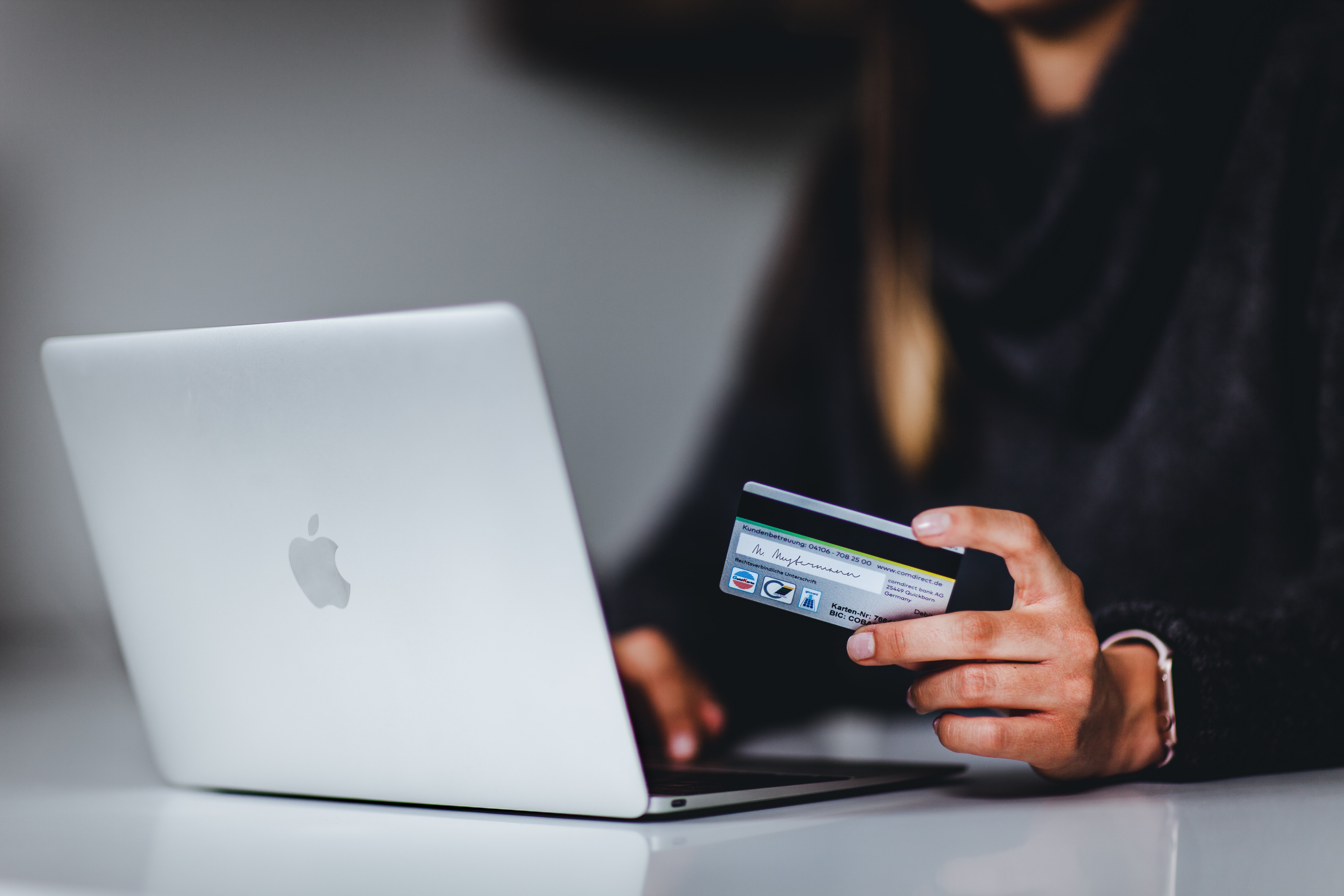
a woman holding onto a credit card

Image Credits: unsplash.com

With a debit card, the money for your purchases is deducted right away from your available funds.

You don’t have to worry about interest charges or making monthly payments.

Everything is paid in full.

On the spot.

This can give you peace of mind knowing you don’t owe anything and your spending is kept in check.

Credit cards, however, allow you to pay over time with interest which ends up costing you much more in the long run.

Avoiding unnecessary interest charges

And lastly, there’s no interest applied and no bill to pay later (except maybe for selected BNPL schemes).

With credit cards, the amount you spend is essentially a loan that accrues interest if you don’t pay the full bill on time.

And when those interest charges accumulate, minimum payments barely make a dent in what you owe.

Stick with debit and avoid the stress of a revolving credit card debt.

All in all, a debit card is a better choice if you’re trying to keep your finances in check. Yes, credit cards come with perks, but those rewards aren’t worth it if you can’t pay your bill. A debit card helps you stick to a budget and avoid debt. You will sleep better at night knowing exactly what’s in your bank account rather than worrying if you can cover that next credit card payment. So go for the debit lane and avoid the credit card chaos.

Read More...

Expanded Occupancy Cap for Larger HDB & Private Residences: Allowing Up to 8 Unrelated Individuals

Between January 22, 2024 and December 31, 2026, the Housing & Development Board (HDB) and the Urban Redevelopment Authority (URA) announced a temporary relaxation of the occupancy cap for larger HDB flats and private residential properties. During this period, these accommodations will be permitted to accommodate up to eight unrelated persons, an increase from the current limit of six. This measure aims to address rental demand and support households seeking rental accommodations.

This relaxation applies to four-room and larger HDB flats, living quarters of HDB commercial properties equivalent to at least a four-room flat, and private residential properties of at least 90 square meters. However, any extension of this relaxed occupancy cap beyond 2026 will be subject to review based on market conditions at that time.

Minister for National Development Desmond Lee highlighted the surge in residential rents, largely attributed to heightened demand amidst construction delays caused by the Covid-19 pandemic. To alleviate this situation, the government accelerated housing supply, with nearly 100,000 homes slated for completion by 2025. Mr. Lee emphasized that this increased supply would enable Singaporeans to vacate rental units sooner, thereby freeing up rental stock.
He stated that the government “(anticipates) the need to maintain a healthy rental supply to support those seeking to rent.”

Image Credits: unsplash.com

To ensure a harmonious living environment, the temporary measure applies only to larger properties capable of accommodating more occupants with minimal impact on their surroundings. Residential property owners currently housing up to six unrelated persons must apply to HDB or URA, depending on the property type, to include additional occupants. Private property owners can register their properties through URA’s e-services for a S$20 administrative fee.

HDB and URA reiterated that the existing rule requiring HDB flat owners and commercial property owners to obtain approval before commencing tenancy remains unchanged.

Applications for renting out HDB flats or bedrooms can be submitted online through HDB’s e-services, with an administrative fee of S$10 per bedroom or S$20 per whole flat rented out. Similarly, HDB commercial property owners and tenants seeking to rent out living quarters can apply via the GoBusiness Licensing Portal, with an applicable administrative fee of S$100 per application.

Furthermore, to meet growing housing demand, the government has bolstered the supply of both public and private housing units, collaborating closely with the construction industry to address supply-side challenges.

With a significant surge in housing supply anticipated in the coming years, rental demand is expected to be sufficiently addressed. This year, around 40,000 homes are projected to be completed across public and private residential sectors, marking the highest completion rate in five years. Furthermore, from 2023 to 2025, approximately 100,000 public and private residential units are scheduled for completion. HDB is also doubling the supply of flats under the Parenthood Provisional Housing Scheme (PPHS) to about 2,000 units, compared to 2021.

Image Credits: unsplash.com

For enquiries regarding the rental of HDB flats/living quarters, the public can write in using HDB’s e-Feedback form, or contact the HDB Branch Service Line at 1800-225-5432 (for HDB flats) or HDB Commercial Enquiry Line (for living quarters) at 1800-866-3073. For enquiries regarding the rental of private residential properties, the public can reach out via URA’s e-Feedback form or contact the URA Development Control Line at 6223-4811.

Sources: 1,2, & 3

Read More...

Singapore dollar hits an all-time high of 3.57 against the Malaysian ringgit

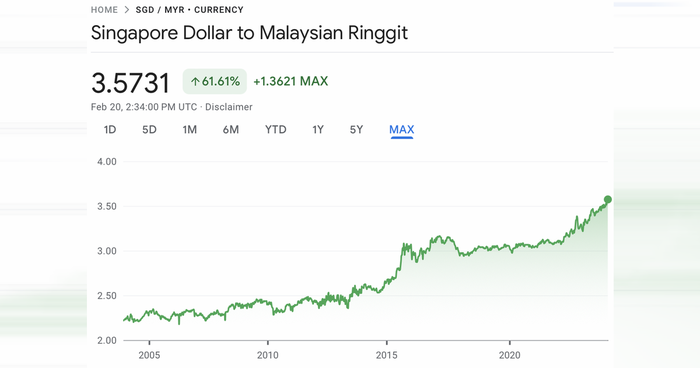
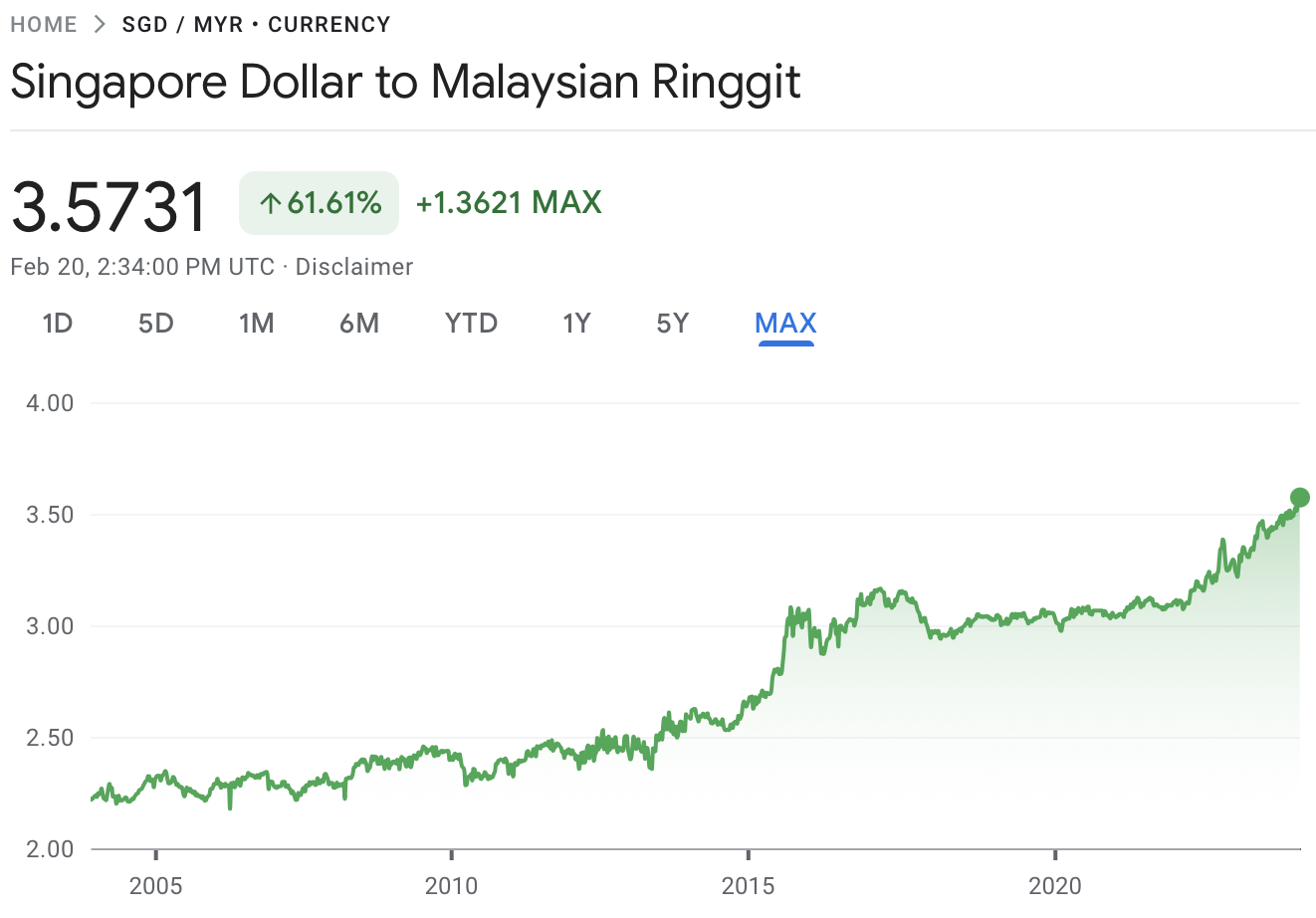
The Singapore dollar (SGD) has surged to an all-time high against the Malaysian ringgit (MYR), crossing the 3.57 mark as of 20 February 2024 at 9:43 PM. (GMT+8)

As at time of writing, the Singapore dollar is trading at RM3.5731.

Source: Google Finance

For Malaysia, the continued weakness in its exports has been a significant concern. This downturn in export performance can be linked to sluggish global demand and competitive pressures, which directly impact the country’s trade balance and, consequently, the value of its currency.

Additionally, “external factors” such as the rate hikes by the United States Federal Reserve have exerted pressure on emerging market currencies, including the Malaysian ringgit. These rate increases tend to attract investors towards US-denominated assets, leading to a depreciation of other currencies. Geopolitical concerns and uncertainties regarding China’s economic prospects further contribute to the volatile global economic environment, affecting investor sentiment and causing fluctuations in currency values.

In contrast, the Monetary Authority of Singapore (MAS), has maintained its monetary policy unchanged, continuing its tight stance as the city-state grapples with persistent inflation. Unlike most countries where central banks adjust interest rates to influence economic activity, Singapore’s monetary policy is primarily centered on managing the exchange rate. The MAS allows the Singapore dollar to appreciate or depreciate against the currencies of its major trading partners within an undisclosed band. This strategy aims to stabilize prices and maintain competitiveness, thereby directly influencing the value of the Singapore dollar.

Read More...

Evolution of Forex Trading: Navigating the Dynamic Landscape

Forex trading, an intricate tapestry woven from the threads of global economies, has evolved into a dynamic and multifaceted industry, presenting both challenges and opportunities. Understanding the historical trajectory and the contemporary nuances of this market is paramount for traders, whether they are novices embarking on their financial journey or seasoned professionals seeking to harness its vast potential.

Historical Overview

The roots of forex trading are closely linked with those of economic history in general, with an important milestone being marked by the Bretton Woods Agreement in 1944. This accord laid the groundwork for an exchange rate system that would be fixed, setting the stage for international monetary cooperation. However, it was the subsequent shift in the early 1970s to an exchange rate system that was “floating” that catalyzed the modern era of forex trading. This move unleashed currencies to fluctuate based on market forces, leading to what would go on to become the decentralized and 24-hour market that we recognize today.

Role of Brokers

Brokers are an integral part of the system, and they do their job by offering trading platforms that empower individuals to buy and sell currencies. It’s within this framework that legitimate forex trading platforms come to the forefront, serving as reliable intermediaries facilitating access to the global forex market.

The Necessity of Broker Licenses

A linchpin in the forex trading ecosystem is the acquisition of a broker license, a regulatory imprimatur that distinguishes reputable brokers from their counterparts. Regulatory bodies such as CySEC, FSCA, and ASIC bestow these licenses upon brokers who demonstrate a commitment to financial regulations, ethical business practices, and the protection of client funds. The importance of broker licenses cannot be overstated, and popular platforms tend to exemplify this commitment, ensuring a secure trading environment for their clientele.

Guarding Against Scam Brokers

The allure of the forex market also attracts less scrupulous entities—scam brokers seeking to exploit unsuspecting traders. These unregistered and unauthorized actors can pose a threat to the integrity of the industry. Regulatory bodies globally actively combat such malpractices, emphasizing the crucial role of broker licenses in identifying trustworthy platforms. Services like OctaFX, FBS, and IQ Option, being stalwarts in the industry, prioritize the safety of their traders by adhering to stringent regulatory standards.

Forex Trading: An Ever-Evolving Landscape

The evolution of the forex market marches in tandem with technological advancements, giving rise to sophisticated trading platforms. These platforms are instrumental in executing trades, providing real-time data, and offering advanced analysis tools. The continuous interplay between forex trading, reputable brokers, and cutting-edge trading platforms showcases the industry’s adaptability and resilience in the face of changing global dynamics.

Educational Imperative for Traders

In an industry as dynamic as forex trading, education emerges as a powerful tool for traders who are new to the game, as well as those who are already veterans. Continuous learning equips traders with the knowledge needed to navigate the ever-evolving landscape, make better decisions, and guard against potential pitfalls. Platforms are constantly competing for users, so it is in their best interest to offer traders more than just a simple trading system, but other resources as well, such as guides and educational materials.

Conclusion

As forex trading continues to shape the global financial landscape, understanding its history, the role of brokers, and the significance of broker licenses remains paramount. The ability to adapt, stay informed, and choose reputable brokers like OctaFX, for example, is key to success in this dynamic industry. The ongoing evolution of forex trading, coupled with the safeguards provided by broker licenses, ensures a resilient and trustworthy place for traders worldwide to operate.

Read More...

Smart Money Hacks for 2024

As we step into the final weeks of 2023, it’s time to break free from old financial habits and embrace money-saving strategies that can boost your income and savings.

ALWAYS HAVE A SHOPPING LIST

Heading into a grocery store without a plan can be a recipe for overspending. We’ve all been there, wandering aimlessly and ending up with a cart full of things we didn’t really need. Avoid this by always carrying a shopping list with you. Having a clear plan in place will help you stick to your budget and make wiser purchasing decisions.

Image Credits: unsplash.com

SEPARATE YOUR SAVINGS ACCOUNT

If impulse shopping has been an issue for you in the past, it’s essential to protect your savings from unnecessary spending. Keep your savings in a separate account, entirely distinct from your day-to-day spending. By creating this barrier, you make it more difficult to dip into your savings impulsively, promoting a healthier financial discipline.

MONITOR YOUR EXPENSES

Stay in control of your finances by cultivating a habit of tracking your expenses. Whenever you receive a paycheck, record it in your budget’s income category. Likewise, make sure to log every expenditure, whether it’s filling up your gas tank or treating yourself to a delightful charcuterie night. By keeping a close eye on your spending, you’ll be able to identify areas where you can save and make necessary adjustments to stay on track.

DELETE SHOPPING APPS

Did you know that 4 out of 5 Singaporeans give in to impulse purchases? With 54% of consumers admitting that shopping on mobile devices has led to increased spending, it’s time to take control. Cut down on impulsive buying by removing those shopping apps from your phone. Instead, opt for online shopping from your laptop or desktop where you can be more intentional with your purchases.

PRACTICE MINDFUL BUYING

Before you hit that “buy” button, take a moment to reflect. Ask yourself, “Is this the right time to make this purchase?” Give yourself some space between the desire to buy and actually making the purchase. Set a specific timeframe for consideration; for instance, commit to not checking out for 24 hours or even a few days after adding items to your cart. This simple money hack can be truly game-changing.

REGULAR BUDGET CHECK-INS

Whether you have ambitious financial goals as a family or just want to stay on top of your finances, communication is key. Schedule regular budget check-ins, either on a weekly or monthly basis, and involve everyone responsible for the family’s finances. By doing so, you can make informed decisions, track your progress, and work together towards achieving your financial objectives. Effective communication about family finances is vital, regardless of your specific goals.

CREATE A MINI-BUDGET FOR UNEXPECTED EXPENSES

No matter how well you manage your finances, there will inevitably be times when unexpected expenses arise. Rather than panicking and derailing your entire budget, it’s best to have a plan in place to handle these situations.

Consider creating a microbudget specifically for handling short-term unexpected expenses. Set aside a portion of your savings to serve as an emergency fund. This way, when unexpected costs arise, you can dip into this fund without disrupting your regular budget or long-term financial goals.

AVOID FREQUENT PHONE UPGRADES

Resist the temptation to constantly upgrade your mobile phone just to keep up with others. Telecommunication companies may entice you with appealing upgrade offers, but remember that you’ll end up paying for that phone through your monthly contract. Instead, focus on choosing a phone that meets your needs and holds its value over time, allowing you to save money in the long run.

REMOVE STORED CREDIT CARD INFORMATION

Increase your mindfulness and avoid impulsive online shopping by refraining from storing your credit card details on websites. When you have to enter your credit card information each time you make a purchase, it provides an essential pause to consider if the expense is necessary.

Image Credits: unsplash.com

Additionally, by not saving your details, you reduce the risk of potential hacking and unauthorized access to your accounts. Keep your online shopping experiences deliberate and secure.

Sources: 1,2, 3, & 4

Read More...