Stock investing is not for everybody. But with a little homework and planning it is possible to select a stock in a manner that reduces your risk and puts you in a position to benefit when its price rises.
There is a great deal of information available on publicly traded companies that can help you decide if its stock is worth buying. But it is a challenge to sift through all the data to arrive at the figures that tell you the real story about its performance and its prospects.
For a young working adult, staying at home with your parents seems like the perfect place to live in. Since the rent and food are usually free, you will be able to get a financial head start.
However, this living arrangement can hold you back if you want to live an independent and autonomous lifestyle. Think about it!
To help you, here are some signs to validate your desire to move out:
1. YOU ARE DONE ANALYZING YOUR CURRENT SITUATION
Renting or buying your own flat is one of the biggest investments you can ever make in your life. It is a long-term commitment that you should carefully analyze and plan.
Before deciding on whether you are renting or buying your own home, you must first know how much you earn, how much you can afford, and how much do you need. The type of flat you can afford to rent or buy depends on your income and savings. The exact amount of money you need includes the upfront payments and the monthly payments such as conservancy charges or housing loan installments.
You are only ready to move out when you are done examining your financial capabilities and done weighing your housing options.
2. YOU HAVE SUFFICIENT SAVINGS
In order for you to move into your own nest, you must have sufficient savings in your account. This savings is not only for your down payment but also for your emergency fund that compromises maintenance, repair, and moving expenses.
Image Credits: pixabay.com (License: CC0 Public Domain)
Since loans may take up a huge chunk of your income, it is advisable to have a sufficient cash at hand (amounting to at least four months’ worth of salary).
3. YOU HAVE ENOUGH MONEY TO PAY FOR DOWN PAYMENT
If you are purchasing a house in Singapore, the bank can give you a loan of up to 80%. This means, you will need to have 20% of down payment upfront. Instead of getting trapped in a credit hole, it is important that you can afford the down payment. And if you really cannot afford it just yet, you can either wait or find a cheaper place.
4. YOUR POTENTIAL HOME WILL NOT ELIMINATE YOUR ENTIRE CPF
As a working Singaporean, you are entitled with a comprehensive savings plan called the Central Provident Fund (CPF). This is mainly used for your healthcare, retirement, and housing needs. However, you must not blow it all on one area such as housing.
If you do not have other investment options to cover your lifespan then, it is not necessary to take the highest HDB loan possible just because you can.
5. YOUR PARENTS ARE ITCHING FOR YOU TO GET OUT
If you are constantly finding yourself in an argument over simple things especially the ones that pertain to the house rules then, it is time to consider moving out. Furthermore, if your parents are throwing subtle comments on you then, it is time to take the hint.
Moving out may be the suitable solution for you to keep your loving and peaceful relationships in tact.
Image Credits: Denis Bocquet via Flickr (CC License)
Aside from these signs, you must not overlook the pleasure and responsibilities of living on your own!
Creating a budget for the first time is like learning how to ride a bicycle. At first you were scared to mount up those two-wheelers like how scared you were to conquer those mountain of debts. Even though you know these are healthy for you and your finances, you just cannot hop around and go!
That fear of yours consumed you. You never learned how to ride a bike gracefully. You never learned how to implement a budget efficiently.
Don’t you think it is the right time to change? For a brighter future ahead, I think it is!
Let me carefully take you to step 1…
Step 1: LOOK FOR A SAFE PLACE TO PRACTICE
When you are riding a bike for the first few times, it is better to find a place that will cushion your potential falls. Find a grassy field with short grasses so that it does not drag the wheels too much.
Likewise, you must find safe place to practice budgeting. That safe place is inside your head! Visualize your financial goals and examine how you are going to achieve them. Make it feasible and smart so you would not have too much unrealistic expectation. Then, list down your short-term and long-term financial goals.
Step 2: ENSURE THAT YOU HAVE ALL THE NECESSARY RESOURCES
After finding a “safe” place, the next things you have to gather are all the needed materials and information. For beginners in biking, consider strapping a helmet and kneepads. Tuck in your shoelaces while you are it. And avoid long pants, long skirts, and heavy clothing because the fabric can get caught in the gears or tires.
For beginners in budgeting, consider tracking your spending history (for the last two month). Gather all the past receipts, credit card statement, utilities bill, and bank statements. Estimate how much you make and spend each month.
Step 3: PRACTICE AND JUST DO IT
In order for you to practice riding or budgeting, you must push yourself to just do it. Mount the bike and get the feel of how it leans and steers. Notice how your body leans when you are going intro a curve. Instead of just using your hands to brave the curve, try letting your body turn and the bike will follow.
This will help you learn an important biking skill – balancing.
Now that you know your income and expenses per month, it is time to make a plan. Categorize your spending into 2-3 main categories namely: needs, savings, and wants. Learnvest suggests allocating 50% of your budget to your basic needs such as rent, food, transportation, and utilities. Secondly, 20% of your budget will go to your savings such as emergency fund. The last 30% of your budget will go to your wants such as mobile phone plans, gym memberships, and vacations.
This will help you learn an important budgeting skill – organizing.
Step 4: GET READY TO RIDE AND SAVE
From finding your safe place to pushing yourself to do it, the final step to take is to face your fears.
Ride that shiny bicycle! Follow that well-devised budgeting plan!
Raise the seat of your bike but keep it low enough so that you can touch the ground with your toes. Balance and steer along the flat surface. Glide along the gentle slopes. Allow yourself to go naturally with the flow of the road.
On the other hand, you must follow your budgeting plan that you devised on spreadsheet file or budgeting software. Track your spending and eliminate at least two unnecessary expenses every month. By doing so, you are keeping things under control.
Image Credits: pixabay.com (License: CC0 Public Domain)
Over the course of the month, you will encounter slopes and obstacles but you have to persevere on. It will all be worth it in the end!
Would you rather spend your six minutes to check the latest gossip on Facebook, to stalk the recent celebrity updates on Instagram, or to save a decent amount of money?
The last choice proves to be healthy not only to your finances but also to your life in general.
So start allocating at least 6 minutes of every day to do 1 of these money-saving steps:
1. UNPLUG THE TELEVISION
Did you know that the electricity cost for households is 20.35 cents per kWh? Thus, the monthly cost of a 40″ LCD television (TV) running for 6 hours daily is about S$7.69.
In reality, you cannot maintain the energy consumption of the television constant due to social events. There may be days when you alone time with yourself the remote and other days when you want to go out with friends. Also, free previews during holidays can make you want to use the cable TV even more.
To keep the tariff into a minimum, it is important to switch off and unplug your TV when no one is watching. Instead of leaving the TV on as a background noise, consider your hand phone as a radio. This small daily acts can save you a whole month’s worth of major electricity.
2. LOOK FOR ONE EXPENSE TO ELIMINATE
Spend your 6 minutes by examining your last month’s utilities bill or last month’s credit card statement. Use your hawk eyes to look for one expense you can reduce or eliminate. Whether it is the unusable Yoga studio membership or the expensive dinners at the restaurants, there is a surefire way to cut and save!
For example:
Say you have different telecom provider for your hand phone, landline, and cable TV. Cut them all and save money by getting a promotional bundle from one provider.
3. ALTER AND FIX YOUR CLOTHING BY YOURSELF
Tailoring or sewing services in Singapore can range from S$5-40 depending on the type of clothing article. Some of the prices are too much if you asked me. You might as well buy a new one. Good thing there is a better and quicker option – altering clothes by yourself.
Instead of tossing away your favorite shirt because of several broken or missing buttons, sew new ones into the fabric one by one. Learning how to sew a button is quick and uncomplicated. The first thing you must do is to choose a suitable button and a matching thread. Then, be guided by this short video:
Aside from sewing buttons, master the basics stitches now by browsing through the free tutorial videos available online or by reading this post.
4. COMPILE THE BEST FINANCIAL RESOURCES ON THE WEB
Make a concise list of the premium financial resources on the Internet that are both free and objective. Upon making the list, subscribe to their email or Facebook notifications so you are constantly reminded of the money-saving tips, great deals, online coupon codes, and other financial news. Rather than using your personal email, it is advisable to make a separate email for this.
This simple step can save you money regularly in 6 minutes or less! Begin the list by including Money Digest and MoneySENSE (the national financial resource made by the government).
Finally! After grueling years of hard work and burning the midnight oil, you have graduated. You are bound to face the next chapter of your life – transitioning to the workforce.
Aside from dressing professionally, meeting the deadlines, helping your boss, and socializing with your fellow colleagues, it is your responsibility to create an effective financial plan.
Financial planning is a process of managing your finances and knowing where you want to go. It protects you from all the potential pressures such as taxes and unexpected fees. And, an effective financial plan shall include a savings account and an insurance.
What if an unforeseen event happened to you in your first few months on the job and you have to be confined at the hospital for a week? Restoring your health to its full strength is overwhelming enough and the last thing you want to think of is whether you can afford the medical bills! Medisave and Medishield may alleviate the impact however, having an insurance policy would have been a better option to offset the charges.
This is why it is important to protect your future with a reliable insurance policy!
In fact, a study showed that the average amount of life insurance coverage a working adult needs (minus his personal and Central Provident Fund savings) is approximately equivalent to 3.7 times his annual income.
The good news is…there is an insurance company who have young working adults at heart. It is no other than DIYInsurance. DIYInsurance, Singapore’s first online insurance comparison web portal, insures young working adults with S$1,000,000 in protection and 75% of the starting job’s salary should you be unfit to work.
HOW DOES IT WORK?
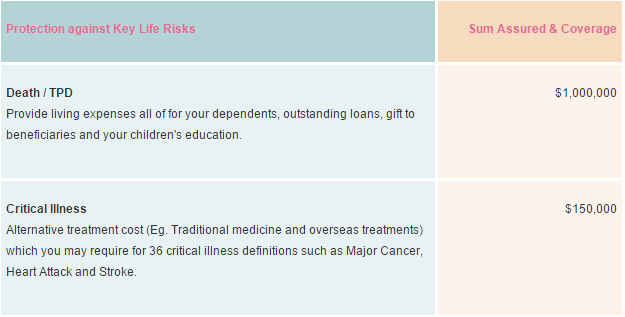
DIYInsurance compared and analyzed policies across several insurers such as NTUC, Aviva, AXA, and Tokio Marine, to put together a package that is tailored to provide you with a comprehensive coverage. This package is called the “Young Working Adult Package”.
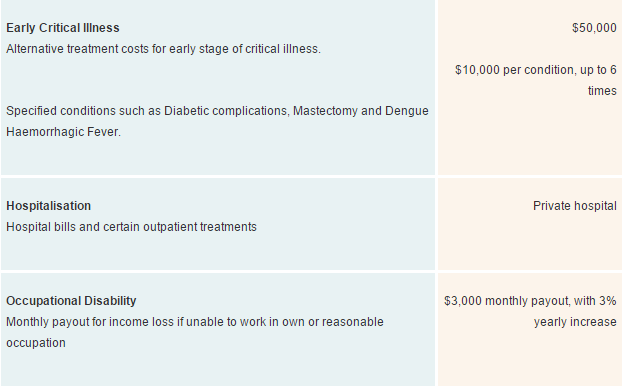
The Young Working Adult Package consists of:
S$1,000,000 assured in death and total permanent disability protection.
S$150,000 assured in critical illness.
S$50,000 assured in early critical illness.
75% of your income assured in occupational disability.
Here is an illustration:
This potent package that can easily be purchased in one go, will cover you during your working years till you turn 65!
What’s more? You can customize the plan according to your budget and needs!
In one amazing package, you get to protect your income stream, cover your hospital bills, have enough money for alternative cancer or stroke treatments, and provide your dependents with a substantial amount of money should you pass away!
So, what is the total cost of it all? An estimated amount of only S$220 per month (for a 25 year old non-smoker who is working on a desk job). If you must know, this starter pack will also reimburse you about S$350 in commissions.
This price makes DIYInsurance’s Young Working Adult Package ideal for working adults who want their essentials protected yet keep their expenses to a minimum.
With a perfectly tailored insurance package that includes fuss-free processing and reliable after-sales service, what more can a working adult ask for?
*Aside from the package above, DIYInsurance launched the Price Beater option that guarantees to offer you with the best insurance deals out there! Simply email them the quote and benefit illustration you have been offered at [email protected]. Aside from offering you with a better price, they will give you up to S$50 in shopping vouchers (until 31 Dec 2015 only) !