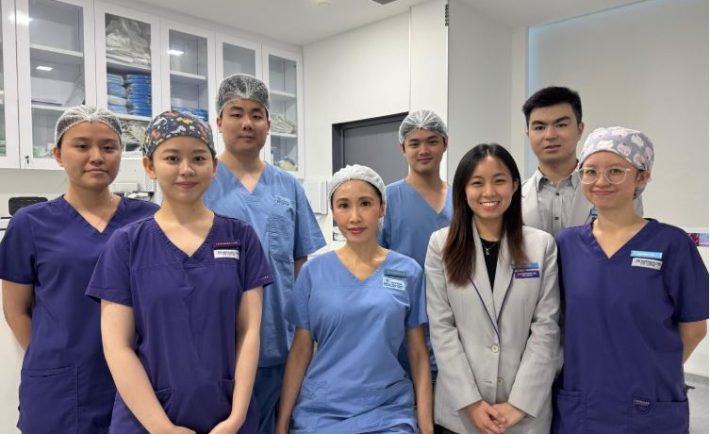
Ophthalmologist introduces flapless laser vision correction procedure as an alternative to LASIK and SMILE.
When Dr Natasha Lim first learned about Smooth Incision Lenticule Keratomileusis (SILK), she saw an opportunity to offer her patients better outcomes with less invasive procedures. Now, as one of Singapore’s pioneer surgeons performing SILK, Dr Lim is ushering in an alternative approach to refractive surgery that may be suitable for a wider range of patients seeking vision correction.
Clinical Background and Professional Experience
Dr Natasha Lim has made significant contributions to the field of refractive surgery throughout her career, being the only ophthalmologist from Singapore whose LASIK results were published on the worldwide AMO iDesign Registry, a platform used by LASIK surgeons for clinical reference.
Her experience with established refractive procedures has thus informed her decision to offer a newly advanced SILK technology to modern laser vision correction (LVC) candidates. Having performed many LASIK procedures, Dr Natasha Lim recognised that SILK’s technological advancements could address certain limitations of existing LVC techniques. Her comprehensive understanding of corneal biomechanics and refractive outcomes positions her to evaluate which patients may benefit from this flapless approach.
Understanding SILK as a Refractive Option
For patients considering laser vision correction, SILK represents a flapless alternative to existing procedures like LASIK.
LASIK, an established refractive surgery for myopia and astigmatism, involves the creation of a corneal flap. The procedure has been performed for several decades with documented outcomes, demonstrating efficacy in correcting myopia up to -12.00DS and astigmatism up to -6.00DC clinically.
SILK, on the other hand, is a flapless procedure and has been shown to address a comparable range of myopia up to -12.00DS and astigmatism up to -6.00DC. The procedure uses a femtosecond laser to create and extract a lens-shaped piece of corneal tissue (called a lenticule) through an incision of approximately two millimetres only. The system uses unique femtosecond laser cutting technology that combines short pulse duration, small laser spot size, and high pulse repetition rate, which enables a continuous, tissue bridge-free laser resection for a smooth corneal surface.
The flapless nature of SILK means the procedure does not create a corneal flap, hence does not suffer certain risks associated with flap complications, such as cornea wrinkles, flap dislocation, corneal ectasia and dry eye syndrome2, all of which can affect both immediate and long-term visual outcomes.
Technical Development from SMILE
SILK also builds on Small Incision Lenticule Extraction (SMILE), introduced in 2009, incorporating technological modifications to the SMILE technique.
The SILK procedure employs a submicron-precision laser system delivering lower energy per pulse of 40 to 90 nanojoules, designed for minimal collateral tissue damage, hence enabling smooth tissue dissection with the aim of reducing post-operative inflammation.
Compared to the asymmetrical shape used in SMILE, SILK uses a biconvex lenticule shape intended to facilitate smoother tissue extraction and create a more uniform corneal surface. Combined with the reduced laser energy, these technological refinements aim to shorten surgical time and enable faster post-operative visual recovery.
Dr Natasha Lim added: “As an updated version of SMILE, SILK has the potential to be a more effective option for refractive surgery with reduced downtime.” and that “Ophthalmologists may soon advise SILK surgery for patients seeking a more comfortable and quicker path to clear vision.”
The SILK Procedure
The SILK procedure takes approximately two minutes per eye. Before surgery begins, detailed measurements of the patient’s eye—including corneal thickness and prescription strength—are entered into the SILK laser system. The system then automatically calculates the exact specifications needed for the tissue removal.
During the procedure, the patient is positioned comfortably under the surgical microscope and laser system. The patient will be directed to focus on a small light to keep the eye steady while the laser creates a precise cutting pattern in the cornea. The surgeon then carefully removes the lenticule through the small incision.
The laser application itself takes approximately 16 seconds, with 85.3% of eyes requiring only mild dissection.
Clinical studies of SILK demonstrate favourable outcomes for visual recovery, with patients reporting an average of one day of downtime for the cornea to reshape.
Within one week, 88% of patients experienced 20/20 vision or better, increasing to 96% within three months.
Patient satisfaction data also shows positive responses: 100% of patients reported satisfaction with having undergone the SILK procedure, while 98% were satisfied with the speed of their vision improvement. Additionally, 96% of patients indicated they would recommend SILK to friends or family members.
Expanding Options for Vision Correction
As a pioneer surgeon for SILK in Singapore, Dr Natasha Lim provides patients with access to this recent development in refractive surgery alongside established procedures such as LASIK, PRK and Implantable Collamer Lens surgery. The availability of multiple laser vision correction technologies at her eye centre in Royal Square Novena allows Dr Lim to unbiasedly recommend treatment options tailored to each patient’s specific ophthalmological conditions and clinical profile.
To learn more about which refractive surgery option may be suitable for your vision correction needs, schedule a consultation with Dr Natasha Lim at Dr Natasha Lim Eye Centre.