Commutes Adjust as Public Transport Costs Rise 5% From Dec 27

Starting December 27, public transport fares will rise by 5%, marking the third straight year of adjustments. Adult commuters will pay 9 or 10 cents more per trip depending on distance, while concessionary passengers such as seniors, students, and low-wage workers will see smaller increases of 3 or 4 cents.

The Public Transport Council (PTC) announced the revision on October 14, describing it as a careful response to rising energy and manpower costs while keeping fares affordable. Although this follows higher hikes of 6% in 2024 and 7% in 2023, the latest increase is viewed as a more measured step to balance cost pressures with public interest.

Image Credits: unsplash.com

To soften the impact on frequent riders, the PTC will lower monthly travel pass prices. From December 27, adults will pay S$122 instead of S$128, seniors and persons with disabilities S$55 instead of S$58, and low-wage workers S$92 instead of S$96. About 155,000 commuters are expected to benefit from these reductions, helping offset the fare increase for regular users.

Additional relief will come through S$60 public transport vouchers provided by the government to households earning up to S$1,800 per person monthly. Eligible households can redeem these vouchers via the SimplyGo app or at designated kiosks and service centers beginning December 29.
Image Credits: unsplash.com

Beyond fare changes, the PTC is also updating how future adjustments are calculated. Instead of relying on data from the previous calendar year, future reviews will assess energy prices, wages, and other cost factors from the 12 months leading up to June of the review year. This shift aims to make fare adjustments more responsive to real-time economic conditions and reduce delays between cost changes and fare updates.

Transport operators SBS Transit Rail and SMRT Trains had sought a 14.4% increase to cover rising maintenance and labor expenses. The PTC approved only a 5% adjustment but required both operators to contribute 20% of their additional fare revenue (i.e., about S$10.6 million combined) to the Public Transport Fund, which helps cushion fare hikes for lower-income households.

Image Credits: unsplash.com

Meanwhile, express bus fares will rise slightly to reflect higher operating costs, while short-distance concessionary trips of up to 3.2 kilometers will remain unchanged. This move benefits passengers who rely on short daily commutes to schools, workplaces, and community amenities.
The fare review highlights a recurring challenge of keeping the transport system financially sustainable while easing the burden on daily commuters. Though the increase may seem modest, it reflects a broader effort to sustain efficiency and affordability in one of the region’s most advanced public transport networks.

Sources: 1 & 2


Read More...

6 Thomson-East Coast Line Stations Will Soon Open In Q3 2021

Represented by the color brown on the rail map, the Thomson–East Coast Line (TEL) is a new Mass Rapid Transit (MRT) line in Singapore. It is currently under construction and is expected to be completed by year 2024. Its completion will provide the residents in the East and along the North-South Corridor a faster access to the city.

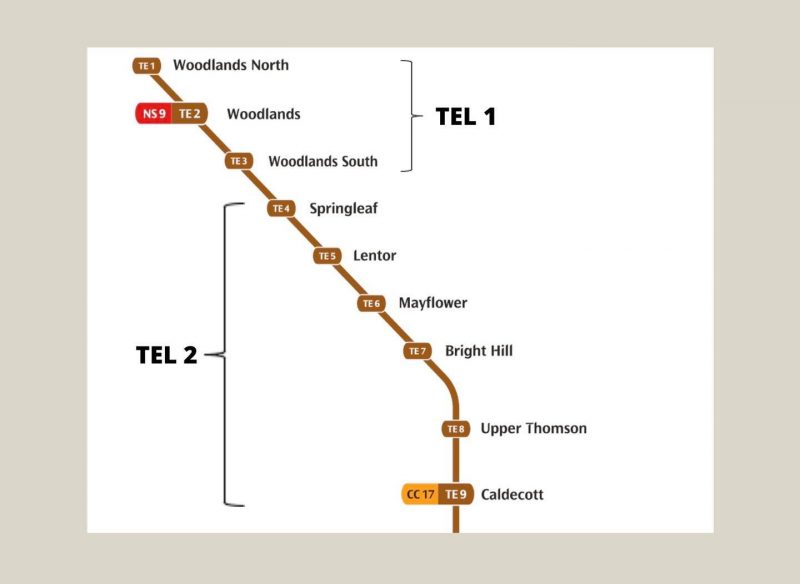
The TEL’s development spans five different phases. When these phases are accomplished, it will serve approximately one million commuters a day. The first phase of TEL (TEL 1) opened for service last January 31, 2020. TEL 1 includes Woodlands North, Woodlands, and Woodlands South MRT stations. The second phase of the TEL (TEL 2) is scheduled to open in the third quarter of 2021.

EXPERIENCING EARLIER DELAYS

Due to the circumstances brought by the COVID-19 pandemic and further system review, the second phase of the Thomson–East Coast Line had been delayed twice from its original target opening date. A system review was prompted by a five-hour disruption along the line last Dec 4, 2020.

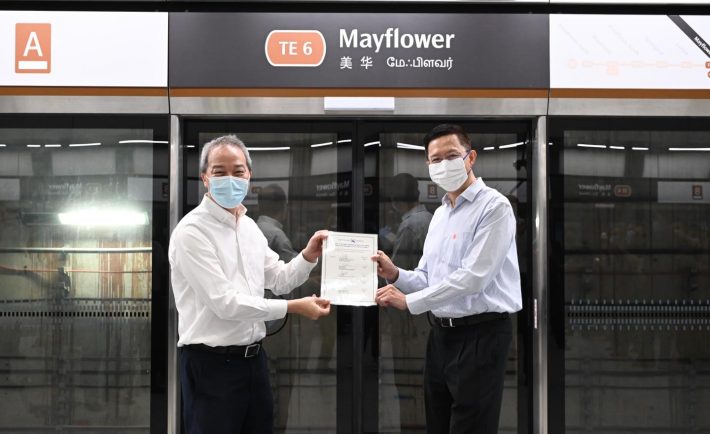
In a glimmer of hope, the Land Transport Authority (LTA) handed over six MRT stations along the second phase of the Thomson-East Coast Line to SMRT last Friday (April 30, 2021). This entails that there will be nine operational stations in the TEL soon.

Image Credits: facebook.com/WeKeepYourWorldMoving (LTA)

MORE ON THE SIX STATIONS

The six stations (TEL 2) that were handed over to SMRT included Springleaf, Lentor, Mayflower, Bright Hill, Upper Thomson, and Caldecott. The Caldecott station will become an interchange that connects to the Circle Line.

According to LTA: “The civil and structural works for the six stations have been completed, with some architectural, electrical, and mechanical works ongoing.

LTA has also completed rigorous testing and commissioning of the trains and systems for (the second stage of the Thomson-East Coast Line), including tests to ensure that the new stations operate seamlessly with the three (operating) stations.”

Train operator SMRT will continue with more tests to ensure everyone’s safety.

UPGRADE IN THE COMMUTER’S TRAVEL TIME

LTA highlights the convenience of faster travels upon the opening of the Thomson-East Coast Line’s second phase. By Q3 of 2021, residents from households near (i.e., within a 10-minute walking distance) one of the nine stations can expect travel time savings of up to 50%. For instance, a Sin Ming resident travelling to Republic Polytechnic by public transport will enjoy a 25-minute journey instead of the current 50-minute travel time.

Image Credits: facebook.com/WeKeepYourWorldMoving (LTA)

More TEL stations will be opened in the next three years. Moreover, the Jurong Region Line and the Cross Island Line are still under construction. Let us stay tuned!

Sources: 1, 2, & 3

Read More...

Transportation Hacks For Every Singaporean

Getting around Singapore can either be a breeze or a storm. It is up to you to weigh your options. Nonetheless, you may use this guide to travel from one place to another without a personal vehicle.

PLAN YOUR TRIP AHEAD

To budget your transportation expenses, you may plan your trip ahead of time. You can use fare calculators to complete the task. With an extensive collection of MRT lines and bus services, you may not be able to memorize each route or fare.

Know the most affordable way to get to your destination by checking GoThere.sg. You may also download the lite version of the app for free or plan your route the latest MRT map.

DO NOT TAP OUT

There will be days when you cannot hold your pee any longer! Not to mention, there will be times when nature calls at the worst places.

If you find yourself within the CBD area, simply alight at Bugis station and use the toilet within its gantry area. This will save you money without having to tap out. As this toilet is meant for the people who need it most (e.g., PWDs), please exercise courtesy.

CHOOSE YOUR CABIN WISELY

All our movements inside the train station are fueled by time. There are times when you have to settle with the cabin in front of you. Otherwise, the door will shut! Then, you have to endure the distance from your cabin to the escalator.

When you have time to spare, choose your cabin wisely. Avoid the mini “pilgrimage” by entering the cabin that opens directly to the escalator at your exit. A nifty app called Singapore MRT Lah 2.0 may help you. This app lists the quickest routes out of the train station. See for yourself!

ENJOY FREE WIRELESS CONNECTIVITY

Commuting can be boring for some. Thus, these people may turn to their phones for entertainment. Spiraled into the online abyss, you may encounter some ads. You do not know how much data a video ad can consume! So, reduce your mobile data consumption by tapping into areas that offer free WiFi spots.

Image Credits: pixabay.com

Simply download the Wireless@SG app via the App Store or Google Play. Register to enjoy free wireless connectivity at a variety of stations.

Sources: 1 & 2

Read More...