
An Investment for Property Lovers and Dividend Seekers

Singaporeans are fixated with buying property – and they don’t just stop at one.

In a report published in June 2016, Maybank Kim Eng’s research team found that approximately 1.1 million households in Singapore own the homes they occupy, but there are another 200,000 housing units are currently held as investments. This demand, coupled with land scarcity, means that property in Singapore doesn’t come cheap.

There is however, a more affordable option for those looking to invest in property: real estate investment trusts (REITs). REITs – Singapore REITs (S-REITs) in particular – have been making headlines recently for offering handsome dividends, made even more attractive by a persistent low interest rate environment. If you are a dividend investor, you may want to learn more about this asset class.

How Have Singapore REITs Fared?

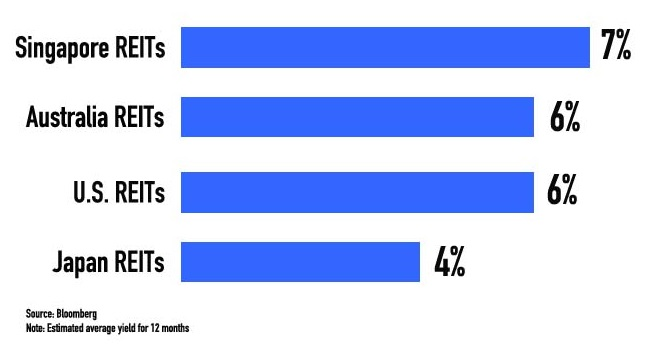
According to a Bloomberg report in October 2016, the 7% yield offered by S-REITs exceeded those listed in Australia, the US and Japan. That’s been the driving force behind an approximately 9% increase in the FTSE Straits Times Real Estate Investment Trust index this year as yield-hungry investors flock to the offerings amid record-low interest rates.
reits1

Findings by SGX My Gateway published on 11 September 2016 also showed that the sector logged an indicative average dividend yield of 6.7% p.a. thus far, compared to that of the Straits Times Index (3.9% p.a.) and MSCI World REIT Index (3.9%p.a.).

Compared to fixed deposit rates? The difference is even wider. In September 2016, the 12-month fixed deposit rate  – or the average rate compiled from that quoted by 10 leading banks and finance companies – was 0.35% p.a.

What is a REIT Anyway?

A REIT is a trust that owns and operates income generating real estate. The rental income or interest payment that is earned by the REIT is passed on to investors in the form of dividends.

Here are more facts about REITs and S-REITs:

  • There’s a reason why S-REITs pay handsome dividends. They are required to distribute at least 90% of their taxable income each year in order to enjoy tax exempt status by IRAS, subject to certain conditions.
  • Investing in one REIT gives you exposure to not just one, but a portfolio of properties, and at a fraction of the price that it would cost you to buy a single property.
  • The portfolio of properties are not limited to those in Singapore. Some REITs have international properties in their portfolio.
  • REITs are more liquid compared to property as they can be bought and sold on stock exchanges throughout the day just like any other stock.

What S-REITs are Out There?

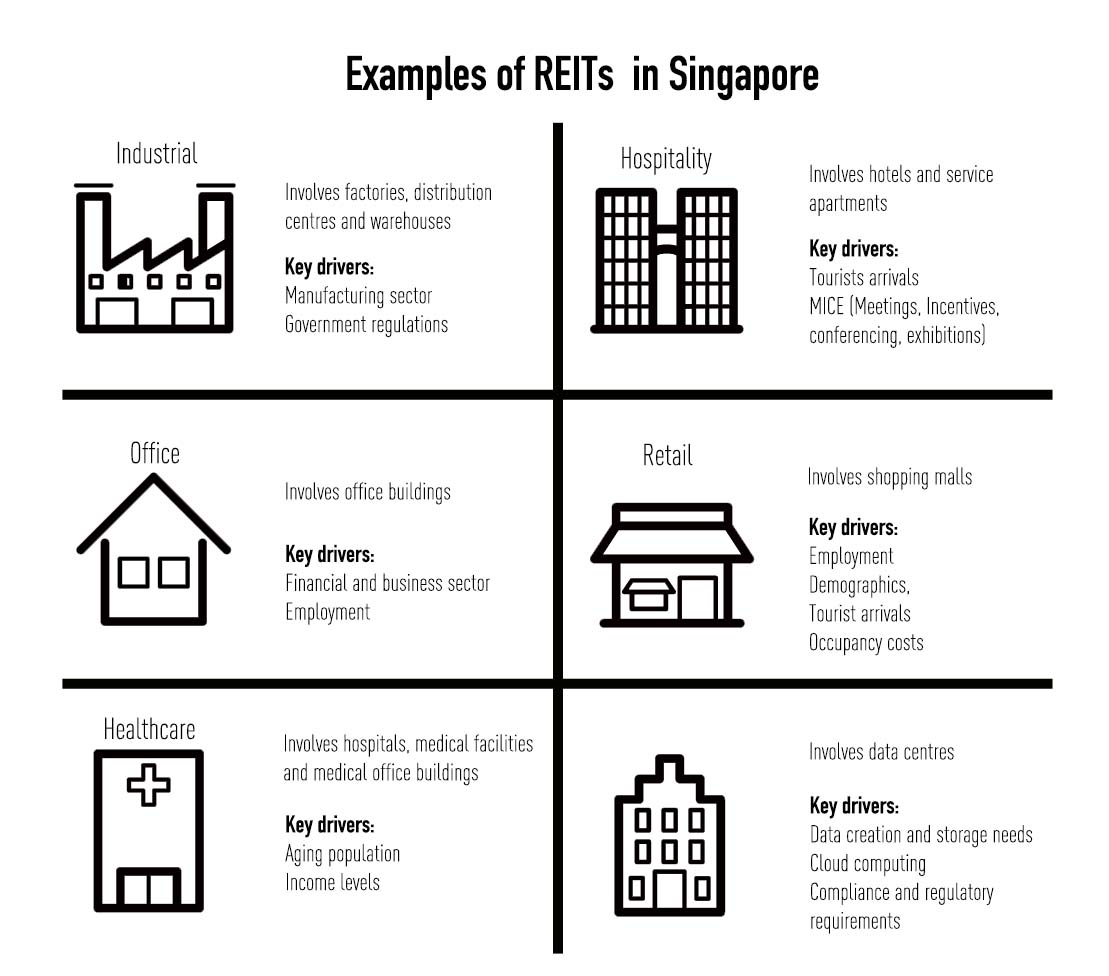
There are different types of S-REITs to choose from, and they are affected by different factors.
reits2

Maybank Kim Eng’s research team believes that industrial REITs, like Ascendas REIT and Mapletree Industrial Trust, could benefit from public spending’s focus on boosting innovation and productivity. Business parks, science parks and high-spec industrial space will be in demand. So if you are wondering what type of REITs to watch out for, you could consider finding out more about industrial REITs and whether they fit the objectives of your portfolio.


Disclaimer: This message is for general knowledge or information only. It is not an offer or invitation to buy or sell securities, futures or other products or services. Our products or services vary in different jurisdictions, subject to their respective terms and conditions and the licences our affiliates and us hold. This message is not an advice or recommendation for any financial planning, investment, legal, tax or other purposes and, accordingly, no responsibility or liability is assumed by us or our affiliates, whether directly or indirectly, from any person taking or not taking action

Read More...

4 Must-Read Books On Real Estate Investing

Books will always serve as a clever investment. Books will offer you the chance to learn new strategies to become a better real estate investor. Furthermore, you can save a substantial amount of money by avoiding the expensive mistakes of other authors.

On that note, here are the must-read publications if you are looking for ways to make the most of your property investments:

1. REAL ESTATE INVESTING FOR DUMMIES BY ERIC TYSON AND ROBERT GRISWOLD

Buy it here.

The preconceive notion of purchasing a “For Dummies” guide is that you are utterly clueless about a certain topic. Do not mind this! This book is a good resource for newbies in the Real Estate scene, especially made for those who have no prior experience. It elaborates difficult concepts in simpler terms.

The authors do not promise an overnight success story. Instead, they offer practical and realistic advice for its readers. These advice will help you conquer the challenges and take advantage of the opportunities ahead.

2. LANDLORD ON AUTOPILOT BY MIKE BUTLER

Buy it here.

The rich wisdom of this book grew from the author’s experiences after he managed 75 rental properties while he still committed to a full-time job as a police detective. It may seem impossible to juggle the two worlds but, it is doable.

Landlording on AutoPilot features useful information on dealing with the dynamics between the tenants and the landlord. It can dramatically improve your rental business and its surrounding relationships. If you are afraid to jump in this field or if you are struggling as a landlord, you must give this book a shot!

3. RICH DAD POOR DAD BY ROBERT KIYOSAKI

Buy it here.

As you dive in the world of investments, feed your mind with the philosophy of the renowned author and lecturer Robert Kiyosaki. I was intrigued about his teachings after I watched the book summary video by Evan Carmichael. See it for yourself.

What you can expect from this book is a lot of motivational talk. It is one of the library staples among investors because it contains a massive amount of thought-provoking content. He created two unique perspectives about money that emerged from two of his fathers – the rich and the poor. While the poor dad will tell you to work for your money, the rich dad will tell you to let the money work for you. The author did a great job in encapsulating the what I had been feeling for a long time.

4. THE ULTIMATE GUIDE TO REAL ESTATE INVESTMENT IN SINGAPORE BY ISMAIL GAFOOR

Buy it here.

When it comes to the big players in the Singapore real estate industry, Ismail Gafoor leads the wolf-pack. This book is the culmination of his passion and hardwork. Let us begin with his inspiring life story.

Mr. Gafoor and his family struggled with money when he was young. At the prime age of 7, he was tasked to deliver newspapers with his dad. This means that he was constantly late for school. As a young adult, he began a career with the Singapore Armed Forces. His cumulative salary led to his brave decision to buy his first property at Normanton Park. Because he saw the potential of real estate investments as a decade passed, he decided to open his own property agency with his wife. Nowadays, we know this leading agency by the name of PropNex Pte Ltd.

Image Credits: pixabay.com

Image Credits: pixabay.com

Enclosed in this book are answers to various questions that investors ask. It is hard to go wrong with this book knowing that its contents came straight from the workings of a top real estate pioneer.

Sources: 1 & 2

Read More...

The Importance of Your Family Wealth Structuring: What You Need to Know

As the head of a family or household you’ll understand just how important your finances are. The money you have is what keeps your home – and indeed your personal lives – in order, and without properly managing this you run the risk of getting into monetary troubles.

Knowing exactly what to look out for and how to effectively manage money is quite a challenge – especially if you lack experience in handing your finances. There are a variety of different aspects to consider such as where you should invest your money, how to ensure you have enough money and what’s the best course of action for your financial future – certainly a headache for many of us.

Luckily though, there are alternatives and also ways you can ensure you have a solid family wealth structure. In this post then, you’ll find a number of different examples of financial concerns and expenses and why you need to manage these. Then we’ll discuss what you can do to prevent any problems and offer some useful tips for making the right choices with your money.

Family Expenses

In our day to day lives, we have plenty of different things we need to spend money on each month in order to maintain a decent standard of living. Naturally, this is increased depending on if you have more than one child, and ultimately without keeping these in check you may run into debts. Here is a breakdown of some the main expenses you’re likely to encounter:

  • Rent or Mortgage Payments – regardless of whether or not you own or rent a property, the chances are you’ll have some form of payment to make each month. These are often a significant part of your monthly costs.
  • Food bills – the food you eat is another necessity which can again become more and more expensive over the years with a growing family.
  • Utilities – the bills you have to pay can be spread in different payment plans, but the reality is that every day you’ll be adding to your expenses with your use of gas, electricity and water.
  • Taxes – you’ll also have to pay taxes which more often than not will be taken from your monthly salary, what’s more you can also pay council tax on your home or accommodation.
  • Travel – another typical expense is for your travel. From your commutes to work, to taxiing your family around you’ll have to pay for fuel, tickets and/or fares.

Additional Expenses

These are just the basics though, the wealth management of your family can also cover additional costs like:

  • Leisure – the time you spend enjoying your life or socialising can add up over the month.
  • Clothing – you’ll need to buy new clothes fairly regularly, especially if you have a growing family.
  • Maintenance – there may be unexpected issues with your home or your appliances which need to be fixed.
  • Childcare – if you work full time and have a young family there’s also childcare costs that you’ll need to factor in each month.

All of these are aspects you should be budgeting for on a monthly basis.

Savings and Investments

With the money you have left over, you also need to consider what you’re going to do with it. The most obvious step is to open a savings account, but there are also real investment opportunities you should look at.

Heading to the stock markets is one avenue you might want to go down, but another popular choice is to buy additional properties as lets, or to renovate and sell for a profit. With this though you’ll need a decent understanding of finance and how the markets work to ensure you see a positive return.

The Simple Solution

While you can simply look into the markets yourself, or budget each month to manage your investments, if you feel you lack the expertise needed to keep your money secure there are other simple solutions. A sensible choice then is to put your trust into a financial expert to take care of the responsibilities for you.

There are plenty of companies and firms such as Withersworldwide who offer a variety of financial management services, from offering advice on investments to simply helping you look after your money more effectively. It’s also worth choosing an established company with a long history of success, that way you know they’re obviously doing something right with their services.

The Bottom Line

As aforementioned, the last thing you’ll want is to put your family’s welfare at risk by making poor decisions with your money. Consider the above options with investments, or make the smart move and search for expert advice and leave your finances in safe hands. This way you can count on a more secure future, not just in the present but for many years to come.

Read More...

Practical Ways To Ease Your Stress On Financial Responsibilities

DO NOT BE FOOLED BY THE 0% INSTALLMENT PLANS

There are an array of goods that you can buy through 0% installment plans such as furniture, designer bags, electronic devices and appliances. Without control, you can potentially pile up your installment plans to the point that you can no longer afford paying for credit card bill.

Say you are strolling around the mall in the lazy weekend when you suddenly saw a shiny sign that says:

“FULL HD FLATSCREEN TV FOR SALE

    S$1,400 (U.P. S$1,600)

0% INSTALLMENT THRU UOB & OCBC CREDIT CARDS.”

It sounds tempting, right? But do you really need that telly when you have a functional one at home? Do you need another burden to add on your credit card bill? Well, it is time to live within your means!

UTILIZE YOUR CPF ACCOUNT WISELY

The Central Provident Fund (CPF) is a compulsory savings scheme for Singaporeans that is automatically deducted from the wages. Your CPF account can be used to support crucial financial commitments such as retirement, healthcare, and property purchases. While it is sitting there passively, you can maximize its use by utilizing it wisely. For instance, if you are using your account to purchase a new flat or refinance your current one, examine the situation every few years to see which is the better economical option.

And if you are not touching your CPF savings for a long period of time, consider putting it to the CPF Investment Scheme. It is a way to invest your CPF savings to various banks such as OCBC, DBS, or UOB. The money you will generate from your investments will eventually go to your CPF account and not your pockets. Compare the investment options and their charges. Instead of complaining about your “useless” account, why don’t you start investing?

FOR MARRIED COUPLES, SUPPORT EACH OTHER

Alongside merging two souls, marriage merges two finances together. Having another person to run to for support, opinion, and advice can help you make better financial decisions. For instance, if you are searching for a space at an Executive Condominium (EC), consult your spouse first. Are your incomes enough to suffice the payment of the EC? You do not want to end up working took hard for an EC when what your spouse just wanted an HDB all along.

Setting long-term and short-term financial goals such as purchasing a house or establishing realistic budget should be done together. Along with the goals, you must assign financial responsibilities to each other. Encourage and support each other throughout the process.

ALWAYS COMPARE PRICES

Almost every shopping hack includes a section about comparing prices so that your money would not go to waste. True enough; reading reviews and shopping around helps you get the best deal. Since comparing prices in physical stores is a troublesome and time-consuming activity, people have turned to technology. For example, browse at PricePanda if you are camera shopping. PricePanda.com.sg, the leading price comparison website for emerging markets worldwide, provides its users with prices, technical details and other information about the latest gadgets.

And if you are looking for an affordable wedding banquet, turn to SingaporeBrides.com.

Image Credits: pixabay.com (CC0 Public Domain)

Image Credits: pixabay.com (CC0 Public Domain)

SingaporeBrides.com is your one-stop portal for your local wedding festivity needs. Here you will see that the cheapest banquet venue for lunch and dinner costs S$501 at LingZhi Vegetarian.

Sources: 1 & 2

Read More...

4 Don’ts Of Real Estate Investing

Since land is scarce in our country, properties had always been a go-to investment option for many. The majority of these investors have strategies limited to purchasing, reselling, and renting flats or condominiums. While others consider other options such as the Real Estate Investment Trust (REIT).

REITs allow the investor to have a professionally managed portfolio of properties by purchasing a publicly traded investment product. Investors of REITs purchase units of the trust similar to shares of a common stock.

But no matter what type of property you purchase, here are 4 Don’ts Of Real Estate Investing to help you on your journey…

1. DO NOT FORGET TO IDENTIFY YOUR GOALS

Before committing to a property or even a property visit, it is important to understand what you want to achieve from investing on real estate. Be on a peaceful place where you can think carefully about your goals for the long-run.

You must have a transparent idea of your existing income, current expenses, and outstanding loans before diving into another complex route. Also, you must identify your budget and type of risk you are comfortable with.

2. DO NOT GO WITHOUT RESEARCHING

After identifying your financial circumstance and your investment goals, you must do your research on real estate investments in order to be sure that it is worth your money. For example, a two-bedroom HDB flat can cost about S$250,000. That is a huge sum of money you may be willing to risk if you are serious in property investing. The risks only increase when the investor does not understand how the property market works or when and where to invest. Hurrying up without analyzing the situation thoroughly can only bring about more damage (e.g., bankruptcy) than good.

So if you lack sufficient knowledge, seek advice from a financial consultant or other professional advisers. And when you find the “right property”, ensure that you keep your expectations realistic and keep your finances in tact.

3. DO NOT EXPECT TO BE A MILLIONAIRE QUICKLY

Do not fall into the trap that some real estate investors set – offering you properties for small amounts of cash with higher returns. These “undervalued assets or profitable investment opportunities” are mostly likely unsold overseas property projects. You see, real estate investors usually do not offer “jackpot” properties to complete strangers. They only invest with the people they know well.

There are no shortcuts to success on real estate investments! In fact, you must allot a long period of time on finding a property in a decent location, building a good relationship with the tenants, and maintaining the condition of the property. Time that may not be in the good side of most.


Image Credits: pixabay.com (CC0 Public Domain)

Image Credits: pixabay.com (CC0 Public Domain)

4. DO NOT PURCHASE A PROPERTY WITHOUT VISITING IT

In support of your in-depth research, you must drive to the property itself before signing any contracts. There are a number of reputable realtors and agents who can give you feedback about certain properties but you must follow your own instinct in the end.
There are no shortcuts to success on real estate investments! In fact, you must allot a long period of time on finding a property in a decent location, building a good relationship with the tenants, and maintaining the condition of the property. Time that may not be in the good side of most.

Sources: 1, 23, & 4

Read More...