Singapore Bans Hiring of Foreign Creatives Without Work Pass

Singapore’s creative industry has long thrived on weddings, product launches, and lifestyle campaigns that demand skilled photographers, videographers, and make-up artists. But companies are now being warned: foreign freelancers without valid work passes are no longer allowed to take on such jobs.

The Visual, Audio, Creative Content Professionals Association (Vicpa) and the Ministry of Manpower (MOM) issued a joint advisory last month reminding businesses that foreigners on tourist or student visas cannot provide creative services in Singapore. Companies are equally prohibited from engaging or promoting them.

The move comes after MOM received reports of wedding and event firms hiring overseas freelancers as a cheaper option (e.g., make-up artists, on-site painters, photographers, or graphic artists). While often advertised on social media as budget-friendly, such arrangements breach the Employment of Foreign Manpower Act. Offenders face fines of up to S$20,000, jail terms of up to two years, or both. They may also be permanently banned from working in Singapore.

Image Credits: unsplash.com

For local creatives, this is seen as overdue protection. Vicpa’s executive secretary, Jagathishwaran Rajo, said the association has heard growing complaints from professionals who feel undercut by foreign freelancers working without permits. “Our objective is not to stifle competition, but to uphold a fair and level playing field where Singapore’s creative talent is respected, valued and supported,” he said.

The rise of platforms such as Instagram and TikTok has made the issue more urgent as overseas freelancers can now market directly to clients here. In response, Vicpa, an affiliate of the NTUC, has been stepping up monitoring of these channels, providing tip-offs to MOM and running awareness efforts to encourage ethical hiring practices.

For businesses, short-term savings from hiring unlicensed freelancers can quickly turn into heavy fines and strained ties with Singapore’s local creative workforce.

Image Credits: unsplash.com

As enforcement tightens, the bigger question is whether these measures will strengthen the long-term sustainability of the creative industry, or create a bottleneck that limits global collaboration. What is certain is that the rules of engagement in Singapore’s creative economy have changed, and both companies and freelancers must now play by the book.


Sources: 1 & 2


Read More...

5 Ways to Cut Down the Hiring Process Costs

With 2022 coming to a close, many employees will be making the most of the opportunity to reflect upon their careers. January presents a fresh start, with endless career opportunities and renewed optimism. It is the perfect time to hire fresh staff for your team, isn’t it?

Before you begin hiring new employees, you need to fully audit your own recruitment process. Identifying potential savings is a fantastic way to keep your recruitment fit for purpose. On that note, here are five ways to save money and time when it comes to the hiring process.

#1: PLAN AHEAD

You need to have a different game plan than your competitors. Companies that hire in January need to be competitive with their job offers and move fast to get a shot at securing their preferred candidates. It all starts with Human Resource planning.

What are you looking for? The company must then compare their needs to the expected number of qualified candidates in the labor market.

#2: HIGHLIGHT YOUR HIRING PROCESS COSTS

Costs have indirect and direct links. It is important for you to identify both. The direct costs of the hiring process include referral fees, external assessments, background checks, agency fees, LinkedIn Premium or Recruiter accounts, onboarding, training, and creation of contracts.

For indirect costs, it includes candidate dropouts, poor hires, poor team morale, and time away from work. Slow assessment periods or delayed offers can generate hidden costs too!

#3: KNOW YOUR BEST ACQUISITION CHANNELS

In specialist markets, it is likely that you will have to invest in paid job advertisements. Many employers invest in LinkedIn, Jobstreet, Indeed, and Facebook to promote jobs. It is hard to resist the temptation to make sure every single potential candidate sees your opportunity.

Look closely at your advertising channels and create a comprehensive list of all these. Make sure to sort and manage your channels by estimated total cost per year, current usage, and payment models. You will be able to predict your top performing acquisition channels upon assessment of this list. Junk the unnecessary!

#4: AUTOMATE MANUAL TASKS

If you can save time and money by automating manual tasks, do so. Time lost at any stage of the hiring process quickly dominoes resulting in the lengthy time-to-hires and lost candidates.

Here are the manual tasks that can be automated or templated:

a. Application alerts
b. Responses to candidate applications
c. Disqualification emails
d. Getting candidate contact details from CV
e. Creating recruitment related tasks in your project management tool
f. Adding candidates to mailing lists
g. Sending assessments to candidates
h. Sharing candidate history and CV with hiring managers
i. Booking time in hiring managers’ schedules
j. Booking interview times with candidates

Image Credits: pixabay.com

Automating tasks will keep your hiring process more efficient.

#5: EMBRACE COLLABORATIVE HIRING

As organizations grow, the communication lines between recruiters and hiring managers often become more distant and weaker. Combat this by using collaborative hiring. Collaborative hiring happens when you engage more employees in the hiring process.

More employees beyond the recruiter or hiring manager give the candidate a more cohesive vision of what it would be like to work in your organization. Additionally, you will get more feedback on the candidate. Included other employees in the interview, introduction, and assessment phases.

Source: 1

Read More...

Effective ways to overcome retrenchment in Singapore

Retrenchment is a process where companies let their employees go because of redundancy or the company’s inability to keep their staff because of financial challenges. Retrenchment happens every day in the modern world, and it has increased its rates recently due to the Covid-19 pandemic. Retrenchment does not only happen to people around you; it might happen to you too. It would be great to sit down and think about what would happen to your loved ones if you lost your job or source of income. Retrenchment is different from being fired from your job; it occurs due to factors beyond our control. Such factors include job functions like moving overseas, the decision by the management, economic climate, among others.

The Singapore Counselling Centre says it has a 40% increase in people seeking counselling due to retrenchment. Most clients have mixed emotions after losing a job mainly because they have lost;

  • A daily routine and lifestyle
  • A social connection with their workmates
  • A sense of identity and purpose
  • Financial security

Most of these clients lose hope and see that life has no meaning after these events occur, but our team of experts makes sure they brush off any evil thoughts away from them. So, you will know how to deal with all these negative issues if you face retrenchment in Singapore.

How to deal with retrenchment

1. Keep looking for a job.

It would help to look for a job if you still want to put your past days behind you. Avoid the thought that you might end up losing that job, too, like most people. It would be best to remain positive and know that it is not your capabilities that got you retrenched but the market demands.

2. Work on your brand

You might feel like your skills and knowledge are not relevant after retrenchment, but you should avoid those thoughts. Instead, it would be great to trust your talent and check to see if it is still helpful in the market.

Suppose you see any gaps and have financial freedom, then you can take up a course to get more enlightened. This enables you to meet the market demands and go all out when looking for a new employer.

3. Have strong networks

Retrenchment knocks your confidence significantly, and it is at such a time when it gets essential to keep open-minded people close to motivate you. It would also be great to keep your networks at heart, including people with job opportunities or well-connected people. So please keep inquiring from your friends about new job openings and look out for jobs yourself

Conclusion

Retrenchment is the last thing you would want to happen to you; it is a process whereby a corporation or administration decides to cut off its employees to avoid financial strains. However, with the proper guidance, you will go back to your everyday life.

The above article is armed with tips to help you see through this challenging period and bounce back to the working world like you never left. Such include having strong networks, rebranding yourself, among others.


Read More...

Retrenched? Here’s How You Can Get Back Into The Fray

Singapore is in its worst recession since her independence and retrenchment figures are climbing up. For those who are retrenched, initial negativity and shock inevitably surface. Here is how you can manage the emotional impact to ensure that you can stay in the game, and hopefully land a job that is just around the corner.

Keep Your Spirits Up

Photo 41765538 © Gajus | Dreamstime.com

A gamut of emotions often accompanies a retrenchment; ranging from shock and denial to the final stage of acceptance and relief. It’s an emotional roller coaster but do bear in mind that rejections SHOULD NOT define or confine your capabilities. On the other hand, dealing positively with your emotions lay the foundation for personal growth. Take this as an opportunity to re-assess your career choices and consider the options available. For instance, having a positive attitude and an openness to new opportunities will boost your chances of finding employment once again.

Manage Your Finances Prudently

Photo 53759160 © Szefei | Dreamstime.com

If you are retrenched, you might receive a severance package. A common mistake that most who are laid off make would be to splurge on something to make themselves feel better temporarily. Instead, the prudent thing to do is to budget and plan ahead. Make an estimate on how long this retrenchment package may last while you continue to look for a job. This is especially critical if you have familial responsibilities as the financial obligations will not disappear. A helpful budgeting tip is to track your daily expenses and cut down on unnecessary expenses such as luxury items or expensive restaurant meals. It may also pay off in the long run to use part of the severance package to invest and upskill yourself. This can only benefit your aim to get back into the fray.

See A Career Coach

Photo 153900280 © Fizkes | Dreamstime.com

The job search journey may be daunting, especially when you have not been actively looking for a job for some time. Career preparation will be useful in gearing you up to re-enter the workforce and seeing a career coach is definitely one of the key actions to take. With personality and strength finder tools, you will discover more about your strengths and weaknesses as you embark on a journey of self-discovery. Career coaches have a wealth of experience in providing customised career guidance such as:

  • Assessing your personality, qualifications and experience to steer you in your career path towards the industry of your choice
  • Assisting to review your resume, boosting its chances of standing out (Personal strengths are listed categorically and aligned to career objective)

Do leverage the career coaches at Careers Connect, where personalised support is available through the CARE360 series of programmes, as well as Career Matching Services organised by Workforce Singapore (‘WSG’).

Consider Company Attachments

Photo 78661206 © Wiwat Chanovit | Dreamstime.com

While you continue to search for employment, do consider attachments provided by host companies that help you acquire emerging skills or expand your opportunities in new sectors. Such attachments offer a way to prove your value to the company and maximise your chances of being offered a full-time job.

SGUnited Mid-Career Pathways Programme provides mid-career individuals with traineeships and training opportunities at companies and public sector agencies. Alternatively, the Professional Conversion Programme is also available for mid-career PMETs to undergo skills conversion and move into new occupations or sectors that have good prospects for progression.

Remember, managing the emotional impact is half the battle won. Thereafter, approach Workforce Singapore (WSG) to tap on its Career Matching Services that will take you one step closer to securing re-employment again. Get back into the fray once again!

If you’re currently unemployed or have been retrenched, and are seeking career guidance, register your interest to see a career coach with WSG here. Complimentary for all Singaporeans and Singapore PRs.

Read More...

Demand For Banking Professionals falling in SEA

** PRESS RELEASE **

While banking and finance professionals are still struggling with a decline in demand, Singapore and the Philippines are likely to see some pick-up in 2016.

22nd DECEMBER 2015 – According to the latest Monster Employment Index (MEI), Singapore, Malaysia and Philippines experienced a drop in demand for banking professionals amid the volatile economic conditions in November.

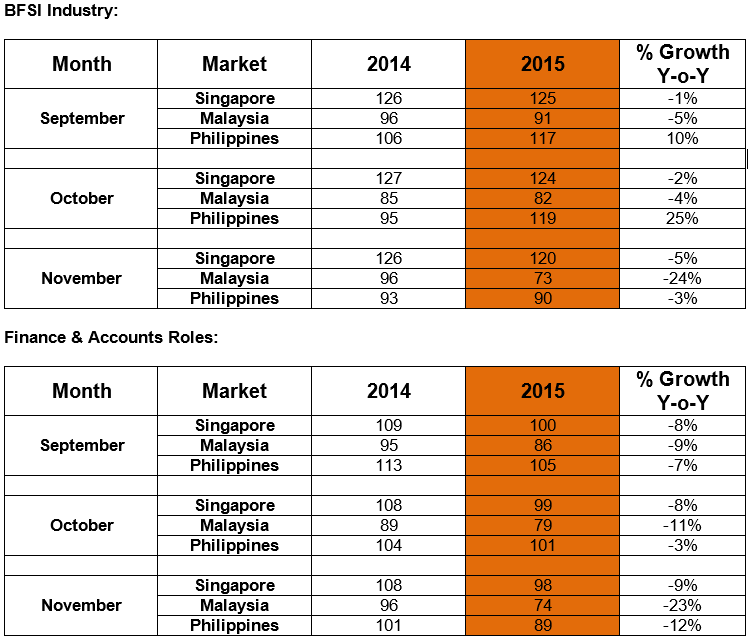
Across the three markets surveyed by the Index, the Philippines reported the least year-over-year decline at -3%, down from October’s 25% year-over-year growth. This is the market’s first negative growth in three months and the steepest month-on-month decline registered among all markets.

The BFSI sector in Malaysia registered the steepest year-over-year decline at -24%, falling six times as much as October’s -4% decline. This is the sector’s third consecutive month of annual decline.

E-recruitment in Singapore’s BFSI sector experienced a slight drop between October and November, at -5% year-over-year. Despite this, the three-month growth rate for November has improved marginally by 3%, compared to 2% in October.

The MEI is a monthly gauge of online job hiring activity, which records the industries and occupations that show the highest and lowest growth in recruitment activity in Singapore, Malaysia and Philippines.

BFSI Industry

Recruitment trends in the BFSI sectors have also led to the sluggish demands for Finance professionals in the three markets. Despite the overall negative growth, Finance and Account roles are the top growth occupational groups in Malaysia and Philippines.

Malaysia reported the steepest decline between November 2014 and November 2015 at -23% year-over-year, a sharp year-over-year decline from October’s -11%.

Singapore witnessed the least year-over-year decline at -9%. This is a marginal drop from October’s  -8% year-over-year. The Philippines reported a -12% year-over-year decline, down from the -3% year-over-year reported in October.

“As the global economy leans towards greater uncertainty, each market will need to take measures to build greater resilience against any vulnerabilities that can potentially deteriorate the country’s economy and affect recruitment,” said Sanjay Modi, Managing Director, Monster.com (India, Middle East, Southeast Asia, Hong Kong).

“While the demands for Finance professionals in the Singapore and Philippines markets appear to remain on the decline, Singapore’s vigilance to any potential economic risks and the Philippines’ strong economic fundamentals in its domestic systems should help see them through external threats.”

The Monster Employment Index is a monthly gauge of online job posting activity, based on a real-time review of millions of employer job opportunities culled from a large representative selection of career websites and online job listings. The Index does not reflect the trend of any one advertiser or source, but is an aggregate measure of the change in job listings across the industry.

See below for countrywide trends in Singapore, Malaysia and the Philippines for November 2015:

Singapore Highlights:

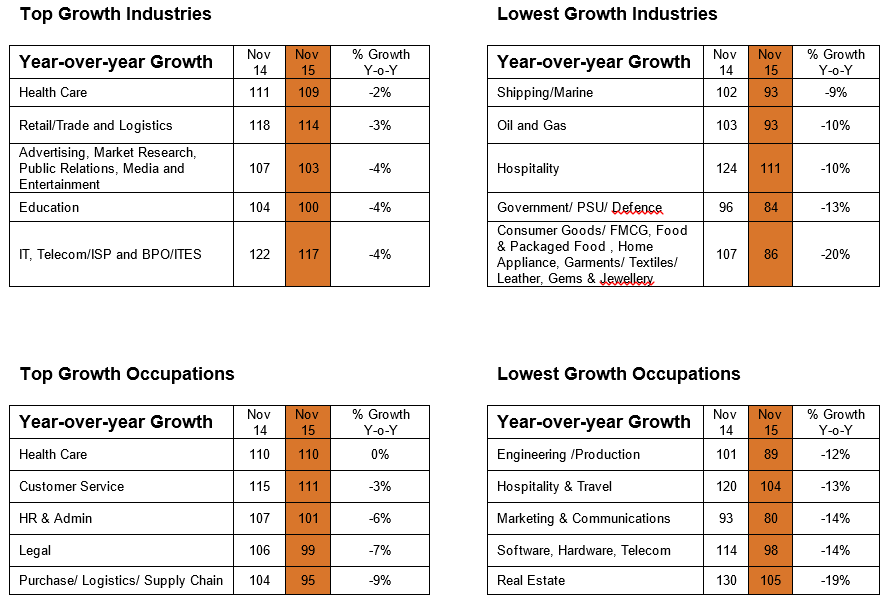
  • The Monster Employment Index Singapore declined -8% year-on-year.
  • No industry sectors or job roles registered positive year-over-year growth.
  • The Healthcare industry registered the least decline in online hiring at -2% year-on-year, while Healthcare jobs saw the highest demand – although at 0%.

Top Growth Industries

Malaysia Highlights:

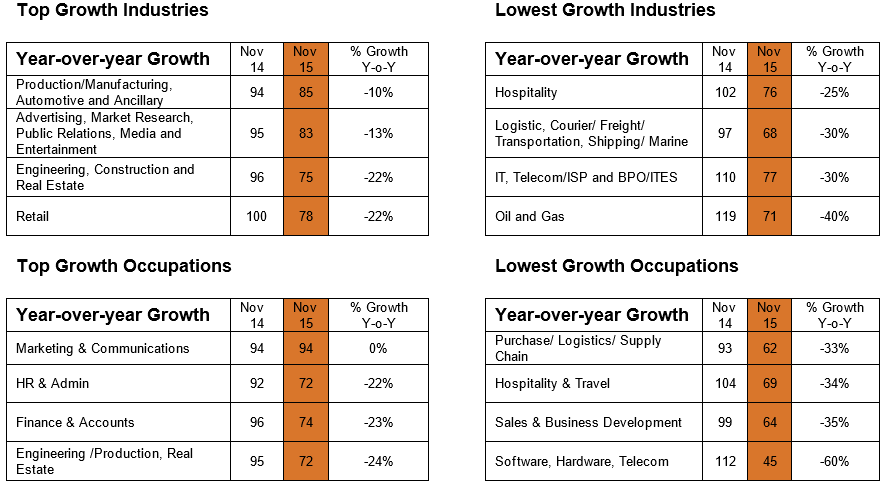
  • Online hiring in Malaysia declined by -31% year-on-year.
  • Not a single industry sector witnessed positive year-over-year growth in online hiring.
  • The Production/ Manufacturing, Automotive and Ancillary sector saw the least decline at -10%, while Oil and Gas registered the biggest drop at -40%
  • Demand for Marketing & Communications professionals takes lead at 0% year-over-year, while Software, Hardware, Telecom roles fared the worst at -60%.

Top Growth Industries 2

Philippines Highlights:

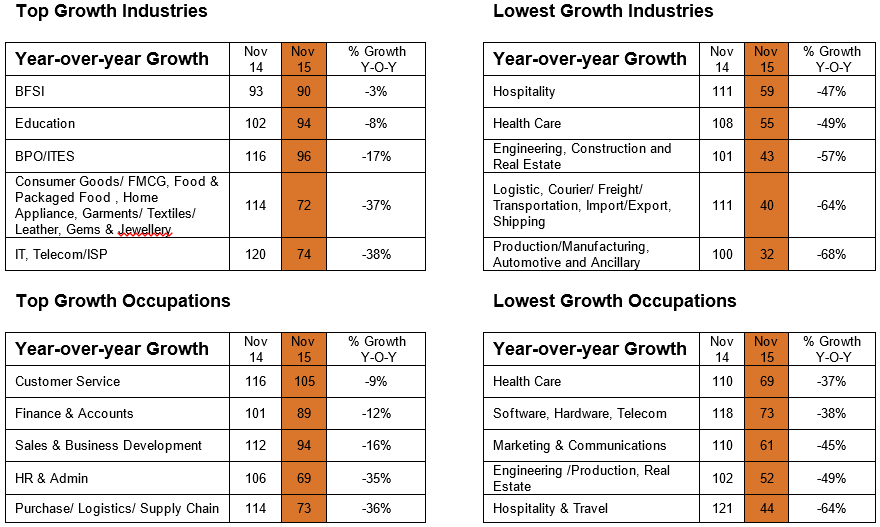
  • The Monster Employment Index Philippines registered a -46% year-on-year decline.
  • The BFSI industry had the least year-over-year decline at -3%, while the Production/Manufacturing, Automotive and Ancillary sector fared worst at -68%.
  • Customer Service jobs experienced the least decline at -9%, while Hospitality & Travel jobs reported the steepest decline at -64%

Top Growth Industries 3

– Ends –

About the Monster Employment Index

The Monster Employment Index is a broad and comprehensive monthly analysis of online job posting activity in Singapore, Philippines and Malaysia conducted by Monster India. Based on a real-time review of millions of employer job opportunities culled from a large, representative selection of online career outlets, including Monster Singapore, Monster Philippines and Monster Malaysia, the Monster Employment Index presents a snapshot of employer online recruitment activity nationwide. Monster has taken due care in compiling and processing the data available from various sources for Monster Employment Index, but does not guarantee the accuracy, adequacy or completeness of any information and is not responsible for any errors or omissions or action / decision taken or for the results obtained from the use of such information. In the South East Asia region, Monster Employment Index was first launched in Singapore in May 2014 with data collected since January 2011 followed by Philippines and Malaysia in May 2015 with data collected since February 2014.

Read More...