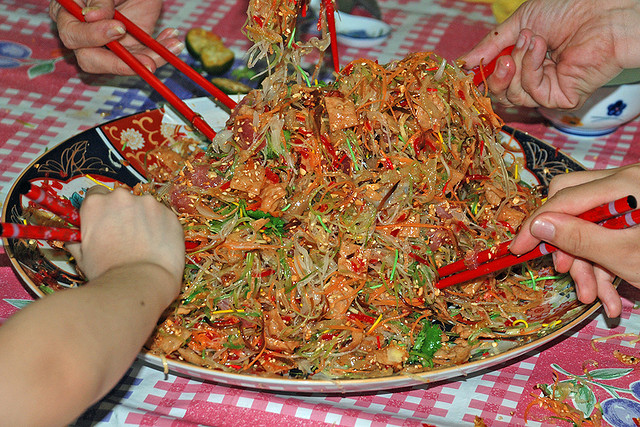
23 Chinese New Year Food For Wealth And Prosperity

Yu Sheng

As we welcome Chinese New Year in a week, many of us are busy during this period to do our shopping for new clothes, food and house decos.

It is also the time when we have the perfect excuse to put on more calories with numerous steamboat dinners as well as snacking on the CNY goodies such as Bak Kwa and pineapple tarts!

Chinese’s culture is rich in traditions and superstitions and we are constantly looking for inspirations to boost our luck and prosperity.

So you want to be rich? Then eat these food during Chinese New Year to bring your luck, wealth and prosperity. (At least that’s what the Chinese think)


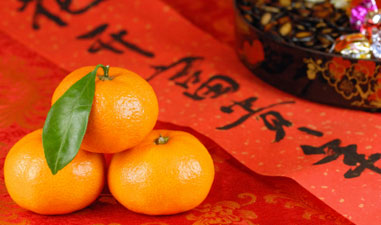
1. Tangerine (桔子)
Tangerine

Tangerine or Mandarin Oranges are often given in pairs during Chinese New Year. That’s because ju (桔) – sounds like luck (吉) and it looks like “gold” with its orange hue.

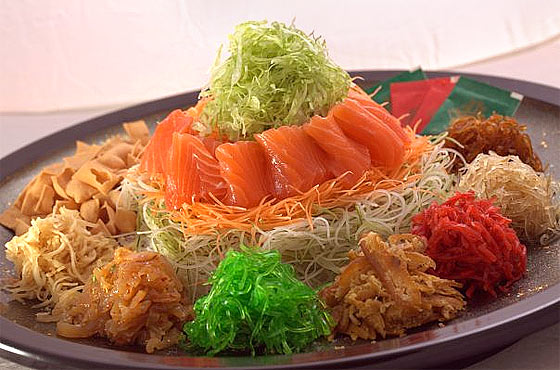
2. Raw Fish Salad (鱼生, Yusheng)
Yusheng


What’s Chinese New Year without lo hei? Lo Hei stands for 捞起 or Prosperity Toss and it comes with different types of shredded vegetables with raw fish slices. Raw fish slices were used because 鱼生 sounds like “rising abundance” and each of the other condiments has its own meaning in the dish. For example, deep fried flour crisps were added to symbolise 满地黄金 (Floor full of gold)

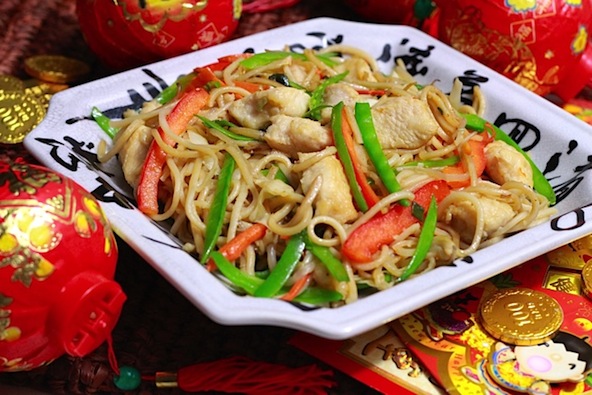
3. Long Noodles (长寿面)
Long Life Noodles

(Image credit: weelicious.com)

Longevity Noodles are often served during birthday celebrations and during Lunar New Year. The noodles, as the name suggests, comes in long strands and this symbolize long life or longevity. Do not break the strands with your chopsticks or by biting them until you put them into your mouth to chew.

4. Chinese New Year Cake (Nian Gao, 年糕)
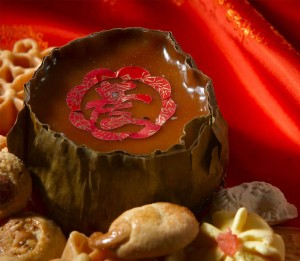
Nian Gao

(Image credit: chinancient.com)

Nian gao is very popular during Chinese New Year as the Chinese words 年糕 sounds like 年高 which can be translated to 年年高升, which means “higher year” literally or a better year ahead – with better luck, wealth and improvement in career.

5. Pomelo (Yòu, 柚)
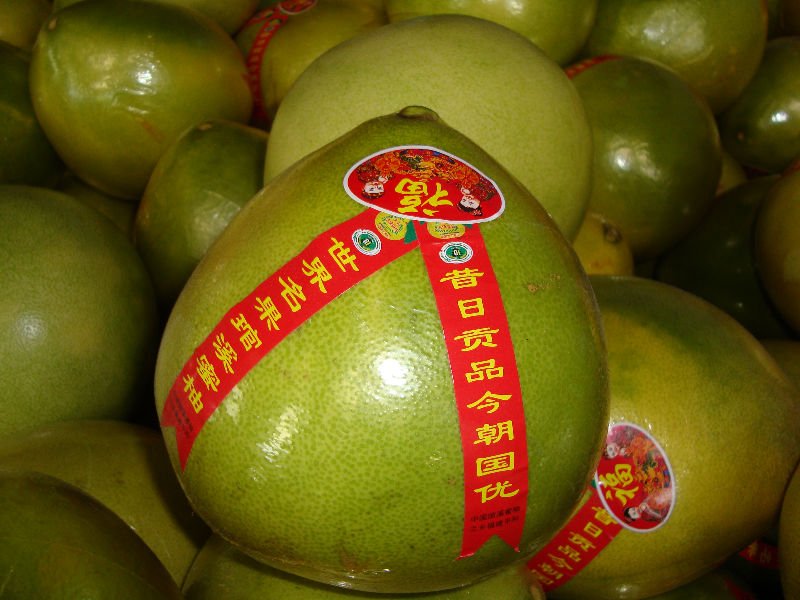
Pomelo

With its sheer size, pomelo is often used as a symbol of good luck.  柚 (yòu)  sounds like 有 (yǒu) which means “to have” or 又 (yòu) which means “again”. It stands for continuous prosperity and abundance (again, and again)

6. Dumplings (Jiaozi, 饺子)

Dumplings

Dumplings can be eaten any other days but on Chinese New Year, it has its own meaning to the Chinese. It look like gold/siver ingots, a currency used in China long time ago. These delicious dumplings symbolise wealth on the table.

7. Lettuce Wraps
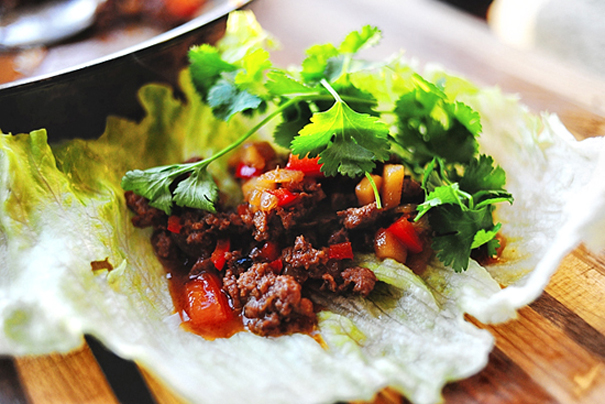
Lettuce Wrap

(Image credit: tastykitchen.com)

When you pronouce Lettuce in Cantonese, you get “Sang Choy” which means “rising fortune”.  It is no wonder Chinese treat it as their “lucky food”. You can use minced chicken and even dried oysters in the wrap. Let your creativity flows through.

8. Pineapple tart (Feng Li Ta, 鳳梨酥)
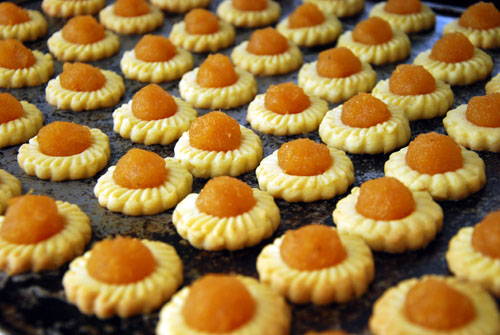
Pineapple Tarts

(Image credit: maameemoomoo.com)

Pineapple stands for 鳳梨 (feng li) or 黃梨 (huang li) in chinese. It also means “Wong Lai” or “Ong Lai” which literally means “Prosperity Come”. Its sweet golden filling looks like “gold” which is an auspicious colour for the Chinese.

9. Spring rolls (chūnjuǎn, 春卷)
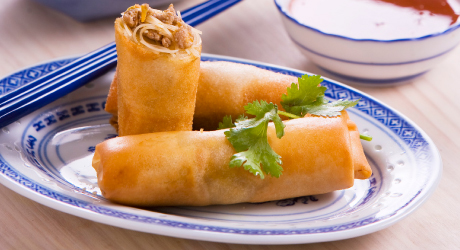
Spring Rolls

(Image credit: thatslife.com.au)

At first glance, what does spring rolls look like? (Hint: Think Colour & Shape)  Right, if you haven’t guess it, it looks like slabs of gold bar with its golden brown colour after being deep fried.

10. Tray of togetherness (全 盒)
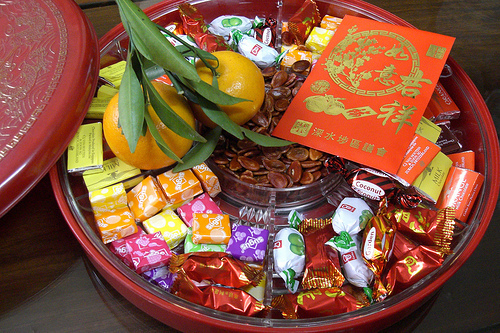
Tray of togetherness

(Image credit: dukascopy.com)

You will always see this when you go visiting during Chinese New Year. Also known as the chuen hup, it packs an assortment of candies, chocolates, dried fruits, seeds and nuts in a presentable red octagonal box. It usually has 8 sections (‘8’ is an auspicious number for the Chinese) and each of the food items in each section has its own meaning – such as dried kumquats as prosperity and red melon seeds for happiness.

11. Dried Oysters with Black Moss (Ho Si Fat Choi)
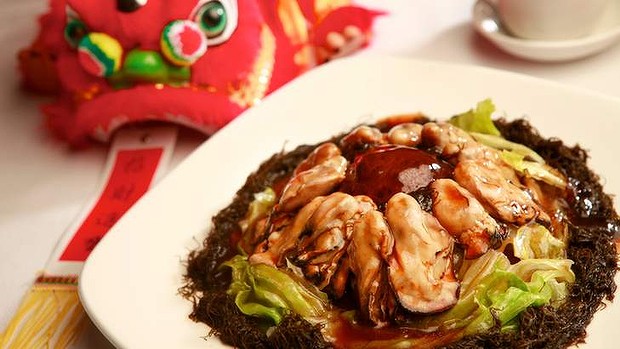
Ho Si Fatt Choi

(Image credit: nationaltimes.com.au)

Dried Oysters stands for Ho Si or “Good Business” and Black Moss stands for “Fat Choi” or 发财 which means “Strike Rich”. When paired together, it is amazingly delicious when braised and it would often leave you craving for more.

12. San Yang Kai Tai (Goat Stew, 三羊开泰)
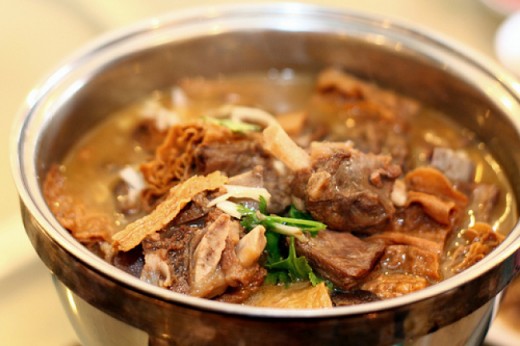
Lamb Stew

(Image credit: janechongyc.hubpages.com)

With 2015 being a “Goat” year, many people find Lamb/Mutton dishes to be auspicious. The Chinese for “goat” (羊) is in a Chinese character for good luck (祥 xiáng). The character “泰” (tài) means lavish and grand.

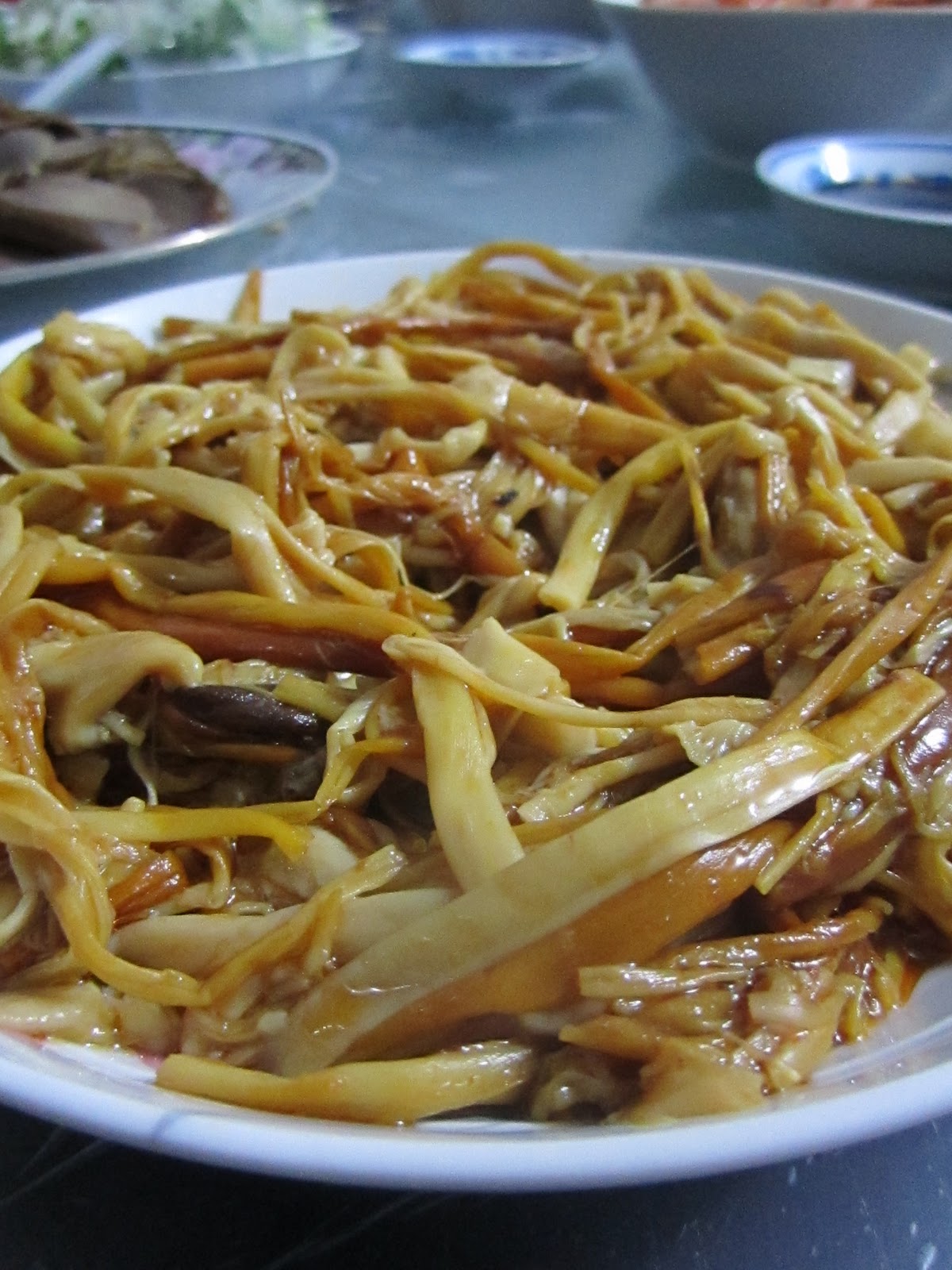
13. Bamboo Shoots (zhú sǔn jiān, 竹笋尖)
Bamboo Shoots

(Image credit: arielleinchina.blogspot.com)

Bamboo shoots in Chinese stands for “Wishing everything to be well” and is often stir fry with mushrooms, black fungus or golden lily bubs.

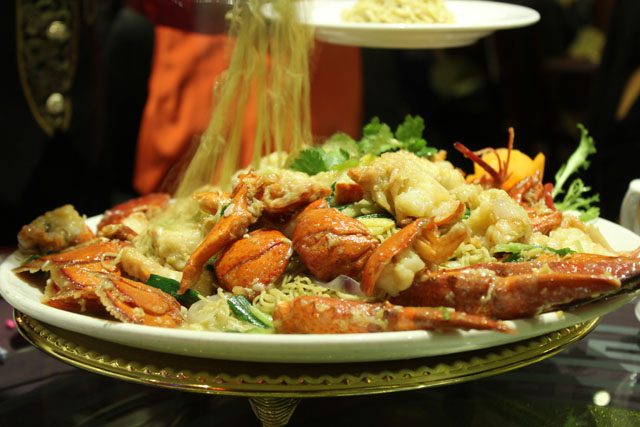
14. Dragon & Phoenix (lóng yĭ fènghuáng, 龙以鳳凰) or Chicken & Lobster
Dragon Phoenix

(Image credit: littleswallow.me)

What? Dragon and Phoenix? Do they even exist? Well, at least it did in Chinese’s folklore. The dragon and the phoenix have positive connotations and usually symbolizes grand and grace. Not surprisingly, the creativity of the Chinese has adapted it and uses lobster (龙虾)as the “Dragon” because of the first character “龙” and chicken meat as the “Phoenix” because of its resemblance as a golden rooster. As lobsters may not be accessible to some, some uses shrimps/prawns as an substitute ingredient.

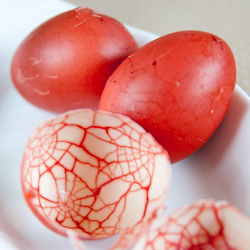
15. Red Eggs (红鸡蛋)
Red Eggs

(Image credit: tastespotting.com)

Usually eaten together with the longevity noodles during your Chinese Birthday, red dyed eggs can be auspicious to eat during Chinese New Year Eve with the colour red being an auspicious colour for the Chinese and it symbolises birth or a new start.

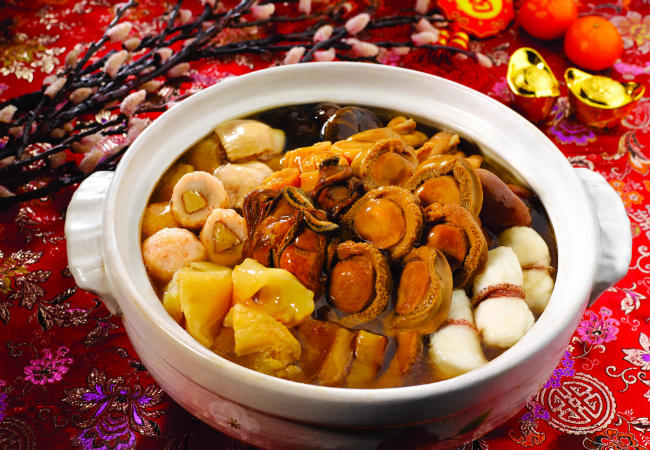
16. Pen Cai or Poon choi (盆菜) or Big Bowl Feast
Pen Cai

(Image credit: thediningtable.sg)

This dish originate from Hong Kong as a Cantonese cuisine and it usually filled with an assortment of delicacies ranging from abalone, scallops, prawns, braised mushrooms and other vegetables. It was a dish served to the Emperor back in the Song Dynasty and it also signifies abundance and prosperity with its luxurious offerings.

17. Abalone (Bao yu, 鮑魚)
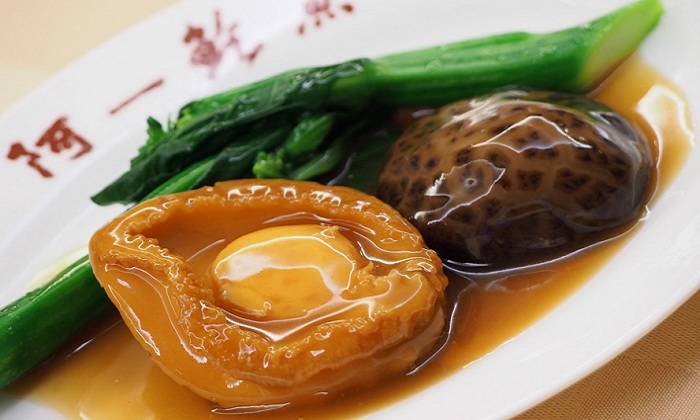
Abalone

(Image credit: juzdeals.com)

Abalone makes a popular dish for Chinese New Year and is one of the higher priced food item in Chinese New Year. It can be eaten in many ways such as being braised with mushrooms and kailan or you can simply dip it into your steamboat! “Bao” stands for assurance and “yu” stands for surplus and eating them means an abundance of surplus or wealth.

18. Golden Lily Buds (金针)
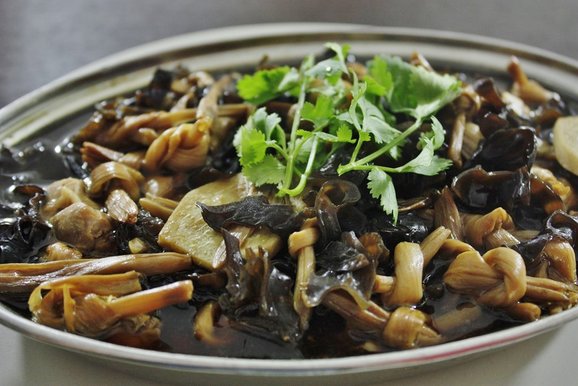
Golden Lily Bubs

(Image credit: springtomorrow.com)

Golden Lily Buds is often one of the ingredient found in vegetarian dishes such as the Nonya Chap Chye. Best eaten when stir-fried with black fungus, tang hoon, cabbage and/or black moss. The Chinese translation for lily buds is “golden needle” and you can understand why the Chinese loves them.

19. Fried Tofu
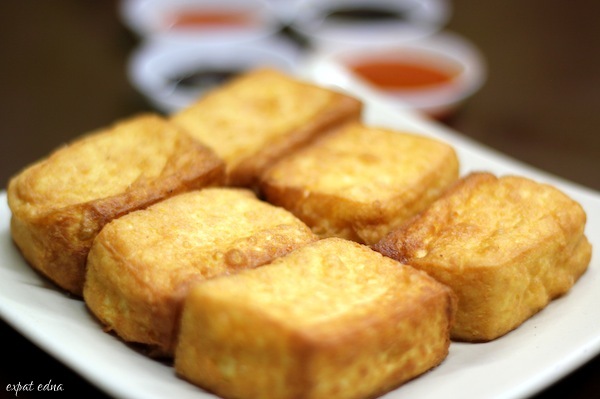
Fried Tofu

(Image credit: expatedna.com)

Just look at the colour and shape! Do i need to say more to describe these ‘gold bars’?

20. Rabbitfish (Pei Tor Hee, 蒸泥鯭)
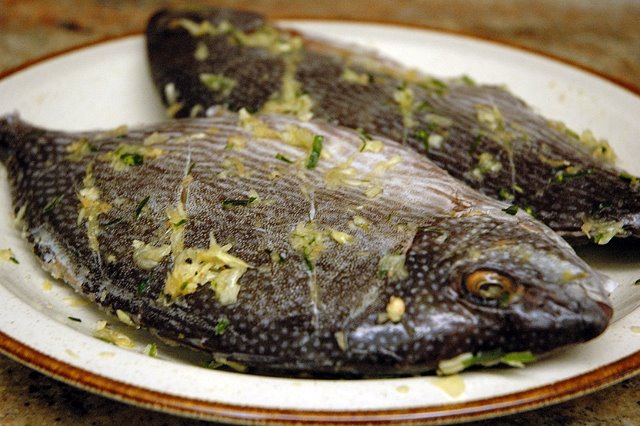
Rabbitfish

(Image credit: blazinghotwok.com)

Rabbitfish are highly sought after during Chinese New Year. They breed during this period, so expect to see its stomach filled with roe which is a sign of prosperity and abundance to the Chinese. Price can go as high as $60-$120 per kg during this period.

21. Whole Fish (清蒸魚
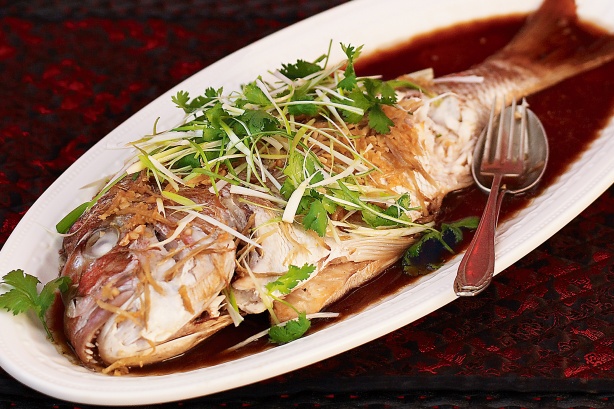
Whole Fish

(Image credit: taste.com.au)

It is believed to eat with the whole fish with the head and tail intact as it symbolizes a year begining’s to the end. Chinese word for fish (鱼) also sounds like abundance (余), so for this lunar new year, 祝你新年快乐, 年年有余! (Happy Chinese New Year, wishing you a year of surplus and abundance!)

*Don’t finish the entire fish, as it is believed that the unfinished portion represents the “surpluses” of the coming year.

22. Leeks (suàn, 蒜)
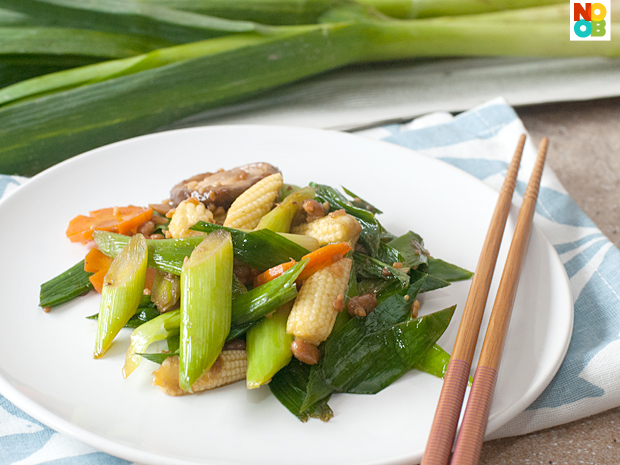
Leeks

(Image credit: noobcook.com)

Leek is an auspicious food for Chinese New Year because the character “蒜” in its Chinese name (蒜苗/大蒜) sounds like calculating (“算”) in Mandarin, symbolizing wealth. While i’m no fan of this on other days, i will make this Chinese New Year an exception.

23. Buddha’s Delight (Luo Han Zhai, 罗汉斋)
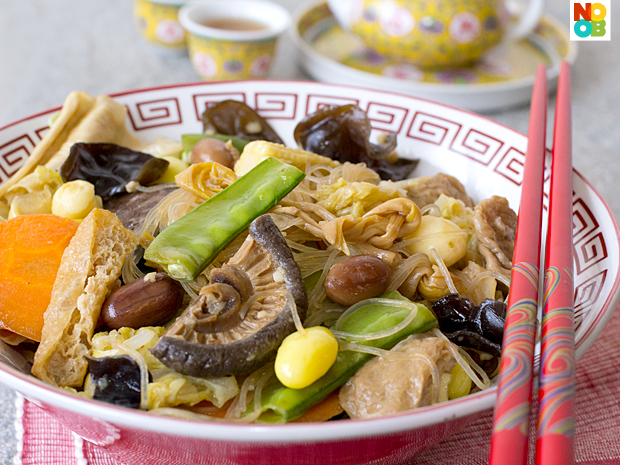
Luo Han Zhai

(Image credit: www.noobcook.com)

A vegetarian dish that is considered auspicious in Chinese New Year, traditionally enjoyed by Buddhists Monks. Buddhists believed that as a form of self-purification, one should maintain a vegetarian diet for the first five days of the new year. With more than ten ingredients, you will definitely taste some of the “auspicious” vegetables like fat choy and snow fungus.

Read More...

Chinese New Year is around the corner, here are 3 places you can shop for cheap clothing

Mich Sara CNY Collection

As Chinese New Year approaches, there is an increasing traffic in malls and online stores where the latest designs of outfits get snapped up in a jiffy. Many are having a headache on where to get trendy outfits without burning a hole in their pockets. In addition, many prefer to wear red, the auspicious colour, during their visits, which adds on to the difficulty to land your hands on suitable clothing for the festival. The trend of traditional costumes has returned and cheongsams have made their comeback. Many stores have brought in beautiful designs and colours and displayed their cheongsams proudly. However, most of them come with exorbitant prices due to the demand and supply during this period of time.

As the belief goes, one should wear brand new clothes, shoes and accessories when celebrating the first day of the lunar new year as it represents a prosperous new beginning. As much as we wish to have a brand new start to the new year, finding suitable new clothes could be a real pain in the neck, especially clothes that are budget-friendly and deemed auspicious. This is especially when you are someone who has to visit traditional seniors who would be particular about the colours of the outfit as well as how conservative you should look. Since different people have different demands for different kinds of outfits, here are 3 places you can shop for a wide variety of cheap clothing!

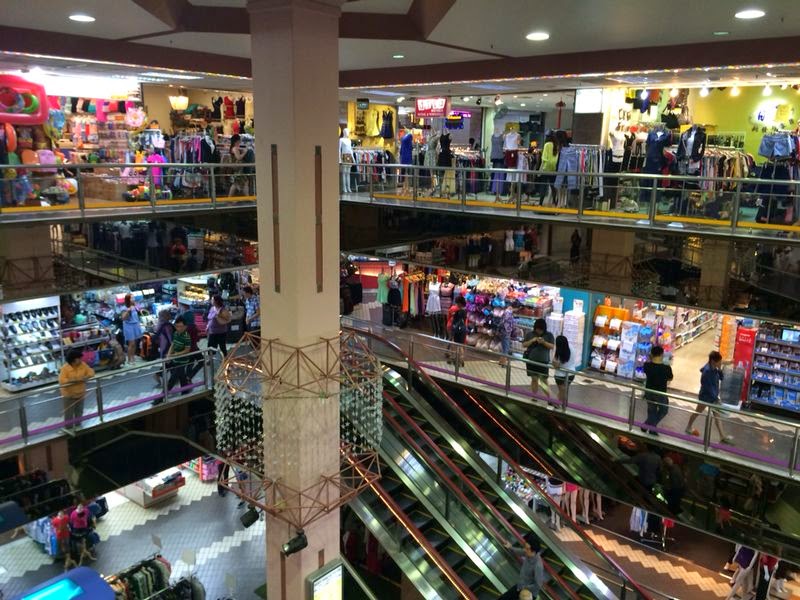
Bugis Village

Bugis Village

(Image credit: missterfaith.blogspot.com)

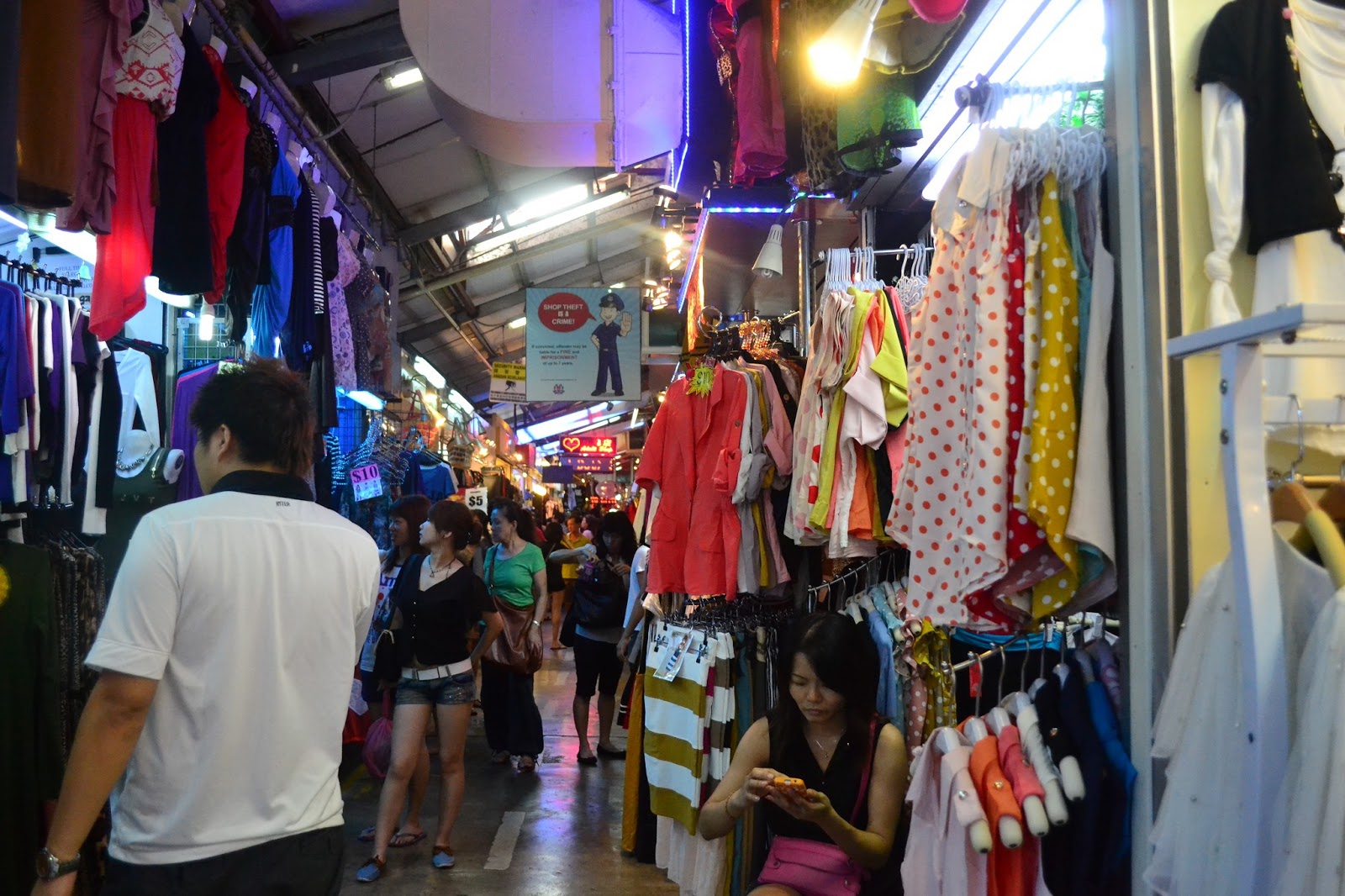
Bugis Village is a very popular place for young people to shop at. That is because they sell many imported products from Thailand and Taiwan where they are cheap and trendy. The clothing are up-to-date and they have a wide variety for you to choose from. Although the area could be cramp and extremely crowded, jostling through the crowd would be completely worth it when you scavenge for the best deals in town. Many of the stalls sell almost the same thing, which means that the sales competition would be steep. Prices could go as low as $8 per clothing where they can get cheaper if you bought more and you can even bargain in some of the shops. It is a 3-storey building so if you are unable to find what you want in the first floor, you can always go upstairs where it is usually less crowded and you can comb the area at your own time. In addition, between the shops are food and beverage stalls where you can take a break and munch on your favourite street snack from all around the world. My personal favourite would be the ‘I Love Taimei’ stall (located at the first floor at the back facing Waterloo Street, they have several other branches as well) where I can sip on flavourful milk tea and munch on crispy aromatic fried chicken as I browse the items.

City Plaza

City Plaza

(Image credit: jpaem.blogspot.com)

Many people know City Plaza to be a rundown building located somewhat opposite Payar Lebar and it functions as a wholesale centre, but not many people know that there are actually many hidden gems inside. Although the building consists mainly of suppliers, they are actually boutiques and if you were to enter any of the shops, most of them would give you reasonable prices should you ask them. They do not just do wholesale but they also sell clothing piece by piece for walk-in customers. Many online stores attain their stocks from here and don’t be surprised that the products sold there are very up-to-date and of pretty good quality! If you are looking for better bargains, it would be best to go with a big group of friends or family so that you can buy in bulk and buy everything at a way better deal.

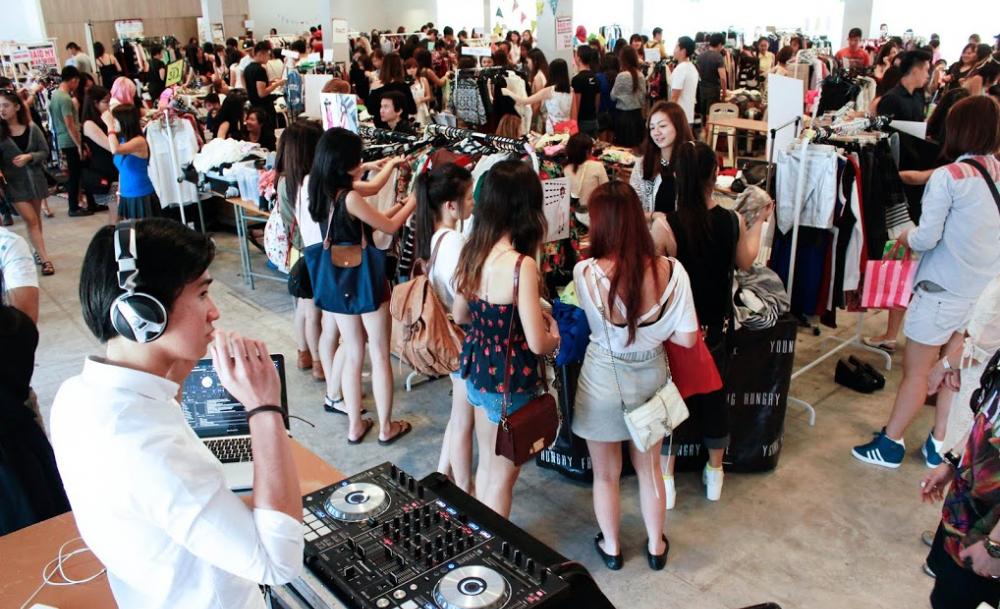
Fleas & Blog shops

Three Blind Mice Flea

(Image credit: sg.asia-city.com/)

The last option would be to go to any flea organised by blogshops. Many would think that fleas are where people sell their used items at a cheaper price. However, many online stores have taken this path of selling their items in fleas so that their customers can not just come down to collect their ordered items, but also to gain recognition and trust in their buyers. Due to the low rental costs, products can be sold at a more affordable price. In addition, they also sell a wide variety of products so not only do you buy clothes, you can also buy watches, shoes and even hats from there. There has been many fleas organised around Singapore, and more have appeared since it is the Valentine’s Day and Chinese New Year period. One of the prominent ones would be the Scape flea where every weekend there would be many venders who set up booths right outside Scape at Orchard Road. Other up and coming fleas include those organised by Three Blind Mice, where they pool famous bloggers and popular online stores to sell their merchandise. The latest flea was held at Triple One Somerset and even City Plaza itself. More details can be found in their website: http://threeblindmice.com.sg/

If you have a busy schedule and don’t want to escape the crowd, why not shop online?  There are many blog shops in Singapore and as they operate online without the brick and mortar store, they can pass on the cost-savings to the customers. Popular one includes brands like Love Bonito, MDS Collections, Mich Sara and Love & Bravery.

Blog shops also update their inventory regularly to bring in the latest trendy fashion often curated by tastemakers. For example, for the month of Chinese New Year, Mich Sara carries a range of Chinese New Year’s collection that is not only fashionable but also of high quality.

Mich Sara

We hope we have given you sufficient tips to prepare for the Chinese New year! Non-Chinese friends should also come along to experience the hustle of the festival. All the best in attaining your last minute loots!

Read More...

3 Budget-friendly Places To Do Your Shopping Before Chinese New year

Chinese New Year Singapore

There are 2 reasons why all of us would be looking forward to Chinese New Year in 2015. Not only because there would be a long weekend for us to take a break from the flurry of work or school, it is also the time for us to indulge in all the festive goodies that are usually only rampant during this time of the year!

On the other hand, some would be groaning at the vast amount of work needed to prepare for the festival, such as the preparation of red packets and being laden with the overwhelming responsibility of whipping up a sumptuous meal for the entire family for the occasion. Not only do you need to feel the pinch of giving money away to the young and old, you are also expected to spend a lot of money on buying exorbitantly priced ingredients to prepare the meal. Besides having to buy ingredients in large amounts since the extended family would be present for the reunion, prices of the ingredients would have risen sky high due to the rise in demand and low in supply during this point of time.
Many dread the process, but we help you make it a little more enjoyable!

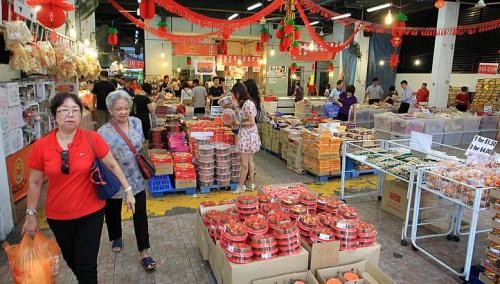
Woodlands Industrial Park

Woodlands Industrial Park

(Image credit: ST)

Many have raved about it, but just how many people really know about its hidden gems? Mainly well-known for their good bargains for food and goodies, many flock there during festive period to stock up.
Despite being an industrial area, there have been tours to Woodlands Industrial Park organised by community centres and other organisations to bring people to the popular outlets for grocery shopping. Honestly, I would admit that it is very much more convenient to travel there if you have a car as it is quite inaccessible where you can only get there via bus. But if you must, there is always bus service 964 from Admiralty MRT Station which can bring you there!

Personally, I have been patronising several distributors found there for my goodies fix such as J&C Fong’s Confectionary (they have excellent pineapple tarts and butter cakes) and Melvado’s with my family since young as my family love the good food and attractive bargains that can only be found there. Apart from the big companies like Frangrance, we can also find smaller suppliers opening booths at their stores selling items such as nian gao (traditional rice cakes) or even steamboat ingredients just for the occasion at a much lower price as compared to NTUC and the like. Customers can grab their groceries at wholesale prices and if you’re re to make a quick calculation, you actually would save a lot more from all the purchases you have made there.

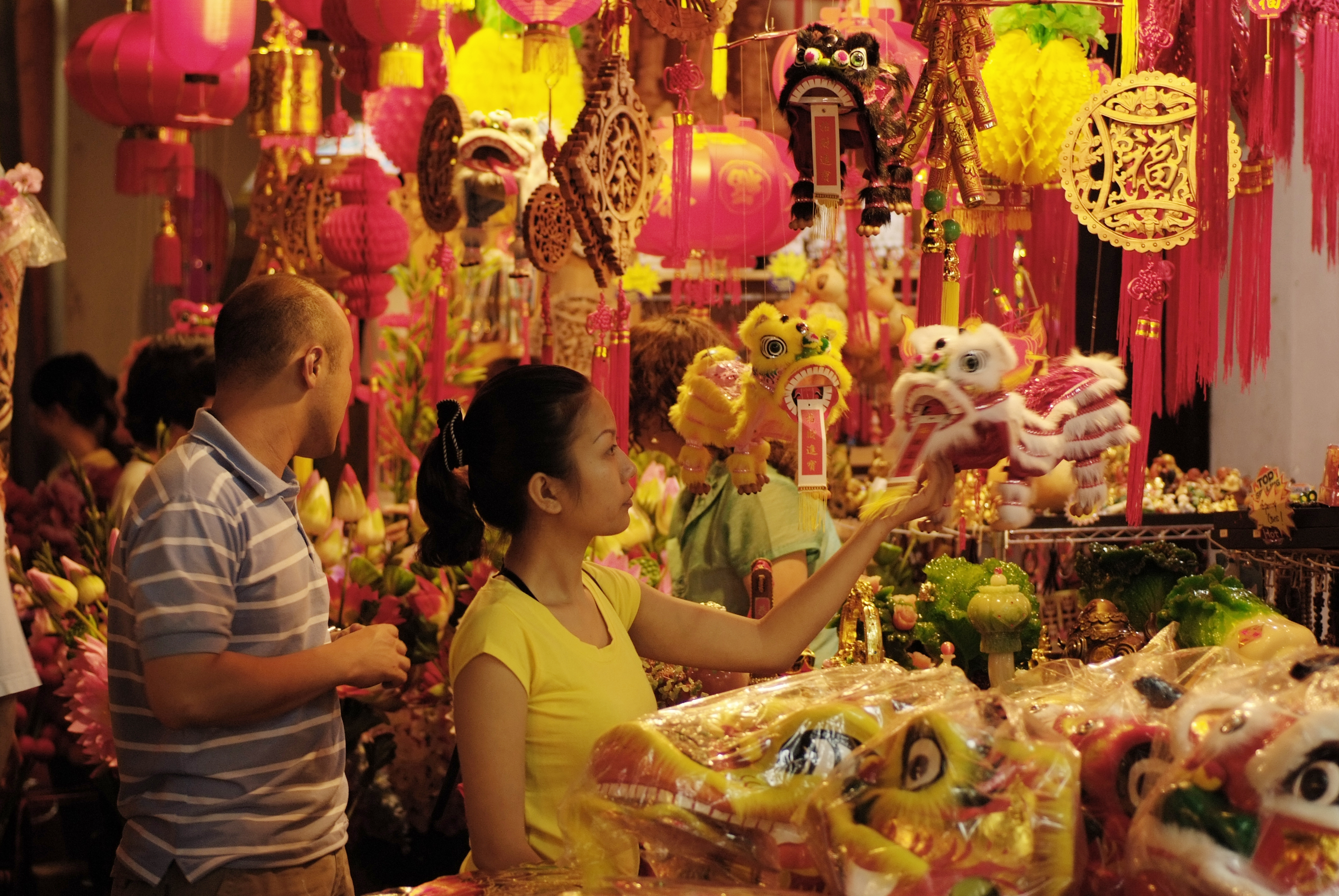
Chinatown on Chinese New Year’s eve

Chinatown

(Image credit: bestofsingapore.sg)

Visiting Chinatown during the Chinese New Year period is mandatory, not just because one would go there to soak up the festive atmosphere, but also because that is a place to buy CNY goodies at crazily low prices. If you are one who don’t mind squeezing in the massive crowd, going to Chinatown on dates closer to the Lunar New Year would be one of the best times because that is when vendors start slashing the prices of their stocks, especially perishables like the Taiwanese Sausages, sweets and pineapple tarts in a desperate bid to get rid of them.

Johor Bahru

CitySquare JB

(Image credit: elgenahearts.blogspot.com)

If you are able to grab hold of your passport, go take a bus from Woodlands checkpoint to JB to do some shopping! Right outside the Sultan Iskandar CIQ Complex (if you are lost, I am talking about the Malaysian customs) are 2 large shopping malls just side by side, linked by a connecting bridge – City Square Mall and Komtar JBCC – where you can shop til you drop. Within City Square itself, there are various hair salons, nail parlours, massage parlours and boutiques to prepare for the occasion! Komtar JBCC has many sports outlets and beauty stores as well. Not to mention the number of restaurants and cafes in both malls that you can visit to rest your aching body from all the shopping. Definitely you would be able to find many things that you need for CNY!

Apart from these places, there are other means to purchase necessities such as going online to shop for clothes etc. because there is no change in the price. But always remember that the best way to avoid hassle is to start early!

Read More...

How Much “Ang Bao” Money Shall You Give This Chinese New Year?

The festivity of the Chinese New Year is about a month away. Abundant food, family reunions, and little red packets called “Ang Bao” will grace Singapore once again.

These red packets are usually given during social gatherings such as weddings or the holidays. Its color embodies “good luck” that is supposed to ward off the evil spirits.

Married couples usually give these red packets to single people (e.g. children or work colleagues). Its history is rooted from the Chinese belief that you achieve the “adult status” once you get hitched. So, the newfound status comes with the privilege to distribute “Ang Baos” to those who still remain single or are younger.

Image Credits: Paul via Flickr

Image Credits: Paul via Flickr

Since Singapore is a mixture of different cultures, we as a nation have created practices centering “Ang Bao” gifting. It is not uncommon to have marriages between two different races, leading to traditional practices being modified or ignored. But aside from the Chinese, Vietnamese, Japanese, Filipinos and South Koreans have similar customs.

A simple survey on TheAsianParent Facebook Page showed that readers usually give out S$2- S$80 to children in 2014. Furthermore, “S$4” was avoided due to its similarity to the word “death” in many dialects.

Ultimately, PerfectWeddings.sg showed that economy and income status affects the money given. During good economy, it was common to receive “Ang Baos” with a minimum of S$6 each for children but economic recession urged its reduction to S$2 each. Since, economic downturn affects the whole country, there was no judgment in the amount you give.

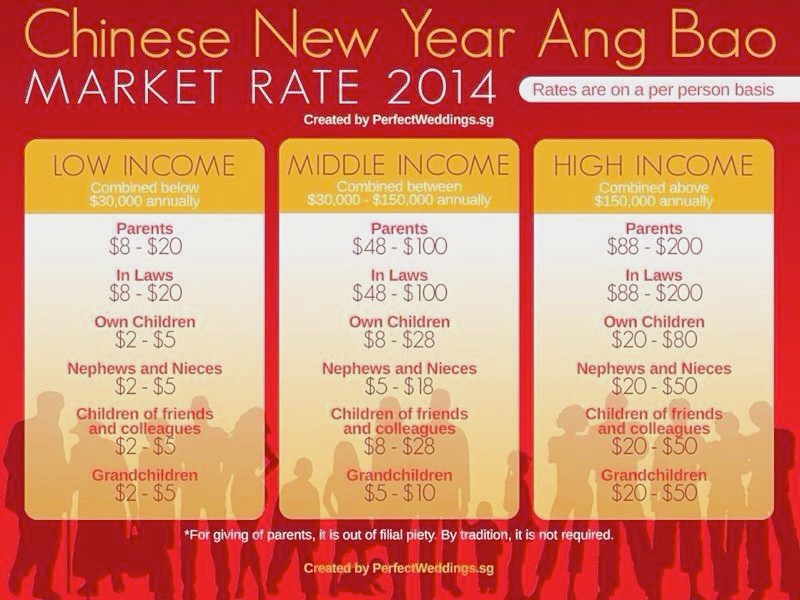
To help you find the right amount to give…here is a concise “Chinese New Year Ang Bao Market Rate 2014” chart by PerfectWeddings.sg :

1511783_10151933528858403_1671344607_n
As you can see, a red packet containing a minimum of S$2-S$20 is common to give for children, while it ranges to about S$8- S$88 for parents. Your in laws will not take it against you if you give them S$88 in the New Year. Lastly, you may give the same amount of money to your friends or colleagues’ children as you did with your own children.

Read More...