How To Deal With The Infectious Workplace Bullies

Whether you are wrongfully accused or verbally abused by your boss or colleagues, workplace incivility shall be treated with maximum seriousness.

Surprisingly, statistics have shown that 1 in 4 Singaporeans have suffered from workplace bullying with the top aggressors being their bosses (62%) and their clients (21%). To make matters worse, Singapore was one of the few countries with the highest acceptance of workplace bullying (alongside Hong Kong and Taiwan).

With high acceptance for this issue, it only makes sense that fewer people address matters associated with it. Thus, the unacceptable behavior prevails.

A study that surveyed 6,000 people in Sweden showed that being subjected to “rudeness” spreads if the workplace environment did nothing about it. Rudeness in this context is defined as a way of violating the norm of mutual respect. For example, it can be as petty as excluding someone from the informed circle or as greater as taking credits for the work of others. As people often imitate and support the behavior of the dominant, there is a risk that rudeness will spread like wildfire and later on lead to bullying.

This is why it is important to identify and address bullying as it happens.

Here are 3 ways you can deal with it:

1. IDENTIFY WORKPLACE BULLYING

Bullying causes physical deterioration in work performance as well mental distress. It is generally categorized into three, namely:

a. name calling, malicious teasing, or pranks
b. sabotaging the colleagues performance (e.g.,spreading rumors)
c. forcing, causing self-imposed exclusion, or intimidation

Identification of workplace bullying is vital as some organizations may not want to acknowledge its existence while some people may not recognize that it is already happening to them.

2. SPEAK UP MORE

Sometimes the person who bullies you is your boss himself/herself. This is called an abuse of power. In our Asian context, there is an underlying culture of not defying the authorities and simply complaining about the issue in our smaller circles. As a result, any behavior from the boss is considered as acceptable and rarely excessive. However, you can only tolerate such behavior to a certain extent.

Once you have recognize that inappropriate behavior occurs, it is time to talk to the H.R. department or your boss about it. Steps to disclosing bullying shall include stating the observable behavior, describing its subjective impact, and validating the nature of the problem.

3. KNOW YOUR RIGHTS

If all else fails, you can always turn to the law. In November 2014, the Protection from Harassment Act 2014 together with 2 accompanying subsidiary legislation are equipped to protect the rights of every working individual.

It states that:

“No person shall, with intent to cause harassment, alarm or distress to another person, by any means —

a. use any threatening, abusive or insulting words or behavior; or
b. make any threatening, abusive or insulting communication, thereby causing that other person or any other person harassment, alarm or distress”

Image Credits: pixabay.com (License: CC0 Public Domain)

Image Credits: pixabay.com (License: CC0 Public Domain)

More importantly, this Act covers the online world too. So you must not undermine cyber-bullying!


Sources: 1, 2, 3, 4,& 5

Read More...

How To Finally Get A Raise This 2016!

Since the new year is about starting afresh and realizing one’s potentials, evaluating your salary is one of the top priorities. If you are seeking for a higher salary, do not open a discussion with your boss unless you are fully prepared.

Consider these 6 things to help you prepare:

1. SHOW THAT YOU DESERVE IT

Say that an important project is due in a couple of days. Send your boss an email of your progress to avoid constant request for project updates. The simple act of anticipating what is needed before it is asked can show that you are capable of working independently. You not only sent a positive reflection of your working etiquette but also made your boss’ life job easier.

2. DO YOUR RESEARCH

Negotiating your salary is a game with all of its players attempting to dominate each other. Dominate the game by researching all the needed information. Go in-depth about the complete aspects of the job and the company. Also, collect data about the average pay and accurate salary opportunities in your position.

3. DEVELOP A BACK-UP PLAN

If the company’s current situation cannot afford to give you the raise you deserve, consider suggesting alternative options such as commission-based pay (if appropriate) or performance-based bonus.

Image Credits: pixabay.com (License: CC0 Public Domain)

Image Credits: pixabay.com (License: CC0 Public Domain)

4. MAKE A GOOD IMPRESSION

During the discussion, greet your boss in a friendly and light manner by smiling and shaking hands. Say your gratitude as he or she spared some time to arrange a meeting for you. Your boss’ mood can change depending on how you approached the room.

5. ASK FOR MORE THAN YOU ACTUALLY WANT

Your first offer must be slightly higher than what you want to avoid remorse and to give you a room to bargain. It uses the door-in-the-face technique wherein the employee starts with a huge and unreasonable request in order for the employer to settle with a smaller request.

6. COMPETE

Negotiating a salary is a conversation that aims to reach an agreement with someone whose interests are not perfectly aligned with yours. Use persuasion and assertion if necessary as scientific research showed that competition is a successful negotiation strategy!

Image Credits: pixabay.com (License: CC0 Public Domain)

Image Credits: pixabay.com (License: CC0 Public Domain)

Sources: 1, 2, & 3

Read More...

Key Disadvantages Of Working From Home

Working from the comfort of your own home may sound like a dream come true. However, just like any other working conditions, it has its disadvantages. Be completely honest with yourself and consider these disadvantages before you take the leap!

INCREASE IN UTILITY COSTS

One of the inescapable costs that come with working at home is utility. And if you are inside your home 24/7, it can cause the bills to shoot up!

This is why you should make it a habit to conserve energy through simple strategies such as scheduling your air conditioning use, reducing indoor heat by painting your rooms white, or working at the brightest part of the house.

Related Article: 8 Earth Friendly Ways To Save Money On Utility Bills

DECREASE IN SOCIALIZATION

Since most people meet new people and make friends in the workplace, professionals who are working from home may experience loneliness, isolation, and depression. As they are plucked away from your previous co-workers and bosses, staying in touch with them is a must! In fact, Global Workplace Analytics showed that teleworkers who maintain consistent communications with traditional co-workers and bosses find career impact to not be an issue.

You can also use social media or join Yoga groups, photography clubs, or other types of support groups to creatively meet new people whom you share the same interests with.

INCREASE IN DISTRACTIONS

Distractions from accessible electronic devices, noisy family members, and many household tasks can be very disruptive. Sometimes these distractions can draw you away from your career responsibilities and later lower your income. Thus, keep your focused by turning off your devices or by using free Website blocking applications such as SelfControl (for Apple users) and SelfRestraint (for Microsoft users).

Also, use your home office space solely for making projects and crafting items so your brain can associate the space to automatic “work mode”.

DECREASE IN PERSONAL TIME

Based on personal experience, there will be days when you are tempted to work any time when you are hired to work from home. The lack of a management enforcing strict working hours and the lack of physical separation between home and work may add to the pressure of working endlessly.

Image Credits: pixabay.com (License: CC0 Public Domain)

Image Credits: pixabay.com (License: CC0 Public Domain)

So if you are under one company, consider setting your daily hours to avoid phone calls and emails that are conflicting with your personal time. Working from home requires time management and organization skills that not everyone has!

Sources: 1, 2, & 3

Read More...

Ways To Be Healthy And Make Money At The Same Time

After eating a lot of food this Holiday season, get back to your desired shape and earn money at the same time by following these five tips:

1. JOIN THE “PACT”

Looking for an efficient motivation to help you stick to your weight loss resolution in 2016? Look no further as GymPact brings you the Pact app! Pact app allows its users to pledge a specific amount alongside the set of days they plan to work out. Users who do not go by the said goal must pay for each day they miss. You earn cash for staying healthy and get paid by “inactive” Pact members. Also, the nutritional option allows you to commit to healthy eating or pay its consequences.

Download it for free on iOS or Android!

2. INCREASE YOUR SALARY

If you are still contemplating on whether or not you must exercise or not then, you must know that regular exercise helps to increase your salary.

In 2012, a study published under the Journal of Labor Research found that employees who exercise regularly earn 9% more than their sedentary counterparts. This may be due to the enhanced mental function, energy levels, and mood. Thus, these improvements make them more valuable to their employers.

3. TRAIN OTHERS FOR A LIVING

If you have passion for fitness, interpersonal skills, and sufficient knowledge to back it up then consider a career as a personal trainer. A personal trainer works directly with the clients to make fitness assessments, set goals, demonstrate exercises, and provide constant feedback to improve the client’s physique.

The salary is usually S$70-90 per session. Aside from getting paid by doing something you love, you can also save money on costly gym or studio memberships.

4. MAKE YOUR OWN HEALTH BLOG

By constantly writing or blogging about a certain topic, you become sort of expert on that topic. The most feasible ways to earn money from your blog are paid advertisements, paid articles, offering fitness courses, and selling health books.

Start by sharing your own wisdom and genuine passion to educate the readers about being in shape. After which, only promote the products and brands that you really believe in.

5. BECOME THE HEAD AT BOOT CAMPS

Whether you believe it or not, some people pay money to be pushed to their limits and scream at for the most parts! If you are knowledgeable about fitness and you are capable to teach a group of people then, consider becoming an instructor at a boot camp. Do the workouts with your students to burn as much calories as you can!

Image Credits: pixabay.com (License: CC0 Public Domain)

Image Credits: pixabay.com (License: CC0 Public Domain)

Sources: 1, 2, & 3

Read More...

Demand For Banking Professionals falling in SEA

** PRESS RELEASE **

While banking and finance professionals are still struggling with a decline in demand, Singapore and the Philippines are likely to see some pick-up in 2016.

22nd DECEMBER 2015 – According to the latest Monster Employment Index (MEI), Singapore, Malaysia and Philippines experienced a drop in demand for banking professionals amid the volatile economic conditions in November.

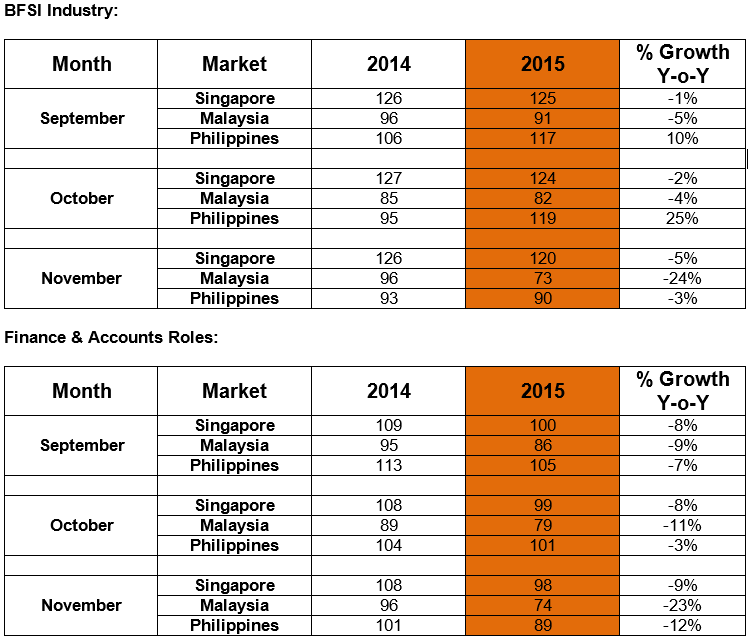
Across the three markets surveyed by the Index, the Philippines reported the least year-over-year decline at -3%, down from October’s 25% year-over-year growth. This is the market’s first negative growth in three months and the steepest month-on-month decline registered among all markets.

The BFSI sector in Malaysia registered the steepest year-over-year decline at -24%, falling six times as much as October’s -4% decline. This is the sector’s third consecutive month of annual decline.

E-recruitment in Singapore’s BFSI sector experienced a slight drop between October and November, at -5% year-over-year. Despite this, the three-month growth rate for November has improved marginally by 3%, compared to 2% in October.

The MEI is a monthly gauge of online job hiring activity, which records the industries and occupations that show the highest and lowest growth in recruitment activity in Singapore, Malaysia and Philippines.

BFSI Industry

Recruitment trends in the BFSI sectors have also led to the sluggish demands for Finance professionals in the three markets. Despite the overall negative growth, Finance and Account roles are the top growth occupational groups in Malaysia and Philippines.

Malaysia reported the steepest decline between November 2014 and November 2015 at -23% year-over-year, a sharp year-over-year decline from October’s -11%.

Singapore witnessed the least year-over-year decline at -9%. This is a marginal drop from October’s  -8% year-over-year. The Philippines reported a -12% year-over-year decline, down from the -3% year-over-year reported in October.

“As the global economy leans towards greater uncertainty, each market will need to take measures to build greater resilience against any vulnerabilities that can potentially deteriorate the country’s economy and affect recruitment,” said Sanjay Modi, Managing Director, Monster.com (India, Middle East, Southeast Asia, Hong Kong).

“While the demands for Finance professionals in the Singapore and Philippines markets appear to remain on the decline, Singapore’s vigilance to any potential economic risks and the Philippines’ strong economic fundamentals in its domestic systems should help see them through external threats.”

The Monster Employment Index is a monthly gauge of online job posting activity, based on a real-time review of millions of employer job opportunities culled from a large representative selection of career websites and online job listings. The Index does not reflect the trend of any one advertiser or source, but is an aggregate measure of the change in job listings across the industry.

See below for countrywide trends in Singapore, Malaysia and the Philippines for November 2015:

Singapore Highlights:

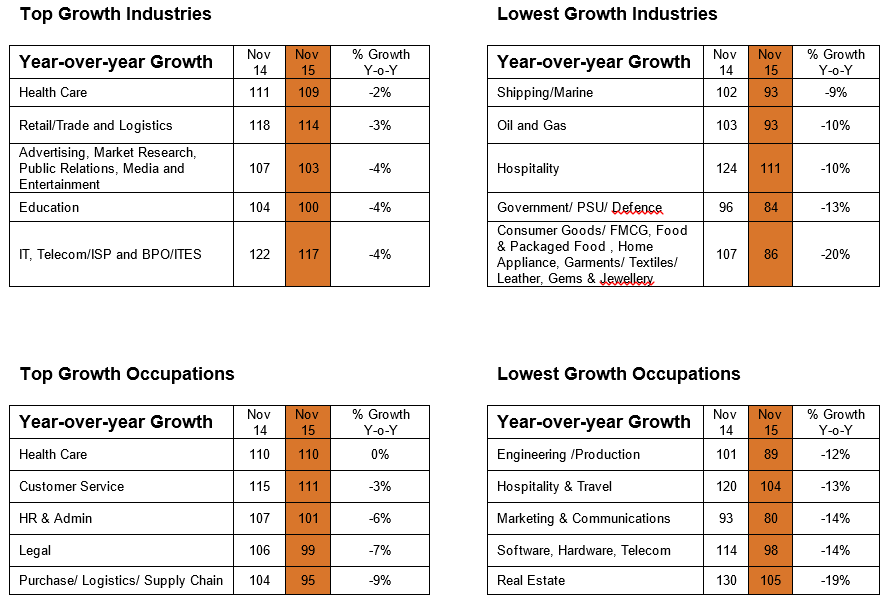
  • The Monster Employment Index Singapore declined -8% year-on-year.
  • No industry sectors or job roles registered positive year-over-year growth.
  • The Healthcare industry registered the least decline in online hiring at -2% year-on-year, while Healthcare jobs saw the highest demand – although at 0%.

Top Growth Industries

Malaysia Highlights:

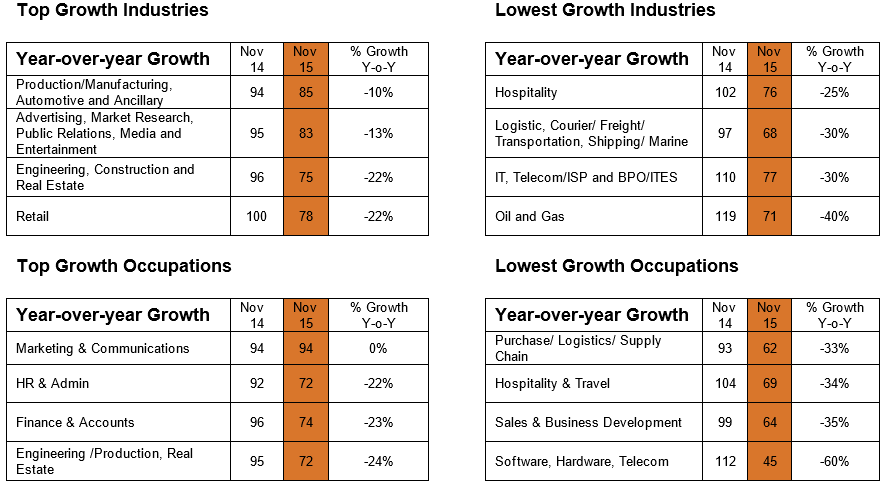
  • Online hiring in Malaysia declined by -31% year-on-year.
  • Not a single industry sector witnessed positive year-over-year growth in online hiring.
  • The Production/ Manufacturing, Automotive and Ancillary sector saw the least decline at -10%, while Oil and Gas registered the biggest drop at -40%
  • Demand for Marketing & Communications professionals takes lead at 0% year-over-year, while Software, Hardware, Telecom roles fared the worst at -60%.

Top Growth Industries 2

Philippines Highlights:

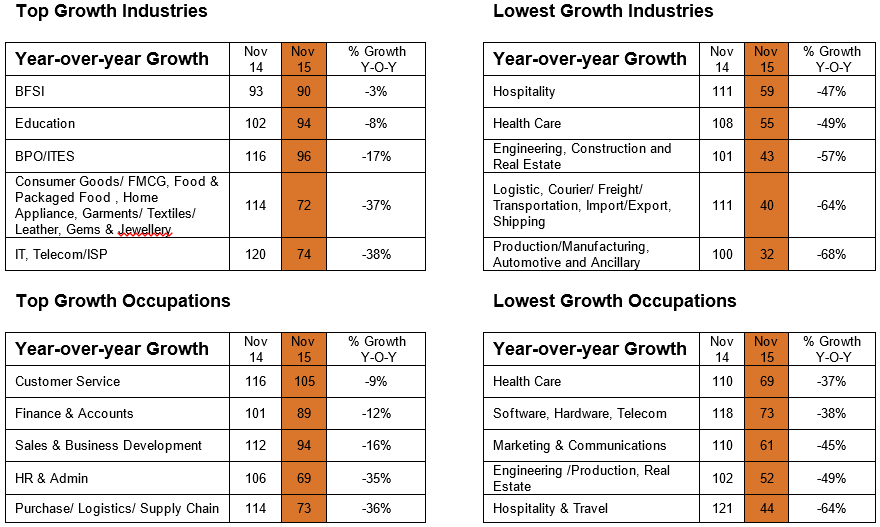
  • The Monster Employment Index Philippines registered a -46% year-on-year decline.
  • The BFSI industry had the least year-over-year decline at -3%, while the Production/Manufacturing, Automotive and Ancillary sector fared worst at -68%.
  • Customer Service jobs experienced the least decline at -9%, while Hospitality & Travel jobs reported the steepest decline at -64%

Top Growth Industries 3

– Ends –

About the Monster Employment Index

The Monster Employment Index is a broad and comprehensive monthly analysis of online job posting activity in Singapore, Philippines and Malaysia conducted by Monster India. Based on a real-time review of millions of employer job opportunities culled from a large, representative selection of online career outlets, including Monster Singapore, Monster Philippines and Monster Malaysia, the Monster Employment Index presents a snapshot of employer online recruitment activity nationwide. Monster has taken due care in compiling and processing the data available from various sources for Monster Employment Index, but does not guarantee the accuracy, adequacy or completeness of any information and is not responsible for any errors or omissions or action / decision taken or for the results obtained from the use of such information. In the South East Asia region, Monster Employment Index was first launched in Singapore in May 2014 with data collected since January 2011 followed by Philippines and Malaysia in May 2015 with data collected since February 2014.

Read More...