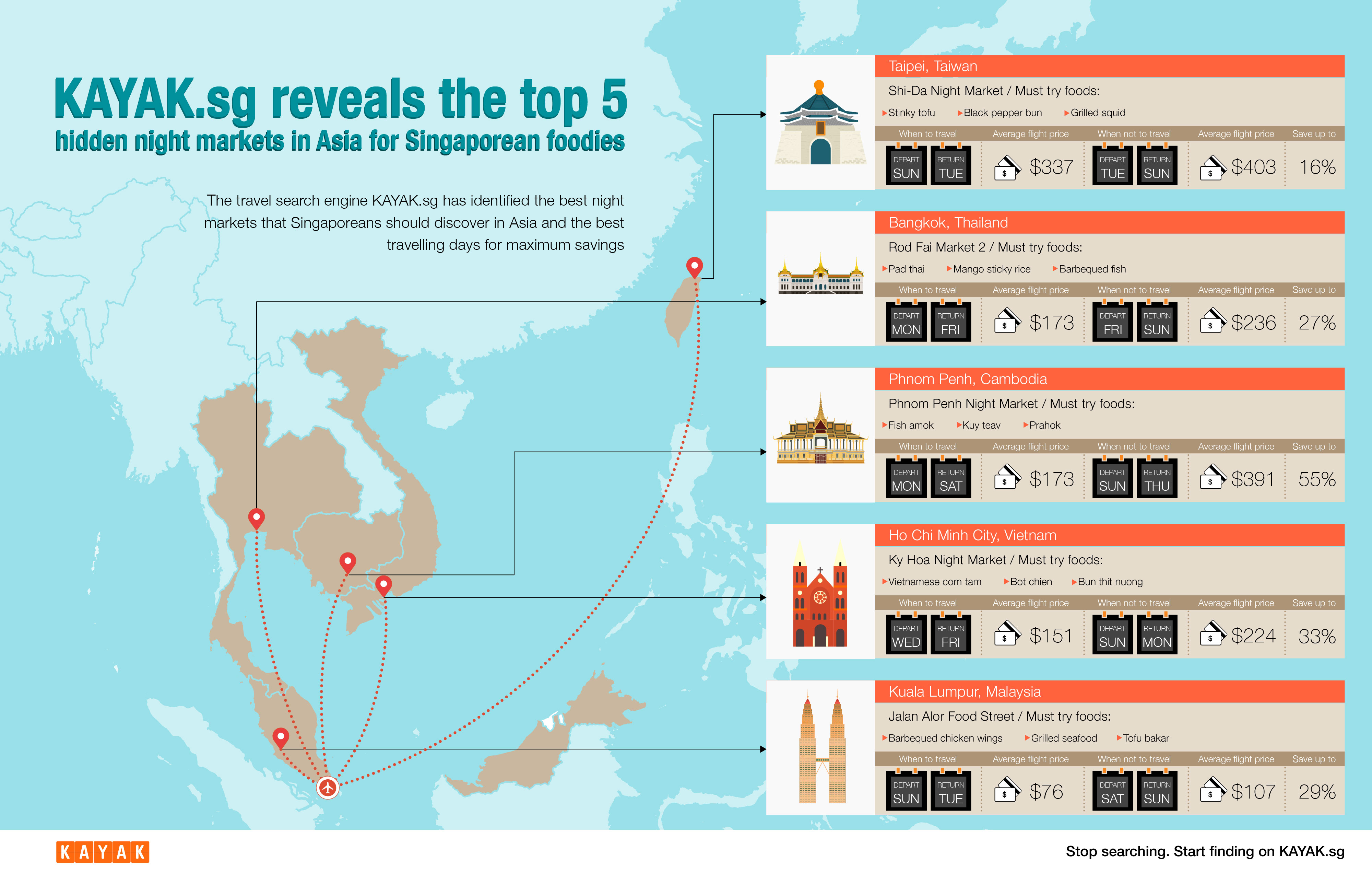
KAYAK.sg reveals the top 5 night markets in Asia for Singaporean foodies

The travel search engine KAYAK.sg has identified the best night markets that Singaporeans should discover in Asia and the best travelling days for maximum savings

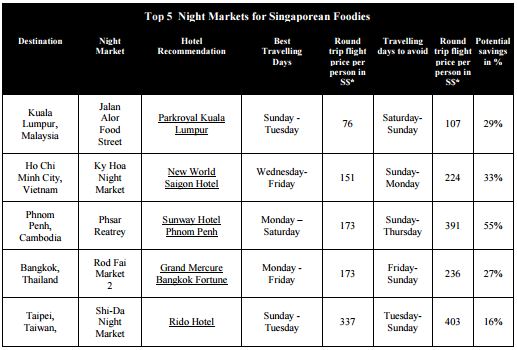
  • Singaporean travellers can save up to 55% on a round-trip flight to Phnom Penh when flying on Monday and returning Saturday
  • The cheapest return flight is from Singapore to Kuala Lumpur with an average price of S$76
  • When booking a return flight for a trip to Ho Chi Minh city travellers can save up to 33% flying on Wednesday and returning Friday

Singaporean foodies can never get enough of good food and are always on the hunt for the best local gastronomic experiences. KAYAK.sg reveals which destinations have the best local food at the most wallet-friendly prices, as well as which travel daysafford the best flight deals. Knowing which days are the best to fly on when booking a return trip allows Singaporean travellers to better plan their trip, while spending less on their flights and more on local delicacies in Asia’s best night markets.

Debby Soo, KAYAK Vice President APAC said “Tasting local food is a highlight on every traveller’s itinerary. To avoid disappointment, travellers should make sure to check the opening hours of night markets as they are not all open daily. Also, Singaporean holidaymakers should come prepared with sufficient loose change as the vendors only accept cash payment.”night_markets-v1-01
Top5


Kuala Lumpur, Malaysia: Jalan Alor Food Street

@Kheng Guan Toh/Shutterstock.com

@Kheng Guan Toh/Shutterstock.com

Jalan Alor is the best local tip when it comes to night markets in Malaysia. Expect to find a smorgasbord of street food; ranging from local Malay and Chinese food to international cuisine and exotic snacks; it is the perfect place for those who want to try all of the famous, local dishes. The famous food street is open until late to cater to party-goers around the area. Everything is on offer, including barbequed chicken wings, grilled seafood, tofu bakar and belacan fried rice. The street market is open every day from 5pm till late. Travellers should note that some of the street’s restaurants have very specific opening times and are not open every day or at all hours, thus they should be sure to check the opening times before visiting them. To get better flight deals, Singaporean foodies are encouraged to travel to Kuala Lumpur on a Sunday and stay until a Tuesday, when the average price for a return trip amounts to S$83, saving travellers an average of 29% when compared to a Saturday to Sunday getaway. If travellers are making frequent trips to Jalan Alor to satisfy their cravings, they should consider their stay at Parkroyal Kuala Lumpur – a 10 minute walk away from the food street.

Address: Bukit Bintang, 50200 Kuala Lumpur, Wilayah Persekutuan Kuala Lumpur, Malaysia

Ho Chi Minh, Vietnam: Ky Hoa Night Market

@jreika/Shutterstock.com

@jreika/Shutterstock.com

Adventurous travellers can slip away from the French cafes and tourist heavy spots in District 1 and hop over to District 10 to explore Ky Hoa Night market which offers a wide range of local food. Among the most popular local delicacies, Singaporean foodies can try Vietnamese Com Tam (broken-rice) with grilled pork, bot chien (fried rice flour cake with egg), bun thit nuong (cold rice vermicelli) as well as exotic delicacies including fried insects and arachnids. Travellers should head to Ho Chi Minh City on a Wednesday and return on a Friday, when a return flight costs an average of S$151, saving up to 33% when compared to booking a flight leaving on a Sunday returning Monday. Luckily for Singaporeans, the market is open daily from 5pm to midnight; however, to make the most of it, travellers may consider staying in one of the top 5-star hotels nearby, such as the Windsor Plaza Hotel, and extending their taste-testing spree by couple of days.

Address: Thong Nhat Stadium, 138 Dao Duy Tu, Thanh Binh, Vietnam

Phnom Penh, Cambodia: Psar Reatrey

Phongthon Preuksrirat/Shutterstock.com

Phongthon Preuksrirat/Shutterstock.com

Phnom Penh’s only formal night market, Psar Reatrey, overlooks the riverside from the central reservation that separates downtown and northern Phnom Penh. Singaporeans can enjoy live local pop music as they stroll through this less-crowded and less touristy Cambodian night market. Travellers should make sure to taste some specialties from the local cuisine, including Fish Amok (Cambodian style steamed fish), Kuy Teav (noodle soup), and Prahok (crushed and salted mud fish in banana leaves). Holidaymakers searching for novelties should take a seat at the back of the market and try fried cockroaches and salted grasshoppers. Singaporean travellers who want to save up to 55% should leave on a Monday and return on a Saturday when an average price of a return flight amounts to S$208. Moreover, it is perfect timing as the market is open on Fridays, Saturdays and Sundays from 5pm till midnight. Those who want to extend their stay in the capital and spend more time enjoying the local delicacies may want to consider checking into a 4-star hotel e.g the Sunway Hotel Phnom Penh, located within easy walking distance from the market.

Address: Street 1 (Preah Sisowath Quay) in Wat Phnom Commune, Daun Penh District

Bangkok, Thailand: Rod Fai Market 2
@Kidsada Manchinda/Shutterstock.com

@Kidsada Manchinda/Shutterstock.com

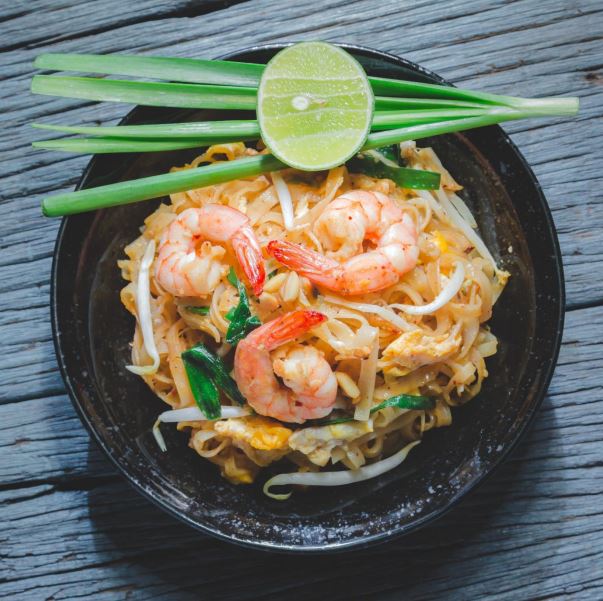
A sea of colourful tents, near the Thailand Cultural Centre, at the BTS station, house row upon row of street food vendors offering travellers everything from stir fried pad thai to barbequed fish and the perennial favourite, mango sticky rice. After eating or when taking a break from it, Singaporeans should head up to the second-story bars, which provide a bird’s eye view of the market below, and enjoy some live music The best days to stay in Bangkok are Monday to Friday, when the average return flight price is around S$173. Also, Singaporean holidaymakers can save up to 27% when booking their flights for these days compared to other booking combinations. For Singaporeans taking advantage of this great deal, take note that the market is only open Thursday to Sunday so book a hotel like the Grand Mercure Bangkok Fortune, just a stone’s throw away from the market, to really make the most of your market dining experience.

Address: Ratcadaphisek Road (close to Esplanade Shopping Mall)

Taipei, Taiwan: Shi-Da Night Market

@Johnson76/Shutterstock.com

@Johnson76/Shutterstock.com

Located in one of the city’s trendiest neighbourhoods and near several universities, Shi-Da has a young and vibrant atmosphere. The market can be found along Longquan Street, which runs parallel to ShiDa Road. Apart from tasting such local delicacies as stinky tofu, black pepper buns and grilled squid, Singaporeans should definitely make time to explore the stalls set up by local fashion designers. Travellers can save up to 16% when flying out a Sunday and back on a Tuesday, with an average price of S$337 when compared to holidaying from Tuesday till Sunday. The market is open from 6pm to 11.30pm daily; however, with so much to see and taste Singaporean travellers, wanting to make the most of their time in Taipei may want to consider somewhere like the Rido Hotel, which is a short stroll away from the market.

Address: Lane 39, Shida Rd, Da’an District, Taipei City


Note:

Data analysis is based on flight searches made on KAYAK.sg from June 2015 until June 2016 for travelling dates between June and December 2016. Average prices are quoted in Singapore dollars and based on a return economy flight for one person. All prices quoted may be subject to change and may no longer be available. Hotels are recommended based on short travel distance from the night markets or food streets, rated at least 4 stars. Searches are made on 18 June 2016 for 1 night stay and 2 guests from 27 June to 25 July 2016.


 

Read More...

Are You Spending Your Money Properly?

No matter how abundant or scarce your money is, spending it wisely shall be your top priority. It not only enables you to get the most out of your dollar but it also allows you to make life-changing decisions.

Determining the reasons behind your spending is the first step to knowing whether your money is allocated properly or not. Are you spending your money on the latest gadget by Samsung because you need it or because you want it?

There is usually a conflict in differentiating between needs and wants. Perhaps, the confusion is due to our subjective definitions of the two terms. Let us take Cheng Ling as an example.

Cheng Ling values the perceptions of others toward her and her daughter. Since her daughter is starting a new school year, she bought her two new pairs of shoes.

She argues that she does not want her daughter to feel embarrassed by wearing the same shoe she wore last school year. Although the last year’s pair is still in mint condition, she bought another pair of shoes to prevent repetitions.

Do you think Cheng Ling’s purchases are necessary in this scenario? Or, was it a matter of personal desire?

Examine your purchases in this manner along with these helpful queries:

“Will this purchase make my life easier and more efficient?”
“Will this purchase provide a lasting pleasure?”
“Will this purchase be meaningful to my life?”
“Is this something I will use regularly?”
“Is this something I can afford?”
“Is the potential gains from this item realistic?”

Carefully assess all these questions and the interplaying factors that can influence your decisions. If your response to all these questions is “YES” then, by all means, make the purchase!

Aside from distinguishing between your needs and wants, you must sort out your “essentials” first. When I say essentials, I pertain to the fixed expenses that you encounter every month. This includes your groceries, utility bills, and school fees. Plan your spending before you receive your paycheck.

Some people spend their hard-earned money like most lottery winners. They get a huge pile of cash now and spend it all in a snap! Remember that wealth is accumulated over time and not something that you can earn overnight.

Image Credits: pixabay.com

Image Credits: pixabay.com

At the end the day, it all boils down to the decisions you make!

Read More...

Ridiculously Entertaining Riddles About Money

A prominent form of literature back in the Medieval age, the riddle’s undeniable charm still holds weight today. If your hobby is answering riddles, do you think you can uncover two or all of these?

Answers are provided below.

EASY

1. What word of five letters has only one left when two letters are removed?

2. Whoever makes it, says it not. Whoever takes it, knows it not. Whoever knows it, wants it not.

3. What has a bank with no money and waves with no hands?

MODERATE

4. A mother offered to pay her son S$5 for every correct answer he gets on his Maths test. Her son said he would pay his Mum S$8 for every incorrect answer. There were 26 questions on the test and no money was exchanged.

Why is that so?

5. Jack lent Rose as much money as she already had then, she spent S$10. On the second day, Jack lent her as much money as she had now and she spent S$10 again. The next day, Jack once again lent her as much money as she currently had. She spent S$10 and was broke afterwards.

How much money did Rose start with?

6. Jenny’s friends were chipping in cash to buy her a baby shower gift. At first, ten friends chipped in, but two of them flaked out. Each of the eight had to give in another dollar to bring the amount back up.

How much money did they plan to collect?

DIFFICULT

7. An elderly Singaporean wanted to leave all of his fortune to one of his three sons. However, he did not know which one is worthy of his wealth. He gave each of them a few S$1’s and told them to buy something that would be able to fill their living room. The first man bought straws, but it were not enough to fill the room. The second bought some sticks, but they still did not fill the room. The third man bought two things that filled the room, and he obtained his father’s fortune.

What were the two things that the wise son (3rd man) bought?

8. An affluent man named Phillip Ng had been counting his money. He accidentally left a S$1,000 bill on his desk. He returned for it but, it was gone. Only 2 other people could have seen the bill in the short amount of time. It was either between his maid and his butler.

The maid told him that she had hidden it for safe-keeping under a green book that was on the desk. When they looked the bill was not there.

The butler said he had found the bill where the maid had left it. He had placed it inside the least suspicious book. He had written down the page numbers so that he would not forget them. The bill was between pages 35 and 36, he said. But there was no money in that book.

After Mr. Ellis had talked to the maid and the butler he phoned the police. He knew who had taken the money. How was this possible?

Image Credits: pixabay.com

Image Credits: pixabay.com

ANSWERS

1. Money
2. Counterfeit or Fake Money
3. River
4. The son got 10 incorrect answers and 16 correct ones.
5. S$8.75
6. S$40
7. The “wise” son bought a candle and a lighter. The light from the candle filled the entire room.
8. Mr. Ng knew that the butler was lying because pages 35 and 36 of a book are always printed on the opposited sides of the same paper.

Adapted from the riddles on sources: 1,2, & 3.

Read More...

Efficient Financial Tips For Fresh Graduates

Congratulations! After the backbreaking years of higher education, you have graduated. The next chapter ahead will not be easier but I hope you find prosperity and joy in the process.

Much like attaining your degree, financial responsibility takes hard work and discipline. Start by reading these following tips to help you stay on top of your money:

GRAB A BOOK OR TWO

Read and understand materials about self-empowerment, investment, and money management. Here are four books to get you started with:

“The War of Art” by Steven Pressfield
“Turning Pro” by Steven Pressfield
“A Money Saving Mindset: 40 Ways to Help You Save” by Derek Polen
“Why Stocks Go Up and Down” by William Pike
“The Intelligent Investor” by Benjamin Graham

AVOID UNHEALTHY COMPARISONS

It is important to limit lifestyle comparisons even before you start making decent amount of money. Comparing your own “backyard” to that of others is basically human nature. However, turning this auto-response into a habit can become unhealthy not just for you but for your wallet. Imagine keeping up with your friends or coworkers who spend their money on designer bags, five-star restaurants, and trendy gadgets. Following their footsteps can easily put you to debt.

SAVE AT LEAST 15% OF YOUR INCOME

Mr. Tan Kin Lian, an experienced professional and former CEO of NTUC Income, highlights the essence of saving at least 15% of your income in addition to your CPF account. Your savings will help you pay for emergencies without having to be tied up with a creditor’s interest rates. Growing your savings shall start with your first paycheck.

PROTECT YOURSELF FROM UNEMPLOYMENT

Having a future mindset can help you cope with unforeseen events such as unemployment. To protect yourself from the immediate effects of unemployment, Mr. Tan Kin Lian also suggested these:

a. Save at least 6 months’ worth of your income.
b. Shy away from relatively large loans that require fixed repayments within several years.
c. Avoid saving in a life insurance policy.

REALIZE THE VALUE OF MONEY

I began to saw the true weight that money holds when I had my first full-time job. It was difficult for me to spend the money that I worked hard for. This is because I know the exact amount of time and how much sweat I poured just to earn my salary. I hope you realize soon especially because we live in the most expensive city in the world.

LIMIT SPLURGING FOR “EXPERIENCES”

Many young adults have turned their spending patterns to experiences rather than material goods. If you solely spend your hard-earned income to pay for your travel without the consideration of your savings, things can go down hill. Saving money is important not only because emergencies may arise but also because retirement is inevitable.

Image Credits: pixabay.com

Image Credits: pixabay.com


Read More...

Stagflation: what is it and why should investors care?

brexit

Following Brexit the term “stagflation” has reared its head, but what is it, what signs should investors look for and how will it affect different investments?

While no-one can say for a fact what the economic fallout of the UK’s vote to leave the European Union will be, the prospect of “stagflation” has been floated as the economy faces an uncertain future.

Uncertainty is the market’s biggest foe, but investors can protect themselves by improving their understanding of the UK economy and remembering that diversifying portfolios, by holding many different assets, offers the best opportunity to ride out any potential storm.

What is stagflation?

Stagflation is a description of an economy in trouble.

It is a portmanteau of stagnation and inflation. It is the term used to describe periods of persistently high inflation – the cost of goods rising – combined with high unemployment and stagnant demand or low economic growth.

The UK previously experienced stagflation in the 1970s when a jump in oil prices squeezed the life from the nation’s economic output and contributed to higher levels of inflation.

What has Brexit got to do with stagflation?

Analysts and the UK government forewarned that Brexit, at least in the short-term, would hit the UK’s economy:

Schroders’ Brexit scenario estimated a fall of 0.9% in GDP by the end of 2017 compared to our baseline forecast, and a rise in the level of CPI (consumer price index) inflation by 0.6%.

Why might the UK economy falter?

There are worries that UK companies will struggle to do business with international trading partners due to the uncertainty over which markets will still be accessible after the UK leaves the EU.

A knock-on effect could see employers stop employing and households cut spending as both companies and consumers batten down the hatches and preserve cash in fear of a slowdown.

There are concerns too that inflation will rise as sterling continues its downward spiral, pushing up the cost of imports and therefore the cost of living. This would come at a time when the UK government could be looking to raise taxes and cut spending to cover its own budget shortfalls.

Ratings agencies have already downgraded British government debt – essentially they are highlighting the risk that the government might not be able to meet its debt obligations.

It is, unfortunately, a self- perpetuating cycle and conditions appear ripe, although far from certain, that the UK could experience some form of stagflation in the near-term and investors need to remain alert.

Four indicators that investors should keep an eye on:

  1. Stagflation-linked assets such as commodities, gold, and energy stocks should see prices rise while recruitment and housebuilding stocks, and bond prices should fall;
  2. A rise in underlying inflation, which includes food and energy prices and may happen ahead of a rise in the headline inflation rate;
  3. A slowdown in consumer spending and downbeat reporting from retailers;
  4. A rise in unemployment and bleak updates from recruitment firms.

Should global investors care?

While the UK is in the eye of the storm there are risks of contagion. Brexit could encourage other euro -sceptic European nations to follow suit and hold similar referendums, putting the European project in jeopardy.

There is also the unknown outcome of the ongoing measures adopted by governments and central banks to reflate the global economy.

While there are currently few signs that the trillions that policymakers have injected into the economy will have sudden boost to inflation, the prospect is still there, and if it comes it could be sudden and violent. This could have global consequences.

What should investors do?

Consider their portfolio positions carefully. Diversification remains the key. Stagflation is not yet a real ity and might not even come to fruition, so positioning solely for it could leave investors over exposed to the flip -side.

Additionally, there might also be a risk-premium attached to some of those assets which might be considered a stagflation hedge, in other words, you might be paying much more than you otherwise would have.

A balanced portfolio offering some protection for the worst case scenario and risk to offer the chance of a higher rate of returns should provide a suitable hedge against stagflation.


Important Information
This is prepared by Schroders for information and general circulation only and the opinions expressed are subject to change w ithout notice. It does not constitute an offer or solicitation to deal in units of any Schroders fund (the “Fund”) and does not have regard to the specific investment objectives, financial situation or the particular needs of any specific person who may receive this. Investors may w ish to seek advice from a financial adviser before purchasing units of any Fund. In the event that the investor chooses not to seek advice from a financial adviser, he should consider whether the Fund in question is suitable for him. Past performance of the Fund or the manager, and any economic and market trends or forecast, are not necessarily indicative of the future or likely performance of the Fund or the manager. The value of units in the Fund, and the income accruing to the units, if any, from the Fund, may fall as w ell as rise. Investors should read the prospectus, available from Schroder Investment Management (Singapore) Ltd or its distributors, before deciding to subscribe for or purchase units in any Fund. Funds may carry a sales charge of up to 5%.


Read More...