The Influence Of Asia On The World Of Cryptocurrencies

Despite being decentralised online payment systems, there are various countries across the globe adopting these cryptocurrencies and sky-rocketing them to the rate of growth and development we’re seeing today. While the USA, South Africa and the UK sit quite prominently within the industry, there are a huge number of Asian countries either catching up, or dominating completely. From China’s ever-changing regulation, to South Korea’s outright ban, the greatest and most prominent countries within the continent are proving time and time again to make quite a substantial difference – the question is, how?

Japan

Japan’s crypto success arguably came when China imposed a ban on cryptocurrency withdrawals. This saw the BTC JPY exchange rate start to raise in a relatively strong upwards curve until the crash in price after the December 2017 high and has since turned more and more businesses within this innovative hub to either utilising blockchain technologies, or accepting Bitcoin and cryptocurrency payments. There has even been recent speculation that future economic booms could either involve, or be thanks to cryptocurrencies and the decentralised technologies that power them. Whether this is ultimately the outcome is a matter of keeping a close eye on changing focuses in the technological and financial industries, but it’s certainly proving an interesting road to take.

 China

China has always been notorious for reducing and restricting the development of anything potentially out of government control and as a digital coin with no centralised system to control, cryptocurrencies were certainly in their line of sight. Despite having initially held one of the biggest markets across the world for cryptocurrency trading and mining, this isn’t so much the case anymore. After the ban of ICOs and the following closure of various local bitcoin exchanges, their stance in the industry plummeted. However, with a focus on ‘blockchain not Bitcoin’, it might not be the end for cryptocurrency use in China just yet.

South Korea

South Korea has taken a similar stance to China, but seems to be offering a far more mixed view than its larger counterpart. Despite its small size compared to China, a simple speculation that bitcoin could be banned was enough to plummet the price of major coins considerably. However, it still remains unclear as to whether this is going to actually be the case. These rumours certainly hold weight behind them, considering the announcement having been by South Korean officials, but have yet to actually be put into place. Instead, we’re simply seeing more and more Korean exchanges and local businesses starting to consider Bitcoin payments as standard, regardless of potential changes to come in the future.

What Could The Future Hold?

Whether we see global bans on cryptocurrency use or global adoption of a ‘blockchain first’ policy, only time will tell for sure. If there is one thing we have quickly learned from the world of cryptocurrencies, it’s that even the slightest movement or speculation can considerably shake up the industry and as a result, Asian countries focused on FinTech and other technologies have an even bigger influence than you may expect.  The future could see unstable governments or economies introducing their very own cryptocurrencies to reap the benefits without the risks, or the simple outright ban and avoidance of all things digital coin.

What do you think?

Read More...

Single’s Day, Black Friday, 12.12 – What To Expect This Shopping Season?

4 Sites for Great Online Shopping Deals

What is the best time to shop in Singapore? Both researchers and consumers can agree on one thing – it’s the fourth quarter of every year that brings merchants the most profits and shoppers – the most savings. What is so magical about that time of year and why do people get crazy savvy when it comes to shopping in Q4?

Even though you might be hearing the news about the upcoming Black Friday, there is so much more to look forward in Singapore once September hits. Asians seem to be quite fluent when it comes to spending money and saving it at the same time – thus numerous shopping events of which you can take advantage. When does it start and does it ever end?

Numbers tell it all, and they seem to be the prevailing theme when it comes to naming the shopping spree events. The 9.9 in which Lazada and Shopee took part this year broke the season wide open with savings of up to 50%. While the organisers of the Great Singapore Sale extend their event every year to make it last longer, those shoppers who miss their chance can still find something amazing on sale. The 9.9 surely builds up everyone’s appetite for the upcoming shopping days.

With October coming up, the Qoo’s 10.10 Shopping Evolution takes place over a few days, and in 2017, consumers could tap into it from the 9th to the 15th. While shoppers could easily shop at their favourite merchants’ available in the online market square, others visited Plaza Singapura to hear about the latest services from Qoo. Even more opportunities to save money – what’s there not to love?

September and October are just a warm-up before one of the most anticipated shopping events in Singapore – 11.11, also known as Double Eleven or Single’s Day. Originating in China to celebrate the single life, it’s a perfect occasion for people from all walks of life to shop for merchandise of all kind – from small-sized accessories to furniture. Here, in Asia, it’s even bigger than the world-renowned Black Friday with profits of online shops skyrocketing every year.

Up until now, it was the Double Eleven that was a benchmark in Asia but people working behind the scenes of sales promotion at Black Friday.Global say that over 80% of Singaporeans are aware of what Black Friday is. Given the fact that the online and offline footfall increased by 117% in the last five years, it is estimated that fewer people will go to brick and mortar shops and more of them will shop at online ones. The shift can also be observed in the fact that more people are happy to mingle between the two to find the best bargain deals. An average Singaporean is likely to spend S$ 225 on goods like fashion, electronics and beauty.

Black Friday isn’t the end, though. Soon after the post-event emotions go down, there’s one last chance to shop before Christmas. The 12.12 will bring all the biggest merchants in Singapore together in one last major shopping spree. Whether it’s cashback with Shopback or high-fashion spree with Zalora, consumers can use this opportunity to shop their way into Christmas oblivion.

If there is anything we have learned in the previous years it is that it’s never too late to turn your consumer-mode on and that there is always a promotion waiting at one place or another. The savviest shoppers can use their acumen to save thousands of dollars a year and enjoy the fabulous life. Shopping events bring benefits not only to us but also to the economy because bigger profits mean more tax paid to the government. It seems like eating your cake and having it will cost you next to nothing.

Read More...

Highest Paid Positions In Singapore (2018)

When the 2018 Michael Page Salary Guide was released, it highlighted the salary benchmarks for an array of jobs across many sectors and industries in Singapore. Naturally, you may focus on the higher end of the spectrum – those people who earn the most. However, investigation must not stop with a single survey! I came up with a slim list that includes data from PayScale. PayScale is a company which, “pioneered the use of big data and unique matching algorithms to power the world’s most advanced compensation platform”.

On that note, here are the Highest Paid Positions In Singapore (2018):

#5: QUALITY ASSURANCE DIRECTOR

Other than a potent Wi-Fi connectivity, Quality Directors are in demand countrywide. There is a growing need in the following sectors: semi-conductor, aerospace, and chemical. Quality Assurance Directors in these sectors can expect a salary of about S$173,000 to S$315,000 each year.

Holding excellent technical and people management skills will help you to become a Quality Assurance Director.

#4: HUMAN RESOURCES (HR) DIRECTOR

As the global workplace puts emphasis on developing human capital, the head of Human Resources can negotiate a salary of up to S$328,000 annually. A key factor that contributes to the salary is the individual’s years of experience or prior background as a HR Business Partner. HR Business Partners are tasked to align the company objectives with the employees found locally, regionally, or internationally. Furthermore, they serve as a consultant to management on HR-related issues.

Image Credits: pixabay.com

In general, HR Directors found in the banking or financial sector earn the most.

#3: MANAGING DIRECTOR (HEALTHCARE)

It is no secret that Singapore upholds its position as Asia’s fastest growing bio-medical hub! Thus, it creates the need for higher level talents in this industry. Managing Directors in the healthcare sector make a significant amount of money to accompany their significant responsibility. It has been observed that healthcare employers are prepared to provide career progression opportunities to mid to senior-level talents. You can be groomed to earn up to S$390,000 per year.

#2: CHIEF FINANCIAL OFFICER

In banking and financial services sector, executive level talent is always sought-after! Our generation’s Chief Financial Officers are more strategic, pronounced, and immersed. The deeper integration in strategy, planning, and performance management entails an asking salary of about S$144,257 to S$455,977 per year.

#1: LEGAL COUNSEL

Lawyers in the private practice have the highest salaries as they earn an average of S$500,000 annually.

Image Credits: pixabay.com

Without a doubt, the years of experience play an integral part in determining one’s salary. For instance, lawyers with 10 years of experience can earn up to S$375,000 a year. You can expect a 25% jump in their salary (approximately) as you transcend the 15 year mark.

Sources: 1 & 2

Read More...

Are you getting $100, $200 or $300? You can now go online to check your SG Bonus, update your payment mode and more.

The SG Bonus was announced in Budget 2018 to share the fruits of Singapore’s development with Singaporeans. All eligible Singaporeans will receive hardcopy letter notifications on their SG Bonus benefit from 2 October 2018. Those who have registered their mobile numbers with SingPass will also receive SMS notifications.

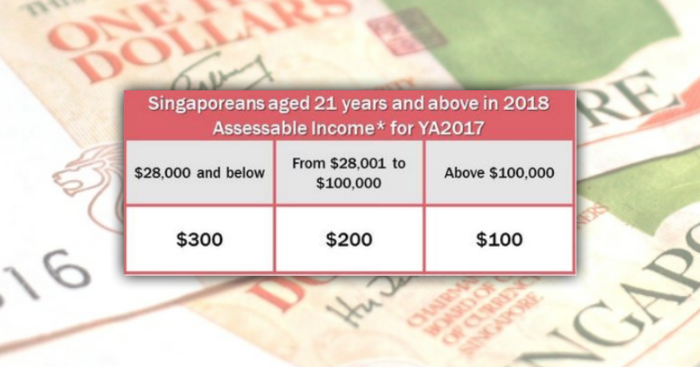
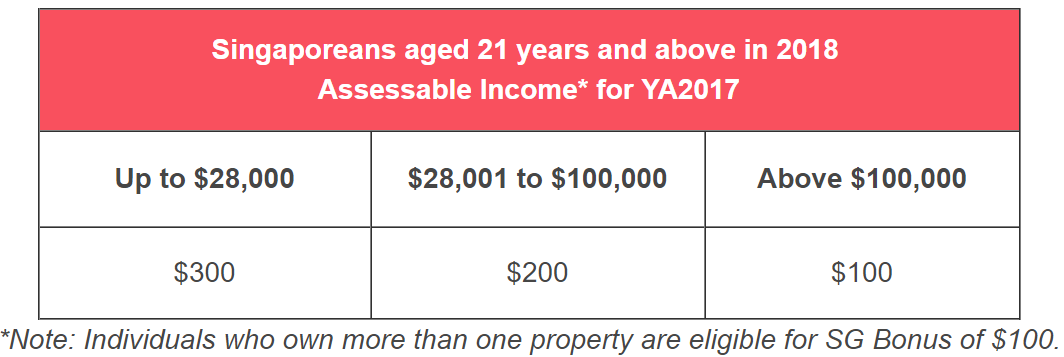
The amount of SG Bonus is tiered according to income, with more for those earning less:

SG Bonus will be paid to eligible Singaporeans in end 2018.

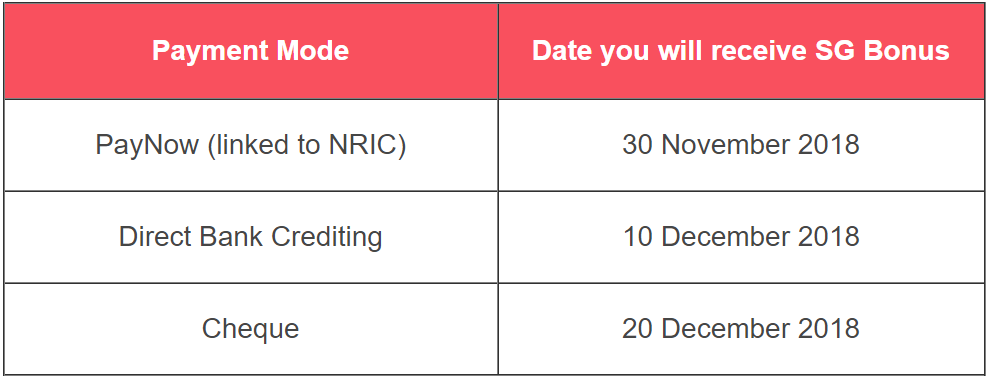
Citizens are encouraged to register their NRIC on PayNow by 7 November 2018 to receive their SG Bonus earlier (see payment dates below). They may do so via their bank’s mobile banking or Internet banking platforms.

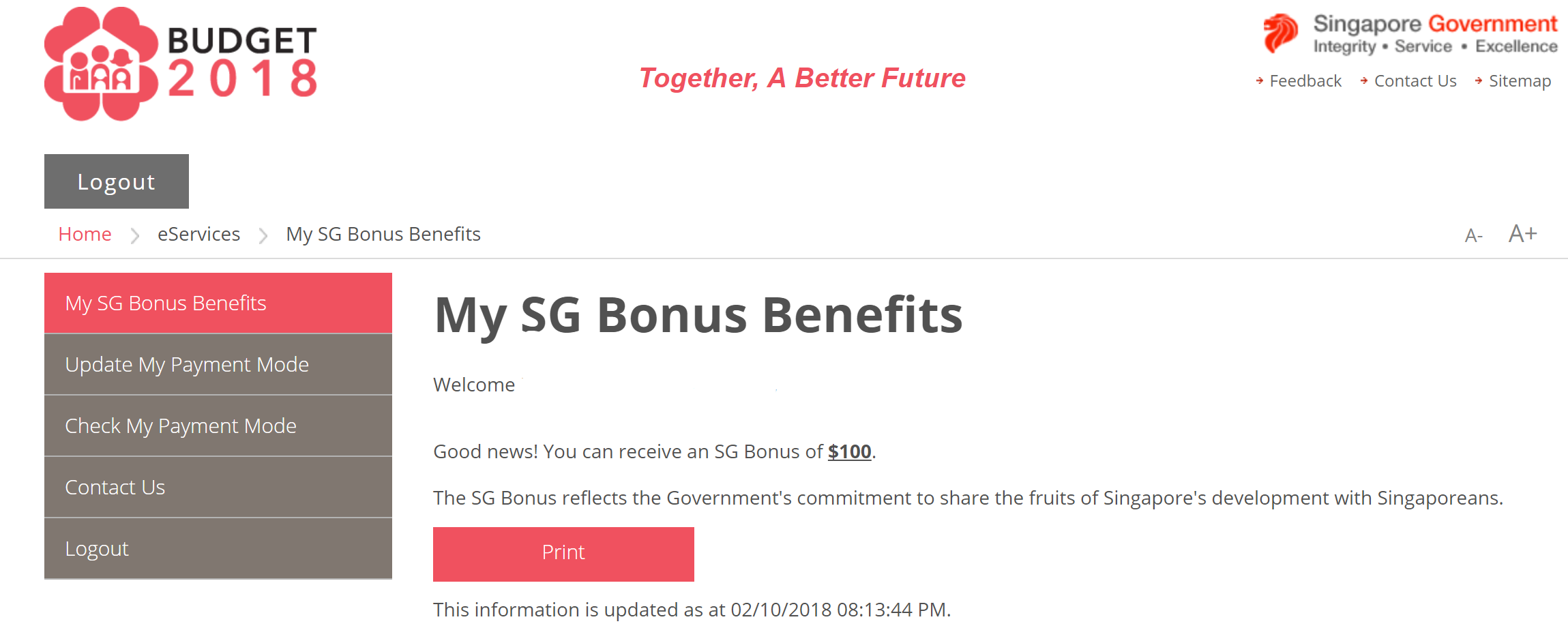
Log in to the SG Bonus e-Service (SingPass login required) to sign up for the SG Bonus, update your payment mode, or make a donation:

Click here to be redirected to the SG Bonus website www.singaporebudget.gov.sg/sgbonus.
Example:

Read More...

Insurance and Cancer: Tips to Buy Health Benefits

Insurance Policy

Purchasing health insurance can be a daunting task. It may be a tricky situation if your family member has cancer. Fortunately, you can make different choices that offer the best coverage for prescription drug and medical needs.

These cautions and suggestions will help you to shop for policy for your cancer treatment:

Plan Covers Your Clinics, Hospitals, and Doctors

Evaluate your plan if it includes a cover for doctors, hospitals, and clinics.  Plans may change your preferred clinics, hospitals and doctors. If your plan is not covering your clinics and doctors, you have to change this policy. Doctors or hospitals out of network may increase your expense.

Plans like australian health insurance – iSelect offer special benefits to a policyholder. You have to do your homework to find out a reliable plan. Keep it in mind that high-deductible plans need you to pay 100% of medical costs until you mollify your deductibles. Deductibles can be more than out-of-network care.

Plan Cover Costs of Prescription Drugs

Some plans are associated with co-pay that is a fixed rate for the prescription of each patient. Other insurance plans may charge one co-insurance that is ideal for the total charges of a drug. It may be expensive for a cancer patient who undergoes multiple services like radiation therapy and chemotherapy for treatment. For cancer medications, a co-pay can be a cheap option than co-insurances.

Plans often divide medications as per formulary into categories or tier. The medicines in higher tiers can be expensive for you. Cancer medications are placed in the highest tier. You may compare every formulary to see the tiers/categories of your drug.

Effects of Step Therapy

Several insurers follow “fail first” or “step therapy” rules in healthcare policies. They necessitate patients to try cheap medications before offering coverage for drugs the doctors would prescribe. If initial medicines prove useless for a patient, the treatment may progress toward expensive therapies.

Advocates of patient and physicians are concerned that this therapy can delay the access to treatments offering maximum benefits. Therefore, they consider it wrong for patients. Several states have laws that permit doctors to apply or supersede these policies. If your state doesn’t enact this law, you can talk to the insurance company to know about their policies.

Work-based Insurance Plans

Several work-based insurance plans offer open enrollment period almost once in a year. It allows you to evaluate your health plans. You can add a new member of family or change plans to avail this opportunity. You may get an option to keep similar plans without any change. If you get an option to change plans, you must carefully evaluate new prospects and their way to cover the treatment of cancer patients.

Carefully secure copies of paperwork relevant to your claims, such as FMLA (family medical leave, sick leave, receipts, bills, EOBs (explanation of benefits and necessary medical letters. Maintain your records and send reimbursement bills to your insurance provider.

Read More...