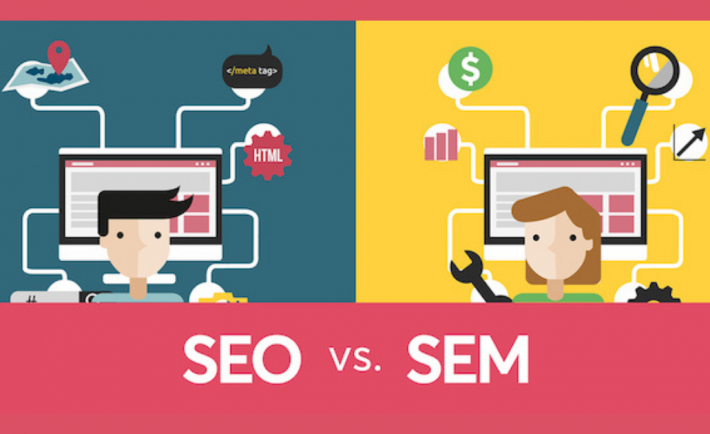
Employ SEO and SEM to rake in more revenue for your business

SEO vs SEM main image

If you’re involved in the business field, there’s a likelihood you’ve heard of SEO and SEM. These terminologies are commonly tossed around, but what do they mean exactly? Is there a difference between the two?

Although the distinction can be minimal, if you understand how to execute them effectively and correctly, they can lead the organisation to extremely high traffic and growth.

Let’s look at the difference between SEO and SEM and how they can be game-changers for your company. Ready for results? Let’s plunge into this integral part of marketing for your business.

An overview before we begin

seeing an overview

Image Credits: Inc. Magazine

The average person will most definitely click on the top few links in a typical search on Google, right?

That’s why the first page on Google search is where you want your website to appear. These days, human attention is short, and it’s essential to be the first few to grab your target customers’ attention before your rivals do. Here’s where SEO and SEM come to play.

They’re ways to promote the company so that your potential customers can access them on search engines, such as Google or Bing. If your company has a website rival, SEO and SEM are essential for more traffic to be guided to your domain.

Let’s explore their primary purposes to grasp these promotional tools better.

SEO otherwise referred to as search engine optimisation, is a concept that lets you organically appear in search results. While SEM, known as search engine marketing, depends on paid strategies to get you ranked on search engines.

Here’s a more insightful look into both approaches.

The four parts of SEO
  • Technical SEO – This focuses on improving your website’s technical aspects and constructing it to provide a fantastic user experience. It’s also part of on-page SEO.
  • On-page SEO – Involves tweaking the web pages themselves so that search engines can understand your title tags, content, internal links, and URLs.
  • Content SEO – Your content needs to match what the searcher intends to find. This is one of Google’s most important factors for its rankings. Consider these: keyword strategy, site structure, and copywriting.
  • Off-page SEO – Connect your website to other trustworthy and high-authority webpages through hyperlinks, PR, or different strategies, and the search engines will push you up the ranks over time.

Now, moving on to SEM.

SEM and PPC

SEM includes PPC ads instead of organic growth. PPC is also better known as pay-per-click. In the form of embedded advertisements, Google or other search engines can showcase your website and display them to your prospective customers.

Not all campaigns, however, are expected to yield results. To make your advertising stand out so that you get the best bang for your buck, you will have to see what your rivals are doing and choose your keywords wisely.

SEO vs SEM

SEO-vs-SEM

Image Credits: Matchcraft

  • With every click your SEM ad gets, you have to pay.
  • In the form of clicks, SEM usually has immediate effects, while SEO takes much longer.
  • SEM advertisements give you more control over how they appear. This doesn’t apply much for SEO.
  • SEM provides you with data specifics so that you can quickly tweak your advertising for instant results. When it comes to SEO, that’s a bit more challenging.
  • Over time, SEO visibility expands, so the impact snowballs as you progress. With SEM, exposure comes to a halt as soon as you disable your advertisements.
Is one better than the other?

There is no straightforward answer as it falls on how your organisation is structured and what priorities you have at hand. But here are a few pointers to note:

  • What is your objective? You want to go for SEM if it’s a short-term one.
  • How is your current SEO health? SEM can be a great backer if it is already substantial.
  • Go with SEM if you expect that your company would have a higher consumer lifetime value. SEO could be ideal if it’s the opposite.
  • Did you have your sales and profits assessed? See if making a profit from SEM is practical for you. Go with SEO if it’s not urgent.

When it comes to driving traffic, either SEO or SEM is useful for your company. But why not use both? Most of the time, having the financial capacity to combine them will allow you to reap the benefits of both.

Here are some of the benefits of implementing both strategies:

  • Do you recall how we mentioned data was available only for SEM but not for SEO? Well, now you can use SEM as a tester for your SEO strategy.
  • Through incorporating remarketing strategies within your SEM plan, you will make your SEO efforts go the distance to convert those who didn’t buy before into paying customers in the future.
Final thoughts

Now that you know what SEO and SEM are all about, you can use your new-found insights to refine your competition strategy and make the best of both worlds to conquer the organic and paid regions. All the best in ranking your company site at the top of search engines!


Read More...

Is Regifting Okay?

The practice of gift recycling or re-purposing gifts is often considered as taboo. While we all have given gifts to our loved ones and friends in several occasions, finding the right gift is extremely hard. There are many factors such as the time spent on travel, queues in the malls, and overwhelming options. It comes as no surprise that Singaporeans will opt for alternatives to the gift giving process such as giving personalized items.

It is probably safe to assume that we all, at some point, have regifted something. I will not blame you if you deny it. It is typical to feel a sense of guilt when passing along an item that was picked out just for you. A gift is something special and you do not want the giver to feel that his or her efforts were put to waste.

However, regifting is acceptable. The rising popularity of sustainable goods has welcomed the process of regifting. Why toss something that may be cherished by someone else? It is alright to regift as long as you follow certain guidelines.

#1: AVOID RECYCLING GIFTS WITHIN THE SAME CIRCLE

As obvious as this may sound, you must not regift to someone who interacts with the original giver. You will be caught in an uncomfortable situation if you give your co-worker’s present to your boss. Keep in mind that some of your social circles may overlap.

#2: REGIFT ITEMS IN PERFECT CONDITION

When re-purposing a gift, ensure that the item is brand new or still in its original packaging. Inspect the gift to look for signs of wear and tear. Moreover, the present must not be personalized for you. Watch out for engraved monograms or hidden letters inside the box.

#3: DO NOT REGIFT FAMILY GIFTS

Do not give family heirlooms away. Your mother may have given your grandmother’s ring as a Christmas present. The design may not be your cup of tea, but you have a friend who loves vintage items. As much as she would love the ring, please do not regift the ring. Hit up a thrift store or a flea market instead. Your grandmother’s ring belongs in a jewelry box to be passed down to your future daughter.

#4: BEAUTIFY THE PRESENTATION

Elevate the presentation by rewrapping the gift. If the cardboard box or the original packaging is crumpled, purchase a fresh box. Then, pick out a beautiful wrapper that the recipient will like. Add ribbons and bows too!

#5: PUT THE RECIPIENT IN MIND

When regifting an item, you must think about what the recipient will want to receive. Regift an item that you would have purchased for the individual had you gone to the store. Who would be excited to own the item?

SUMMARY

There are certain situations when regifting a present is acceptable. You can only regift an item that has never been been opened before, that does not belong to the same social circle, and that has the recipient in mind. You can also regift something generic such as a box of Valentine’s Day chocolates. In the event that you get caught regifting, opt for honesty. Be upfront about it, especially to the people close to you.

Image Credits: unsplash.com

Sources: 1 & 2


Read More...

A nutritionist’s guide to the best foods to take for a healthier gut

korean holding a kimchi cabbage

Did you click in because you’re suffering from inflammatory bowel disease (IBD)? Those who aren’t aware of what IBD is, just know that there are two main types:

  • Crohn’s disease – frequently happens in the small intestine and the colon.
  • Ulcerative colitis – inflammation of the lining of your large intestine, rectum, or both.

Whether it’s your genetics or your immune system that’s causing IBD, it’s wise that you know how to spot the symptoms. These are some common ones:

  • Diarrhoea
  • Bleeding ulcers
  • Weight loss and anaemia
  • Stomach pain, cramping, and bloating

If you suspect you’re suffering from IBD, please see a doctor and make some lifestyle changes. Here’s a nutritionist’s guide on the best foods to take for a healthier gut.

#1: Ginger
ginger tea

Image Credits: Nutrition Force

A research paper uploaded in the European Journal of Cancer Prevention demonstrated that in individuals who are more prone to developing colorectal cancer, ginger might better suppress colorectal cancer markers’ development.

Ginger may be a root herb well-known among the older generations but not so much with the younger folks. Here are five easy tips to include more ginger in your diet.

Those who prefer to swallow a pill can consider the Ginger Root Veg Capsules 550mg (S$16) from Shopee instead.

#2: Blueberries
blueberries

Image Credits: News Medical

Blueberries have antibacterial and anti-inflammatory effects according to a study. Another research by Lund University has shown that the fibre in blueberries helps to protect against intestinal inflammations.

Do a quick search on the internet, and you will find various proven health benefits of blueberries. They are low in calories, may help protect against ageing, and can even lower blood pressure.

It’s sweet too. What’s there not to like about it?

#3: Bone broth
both broth

Image Credits: The Seattle Times

When you visit a doctor, you will most likely be prescribed IBD medication. But there might be a better option for you, and that is bone broth.

You want to take in more bone broth because it’s rich in collagen, amino acids, and minerals. A 2016 study revealed that collagen has an impact on reducing rectal bleeding and down-regulated inflammatory markers in mice.

Get your Superior Chicken Collagen Broth 250g (S$6) from RedMart if you don’t have the luxury of time to simmer your own at home.

#4: Oily fish
grilled mackerel

Image Credits: slapyodaddybbq.com

Salmon made it to our list again. If you missed last week’s article on the “foods and supplements you can take to counter high cholesterol”, click through to read it.

Other than salmon, oily fish like trout, sardines, and mackerel provide inflammation-fighting benefits. This is thanks to its omega-3 fatty acids eicosapentaenoic acid (EPA) and docosahexaenoic acid (DHA).

There is evidence that omega-3 fatty acids may help prevent and treat IBD, though more research is needed to define the daily recommended amount.

#5: Fermented foods
miso soup with silken tofu

Image Credits: The Spruce Eats

The main idea here is that you take in naturally occurring beneficial probiotic bacteria. They can help regulate bodily responses and homeostasis and up your immunity.

Recent studies like one in 2018 have shown that selected probiotics can be used as an alternative therapy for IBD patients. Another analysis done last year concluded that probiotics positively affect patients with ulcerative colitis (one of the main IBD types).

Yes, go ahead and eat your kimchi, miso, yoghurt, tempeh, and kombucha.

Don’t let an unhealthy gut affect you

An unhealthy gut can mess up not only your digestive system but your overall health. The American Heart Association News said that gut bacteria have an interconnected relationship with anxiety, depression, and the brain’s areas that process emotions.

Don’t let an unhealthy gut create unnecessary problems for your body. Your health starts with what you put in your mouth. Pay more attention to that!

Read More...

Financial Responsibilities Of Newly Married Couples

Managing your finances together is one of the most important roles you partake on in a marriage.

Differing views and attitudes towards money can pose issues to a relationship. For instance, you may seem frugal to others and stingy to her. If you both live beyond your means and spend lavishly on each other, you might find yourselves trapped in debt. There is time to change. Planning ahead as a team can help you build a strong foundation for your marriage.

1. GETTING TO KNOW EACH OTHER

Get to know each other’s financial beliefs and spending habits. Understand where your partner is coming from and adapt if necessary. If your partner is a spender, agree on establishing some limits. If your partner is prudent, agree on the things you would like to prioritize. Make your expectations clear to arrive on the same page.

“The handling of finances is one of the major emotional battlegrounds of any marriage. Lack of finances is seldom the issue. The root of the problem seems to be an unrealistic and immature view of money.” – David Augsburger, The Meaning of Money in Marriage

2. DELEGATING FINANCIAL DUTIES

Assess the differences in your income and money management strengths to determine how to divide the financial duties. Delegate the person who is financially savvier to take the role of managing your family’s investment options. While, the person who is better at budgeting can take charge of managing the household bills. Take advantage of each other’s strengths and fill the gaps in between.

3. PROVIDING SOLELY FOR YOUR FAMILY

For families with a sole breadwinner, it is practical to maintain an adequate emergency fund to withstand unexpected financial woes. Please consider the number of dependents when finalizing the amount of money to be set aside.

Single income couples should consider helping each other in terms of their CPF responsibilities. You can top up your spouse’s CPF account, especially if he or she has low CPF balances. You can transfer your CPF Ordinary Account savings after setting aside the Basic Retirement Sum in your own CPF account.

4. SHARING BANK ACCOUNTS

There is no one size fits all! Your household arrangement depends on your marital assets, income levels, and financial commitments. Think about which expenses you want to keep separate and which you want to share. You open a joint account for their household bills. Set aside a specific amount monthly to grow your joint account together. Meanwhile, you can keep your own individual accounts to fund your own spending.

5. AVOIDING FINANCIAL INFIDELITY

Financial infidelity refers to hiding financial information behind your partner’s back. Failing to mention a significant expenditure to your spouse may cause problems in the long run. Top money lies include under-declaring one’s income or hiding one’s debts. Such dishonesty can diminish the level of trust between a couple.

6. WORKING ON SAME FINANCIAL GOALS

Find a way to work on shared financial goals. Agree on the amount of personal contributions depending on your income.  Some of the common themes that most financial goals share are having a budget, living frugally, getting out of debt, and having a good credit score. Do not forget to save for your emergency fund and retirement plans.

Image credits: pixabay.com

You are in this (wild ride) together!

Sources: 1 & 2

Read More...

The importance of creating customer avatars for your business

customer avatars

Creating customer avatars for your business should be part of your marketing plan. Remember that you want to nudge a lead or customer to the next level by smartly employing digital marketing.

Many start-ups deal with cold prospects in the beginning. To convert these cold prospects to fans and beyond, identifying your ideal customers’ profile is necessary.

This is where a customer avatar comes in handy. A customer avatar can also be referred to as a target audience for the laymen. We will use it interchangeably in this article.

Give life to your avatars with these components

To help you better understand your target audience, you want to give life to your avatars.

Tackling these components are useful – know their goals and values, the platforms they source for information, and their demographics. It’s also wise to think through the potential reasons why your avatars would reject your product or service.

There are many ways to gain the abovementioned information. You can conduct a study, schedule surveys, or have conversations with members of the public. But lest you think it’s do or die, that’s not true.

Go ahead and make the first cut while trusting your assumptions about your target audience. Once you have done enough research and gathered results, fine-tuning is all it takes to move forward.

Find your niche with the “but no one else would” trick

via GIPHY

Let’s zoom in on the finer details with the “but no one else would” trick. This trick will allow you to choose the right tools, platforms, and influencers to engage.

Take a look at these sentences:

  • My target audience would read [name of a book], but no one else would.
  • They would subscribe to [name of a magazine], but no one else would.
  • The company’s ideal customers would attend [name of a conference], but no one else would.

By answering the above, you will filter and narrow down on some hows and wheres of marketing. The main idea here is finding your niche, so it’s extremely targeted. You won’t want to be wasting any of your marketing dollars, right?

Use different customer avatars for various campaigns

Throughout the lifetime of your business, you will be running several marketing campaigns in a year. No one campaign should be precisely the same as the other.

If you’re simply using the same profile for each of your campaigns, you will quickly realise that it doesn’t work. To craft personalised content and offers, you need to establish who you’re marketing to.

Knowing your target audience will help you deal with the rest of your marketing components, including the type of content to produce, the social media sites to use, and what kind of advertisements you should buy.

You can create your customer avatar in just five easy steps. For the visual learners, this will help:

Read More...