
Avoid these parenting mistakes when disciplining your kids

a displeased mom and angry child

When we think we’ve got it all figured out, our lovely children delight in turning our lives upside down with their erratic moods and behaviors. Nonetheless, we must remember the typical disciplinary blunders, particularly when correcting our children in unfamiliar areas, to guarantee that our actions and thoughts are beneficial and that we can stop harmful habits from blossoming.

Read on to avoid these parenting mistakes when disciplining your kids.

Bribing

You might be inclined to use the lure of sweets at the checkout counter to stop your child’s breakdown in the supermarket. This technique might succeed, but only for the time being. Bribing a child for poor conduct is essentially encouraging negative habits, so don’t be shocked if your kid starts whining the next time he or she wants anything.

Actionless

Set boundaries and stick to them, because leniency and counteroffers all imply that compliance is a choice. To encourage children to respect rules, set clear expectations, and intervene when those conditions are not met. Begin with courteous commands if you want your child to accomplish things like pausing computer games and finishing schoolwork. Compliment when they follow through and impose a “penalty” if they don’t.

High expectations

disciplining in public

Image Credits: parents.com

Young kids have yet to establish impulse control or the etiquette necessary in public areas such as restaurants and shopping malls. When your child deviates from the usual, consider the fact that they aren’t seeking to be a nuisance; they just don’t know what to do in the scenario, therefore exploding won’t help. Because children are born imitators, modeling or calling attention to something we would like them to do can likely help them succeed.

Long-windedness

It is not useful to give an extensive description of your child’s unacceptable conduct. Kids, especially those in primary school who are improving their attention spans, can quickly lose track of talks that go too far in-depth. Make things as simple as possible for your child by breaking them down into fundamentals. Clarify what the conduct was and why it was incorrect with younger ones and address what went awry with older children using various scenarios that may have resulted in better decisions.

Setting a bad example

You advise your teenager not to lie, yet you habitually do so to avoid joining a school volunteer event or attending an insignificant lunch meeting. You scream at your kids and implore them angrily to talk respectfully to one another.

The concern here is that we are frequently blind to our actions and forget that the little ones are watching and learning from us. Be a prime example of the conduct you want your child to mimic as often as possible. If you violate one of your standards occasionally, explain the situation to your kid, discuss how you could have acted differently, and respond with better grace next time.

Getting kids to obey might feel like an impossible endeavor since children are capable of pushing against the boundaries of their environment to learn what is tolerable and what is not. This may be perplexing for parents who feel compelled to constantly raise the stakes to turn every encounter into a teachable moment. Keeping the aforementioned missteps in mind, nevertheless, can assist parents in developing a disciplinary system that is fair, effective, and encourages a child to learn the right things when the opportunity presents.

Read More...

Drivers can now look forward to better EV charging networks in Malaysia

ross-border EV charging network

By now, it’s impossible not to know that Singapore wants to establish a greener and more sustainable land transport industry, lowering peak land transport emissions by 80%. As a result, the Singapore Green Plan 2030 comprises a significant push to electrify our car population, which would assist Singapore in achieving our goal of having much cleaner energy automobiles by 2040.

With all of the latest buzz around electric vehicles (EVs) and the reopening of the Singapore-Malaysia borders, drivers are questioning if their electric car road trips to Malaysia would go smoothly. If you’ve been keeping up with the news on Malaysia’s EV infrastructure, you will know that the past journeys taken by other drivers have been a bit nerve-wracking.

Situation last year

In March 2021, drivers on Malaysian highways revealed their frustrations with driving an electric car. Many people have discovered that driving an electric car in Malaysia was difficult due to the country’s lack of infrastructure to support the widespread adoption of EVs. There were only about 300 electric charging sites in the country at that time, with the majority located along the west coast and in the Klang Valley.

In addition, drivers were aware that there were insufficient garages or maintenance services dedicated to EVs in Malaysia should urgent servicing be required. Nonetheless, many people remarked that the scenario was developing, and there was hope that in the future that taking a road trip in Malaysia in an electric car will become a more practical alternative.

Better EV charging networks this year
map of charging points in Malaysia

Image Credits: City Energy

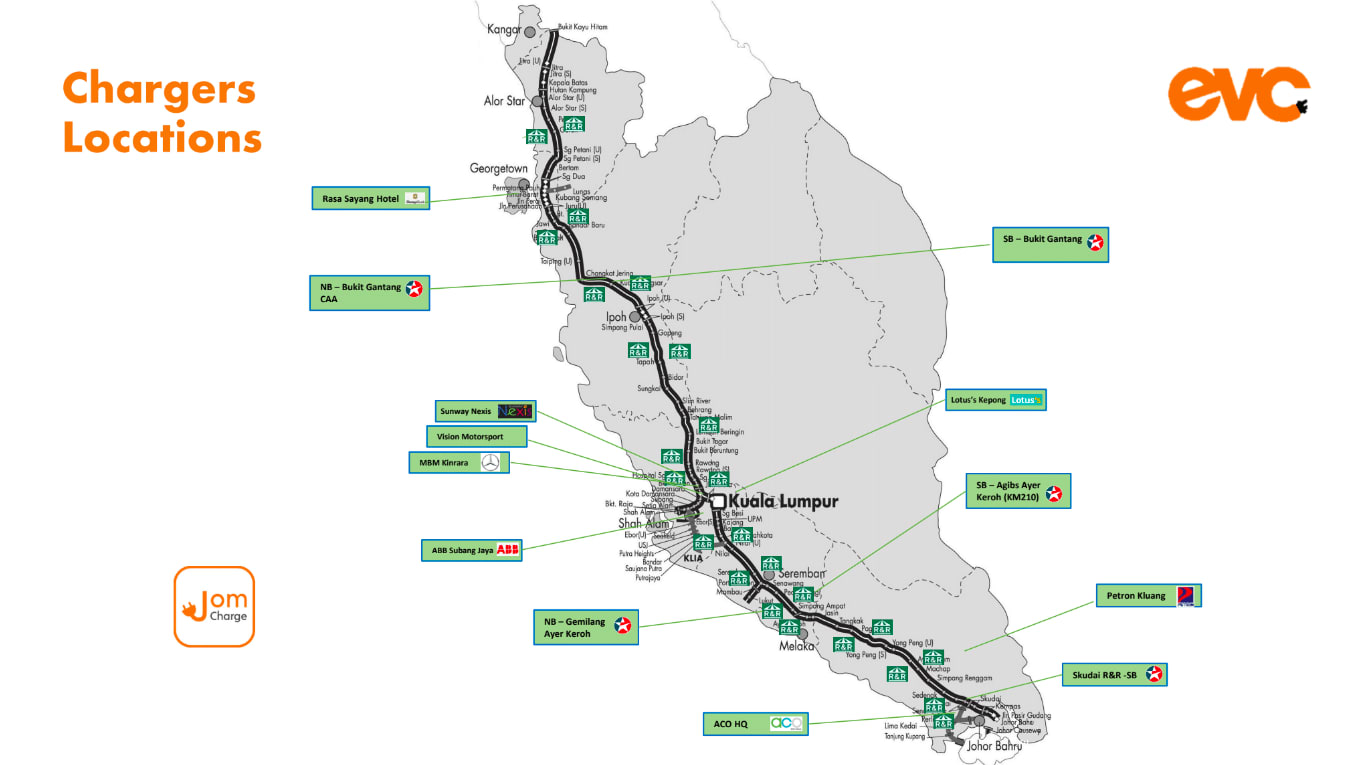
This month, we have good news. Local gas supplier City Energy partnered with a Malaysian firm to establish a cross-border EV charging network, improving accessibility for EV drivers in both Singapore and Malaysia. The EV charging service, known as Go, is accessible via a smartphone app that allows users to identify and access charging stations that are part of this collaboration in both nations.

The service is made possible by City Energy’s relationship with Malaysian firm EV Connection, which has a network that spans Johor, Penang, and Kuala Lumpur. There are already EV charging stations along the north-south expressway and the app will provide greater ease since consumers will be able to initiate charging and make payments across Malaysia using the same City Energy Go app.

By the end of this year, the JomCharge network will have deployed at least 50 more DC (fast charging) chargers. Drivers in Malaysia should seek EV charging facilities with the JomCharge logo, which are often located at gas stations. Users will be presented with a map indicating their current location as well as the numerous EV charging sites accessible after launching the City Energy Go app.

To begin, scan the QR code at the charging station or input the ID of the charging point. Next, choose between DC and AC (regular charging) and press the “start charging” button on the screen. Once you’re done, just pay for the final billing amount via the app and you’re good to go! Easy peasy, isn’t it?

Read More...

Best questions to ask at the end of an interview

a woman having an interview

The interviewer will almost always ask whether you have any questions for them at the end of an interview session. Your response should always be yes because you should take this chance to pose a few relevant ones.

Remember that the purpose of the interview isn’t merely to make your future employer want to hire you. It’s also about determining whether or not you think highly of the company and if you would be a good match. You will send a strong signal that you’re engaged and serious about the position if you ask the right inquiries.

Here are some of the best questions to ask at the end of an interview.

How do you measure success?

It’s critical to understand how a firm gauges the performance of its workers. It will assist you in determining what it would take to grow your career there and whether the employer’s beliefs are compatible with your own.

Why did the previous person leave?

While addressing this may be awkward, it demonstrates that you are keen on the organization’s operations. It’s important to discover if the individual who had the position before you was dismissed, transferred, or departed on their own before you jump into the very same role.

What do you like about this company?
man and two women in a meeting

Image Credits: unsplash.com

Inquiring about your interviewer’s personal experiences can provide you further clarity into the team culture as well as assist you to establish a relationship with them. Furthermore, this inquiry may offer you an inside look at the top advantages of working for the organization.

What type of person tends to succeed here?

This question demonstrates to the recruiter that you are concerned about your future with the organization, as well as assists you in determining whether you are a suitable match for the role. Imagine the individual you will be speaking to once the interviewer reveals what he or she is searching for in an applicant. Is that somebody a close match, or is it too far from who you are?

Do you have any qualms about my qualifications?

This query throws you into a competitive disadvantage, but it also demonstrates that you are confident in your ability to tackle your shortcomings. Their response may also offer you insight into where you rank and allow you to resolve any reservations the interviewer may have while you have their undivided attention during the session.

Can you let me in on the daily responsibilities of this job?

Lastly, this question might help you understand the many facets of the job, notably if it’s a cross-functional post or a high team collaboration position. You will ideally have a better grasp of the work duties, which will aid you in deciding whether or not it’s a suitable position for you. You will also have a deeper understanding of the precise skillsets necessary.

Failure to prepare questions might give the impression that you are uninterested in the position, so consider what you can gain from the interview if you ask a few. It’s critical that you use these questions to determine whether the work is truly appropriate for you. Consider adding some of the abovementioned interview questions while creating your list and use the opportunity to convince the employer that you will be a valuable asset to the team.

Read More...

Here’s a glance at Singapore’s new private home sales for Q1 2022

Belgravia Ace

Watching the property market, especially for new private home sales this year? Before we take a glance at 2022, allow us to refresh your memory on December 2021’s stats:

In the wake of new cooling measures and the regular year-end slump, new private property sales in Singapore plunged 58% in December 2021 compared to November that same year. Overall sales, nonetheless, recorded an eight-year high in 2021. Experts believed that purchasers who were not subjected to the Additional Buyer’s Stamp Duty (ABSD) scheme will boost demand this year. These are first-time purchasers or people who have sold or plan to sell their current residential property to purchase another.

Fast forward to 2022, here’s a glance at Singapore’s new private home sales for Q1 2022.

January: Rose by 3.5%

In January, new private house sales in Singapore increased by 3.5%, following a significant drop in December 2021. Ikigai and Belgravia Ace were the only two launches in January, and the latter strata-landed development sold 77 apartments at an average caveated amount of S$4.4 million.

The majority of the customers, according to a Huttons Asia official, were first-time buyers who were unfazed by the cooling measures. He went on to say that the purchasers’ capacity to spend more than a million for the downpayment and stamp duties indicated either adequate cash flow or a hereditary transfer of wealth.

February: Fell by 22.5%
Royal Hallmark

Image Credits: royalhallmark.com

Sales of new private residences decreased 22.5% in February, owing to a combination of cooling measures and global uncertainty related to the Russia-Ukraine crisis. Other barriers might include increased loan rates, property tax increases in 2023, and fewer housing alternatives as a result of this year’s lower lineup of project debuts.

The single February launch, Royal Hallmark, fared quite well though, selling about one-third of its units despite cooling measures and some uncertainty brought on by the Ukraine conflict. The percentage of transactions worth more than S$2 million also remained unchanged. In other words, affordability remained steady, owing to the market’s substantial liquidity.

March: Rebounded by 20.7%

According to recent reports, new private house sales increased by 20.7% in March, following a significant drop in February. Last month, the private housing markets showed signs of improvement, with developers selling more properties. This might be a response to the relaxation of safe management requirements, allowing more people to view show flats. As a consequence of the greater visitor traffic, the number of deals closed increased.

According to an OrangeTee & Tie spokesperson, there were no big project launches above 200 units in March, and existing projects continued to reduce their unsold inventory as buyers returned to the market. The US interest rate rises, on the other hand, may raise mortgage rates and encourage more purchasers to re-enter the market. Some on-the-fence purchasers are likely to lock in house loans before interest rates rise too much since a sharp increase in the cost of borrowing might push some upgraders out of the sector.

Read More...

Your Guide to Home Renovation Costs in Singapore

One of the most expensive possessions that you can acquire in Singapore is a home. Given that it is an investment, people want to make their home as comfortable and presentable as possible. However, doing a home renovation can cost you a lot.

HOW MUCH DOES IT ACTUALLY COST?

In Singapore, the ultimate cost of renovation depends on the several factors. Firstly, the type of home will determine the scope of renovation. This refers to whether you live in a condominium, an HDB flat or a landed property. The next factor is the age and condition of your home. The extent and type of renovation work for a brand new BTO differs from a decade-old resale flat.

Thirdly, the type of materials to be used for the renovation must be considered. It is up to you to choose affordable or high-end materials. The contractor or interior design firm is also up to you. Shop around to find the firm that suits you best. Lastly, your total cost will be influenced by how much work you want done. Starting with a blank canvas can cost more than renovating a single room.

You can expect to pay from S$5,000 to over S$100,000 when you are renovating a 4-Room HDB flat (i.e., approximately 90 sq m). Remember that all the aforementioned factors will influence the renovation costs. In fact, Qanvast stated that the average 4-room HDB BTO flat renovation was estimated to cost about S$43,000 to S$45,000 in 2020. Since renovating a resale flat is more extensive and expensive, the expected cost was from S$45,000 to S$52,000.

WHAT ARE YOUR LOAN OPTIONS?

If you are looking for financial aid, you will apply for a renovation loan. Renovation loans are different from personal loans. With personal loans, you receive the money in cash. The institution does not know what you are going to do with the money, so it is riskier for them to lend it to you. As a result, personal loan interest rates are generally high.

On the other hand, renovation loans work by giving the money directly to your contractor. Because the bank knows exactly what you are going to do with the money, they can charge you lower interest rates. Renovation loan interest rates are usually less than 5% p.a.

Before you can apply for the renovation loan, you need to have the contractor’s invoice or quotation signed by both parties. Renovation loans can let you borrow up to S$30,000 or 6 times your monthly income, whichever amount is lower. You can repay this in monthly installments.

HOW CAN YOU REDUCE YOUR RENOVATION COSTS?

Image Credits: pixabay.com


#1: Determine what you want.

Not all design styles are created equal – some cost more than others. Experts suggest that the most affordable style is the Scandinavian interiors as it involves simpler aesthetics and fewer built-in carpentry.

Knowing which design style you want, and which rooms you want to renovate will help you determine the total renovation costs.

#2: Paint your walls.

You can save money by painting your walls or an accent wall instead of using wallpaper or building a feature wall.

It is a practical choice if you want to change your home’s look every couple of years. You see, wallpaper or stone are notoriously difficult to remove.

#3: Have less built-in furniture.

Carpentry can take up a substantial chunk of your renovation costs. To reduce your expenses, you can make a list of your top five carpentry must-haves. Your priorities must revolve around custom solutions that require real design work that you cannot easily purchase. For things that you can easily purchase, you can buy as you go along with the renovation.

#4: Compare the available renovation firms.

There are a myriad of renovation, interior design, and contractor firms in Singapore. Different companies tend to provide different price structures. It is best to research all the available options to find the best company that suits both your budget and preferences.

#5: Keep or sell unused items.

When renovating your home, you may find some unused items such as excess paint or wood. It is recommended that you sell these items to make some money. This money can be used to reduce your overall renovation costs.

Sources: 1, 2, & 3

Read More...