Consideration of Car Insurance When You Need One

Unlike practically everything else in the world (even vehicles!) where it’s quite straightforward to comparison-shop for the cheapest costs, car insurance is a hard one since pricing for premiums are provided on a case-by-case basis. On top of that, not every insurance would divulge their costs easily or offer you a price online.

When it comes time to renew or get auto insurance, it makes perfect sense to use free internet resources to compare rates.

In Singapore, How Much Does It Cost To Insure a Car?

Need to get a Singapore car insurance? A year’s worth of coverage might cost anywhere from $700 to $1,000 — or even more! — depending on your location.

Your yearly auto insurance premium is computed on an individual case-by-case basis. In general, insurers attempt to determine how probable it is that you will be involved in an accident and how expensive it will be for them to cover the costs (i.e., the risk they assume).

How Can I Get the Best Deal on Auto Insurance?

It’s impossible to alter one’s driving history, driving record, or automobile. You may, however, search around to find the greatest deal for your specific profile and vehicle. To begin, obtain insurance estimates from at least five or six different firms. With the help of MoneySmart’s Car Insurance Wizard, you can easily obtain this information.

Insuring your vehicle should not be as inexpensive as it appears. Cheap insurance is worse than having no insurance since you’re wasting your money and putting yourself at risk.

High excess (the amount you must pay ahead before the insurer begins to pay for the remainder) and/or terrible terms & conditions (i.e. you can’t claim crap since EVERYTHING is excluded) are often associated with cheap rates. Check the fine print of your policy to make certain you’ll receive the protection you desire.

Directly Through an Insurance or Through a Broker, Which Should I Choose?

Keep in mind that rival insurers may offer lower rates to attract new clients. After all, our auto insurance specialists will perform the comparison for you while you rest and enjoy your time off. In the event that your current insurance provider offers a better bargain, at least you won’t have to worry about missing out on a better deal.

You may, of course, get automobile insurance on your own if you don’t mind going over the tiny print and checking out the facts.

Various Kinds of Car Insurance to Consider

Comprehensive Car Insurance

This sort of auto insurance, as the name indicates, covers practically everything, even the expense of repairing or replacing your own vehicle. This sort of insurance is the most frequent in Singapore because of the high cost of automobiles here.

Third Party Only (Tpo) Car Insurance

This is the most basic and least expensive sort of insurance since it only covers damage to the property of others. You’ll be on the hook for repairs to your own vehicle if something goes wrong with it. Most experts advise against attempting to fix a really old automobile that has reached the end of its COE lifetime.

Third Party, Fire & Theft (Tpft) Car Insurance

An enhanced form of TPO vehicle insurance. Except that TPFT also covers your automobile for loss, theft, and fire damage. Despite the fact that it provides a little extra security, this is typically just an option for drivers of older vehicles.

  

Most insurance companies in Singapore use a $500 or $600 deductible as a baseline for their estimates. The average amount that automobile owners are prepared to spend out of their own money may be derived from this figure. When comparing auto insurance rates, it’s important to consider both the premiums and the excess. If you choose a high excess, you can save money on your premium, but are you really willing to pay $2,000 if you are involved in an accident? It’s probably not going to happen.

Read More...

7 Financial Commandments for Your Thirties

Hitting your thirties signify that you are halfway to retirement. After establishing a financial foundation in your twenties, it is up to you to use the following decade of your life to build and protect your wealth.

Whether you want to purchase a flat or to travel the world, these seven financial commandments can help you stretch your dollar.

#1: YOU SHALL LEARN SELF-CONTROL

Throughout your childhood, your parents or teachers taught you to practice self-control. The sooner you learn the importance of delayed gratification, the better off you will be. Applying self-control makes it easier to stay on top of your finances.

Select consciously spending cash rather than swiping your credit cards. Credit cards are convenient, but you must pay your bills on tip to maintain a good credit score. Do you really want to pay interest on a pair of jeans or a box of cereal? Think about it.

#2: YOU SHALL GET YOUR INSURANCE IN ORDER

Let us face it! You are not getting any younger. You need to sort out your health insurance, life insurance, and other policies. Considering a life insurance is prudent, especially if you have people depending on you.

#3: KEEP ADVANCING IN YOUR CAREER PATH

Developing your skill set occurs in your twenties. In your thirties, you will need to apply these skills to increase your earnings. Start by researching potential career paths and identifying companies where you can fit in. If you have the resources, you can go back to school to further your studies. Alternatively, you can take free online courses to boost your career.

Related Post: 5 Websites Where You Can Learn For Free

#4: YOU SHALL INCREASE YOUR EMERGENCY FUND

The pandemic highlighted the importance of keeping an emergency fund. Having an emergency fund can help cushion the financial blow of unexpected events. If you started an emergency fund in your twenties, you followed the standard rule of keeping at least six months’ worth of your expenses.

Image credits: unsplash.com

As your income increases in your thirties, you should also boost the balance in your emergency fund and take your family in consideration. Make it a habit to save money and to pay yourself first!

#5: HONOR YOUR PAYCHECK

Stop spending your entire paycheck in less than a month! Live within your means and do your best to save a portion of your paycheck to propel your future. Gradually increase the amount you save while decreasing the amount from which you live off.

Use the 60-80% of your income to fulfill your needs and allocate the remaining 20-40% of it to your savings and investments. Transferring the money automatically to your savings ensures that you will not be tempted to use it.

#6: YOU SHALL WRITE YOUR WILL

Do you still think that you are invincible? Try waking up in your thirties after a night of heavy partying! Protect the people you love by writing a will. Without one, others will have the power to decide how to split up your estate and how to raise your children.

#7: YOU SHALL NOT COVET THEY NEIGHBOR’S THINGS

As you reach your thirties, you may find yourself in a place where you tend to compare your accomplishments to your peers. Scrolling through your feed can highlight the milestones that your friends have reached such as purchasing a flat or getting married. You can admire your neighbors’ new car or new job. However, you do not need to stretch your budget to keep up with them. Doing so will ruin your finances.

Focus on your financial goals, live within your means, increase your savings, and do your best to be content. Acknowledge your inner strengths and use it to succeed!

Sources: 1 & 2

Read More...

6 Savvy Financial Tips for Young Adults

Managing finances can be challenging, especially when you are navigating through different conflicts such as budgeting with an entry-level salary or carrying a hefty student loan debt.

Focusing on the fundamental financial strategies will enable you to strengthen your financial position. Work towards achieving your goals and financial success with these savvy tips.

#1: ESTABLISH YOUR EMERGENCY FUND

The importance of building an emergency fund has been the subject of many financial articles. After all, it is one of the most vital financial tasks that you can accomplish as a young adult. An emergency fund is a pool of money that you can earmark for unforeseen expenses.

When unexpected life events occur, the emergency fund acts as a cushion for your finances. For instance, you can use your emergency fund to pay for expenses that come with sudden job loss or appliance breakdown. The amount that you will save depends on the stability of your job, the debts you have, and your income. Experts recommend saving about six months’ worth of living expenses. You can allot at least 2% of every paycheck to accumulate this amount.

#2: GET BASIC HEALTH AND LIFE INSURANCE

Financial literacy involves understanding how to prevent and manage financial issues as they arise. To help you deal with unexpected expenses, you may get yourself insured. Educate yourself about the different insurance products available on the market right now.

Get yourself insured while your premiums are low (i.e., mainly due to your age). If you have dependents, consider getting term insurance to protect them in the event that you become permanently disabled or you pass away.

#3: KNOW WHERE YOUR MONEY GOES

Stay on top of your budget plan by knowing where your money goes. Ensure that your expenses do not exceed your income. As you may be earning with a starting salary, keeping your recurring monthly expenses low can save you significant money over time.

Once you see how the cost of your morning coffee or take-away dinner adds up, you will realize that making small changes to your daily expenses can have a big impact on your financial situation.

#4: PAY OFF THE CREDIT CARD BALANCES

Searching for the lowest interest rates when comparing loan terms can help you save a substantial amount of money over time. You can pay off your credit card balances each month, so you do not get trapped by the interest charges. You can look for a credible expert such as a credit counselor if necessary.

#5: MAKE INFORMED FINANCIAL DECISIONS

Examine your personal needs and goals. Make informed financial decisions by studying the potential outcomes of your options. There are trade-offs between your short-term and long-term goals. For instance, purchasing a car can impact your savings for retirement.

Therefore, you must invest in items that will improve your earning abilities. You can invest in a good suit, an educational advancement, and a set of electronic devices to help you in your job hunting.

#6: LEARN SELF-CONTROL

As a young adult, learning the art of delayed gratification is easier said than done. However, personal finances are easier to manage when you have self-control.

Effortlessly purchasing an item on credit is possible, but the best step is to wait until you have saved up enough money for your purchase. Do you really want to pay interest on a pair of designer shoes?

Image Credits: unsplash.com

Please do not carry more cards than you can keep track of. This savvy tip is crucial for creating a healthy credit history.

Sources: 1 & 2

Read More...

Have You Heard About the Debt Snowball Strategy?

WHAT IS THE DEBT SNOWBALL STRATEGY?

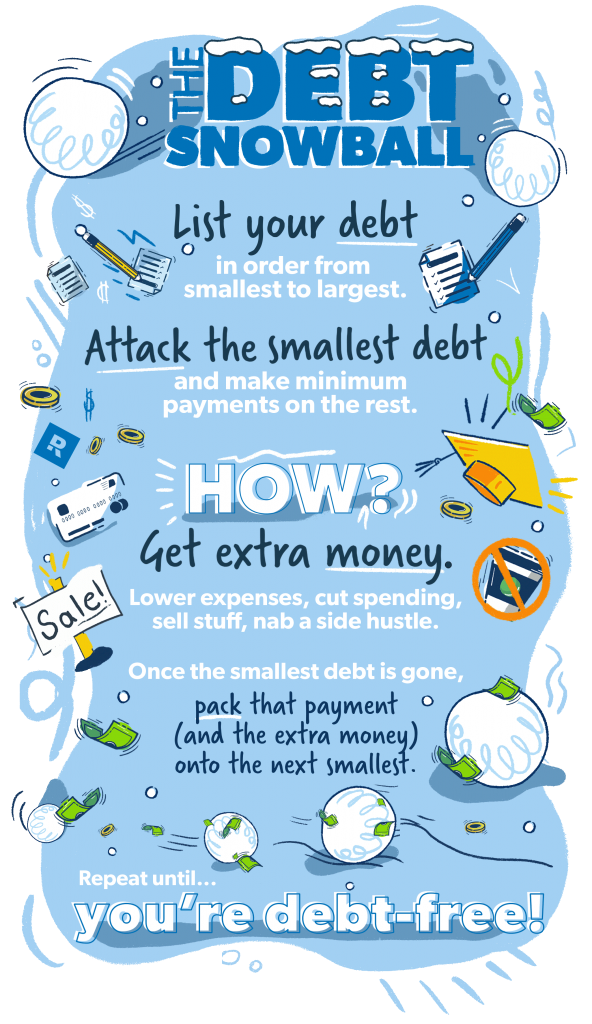
Popularized by personal finance author Dave Ramsey, Debt Snowball is a strategy used for paying down debts. It focuses on paying off your smallest balance first before moving to the larger ones. The person lists down all his or her debts and categorizes these debts from smallest to largest. Money will then be allocated to pay off the smallest debt first, while making only minimum monthly payments on the other debts.

This strategy would not save you as much interest as the Debt Avalanche, but it can help you stay on track in your debt repayment journey.

HOW CAN YOU GET STARTED?

List down all your debts to get started. Then, gain momentum as you knock out each remaining balance. When the smallest debt is paid in full, you will move your efforts toward the next smallest debt on the list. To illustrate, here are the steps:

Step 1: Write down all your debts from smallest to largest, regardless of its interest rate

Step 2: Make minimum payments on all your debts except for the smallest debt on your list.

Step 3: Pay as much money as you can on your smallest debt. This is going to be your priority.

Step 4: Repeat the process until each debt is paid in full.

HOW CAN I APPLY THIS STRATEGY?

Let us imagine that you can afford to put aside S$1,000 every month to pay off your three sources of debt: S$30,000 worth of student loan debt (minimum monthly payment of S$500), S$5,000 worth of car loan debt (minimum monthly payment of S$100), and S$2,000 worth of credit card debt (minimum monthly payment of S$50).

Using the Debt Snowball strategy, you would spend a total of S$650 to cover each debt’s minimum monthly payment. You would then put the remaining S$350 toward the credit card debt because it is the smallest on your list.

Once the credit card debt has been fully paid, the extra payment will go towards your second-smallest debt. At some point, you will be able to clear up your car loan and focus all your money on eliminating your student loan. Like a snowball, each paid-off debt frees more cash to get rid of the remaining ones.

WHAT ARE ITS ADVANTAGES AND DISADVANTAGES?

Its advantages include increasing your motivation and easing your implementation. Paying off three or more debts can seem more manageable if you break it down into smaller pieces. You see, you can get frustrated with the repayment plan if you focus all your efforts on the largest debts. Furthermore, this strategy is easy to implement. You do not need to compare the annual percentage rates (APRs) for all your debts or to tackle deeper into the terms and conditions. You simply need to know the balance owed and its minimum monthly payment to categorize each debt.

On the other hand, its disadvantages include issues in time and interest. Since this strategy focuses on repaying debts according to the balance, it may take you longer to pay off your debts. Interest can be another factor because you are prioritizing balances over APRs. Remember, you could end up paying more money in interest over time.

WHAT ARE THE KEY TAKEAWAYS?

The Debt Snowball Strategy helps you pay off debts by focusing on your smallest balance before moving on to the remaining ones. You will always pay the minimum on each of your debts, except on your smallest debt. This strategy cannot save you as much interest as the Debt Avalanche, but it can help you stay motivated.

Prudent use of personal loans can save you more in the long run, especially if you’re currently saddled with severe credit card debt or are facing a financial emergency that could wipe out your savings. Ultimately, the only way to prevent bad debt from snowballing is to have the discipline to control your spending until your loan is repaid. If you find yourself in any of the above situations and are looking for a personal loan to help relieve some of your financial burden, be one of the first 2 applicants daily to have your 1st year’s interest (up to S$550) covered by SingSaver. Click here to learn more. Offer until 21st Mar 2022. T&Cs apply.

Image Credits: ramseysolutions.com

If you need professional help when it comes to managing your debt, you can seek assistance from a credit card counselling organization such as the non-profit organization called Credit Counselling Singapore (CCS).

Sources: 1, 2, & 3

Read More...

Travel Insurance vs International Health Insurance with selected Covid-19 Coverage

Are you unsure about the difference between travel insurance with selected Covid-19 cover and international health insurance? Here we look at the key differences between the two types of cover.

In short, travel insurance with Covid-19 cover is designed for holidaymakers and those on short business trips to cover things like emergency medical treatment (including covered events related to Covid-19), cancellations and personal belongings. International health insurance provides multi-country cover and is designed for those living and working overseas who need cover for in-patient medical check-ups, medical emergencies and ongoing treatment of chronic conditions.

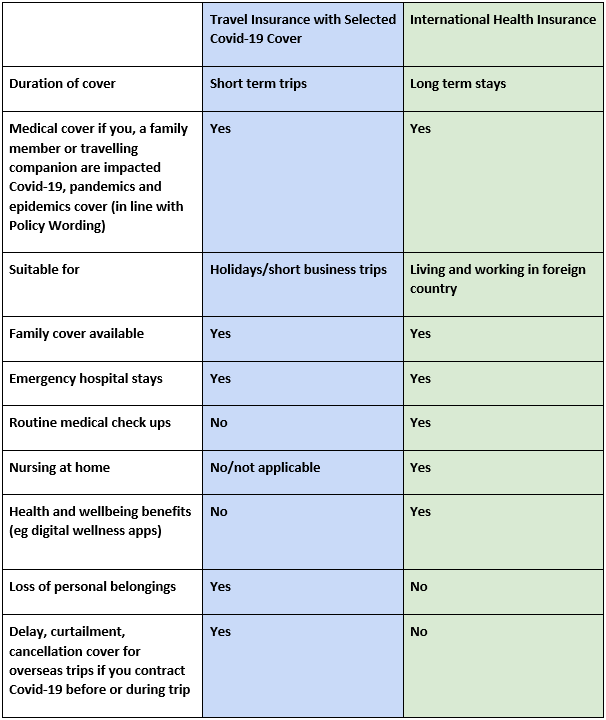
Below is a general comparison of travel Insurance with selected Covid-19 cover and international health insurance. Exact coverage will depend on the chosen policy.

What about lockdowns and other kinds of general travel disruption?

It’s important to remember that travel insurance doesn’t cover you for everything*. For instance, it does not generally cover against lockdowns, border closures and other kinds of general travel disruption.

*It’s important to remember that travel insurance doesn’t cover everything. Your policy will be subject to the terms, conditions, exclusions, and benefits limits of the policy wording

Travel insurance (with selected Covid-19 cover*) – in more detail

Travel insurance with selected Covid-19 cover is travel insurance that covers you for things like trip cancellations / trip interruptions / trip delay , loss/theft of personal belongings and emergency medical treatment, and includes selected coverage for Covid-19, pandemics and epidemics before or during your trip (in line with the Policy Wording of your chosen policy).

For example:

  • If you or a travelling companion/family member are diagnosed with Covid-19 before your trip and need to cancel, you can make a claim for things like travel and accommodation costs.
  • If you or a travelling companion/family member are diagnosed with Covid-19 during your trip, you can make a claim for things like medical care and quarantine costs.

In terms of medical coverage, travel insurance is intended to provide short-term emergency medical treatment within your specified area or period of cover. The aim of this is to get you well enough to return home. Travel insurance rarely covers long term medical treatment.

Selected Covid-19 coverage* with Allianz Travel

Travel insurance from Allianz Travel Singapore includes selected Covid-19 coverage*, plus cover for epidemics and pandemics in general (when diagnosed with a disease). The Medical and Dental cover limit is S$1,000,000 (Comprehensive Bronze and Silver) and unlimited for Comprehensive Platinum.

Travel insurance in general is designed to cover you for trips of limited duration. It is intended for holidaymakers and short term trips abroad, and also offers protection against other travel related issues.

For example, Allianz Travel insurance benefits include:

  • Selected Covid-19, pandemic and epidemic cover*
  • Medical/dental cover of up to $1,000,000
  • 24/7 Medical Assistance
  • Cancellation, Delay, Curtailment
  • Loss/theft/damage of valuables
  • Rental Excess cover (Silver & Platinum Plans only)

If further treatment is required, you will be expected to return to your home country. Cover ceases once you are back in your country of residence.

*It’s important to remember that travel insurance doesn’t cover everything. Your policy will be subject to the terms, conditions, exclusions, and benefits limits of the policy wording. For more information please click on the Allianz Travel Policy Wording

Buy Travel Insurance Now

Get exclusive 40% off for MoneyDigest readers.
Use promo code: moneydigest40 until 28 March 2022

International health insurance – in more detail

International health insurance is designed for individuals and families living and working overseas for prolonged periods. It is designed to cover things like in-patient care, out-patient GP visits, emergency treatment, specialist consultations, maternity and dental. International health insurance is multi-country and provides members with flexibility in terms of choice of doctor and treatment facility, and with the ability to receive treatment anywhere within their region of cover.

For individuals or families who are unfamiliar with a country’s health system and/or language, international health insurance can make it easier and simpler to obtain medical care. Depending on which country you are moving to, it may also save you significant sums of money compared to ad hoc care if you are not entitled to local free or subsidised medical care.

International health insurance plans vary, but often include:

  • Hospital stay
  • Routine check-ups
  • Cover for pre-existing conditions
  • Cover for chronic conditions
  • Choice of medical providers

Some international health insurers make it possible to build a plan that suits specific needs. For example, Allianz offers a standard Core plan to which modules can be added, including:

  • Out-patient treatment
  • Maternity care
  • Dental care
  • Repatriation

If you choose international health insurance from Allianz, benefits include:

  • A range of treatments, inclusive of specialist fees and diagnostic tests, plus generous cover for alternative treatments and physiotherapy
  • Health and wellbeing benefits, including digital health apps
  • Cover for emergency treatment overseas, medical evacuation and nursing-at-home
  • Choice of supplemental cover including Maternity, Dental and Repatriation Plans
  • A growing network of over 900,000 quality medical providers
  • Cover for Covid-19, pandemics and epidemics

Get 10% off until 28 February 2022

Discover More

Read More...