Mutual funds are investments that gather the investors’ money into a pool to make multiple types of investments, known as the portfolio.
Professional money or investment managers, who invest the fund’s capital and attempt to produce capital gains for its investors, operate the mutual funds.
The investment manager’s compensation relies on how well the fund performs. In this way, you can be assured that they will work hard to make sure the fund grows well.
Image Credits: Steve Jurvetson via Flickr
As a mutual fund investor, you become a “shareholder” of the mutual fund company. When there are profits you will earn dividends. When there are losses, your shares will decrease in value.
Mutual funds are diversified or are made up of different investments to lower the risk of loss.
Advantages of Mutual Funds
1. Mutual Funds give small investors the access to professionally manage, diversified portfolios of equities, bonds and so on. This is difficult and nearly impossible to create with a small about of money.
2. Each shareholder participates proportionally in the gain or loss of the funds.
3. The experts handle your money professionally…so even if you have little knowledge on stocks, you may learn as time goes.
Three Categories of Mutual Funds
1. EQUITY FUNDS. Equity funds are made up of common stock investments alone. Although this can be riskier, this can earn more money than other types of funds.
2. FIXED-INCOME FUNDS. Fixed-income funds are made up of government and corporate securities. Since the government and corporate securities provide fixed return, the risk of the investments are low.
3. BALANCED FUNDS. Balanced funds combine both stocks and bonds in the investment. It offers a moderate to low risk. So before investing to mutual funds, you will have decide how much risk you are willing to take.
It is the beginning of a new journey entitled “2015”. There is a long way ahead and the worst is behind us. The future looks so much brighter! As you lay out your plans for the New Year, why don’t you take on the important goal of saving money?
Here are 5 Money Saving Tips from the Experts…
1. GET POSITIVE MOTIVATION FROM FRIENDS AND FAMILY
Bob Weinschenk, the CEO of “SmartyPig.com”, believes that saving money is a group activity in many cultures. By sharing your financial goals to your trusted partner, family or friends, they can be able to support you and even donate a few bucks. Having someone by your side that share the same goal will surely motivate you to continue this positive saving behavior.
Image Credits: Ken Teegardin via Flickr
2. TAKE THE SHOPPING DEALS ONLY IF YOU NEED THE PRODUCT
Donna Freedman, a writer for “Get Rich Slowly” and “Money Talk News”, said, “Coupons plus sales can easily tempt you to buy something you don’t truly need”. Do you really need to buy a bulk of toothpaste just because you have coupons and vouchers for it? Simply, when you see an item on sale think deeply if you will purchase that item on its original price.
3. LIVE WITHIN YOUR MEANS
Purchase within your means by balancing what you need and what you want.
Miranda Marquit, the founder of “Planting Money Seeds”, highlights that by knowing that you have enough purchasing power may turn into comfortable spending without keeping the best options for your finances. So, just because you can afford something, does not mean that you should buy it.
4. THINK TWICE WHEN BUYING PERISHABLE GOODS IN BULK
Jeff Yeager, the author and host of “The Cheap Life”, said “it’s not a good deal if it goes bad before you use it”.
This is why he stresses the importance of making a shopping list and sticking to it.
5. LASTLY, LEAVE YOUR CREDIT CARDS IN THE HOUSE
Stacy Johnson, the President of “Moneytalksnews.com”, said, “we’re more likely to overspend with pieces of plastic than real money”. Personally, when I shop, I only carry cash that I am willing to spend so I won’t go over budget. This prevents impulse buys.
It is just like the eternal question every year again – what stocks to buy and what to ignore. The question is simple, but the answer is somewhat complex, as there isn’t any easy and straightforward way to respond to it. Investors can choose however different strategies. Like every year there are always certain companies that will grow no matter what the state of the economy does. These rather save investments are perhaps one of the best strategies to follow. But there are also sectors and industries that will be particularly flourishing in 2015.
Certain stocks have been climbing for four years in a row. Better judgement might suggest that there is an end to it. However, certain companies are simply not giving in. Furthermore, the December sell-off is the perfect opportunity for investors to enter the game. Companies like Apple (APPL) have been trending and created nothing but revenue for investors. The Apple stock has generated profits for five consecutive years and there isn’t any indication that 2015 will be different. The reputation of the company’s iOS operating system is better than ever and iPhones are leading the smartphone market. Apple appears to be a no-brainer.
The same holds for other IT stocks. The social media platform Facebook (FB) has enjoyed a 40% increase in the last year alone. Instagram, which is part of Facebook Inc., just reached 300 million active users and is said to have a vast potential for growth. With potential video ads launching on Instgram this year, the Facebook stock is set to climb further. Next to Apple and Facebook stands another giant, which has similar prospects – Google (GOOGL). The market share of the company is beyond belief and easily surpasses the ones of the competitors. No matter whether mobile phone market, online search or services and applications – the sails are set into one direction. Investing in any of these IT brands could be a risky undertaking considering their extremely long runs up the market ladder, but they are clearly not finished yet. Therefore, any of them should be a save investment for 2015.
However, these are not the only stocks, which are predicted to go up. Many other information technology stocks are said to behave similarly. Even the famous heavyweight Goldman says that investment in this sector will bring favourable profits. The growth predictions for this particular industry are set around 9%. This will ensure decent returns for shareholders.
Another investment tip given by many important financial institutes are the big global stock market indices. At least within the first half of 2015 the major indices are expected to grow. Especially the S&P 500, the American stock market index, is according to the forecast of the financial institute Goldman Sachs continuing to increase in value. Since the crash in 2009, the index has doubled in points and even climbed over the value it has had before the crash. Analysts calculate with at least another 5% increase in the first few months of 2015. Also the TOPIX, the Tokyo Stock Price Index, is on an upward spiral and estimated to be even steeper than the American index. Although the Japanese economy has suffered various setbacks in the last years, the predictions for the second most important Japanese stock market index are positive.
Investments not to make are material stocks. As the Chinese economy is experiencing stagnation, the demand for raw materials is going back. The stocks have increased in the last years, however the prediction for 2015 is dim. Most likely the stocks fall deep before they will increase and stabilise again. One should wait until they fall though. The moment when they will fall is unclear, but the fall itself is almost certain. Once the material stocks have considerably decreased, one should consider investing again.
No matter whether coal, oil or base metal – the price is weak. The oil price hit a five-year low and the coal price even went below its 10-year average. The wheels of the commodity super-cycle seem to be stuck in the sand. With oil and coal having increased up to a ten-fold in the last 15 years, the growth has been cut. China and other emerging nations had been responsible for a massive demand of materials. However, slow economies and decreased demand, especially in China, are now creating the halt.
Although major economies, such as Russia and China, are slowing down for different reasons, the Asian market is expected to grow in 2015. The emerging markets of China and India as well as South Korea and Indonesia are not to be underestimated in the next twelve months. Reforms and different policy chances have reduced bureaucracy and enable so economic growth. Furthermore, through policy changes unproductive and ineffective industries and sectors will be more exposed to the order and self-regulation of the markets. One of the best performers of the Asian markets in 2014 was the Deutsche X-Trackers Harvest CSI 300 China (ASHR), which increased by 47%. The steep trend increased especially in the last two months of the year and is therefore a top contender to watch and invest in for the first few months of the New Year.
While still in trouble is 2013, India and Indonesia have stabilised their currencies in 2014, while Korea, Taiwan and Singapore had suffered compared to the US dollar. This however has helped India and Indonesia to push reforms and growth their own markets. The Indonesian iShares MSCI Indonesia ETF (EIDO) grew by over 21% and the Wisdom Tree India Earnings Fund (EPI) could improve by more than 27%. Both of them can be interesting for investors in the next six months. Although both experience occasional setbacks, one could consider them as a long-term investment, as their potential growth could be up to 20% for the next two years.
In general 2015 isn’t looking bad at all. The US market as well as different Asian markets, such as the Indian and Indonesian markets, are expected to grow further, although some have already been growing too long in the opinion of some analysts. Investing in information technology stocks will be the safest bet though.
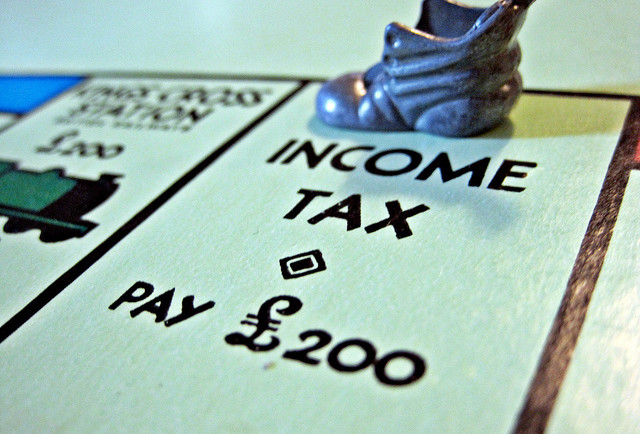
Income tax filing day are just months away and i know you hate the reminder.
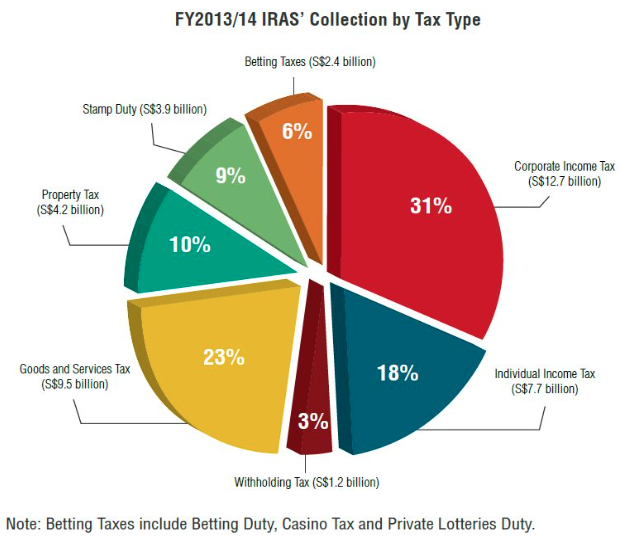
Even while i’m here writing this – you would have paid for your dinner that comes with a Good and Services Tax, leaving you 17% of the cost of the meal poorer.
You may also have to pay for the property or road tax that are due.
For those that smoke and drink, thanks for the additional contribution of excise duties and tobacco tax. And for once, we are proud of you.
For the rest, i can fully understand your resentment as no one likes to fork out extra money from their own pocket for something they cannot feel or touch.
Some of you may fret because you don’t know what exactly you are paying for and what the government is going to do with the taxes collected.
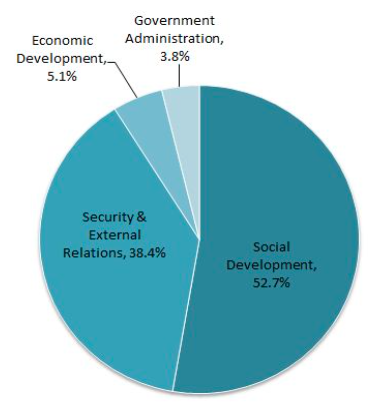
Here is the breakdown for the second quarter of 2014:
(Source: Economic Survey of Singapore, 2nd quarter of 2014)
As you can see above, most of the tax revenues are spent on social development and security purposes.
Taxes are necessary for the development of an economy of a country. Without taxes, you would still be living in the kampong your parents lived in and there is no SMRT or Uber but only Rickshaw Pte Ltd.
I like to pay taxes. With them, I buy civilization. – Oliver Wendell Holmes Jr
At least in a country with the least corrupt government, you are assured that ultimately the money will come back to benefit us in other ways.
Let’s take a look at how most of the funds are spent and why you should love paying taxes:
Building the ‘Great Wall’ of Singapore
(Image credit: asiaone.com)
In tiny Singapore with limited land and resources, what we have to defend ourself is to build a strong military force to be reckoned with. Defence spending has been steady and amounts to billion of dollar each year. So the next time you grunt over your income taxes, make yourself feel better to know that the money goes into the next Leopard tanks or a Next-gen fighter jet that defends you in a place you call home.
Live as long as the Japanese
(Image credit: seniorsworldchronicle.com)
Japan has the most centenarians and that’s probably due to having one of the best healthcare system in the world. No doubt, Singapore also has one of the best quality healthcare system and Finance Minister Tharman Shanmugaratnam has said that healthcare spending will hit S$12b by 2020 in Budget 2014.
There is no such thing as free and cheap healthcare system anywhere in the world, because the public ends up paying for it, either through taxes or hefty insurance premiums.
Perhaps it’s time to substitute your Char Kway Teow and Mee Goreng with seaweed and sashimi? Stop drinking your Starbucks or Coca-Cola, drink Matcha.
Cultivate more Albert Einsteins
(Image credit: ST)
Next on the list of government expenditure is education spending. As the government spend more money building schools and training teachers, don’t you feel proud when Singaporeans are ranked the most intelligent in the world with a IQ score of 108% by British psychologist Richard Lynn and Finnish political scientist Tatu Vananen. Singapore has always top the ranks in the Trends in International Mathematics and Science Study (TIMSS) and who say we can’t produce Albert Einsteins of our own?
Singapore has spent close to $10 billion on education in 2013.
Build a Sing-kansen
(Image credit: gopixpic.com)
Late in the 19th century, Singapore’s main mode of transport to get around in by the rickshaw puller. There is no such thing as the MRT (or SBS, ERP, COE, PIE, etc). The fact that you can see modernised roads and expressways as well as MRT tracks and bus interchanges is due to the taxes you paid. Around $5 billion are spent on transport each year.
If you look at it a bit longer within the next 15 years, by 2030, the network will double and nearly 8 in 10 households will be within a 10-minute walk from an MRT station – so you just walk a short distance and you are there. – PM Lee Hsien Loong
And as Singapore gets more ambitious, besides cars and roads, we also want a Shinkansen (bullet train) of our own as you can see from the KL-Singapore High Speed Rail project which is estimated to cost RM40 billion.
Remembering Silk Road
(Image credit: worldportsource.com)
Singapore’s economy is largely dependant on trade. With no natural resources to boast about, we make use of our strategic location along key shipping routes and deepwater ports. Trade and commerce accounts for up to a quarter of our country’s GDP
Thus, it makes sense to invest the money in the area where we have advantage in. Mainly high-end manufacturing such as electronics, semi-conductors and machinery.
Assembling LEGO bricks
(Image credit: ST)
LEGO? Well, not literally. National Development forms part of the government expenditure and that’s also the reason you see more HDB flats, development of new malls and Garden by the Bay instead of kampong or shacks.
The Ministry of National Development (MND) aims to provide quality and affordable homes, good community bonding, development of green spaces and creation of identity marker through planning and management of land resources.
Act as Robin Hood
(Image credit: missedinhistory.com)
In Singapore, we use the progressive tax system where the rich get taxed more than the poor. It is viewed as a fair and equitable way since the rich spend lesser proportion of their income on necessities. If you earn higher income, you basically pay more tax. Income inequality is a social ill and leads to more crimes and social unrest.
For the lower and middle income group, there is a GST voucher given out every year since 2012 as a form of transfer payment. So for 800,000 HDB households, look forward to the GST vouchers that is coming your way this month in January 2015.
In conclusion
So everyone, a pat on your back for your contribution to Singapore throughout the years. Smile and pay your taxes due without any reproach for you have done your part in the betterment of the society. Tax is not that bad after all, isn’t it? Think positively.
The Christmas holidays and the New Year are over and 2015 has finally arrived. But what does that really mean to an investor? Is there any effect at all? Public holidays always create a little turbulence in the market – no matter where and what the holiday is about. This effect can be positive or might have negative influences on the stocks. However, it is important to understand these disturbances and use them to one’s advantage. Reading the market correctly can bring an investor advantages – however, not only for a few trading days, but for the entire year. The movements of the stock exchange before and after the New Year can give indications for the months to come.
The swinging of the stock market around the New Year is also referred to as the January effect. One can generally say that the market and many stocks are going up during the month of January. This is due to the sudden increase of the amount of investors buying stocks. One might naturally question this tendency as pure chance. However, it is statistically recorded that stocks are being bought in January and especially during the first five trading days of the New Year. The question is – why is that the case? It has to do with tax-loss selling. Investors tend to sell those shares that are not bringing any money in the very end of December in order to counterbalance capital gains that have been made during the year. Therefore, the stocks that have been sold in the old year will be at a discount price of their actual value during the first trading days of the coming year (2015). This will trigger a bargain hunt within the first week of trading in 2015. The effect is increased buying pressure in the market. This tendency holds for most markets – no matter whether New York, London or Tokyo. However, the extent of the January effect can vary from market to market.
One should be aware of the fact that the January effect is a mere indication and not a rule. The effect is purely created by the desire to create tax losses in the end of the year. However, investors are starting to use different schemes, such as tax-sheltered retirement plans, to balance their accounts and enjoy tax reductions. For that reason the sell-off can occur in a reduced measure. It however does happen. Bargain hunters should therefore pay attention to whatever was sold off during the last trading days in 2014. If one wants to attempt a profit, one has to look for risky shares and securities. These are mostly sold off in December and are therefore available at a low price. The opposite happens during December. The demand for lower risk securities, such as government bonds, is driven up. Investing early enough into these lower risk securities can potentially generate a substantial increase in value. The art of benefiting from the New Year swing at the stock exchange is connected to front-running the effect. Although the extent is impossible to be predicted precisely, the shift and the tendency are undeniably occurring.
How can the swing predict the tendency of the year and how to read it? As every market has of course their indicators, one cannot make a general prediction for the entire world economy, but has to watch each market individually. For example, the indicator for the US market is the S&P 500, which is the American stock market index. Statistics have shown that if the S&P 500 has a positive gain within the first five trading days of the year, the chance that the American stock market will increase for the rest of the year are extremely high. Similar tendencies and statistics hold for other markets too. Wanting an indication or prediction for the rest of the year, one has to monitor the stock market index. The benchmark index for the Singapore stock market is for example the Straits Times Index. Other important global indices include the S&P 50 for Asia, the DAX for Germany and the Nikkei 225 for Japan.
There are few things to be kept in mind. The January effect tends to be weakened when there is an ongoing recession. As various markets suffer differently from poor economic situations, each market stands for itself. If the American economy is in a recession, it doesn’t mean that the Singaporean economy is instantly affected. The same holds for predictions. These however are important for the January effect. It generally holds that if there is a recession, the January return will be reduced. Furthermore, the extent of the January effect also depends on the institutional investors, such as portfolio managers. As they are responsible for a large extent of the trade, the decisions of the portfolio managers can sway stocks one way or another. Usually if the prediction for the coming year is positive, they tend to invest large amounts in risk security within the first few trading days of the year. The same is true the other way around. Negative economic predictions will keep institutional investors from buying. Therefore, the opinions of these investors can heavily affect the January return.
First of all, the New Year does have an effect on the stock exchange like other holidays as well. However, the effect and the potential benefits are larger than with other holidays. Although the New Year will most likely not be the coup of the country, there are profits to be made. If the January returns are positive, they are usually strong. However, they are not guaranteed. When investing within the first month of the year, one should consider various points. The most important factors are the general prediction for the economy for the coming year and whether there is a recession ongoing. In case both are positive, one should pay attention to the stocks being sold off heavily in the end of the year. These stocks will most likely be available below their real market value when trading resumes in the first week of the New Year.