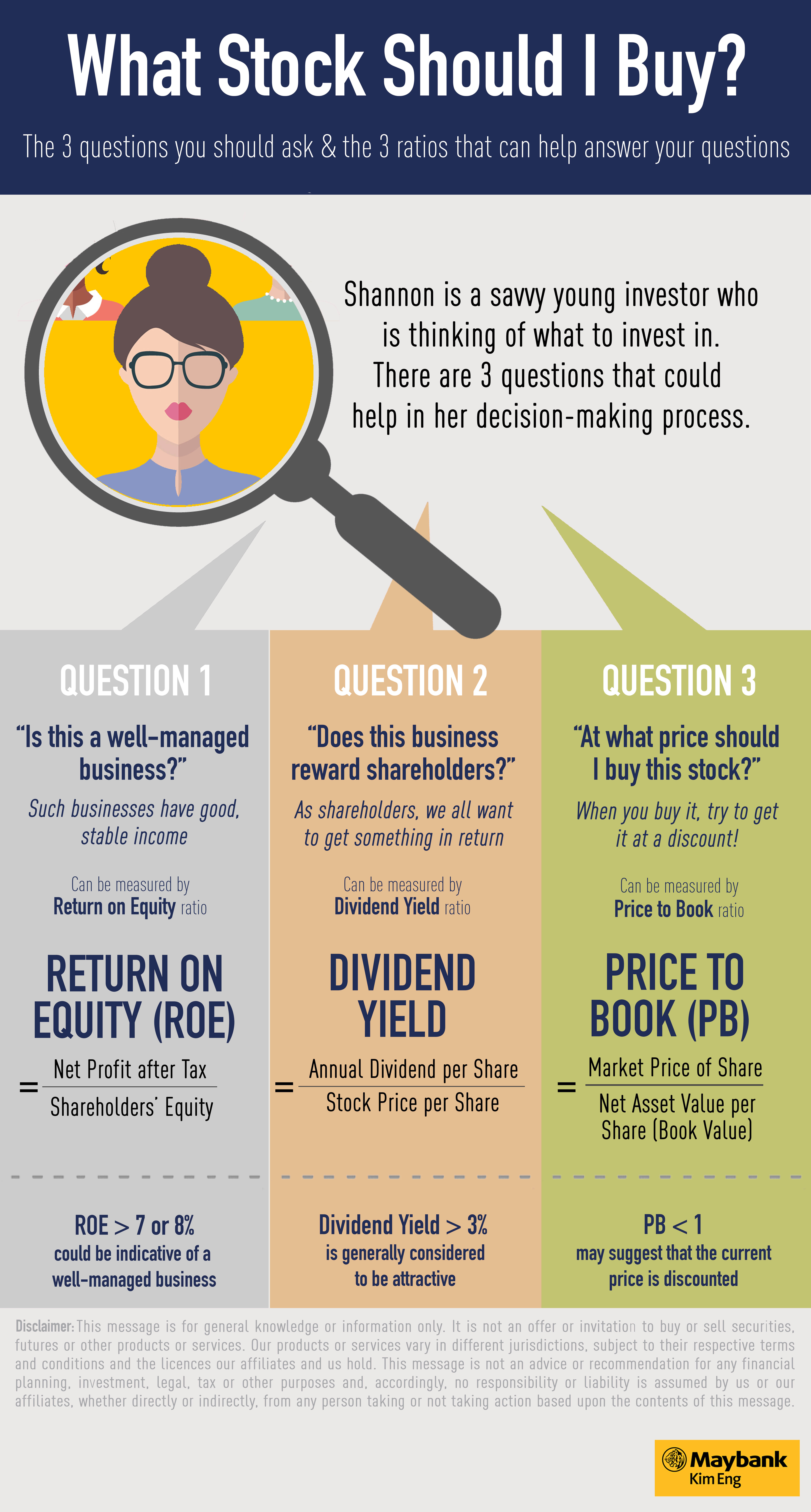
Warren Buffett once said, “it is not necessary to do extraordinary things to get extraordinary results.” When it comes to finding stocks worth investing in, we simply need to ask the right questions.
We share 3 of these questions with you, and 3 financial ratios that can help answer your questions.
What if you don’t have a stock in mind? After all, there are over 9,000 stocks on the Singapore Exchange (SGX), New York Stock Exchange (NYSE), NASDAQ and Hong Kong Stock Exchange (HKex) alone and brokers like us offer access to many more markets including Thailand, China, Indonesia, Malaysia and the Philippines.
There are tools out there that can help you identify stocks using ratios like the ones above. Click here to learn how stock screeners can help you identify trading opportunities.
By definition, maximizing refers to “increasing [something] to the greatest possible amount or degree” while simplifying refers to “making [something] less complex or complicated”. Applying these two opposing strategies to your investments can lead to different results.
Let us find out which strategy is more productive.
With the sole purpose of increasing the value of their portfolios, “maximizers” are vulnerable to the trap of purchasing a product off the bat. They may be too optimistic and expect the best possible outcomes. This idealistic thinking can be far from reality. The truth is, there will always be a few decisions that would not work in your favor.
Aside from investing on the wrong products, maximizers can be overwhelmed and stressed about the abundance of investments that they bought. The mindset of a maximizer is focused on the overall potential that various investment can offer rather than optimizing a single investment.
Sure! You can actually earn five times more than your initial cash-out if you added all of these options. However, can you really pay attention to all of it?
Most people cannot. They end up putting “so-so” effort into each of their investments and fail to achieve the best scenario that they previously envisioned. Also, they end up being drained. Drained investors can become unproductive. Being unproductive may later result to a significant loss.
With all the money at stake, do you still want to maximize?
If your answer is “NO”, try the second strategy called simplifying. Simplifying allows you to create a portfolio that is easier to manage by eliminating complex investments. To tell you frankly, investing does not have to be difficult! You just have to focus on one thing at a time.
Start by analyzing all the possible investment options that you can afford. Next, determine which options suits your personality the best. Remember that investing is more than just about the outcomes.
A powerful mindset that “simplifyers” possess is contentment.
According to Psychologist Barry Schwartz, people who are preoccupied with the best possible outcomes are less satisfied and more susceptible to “buyer’s remorse” than the people who are satisfied with the outcomes that are good enough.
Maximizing can be counterproductive to your investments. The more you try to grow your wealth, the more you can inflict strain and stress to yourself.
Following Brexit the term “stagflation” has reared its head, but what is it, what signs should investors look for and how will it affect different investments?
While no-one can say for a fact what the economic fallout of the UK’s vote to leave the European Union will be, the prospect of “stagflation” has been floated as the economy faces an uncertain future.
Uncertainty is the market’s biggest foe, but investors can protect themselves by improving their understanding of the UK economy and remembering that diversifying portfolios, by holding many different assets, offers the best opportunity to ride out any potential storm.
What is stagflation?
Stagflation is a description of an economy in trouble.
It is a portmanteau of stagnation and inflation. It is the term used to describe periods of persistently high inflation – the cost of goods rising – combined with high unemployment and stagnant demand or low economic growth.
The UK previously experienced stagflation in the 1970s when a jump in oil prices squeezed the life from the nation’s economic output and contributed to higher levels of inflation.
What has Brexit got to do with stagflation?
Analysts and the UK government forewarned that Brexit, at least in the short-term, would hit the UK’s economy:
Schroders’ Brexit scenario estimated a fall of 0.9% in GDP by the end of 2017 compared to our baseline forecast, and a rise in the level of CPI (consumer price index) inflation by 0.6%.
Why might the UK economy falter?
There are worries that UK companies will struggle to do business with international trading partners due to the uncertainty over which markets will still be accessible after the UK leaves the EU.
A knock-on effect could see employers stop employing and households cut spending as both companies and consumers batten down the hatches and preserve cash in fear of a slowdown.
There are concerns too that inflation will rise as sterling continues its downward spiral, pushing up the cost of imports and therefore the cost of living. This would come at a time when the UK government could be looking to raise taxes and cut spending to cover its own budget shortfalls.
Ratings agencies have already downgraded British government debt – essentially they are highlighting the risk that the government might not be able to meet its debt obligations.
It is, unfortunately, a self- perpetuating cycle and conditions appear ripe, although far from certain, that the UK could experience some form of stagflation in the near-term and investors need to remain alert.
Four indicators that investors should keep an eye on:
Stagflation-linked assets such as commodities, gold, and energy stocks should see prices rise while recruitment and housebuilding stocks, and bond prices should fall;
A rise in underlying inflation, which includes food and energy prices and may happen ahead of a rise in the headline inflation rate;
A slowdown in consumer spending and downbeat reporting from retailers;
A rise in unemployment and bleak updates from recruitment firms.
Should global investors care?
While the UK is in the eye of the storm there are risks of contagion. Brexit could encourage other euro -sceptic European nations to follow suit and hold similar referendums, putting the European project in jeopardy.
There is also the unknown outcome of the ongoing measures adopted by governments and central banks to reflate the global economy.
While there are currently few signs that the trillions that policymakers have injected into the economy will have sudden boost to inflation, the prospect is still there, and if it comes it could be sudden and violent. This could have global consequences.
What should investors do?
Consider their portfolio positions carefully. Diversification remains the key. Stagflation is not yet a real ity and might not even come to fruition, so positioning solely for it could leave investors over exposed to the flip -side.
Additionally, there might also be a risk-premium attached to some of those assets which might be considered a stagflation hedge, in other words, you might be paying much more than you otherwise would have.
A balanced portfolio offering some protection for the worst case scenario and risk to offer the chance of a higher rate of returns should provide a suitable hedge against stagflation.
Important Information
This is prepared by Schroders for information and general circulation only and the opinions expressed are subject to change w ithout notice. It does not constitute an offer or solicitation to deal in units of any Schroders fund (the “Fund”) and does not have regard to the specific investment objectives, financial situation or the particular needs of any specific person who may receive this. Investors may w ish to seek advice from a financial adviser before purchasing units of any Fund. In the event that the investor chooses not to seek advice from a financial adviser, he should consider whether the Fund in question is suitable for him. Past performance of the Fund or the manager, and any economic and market trends or forecast, are not necessarily indicative of the future or likely performance of the Fund or the manager. The value of units in the Fund, and the income accruing to the units, if any, from the Fund, may fall as w ell as rise. Investors should read the prospectus, available from Schroder Investment Management (Singapore) Ltd or its distributors, before deciding to subscribe for or purchase units in any Fund. Funds may carry a sales charge of up to 5%.
Is it possible to live in a world where you can carpool with a stranger during an emergency? How about dining at someone’s home or hiring an experienced chef with a swipe of a finger?
With a “sharing economy”, all these are possible!
According to Investopedia, a sharing economy is…“an economic model in which individuals are able to borrow or rent assets owned by someone else. The sharing economy model is most likely to be used when the price of a particular asset is high and the asset is not fully utilized all the time.”
United States, Europe, Seoul, Australia, and other parts of the globe have shifted from a consumer market to a sharing one. In these places, people use technology to rent, lend, and exchange goods and services rather than purchasing them from shops or companies. Considering the scarcity of some resources in the country as well as its technological advancements, experts suggest that a sharing economy is an untapped realm with great potential for Singaporeans.
April Rinne, a consultant and World Economic Forum Young Global Leader, expressed that a sharing economy can help a society to become more sustainable. And is it not what Singapore aims to accomplish?
In fact, in the Sustainable Singapore Blueprint 2015, the state set up a collective vision that includes being a zero waste nation by 2030. A sharing economy fosters activities that enable people to share and earn income from underused assets such as apartments, cars, clothing, and tools.
There are several benefits that a sharing economy can bring to a nation such as reducing environmental waste impact, redefining the materialistic ideal, increasing efficiency in transport, as well as cutting energy and water consumption.
Sharing economy helps to reduce the environmental waste impact and extend the longevity of items. For example, The Freecycle Network™ allows people to give and receive re-usable items to divert them from the landfills. 9,104,727 users post ads of pre-loved items and give them freely to people that would want to take it. Interestingly, I saw one post from Singapore that offered “lofted twin beds with desks underneath”.
A sharing economy also helps to redefine our materialistic ideal as it encourages to sell or share our possessions. You see, we grew accustomed of having material goods as a measure of success. We believe that the more we have, the more society will perceive us as wealthy and happy. But the truth is, having all these designer goods or lavish cars will never satisfy us. It will only make us craving for more. In a sharing economy, you can easily buy and rent clothes online.
Aside from sharing our possessions, a sharing economy supports the idea of community transportation. By community transportation I mean that people can rent cars from companies, carpool with strangers, and pay for a ride from the people in their neighborhood. A good model for this is Uber. Uber allows you to get a taxi or share a ride with other people through a mobile service.
Lastly, a sharing economy allows you to cut on the accommodation costs as well as energy and water consumption thru services like Airbnb and Couchsurfing. In 2014, a study found that sharing homes had considerably lesser energy and water consumption, greenhouse gases, and accumulated waster compared to hotels. The current situation of home sharing in Singapore depends on the Urban Redevelopment Authority (URA). The URA is re-assessing the law which considers that it is illegal for an individual to rent out their home for stays shorter than 6 months.
Image Credits: pixabay.com
For individuals, companies, and the society at large, a sharing economy presents a myriad of opportunities to invent new streams of revenue, solve social issues, and to create community resilience. If this idea is successfully achieved, Singapore can just boost its productivity levels significantly.
Money gives people, of all ages, the decision-making opportunities they need. Educating your teens to make wise money decisions earlier on will affect their finances in the long run. One of the most important things you must do is to expose your daughter or son to the basics of investing. In hindsight, I wished my parents did so.
1. ENLIGHTEN THEM ABOUT YOUR FINANCES
Embedded in our Asian culture, most Singaporean parents keep their financial issues away from their children. However, the teenage years is the perfect time for you to enlighten them about the “real world” and its problems. Keeping your teens in the dark will make them think that managing money is easy and life is perfect.
Help your teenage child to transition from being a clueless kid to an informed young adult by teaching how important it is to set up future goals and a working budget. Take the effort to share your financial experiences including the ones that are related to investing. Be ready to answer countless amount of questions too!
2. PUT VALUE TO THE CURRENCY
Explaining the importance of money is easier said than done. With the idealistic minds of most teens, you must level it down to reality by giving relatable examples. Put worth or value to the currency by telling them that the money they saved and invested can be used to buy concert tickets of their favorite bands. It can also be used to buy the latest gadget that they have been eyeing on.
Make them realize that when money is invested in the right place and in the right way, they can purchase not just one but probably a couple of the things that they need and want.
3. START WITH THE BASICS
Similar to learning how to ride a bicycle, begin by attaching the training wheels. In this case the training wheels are your investing fundamentals. Explain your own investment philosophy and the way you invest. Then talk about the basics of how the stock market operates as well as the different investment options available (e.g., mutual funds and REITs). Differentiate each option by describing its rewards and risks.
Start with these simple concepts first before jumping on the other concepts such as P/E ratios and diversification. This way, you can keep your child’s interest as everything seems understandable.
4. USE TECHNOLOGY TO YOUR ADVANTAGE
Shake things up and make learning fun by introducing free investment and trading apps such as Kapitall and CASHFLOW. Kapitall allows you to assemble a portfolio worth $100,000 and track its progress easily. While CASHFLOW, patterned to a popular board-game, allows you to work at a variety of professions until you implement a successful investment strategy to become the next business mogul. These games help teens to grasp the investment concepts that they need later in life.
Image Credits: pixabay.com (CC0 Public Domain)
As teens can become careless, continue to guide them throughout the process and never leave them “investing” on their own.