While it’s not uncommon for bosses and employees to become “friends,” or rather, have a friendly relationship outside of working hours, being on social media can be a little…
Ehem.
Up to this point, some of you may be secretly laughing inside since it seems like a no-brainer.
“Aiyo, just don’t post anything you won’t say in front of your boss lah.”
But hey, isn’t that an invasion of privacy? It’s social media after all, and not connected to work. Isn’t it stressful to have to “censor” yourself because your boss is part of your friend/follower list?
Let’s delve deeper into this.
What are the downsides?
Numerous.
Since bosses will be able to see what you “like” and your comments on posts, they may form an opinion of you that may not be part of your “professional reputation.”
And if you’re friends with your colleagues, that’s extra stuff to worry about. But but, we won’t get there for this post. Simply put, life is stressful enough to have to worry about what you post online.
Play around with privacy settings
Not all social media platforms allow you to play around with privacy settings. For example, TikTok and Instagram probably can’t (unless you go private).
But for Facebook, you can limit who sees your posts. I mean, if you have no choice but to accept that friend request from your boss, you’ve got to take some safety measures, isn’t it?
Though it would be a pain in the a** to have to constantly keep this at the back of your mind—being careful with what you share and whom you share it with.
What to do when things don’t go your way
Called in sick and took a day off on Monday but posted that photo of you drunk on Sunday night?
If you find that things don’t go away no matter how careful you’ve been on social media, take this chance to disconnect.
And when asked or questioned, just explain that you think it’s better to draw the line between personal and professional.
Is it really a no-no to connect with your boss?
Well, not really.
This is especially for people who don’t have much of a social life. Oops, I’m sorry to be blunt but it’s true.
Or for folks who tend to be on social media to “stalk” or get updates on events, friends, and loved ones.
In such cases, then it’s okay to connect. In fact, you might be on the “winning end” because you will be stalking your boss’ social life instead. Ha!
Jokes aside, I have a few friends who are on social media to showcase their work—designs, and drawings—so there are no danger zones there yeah.
As we close, just know that accepting a request without putting much thought into it may be disadvantageous to you. Ultimately, a boss is a boss and professionalism should come first in the majority of your interactions. Why sabo yourself?
Now, it’s time to face the reality of having to pay back your student loan. And on top of the need to secure a job so you can manage your monthly repayments.
Feeling clueless about how to go about handling this? Here’s a simple student guide to navigating student loan repayment so stop worrying and start reading.
Budgeting starts now
If you’re the sort that earns a dollar and then spends a dollar, something’s got to change.
With a student loan waiting for you to repay, you need to start looking into your salary and budget accordingly.
And by budgeting, I mean going into the nitty-gritty details. Whether it’s food costs, phone bills, insurance, transportation, or giving the old folks “pocket money”, pen it down. Be as realistic as possible and then calculate how much you can afford to put towards your student loan repayment.
Tip: You need to scrimp and save for a start, but it’s good not to squeeze yourself dry and risk mental health issues along the way. It may take some trial and error but you will eventually get the hang of things with adjustments here and there.
How to practice financial discipline
There’s no other method when it comes to financial discipline—stick to your budget.
There’s usually a minimum loan repayment amount tag to your student loan. For example, DBS’s (university) study loan’s minimum monthly repayment is $100.
And following 2022’s median salary for fresh uni grads, it’s $4,200.
Yes, $4,200.
Don’t feel bad if your salary is below the median amount. Life happens.
But that’s not the point.
The main point is $100 is an easy amount to repay based on the salary you receive. Surely you can’t be earning less than $1,000 per month as a graduate, right?
If you set aside 10% of your salary, you can pay off way more than the minimum amount. Just make sure you’re comfortable with it.
Every dollar matters. If you find yourself with extra money at the end of the month, make those payments toward repaying your student loan. The interest is no joke and you want to pay back the lump sum as soon as you can.
How to save on interest and pay off faster
I’ve touched on this point a little earlier but what you want to do is to…
Pay more than the minimum.
Even OCBC’s student loan installments start from $100 per month. That’s the bare minimum.
Image Credits: ocbc.com
But if you aim to get this repayment thing over and done with, you need to “tahan” a little at the start and pay more than the minimum.
If your loan has no interest tag to it, good for you. But if it does, the interest is going to quickly add up. So to stop it from snowballing into tens of thousands of dollars, repay more each month.
What if you can’t make payments on time
My question to you is, why?
Based on my brief research on DBS and OCBC’s student loans, the minimum amount to repay is $100, as I’ve mentioned earlier too.
Even if you’re starting as an intern, the market rate should be >$1000. And that’s just 10% of your salary.
But if the problem is not due to your extravagant spending habits but unforeseen circumstances such as medical bills and whatnot, then you should let your guarantor know.
Seek help from friends or family members whom you can borrow money from. Since the minimum is $100, see if you can borrow $600 to $1,200 (6 to 12 months’ worth) to get by. If all else fails, contact your loan servicer to discuss the issue.
We’re already days into Q2 of 2023. Time just passes by like that and as someone who has had the experience of loan repayment, I’ll honestly tell you that the interest rate is insane. So never let it roll. You want to set a clear budget, stick to the repayment amount each month, and repay more if you can. Suffer a little now in your early 20s, and you can do more of what you want after the loan is cleared. Take that!
You can curse out your ex-manager for being this and that but truth be told, it’s a challenge. And now that you’re in a managerial position, are you in a dilemma?
How on earth do you ensure that your team members are contributing equally? Well, we will be delving deeper into this topic in this post. So buckle up, and let’s roll.
Invest in team building
Depending on companies, some management groups think that team building is necessary at least once a year.
For me, I guess you set your own rules—once every quarter isn’t that bad. If it’s too much, then go for once every 4 to 6 months.
Team building is a good investment if you want a cohesive team. Duh. How can anyone work together in harmony if they don’t know each other well, don’t have common topics to talk about, or don’t see eye to eye?
Have clear sub-goals
Anyone who has walked into a project managed by a manager who does not know how to create clear objectives knows how it feels.
GG.
No, not good game, but good grief.
If you want every member of your team to get a slice of the pie, then make sure you map out your overall objective(s) and concrete sub-tasks.
For example, if you’re a team working on launching the latest summer collection of a fashion brand, then make sure every headcount involved in the project knows what they are doing. From the most senior executive to the newest intern, everyone should have a defined (quality, not quantity) task to work on.
And yes, keep those deadlines in check too.
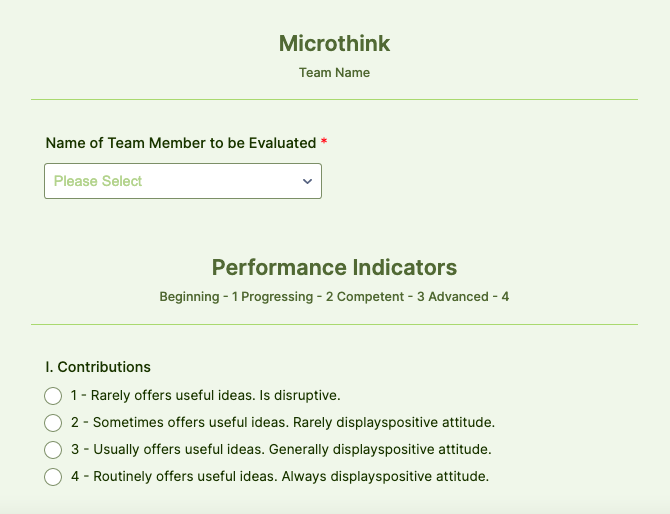
Create an evaluation system
Image Credits: jotform.com
I’m not going to lie, I’m not a huge fan of evaluations. Why? Because it keeps me on my toes.
Knowing that I’m being “watched” not just by my boss but also by my colleagues leads me to pull my weight a little more.
So if you’re a manager who wants to play around with some psychological motivational forces, focus your attention on these:
Step 1: Peer reviews
To ensure that peer reviews work and not harm, it has to be done right.
I suggest making peer reviews anonymous. Whatever means you use to evaluate—the old-school way of paper forms or online ones—the only person that should be able to view those feedback would be you, the manager.
There’s no need to, as the Chinese saying goes, 挑拨离间 (sow discord).
Step 2: Analyze feedback
Once you’ve gathered fellow responses from your team, it’s time to analyze them.
Anonymous peer feedback is the best feedback if a certain point raised is rather consistent across teammates.
For instance, you may get comments such as:
“Meixin is quite slow in the work assigned to her. She doesn’t keep to deadlines.”
If just one person raises this point, then maybe it wouldn’t be that credible. But if you have a team of 10 and more than half has somehow or rather given such feedback, it shows something.
But I understand no one has the time to do such detailed feedback like that all the time. Maybe twice a year or once at the end of the year may work. Or you can consider using automated tools to track project progression and workflow completion ratios. This is wiser for managers who have to take care of >1 team.
In a nutshell, we have raised 3 main strategies in this article to ensure that everyone’s pulling their weight in the company. As a manager, the responsibility is on you to build a team that can work together. While you can’t guarantee everyone will like each other, teamwork can be built based on respect and regular conversations. And don’t forget to always pen down clear tasks for your teammates to work on. Lastly, have an evaluation system in place so there’s a proper outlet for peer reviews that can help you gauge the strengths and weaknesses of each team member.
As someone who has been there and done that, I’ve enjoyed it thoroughly. But at various ages and life stages, I agree that it can be different for everyone. For those who’ve tried it once but didn’t enjoy it that much, I want to say:
Give it some time, and you will notice the magic.
Overcoming the fears of traveling alone
If you’re a foreigner in the world of solo travel, you will undoubtedly experience anxiety.
But rather than dwelling non-stop on the things that can go wrong, why not channel your energy into the things that can go right?
Just think about the new people you will meet and the stories you will hear. Those really excite me. And having traveled umpteen times, I assure you that traveling alone is not that bad.
How to make the most of your time alone
Being alone doesn’t mean you have to be “alone” all the time. I mean, there are opportunities to socialize.
You can start conversations with people you meet on the streets, join day tour groups, and be open to meeting new faces—locals and foreigners.
As an introvert, I’m okay with being alone but that doesn’t mean I’m not sociable. Over the years of solo traveling, I’ve met many new friends through day tours I’ve joined via Klook and Kkday.
I’ve also met nice folks (and some weird ones) on CouchSurfing.
If you’re an absolute newbie or don’t have much experience with solo traveling, you’re probably in need of some advice. Lucky for you, here are some pointers to get you started:
Choose the right destination
I’m not trying to be biased here but certain destinations are flagged as a little more dangerous than others. Just do a search online and you will probably see a list of cities you should avoid in 2023.
Research thoroughly
Just as you (probably) won’t walk into an expensive restaurant for a first date without researching, the same goes for your first solo trip. Information online is abundant so make use of that and read up thoroughly before you go.
Plan your itinerary
I’m a planner and maybe you’re not. But having a big-picture plan helps to navigate precious days abroad and this works especially if you don’t have a whole month to “waste.” Since most of us have fixed annual leave and with only a week or two to spare for a holiday, let’s make full use of it.
Beginner tips for aspiring solo travelers
Image Credits: unsplash.com
If you’ve never traveled by yourself, the first trip might surprise you a little. And that’s okay. Just…
Keep an open mind. Whenever things don’t exactly go as planned, take advantage of the opportunity to try something new or simply go with the flow. Rigidity gets us nowhere. Stranger things can be fun!
Also, take small steps to get used to traveling alone. Folks who do not dare to take the first step, why not start by making short trips to neighboring countries? This will help you get used to the idea of being alone gradually without having to deal with the nerves of traveling to a faraway land right from the get-go.
And please, when in doubt, take flight. Whether it’s an invitation to visit a lesser-known local pub or a dodgy alley that doesn’t scream “Explore me!”, walk away.
Advantages of solo travel that last beyond your trip
For peeps who’ve tried it once but are still uncertain, I urge you to give it another go. That’s because the beauty of solitary travel and the advantages it brings is priceless.
There is more room for self-reflection when your daily schedule is not determined by what someone else wants to do or by the feeling that you must tread along to avoid unnecessary conflict (even besties fight on trips!).
Because there is no one else to lean on except for yourself, you build on your confidence to face challenges, no matter how daunting they may seem. Tip: While it’s cool to navigate unfamiliar areas by yourself, choose the safer ones.
Solo travel necessitates independence and the freedom to think for oneself, whether it’s spending hours studying a map before beginning a climb or becoming engrossed in conversation with a stranger from a completely different culture.
So, what say you?
As we close, I just want to remind us that we’re people of different personalities and what is enjoyable for me may not be for you. But still, if you’ve yet to try solo traveling, I encourage you to open your mind and try. My first solo experience was not so smooth, I’ll be honest, but it was an adventure I lived to tell (more on that when the time is right). So give your guts a chance to surprise you, and you might find that solo traveling is not as bad as it seems.
We live in a highly developed era of technology and that’s not something bad.
Thanks to our devices, we are continually connected with our loved ones, and the internet makes it simple to find solutions within a few clicks.
Aside from the fact that this level of technology has practically taken over every aspect of our lives, sometimes, it’s not necessarily a good thing. If we don’t do anything about our overreliance on technology, we run the risk of losing touch with the real world and ourselves.
What are some analog hobbies to try?
There are many analog hobbies out there, depending on your strengths and interests.
For instance, you can try your hand at woodworking or painting. I was online yesterday and came across an ad run by a graffiti warehouse in Singapore—Heaven Spot.
Each session is an hour long and packages start from S$45. I’ve yet to try them out but it does look intriguing.
Have you had a session with them before? Would you recommend it?
Whatever your interests are, there are a ton of activities that you can do to keep your mind active. You don’t need a ton of expensive materials to get started either. With a few basic tools and materials, anyone can practice any art, from calligraphy to pottery making.
Why is going analog necessary in the digital age?
You might be wondering why we should look to the past for hobbies like knitting or making model airplanes when we live in the era of digital technology with its seductive array of devices.
Well, the obvious answer is that it offers something that modern technology cannot. Yes, I know how much technology has enriched our daily lives. But, a crucial component—the bodily experience—is also being rapidly replaced by technology.
Tactile experiences, such as handling something small and delicate like a tiny brush tip, are ones that a fully digital world cannot offer. Other examples include feeling the weight and texture of clay while you sculpt with it. Also, working with your hands on something tangible can give you a sense of fulfillment that typing on a computer screen just can’t quite match.
The advantages of analog hobbies for the body and mind
Finding an analog hobby can be just what you need to concentrate on when you’re feeling drowned by all the digital noise.
The development of creativity as well as stress reduction and enhanced mental health, are just a few of the significant advantages that an analog hobby can provide.
Reducing stress
Gardening, drawing, or playing an instrument are examples of analog activities that focus you on the work at hand rather than being constantly barraged by notifications from email or social media accounts. By doing this, you can stay right in the moment.
Fostering creativity
By engaging in creative hobbies like painting, sculpture, or writing poetry (on paper), you can foster your creativity and improve your well-being. Moreover, self-expression and overall mental health can also be supported through artistic creations.
A sense of ownership
Arts and music-related analog activities can promote a sense of accomplishment and aid in the management of mental health issues including anxiety. Working on something tangible gives us a sense of accomplishment that is sometimes challenging to achieve through digital activities.
How to work a traditional hobby into your everyday life
So are you convinced to put down your devices, and set aside time for analog hobbies?
Lovely.
We have a few ideas to get you moving:
Start journaling
Journaling in a diary is a great way to reflect on your day’s highs and lows as well as any interesting occurrences. If you’re not sure where to start, why not try a guided journal?
It’s pretty pricey for a logbook but I’ll give it credit because it’s not just a blank one; there are daily positive reminders for your soul!
Choose a long-term hobby you can sustain
There are lots of activities available that exclude screens. For instance, start experimenting with film cameras.
If it sounds too expensive, though, you can start with watercolor paintings or drawings. There are affordable options available on Shopee! For example, this Singapore-based shop called ArtFarm Singapore has a decent range of art supplies, including ‘Paint by Numbers Art Canvases’ for beginners. Click through the links to find out more.
Finding the right balance between digital and analog
Finding the right balance between analog and digital interactions can be difficult, but maintaining an analog way of life in the digital era is not impossible.
One way to achieve this is to set time limits for your digital devices, such as refraining from accessing social media after a specific time you set. Keeping track of how much time you spend in front of a screen is another option. If you set a goal to spend more time offline than online, you will be surprised at how much spare time you have.
So why not give some traditional pastimes a try in this digital age? Along with making you happier, more at peace, and less stressed, it may even help you reach peak levels of productivity as you train yourself on how to focus.
It’s easy to forget that conventional hobbies were once our forefathers’ pleasures in a world dominated by screens and media. Also, concentrating on an analog task can aid in the practice of mindfulness and keep us present at the moment. It doesn’t even have to be a big shift. Traditional hobbies can be quite beneficial, whether you decide to start painting, woodworking, or simply cuddling up in bed with a nice book. Disconnecting from technology can have a variety of benefits, from better mental health to strengthened relationships. So why not go analog and limit the cord on technology as we start the 2nd quarter of 2023?