POSB offers the Save-As-You-Earn (SAYE) programme to everyone, providing a bonus interest rate of 2% per annum (From 3 Aug 16)

POSB SAVE AS YOU EARN ACCOUNT

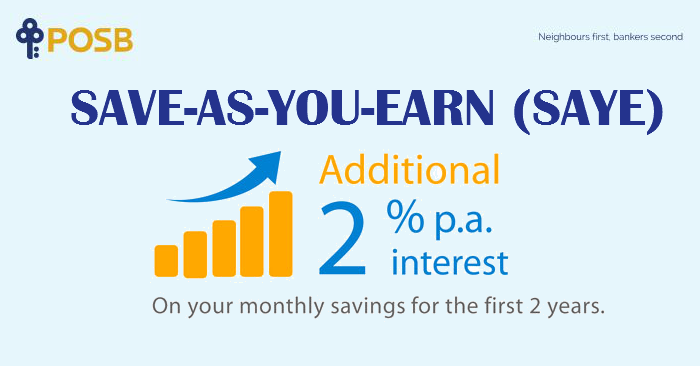
Programme from 1970s makes a comeback, providing a bonus interest rate of 2% p.a. on customers’ monthly savings 

In the latest media release, POSB announced today (3 Aug) that the iconic POSB Save-As-You-Earn (SAYE) programme will be reintroduced.

First launched in 1974, the programme was introduced to encourage Singaporeans to cultivate a habit of setting aside a portion of their salary as savings.

In June this year, POSB offered this programme exclusively to full-time national servicemen (NSFs) to recognise their contribution towards national building under the POSB “Save As You Serve” (SAYS) programme. This special scheme allows full-time national servicemen, or NSFs, to enjoy a bonus interest rate of 2 per cent per annum.

In the lead up to the nation’s 51st birthday, POSB, Singapore’s oldest and most loved bank, announced that they will expand the savings programme to include all Singapore customers, effectively bringing back the POSB SAYE.

To participate, customers simply need to have a DBS/POSB savings account where their monthly salary is credited to. They can then sign up for a POSB SAYE account where a stipulated amount (between SGD 50 to SGD 3,000) is transferred every month from their DBS/POSB salary-crediting account. The bank will then provide a bonus interest rate of 2% per annum on their monthly contributions in their POSB SAYE account. For more information or to sign up for an account, visit www.posb.com.sg/saye
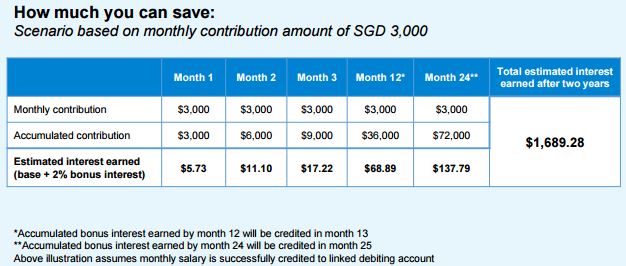
How much you can save

“It was really convenient for me because our salaries were credited into POSB as well so it was very natural to open POSB SAYE which auto-deducted from my salary every month. My pay was very low then so without the scheme, it would be very easy to spend everything when it comes in!” – Jasmine Yeo, 44, POSB customer

POSB is also marking National Day this year with the launch of the POSB Gallery at the National Library Building. The POSB Gallery showcases how POSB has grown with Singaporeans through the years since its founding in 1877. Featuring precious artefacts from the past, ranging from old POSB passbooks from colonial times to the iconic POSB Lucky Draw Drum used in the 1970s, the gallery tells how POSB mobilised an entire national savings movement and played a key role in the development of Singapore. The bank also hopes the gallery will inspire Singaporeans to share their own POSB memorabilia to add towards its collection, which will go towards a larger exhibition for its 140th anniversary next year. More information on the POSB Gallery and how to contribute POSB memorabilia is available at www.posb.com.sg/posbgallery.

Finally, to thank Singapore customers for their support and to celebrate everything Singaporean, POSB will waive PAssion membership fees for Singapore’s fastest-growing card – the PAssion POSB Debit Card – for five years. On National Day, POSB will also offer 5,000 1-for-1 tickets to selected local attractions, as its gift to the nation. Customers can sign up for this card via DBS/POSB iBanking or visit any DBS/POSB branch for instant issuance.

[fancygallery id=”5″ album=”113″]

Images: POSB Singapore

Read More...

Are You Spending Your Money Properly?

No matter how abundant or scarce your money is, spending it wisely shall be your top priority. It not only enables you to get the most out of your dollar but it also allows you to make life-changing decisions.

Determining the reasons behind your spending is the first step to knowing whether your money is allocated properly or not. Are you spending your money on the latest gadget by Samsung because you need it or because you want it?

There is usually a conflict in differentiating between needs and wants. Perhaps, the confusion is due to our subjective definitions of the two terms. Let us take Cheng Ling as an example.

Cheng Ling values the perceptions of others toward her and her daughter. Since her daughter is starting a new school year, she bought her two new pairs of shoes.

She argues that she does not want her daughter to feel embarrassed by wearing the same shoe she wore last school year. Although the last year’s pair is still in mint condition, she bought another pair of shoes to prevent repetitions.

Do you think Cheng Ling’s purchases are necessary in this scenario? Or, was it a matter of personal desire?

Examine your purchases in this manner along with these helpful queries:

“Will this purchase make my life easier and more efficient?”
“Will this purchase provide a lasting pleasure?”
“Will this purchase be meaningful to my life?”
“Is this something I will use regularly?”
“Is this something I can afford?”
“Is the potential gains from this item realistic?”

Carefully assess all these questions and the interplaying factors that can influence your decisions. If your response to all these questions is “YES” then, by all means, make the purchase!

Aside from distinguishing between your needs and wants, you must sort out your “essentials” first. When I say essentials, I pertain to the fixed expenses that you encounter every month. This includes your groceries, utility bills, and school fees. Plan your spending before you receive your paycheck.

Some people spend their hard-earned money like most lottery winners. They get a huge pile of cash now and spend it all in a snap! Remember that wealth is accumulated over time and not something that you can earn overnight.

Image Credits: pixabay.com

Image Credits: pixabay.com

At the end the day, it all boils down to the decisions you make!

Read More...

Details of 2016 GST Vouchers Benefits To Be Sent Out by 1 Jul 2016

GST Voucher Featured

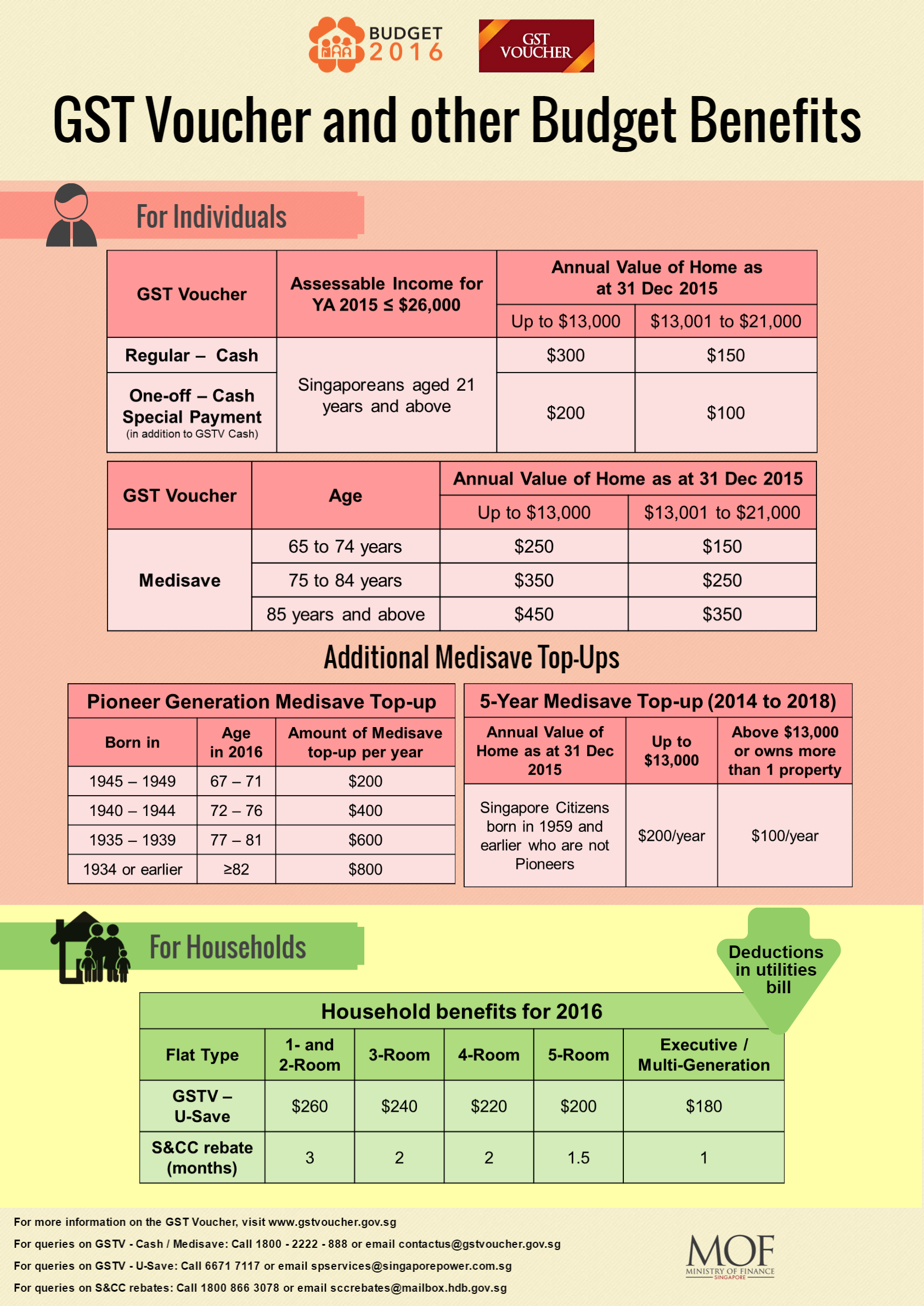
The Ministry of Finance has announced in a press release that 1.54 million Singaporeans will receive a letter by 1 July 2016 with details on the 2016 GST Voucher Benefits (GSTV) as well as information on other Budget benefits such as Service and Conservancy Charges (S&CC) rebates, U-Save and Medisave Top-ups.

1. GST Voucher – Cash Payment

About 1.3 million eligible Singaporeans will receive up to $300 in GSTV – Cash. In addition, as announced at Budget 2016, a one-off GSTV – Cash Special Payment of up to $200 will be provided to support households amid current economic conditions.

This means that eligible GSTV recipients will receive up to $500 in cash in 2016, which will be disbursed in two payments in August 2016 and November 2016.

2. Medisave Top-ups

About 425,000 Singaporeans aged 65 years and above will receive the GSTV – Medisave of up to $450 in August 2016. In addition, Singaporeans born on or before 31 December 1959 (57 years and above in 2016) and do not receive Pioneer Generation (PG) benefits will receive a Medisave top-up of up to $200 each year till 2018. The top-up for this year will also be made in August 2016.
In total:

  • A non-Pioneer aged 65 in 2016 and who is living in an HDB flat (and does not own a second property) can receive $450 of Medisave top-ups this year.

Pioneers would also be receiving their PG Medisave top-ups of $200 to $800 in July 2016. Taking both the PG Medisave and GSTV – Medisave together:

  • A Pioneer aged 70 in 2016 who is living in an HDB flat (and does not own a second property) will receive $450 of Medisave top-ups;
  • A Pioneer aged 85 in 2016 who is living in an HDB flat (and does not own a second property) will receive $1,250 of Medisave top-ups.

You can also refer to the infographic by MOF below:

GST Voucher and other Budgets MOF

More information on Assessable Income and Annual Value of Home:

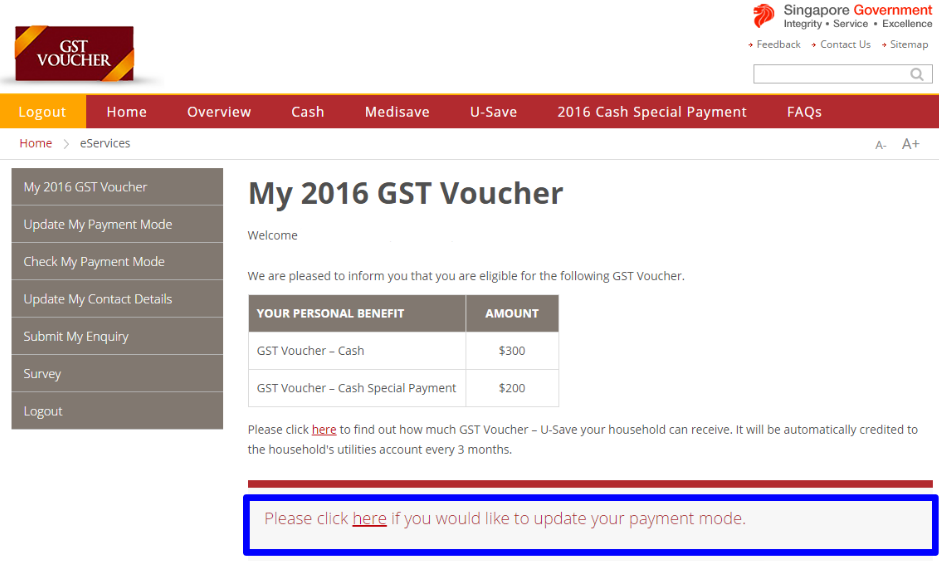
To find out how much you are eligible for, you can log on to https://www.gstvoucher.gov.sg with your SingPass.

You will then see something like this:

GST Voucher Eligibility

* Remember to update your payment mode.

Details on the GSTV can be found at www.gstvoucher.gov.sg, and information on the other Budget benefits can be found at www.singaporebudget.gov.sg. If you require more information, the contact details are as follows:

gstv

Read More...

Handling Money As An Introvert Versus An Extrovert

If you are classified as the shy or quiet one, you most likely belong to a special group of people who are known as the introverts. Contrary to the popular belief, introverts are drained by social interaction. Many introverts can socialize easily but they just prefer not to. In fact, they are more emphatic and interpersonally connected than their counterpart – extroverts.

Extroversion is a strong factor of personality that is difficult to alter. Generally, extroverts have an advantage in the professional scene due to their approachable and outgoing nature. They flow through life in search of interpersonal interactions, leadership opportunities, and new experiences.

You must use your unique introverted or extroverted qualities to your advantage to enhance your financial life. If you do not know which type you belong to, please take the free test here.

FOR INTROVERTS

Image Credits: pixabay.com

Image Credits: pixabay.com

a. INTROVERTS PROCEED WITH CAUTION

When it comes to money, introverts tend to be more cautious at risk-taking as they make sound investments and goal-directed savings. They secure their future by carefully avoiding scams and financial schemes.

b. INTROVERTS SHOP AROUND

As introverts are observers by nature, they collect information from various sources first before making a financial decision. To get the best deal, they also read through the fine print and consider its every aspect.

c. INTROVERTS ARE MORE CREATIVE AT EARNING

Introverts are more likely to strategically plan things and think of creative ideas before finally making a decision. Hence, they can think of more innovative ways to earn money and properly manage the money they already have.

d. INTROVERTS SPEND LESS ON SOCIAL GATHERINGS

Since introverts are less inclined to participate in social gatherings, social expenses are the least of their worries. Furthermore, they may not be easily swayed by what the crowd is doing (e.g., avoiding costly bandwagon trends).

FOR EXTROVERTS

Image Credits: pixabay.com

Image Credits: pixabay.com

a. EXTROVERTS MAKE QUICKER DECISIONS

Extroverts are willing to grab the opportunity faster once it knocks. In some cases, this quick judgment can be advantageous for one’s financial life but it can also be disastrous in other circumstances.

b. EXTROVERTS ARE MORE CREATIVE AT INVESTING

As extroverts are more likely to engage in networking, they are able to learn more about the different types of investments or the new investment strategies. Their fearless and confident attitude can be rewarded when the right investment choices are made.

c. EXTROVERTS TRY NEW THINGS

Introverts tend to stay back while extroverts embrace new experiences with open arms. Extroverts are able to earn and save more by taking risks on new perspectives, jobs, ideas, and products.

d. EXTROVERTS GET FAIR DEALS

When extroverts are in a negotiation or bargaining situation, they may be more aggressive about setting things straight. Introverts may want to avoid confrontation but extroverts will not back down until they feel that they received a fair deal. Getting the value of your money is not a  bad thing for your finances!

Sources: 1 & 2

Read More...

10 Incredibly Easy and Clever Ways To Save Money

1. MOVE TO A BANK WITH HIGHER INTEREST

If you are looking for a new bank to open a savings account with, choose a bank that has the most beneficial perks and the highest interest rates. Check out “2016’s Most Profitable Savings Accounts In Singapore” to get an idea.

2. USE COUPONS WHEN SHOPPING

Couponing is a strategy used by a shopper to pay less in shopping for groceries, tickets, and more. Get coupons for dining, leisure, toys, pets services, and just about anything at cuponation.com.sg or groupon.sg.

3. PLAN AHEAD

Aside from making a grocery list and sticking by it, it is good to trust your routines by having the previous receipt along when you shop. With that receipt, you can tell when something is on sale. That is when you must stock up.

4. CHOOSE YOUR FRIENDS

It is best to surround yourself with people who share the same financial values as you, especially those who are frugal by nature. Filter out toxic financial relationships and know the 6 Kinds Of Friends Who Can Positively Influence Your Finances.

5. STAY HEALTHY

Eliminate your consumption of snacks, chips, and sweets. These types of food are not only unhealthy but they are also costly. Who knew that making healthier choices can help you save more?

6. SELL YOUR COLLECTIBLES

If you had spent hundreds of dollars on collectible items, you can start selling them now and use those funds to reach your financial goals. Try selling your items to the worldwide marketplace platform of eBay and Gumtree.

7. CONSUME THE LEFTOVERS

Save the unconsumed food when you either ordered too much restaurant food or when you cooked excessively. Revamp the dish by topping fresh greens, juicy fruits or leftover slices of chicken.

8. UNPLUG REGULARLY

Even if you turn off the switches, your appliances and electronics will continue to consume energy and spike your tariff. So reduce your bills by unplug your cables and electronics when not in use.

9. REPAIR YOUR OWN CLOTHING

Instead of tossing your shirt because of the missing buttons, sew new buttons that perfectly match the old ones. Learning and mastering the basic sewing stitches can help you save money and extend the life of your favorite clothing.

10. USE FREE AND OPEN-SOURCE SOFTWARE

Stop paying hundreds or thousands of dollars on programs that can be obtained for free with the same level of performance, quality, and reliability. Use free and open-source software such as the packages on this list.

Image Credits: pixabay.com (CC0 Public Domain)

Image Credits: pixabay.com (CC0 Public Domain)

Sources: 1, 2, & 3

Read More...