One of the greatest English novelists, Charles Dickens, encapsulated the unpleasant prowess of procrastination. His advice was “to never do tomorrow what you can do today. Procrastination is the thief of time.” Procrastination feeds into your weakness by following immediate gratification.
You are aware that it affects some areas of your life such as being late for a meeting or missing the billing deadline. However, you might not realize that constantly avoiding responsibilities can cost you money. Start changing your ways! It may seem trivial now, but keeping your financial goals on hold will affect your long-term savings plan.
LEARN TO ACCEPT YOUR BOUNDS
“I do not feel like doing it right now!” “I will be more prepared tomorrow.”
How often have you used these excuses to put off the tasks that you can easily accomplish today? For some people, avoiding the difficult tasks by making excuses became a form of coping (i.e., an unhealthy response). It is time to face the music! You will never be fully ready to tackle your financial goals.
The best thing that you can do right now is to examine your financial situation. Identify the amount of cash that comes in and goes out. You may either download money tracker apps or seek the help of the professionals.
CONSIDER THE PRESENT TIME
A study from the University of Chicago found that participants were more likely to initiate action if they view that the task happens at the present. Apply this thought by determining what phase you are on.
Image Credits: pixabay.com
It is easier to track your tasks by making a simple “to-do list” that even includes the tasks you are avoiding to pursue. Then, write the deadlines together with every task. Even if the deadlines you set are sooner that necessary, it will help your cause.
BREAK IT DOWN INTO SMALL CHUNKS
One of the reasons why individuals put goals aside is its intimidating and overwhelming nature. Listing vague or huge goals can immediately discourage you. Breaking down your financial goals into action items is a good idea. Make these items realistic, manageable, and concrete.
Image Credits: pixabay.com
For instance, you aim to make S$2,000 by Christmas instead of saying that you envision having S$500,000 by retirement. Set up a reward system after you finish an action item.
Everyone experiences a certain degree of money woes. The differences depend on how we deal with each financial issue. On that note, here are just three of the most common ones that we may all face at some points in our lives.
#1: ADJUSTING TO THE POSTNATAL BUDGET
Congratulations to you and your spouse! You just added life to the thriving population of Singapore. The next challenges at hand are the costs that come with it. Raising children, as expensive as it is, causes multiple changes to your household budget. New categories include medical costs, newborn clothes, and insurance contributions.
The significant cost of delivering the baby (about S$10,000) is just the beginning! Tackle each day with ease by knowing how much you will be spending in the next couple of months. You need to repeatedly feed, clothe, and nurture your children for at least 21 years. Preparing a financial checklist will help you fulfill your expected costs.
Whether you want to believe it or not, there is a particular cohort that is at risk of earning insufficient salary. This is none other than the elderly working-class women. The 2014 Labour Force Survey highlighted that more than 7 in 10 participants (i.e., 100,000 Singaporean women aged 60 and above) made less than S$2,000 per month.
Lower earnings adversely affects one’s retirement adequacy as the country operates on the salary-based pension system. These seniors are still working because they need the money and they did not have enough money saved.
Image Credits: pixabay.com
There are two ways to deal with this financial situation. First, you may negotiate a pay raise. If you do not ask then you will not get it. Employers know that they play a part in ensuring that older workers return to the workforce with decent wages.
Secondly, you may get another job on the side. With our access to modern tools, you can make extra money by creating an online business. Free websites such as Carousell and Tictail enables you to showcase your products.
#3: RISING ABOVE UNEMPLOYMENT
Unemployment is a worldwide phenomenon. The economy continues to narrow down jobs at an alarming rate. This means that you need to get in line with about a hundred of job seekers for the same post. A good place to start making connections is LinkedIn (i.e., a professional networking site). Moreover, you may ask your family and friends if they can recommend you to work for their companies. Do not be shy!
Absorb the words of Nancy Collamer, creator of Layoffsurvivalguide.com.
“You need to figure out what it is that you want to do and are most qualified to do, then identify employers and companies where there appears to be some level of growth or opportunity and identify ways to network your way into the company.”
I believe it is safe to say that “Insurance” is an unfamiliar territory for most Singaporeans. For young adults who recently joined the workforce, it is a necessity that comes with the new responsibilities of adulthood. Weighing your insurance options is just the start!
You may have encountered policy terms such as premiums and deductibles. However, do you know what each term means? I shall focus on the former.
DEFINING INSURANCE PREMIUM
In its simplest form, an insurance premium is the amount that an individual or an institution must for upon signing on a policy. It represents a bind that the insurer must provide coverage for the claims made against the policy. More so, it is the income earned by the insurance company.
HOW INSURANCE PREMIUM IS CALCULATED
There are many interacting factors that affect the prices of the insurance premium. For starters, the price heavily depends on the type of insurance (e.g., Critical Illness policy or Car Insurance policy). Other factors include the area where the policyholder lives, the likelihood of claims being made, the behavior of the policyholder, and the amount of premium offered by the competition.
Let us take the Life Insurance policy as an example. Various factors affecting your specific premium include the:
a. policyholder’s age at present time,
b. scope of coverage that the policyholder buys,
c. length of the policy,
d. and the policyholder’s life and health expectancy.
WAYS TO ACCOMPLISH PAYMENT
Singaporeans were blessed with a number of options when it comes to paying for the insurance premiums. Some insurers require the policyholder to pay for the total amount before the coverage starts. While, others offer installments (e.g, semi-annual payments).
It is vital to highlight that you may encounter situations that entail the increase of insurance premium. Firstly, it may increase after the policy period ends. Secondly, it may increase if you made claims during the previous period. Lastly, it may increase if the risk associated to the type of insurance gets more pervasive.
Image Credits: pixabay.com
THE BOTTOM-LINE
In summary, the insurance premium is the amount of money charged by the insurer for an active coverage. The total amount depends on multiple factors including age and address. Individuals may pay premiums annually or in smaller amounts over a year. Also, this amount changes over time. The policy is usually voided when the insurance premiums are not paid.
The trading of currencies on the open market serves many practical purposes. It enables individuals to purchase local coinage when visiting a different country or region. It allows governments to regulate the supply of money within their own economies. It also provides an opportunity for traders to realise a profit, simply by speculating on the price movements of different currency pairs. Each of these contributes to the vast size and scale of trading activity that occurs within the foreign exchange market every single day.
How big is the forex market?
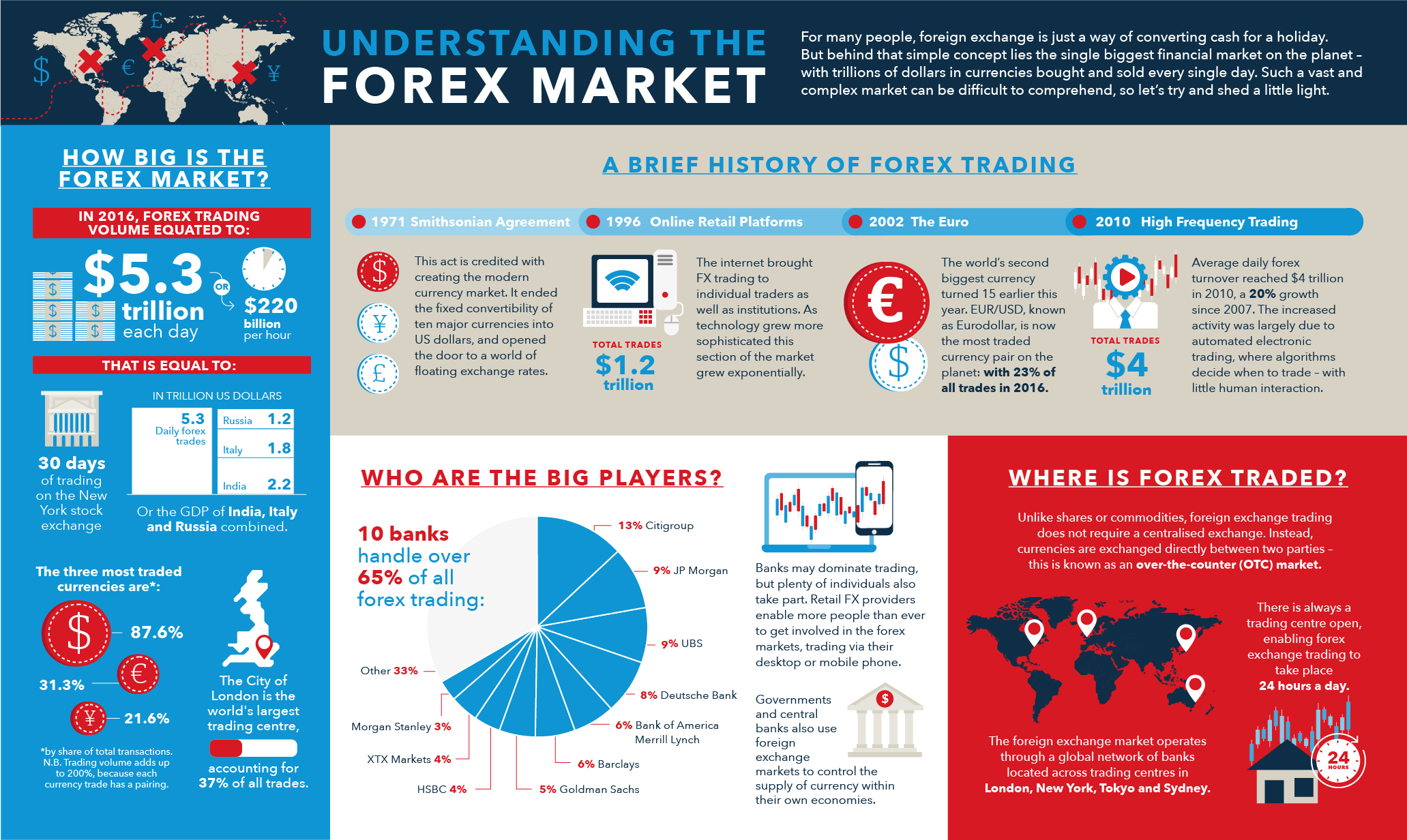
The FOReign EXchange (forex) market is is the single largest financial market on the planet, when measured in daily trading volumes. Each day, around $5.3 trillion worth of currency is bought and sold on the open market. That equates to more than $220 billion of trading activity every hour.
The volume of forex trading far exceeds that of the bond market or the stock exchange – and even the economies of entire nations.
The New York stock exchange, for example, would have to trade for 30 days to match the single-day trading volume of the currency market. The combined annual GDP of Russia, Italy, and India is approximately equal to one day’s forex trading.
A brief history of forex trading
The trading of one currency for another is an ancient phenomenon, but the modern forex market truly emerged in 1971, with the completion of the Smithsonian Agreement.
The agreement allowed the central banks of ten major economies to buy, sell and issue currency in a way that would allow their money to fluctuate in value by 2.25 per cent against the US dollar. The Smithsonian Agreement is widely accepted as the first step towards the free floating exchange rates that we recognise today.
The proliferation of web-based technologies in the 1990s proved another significant milestone in shaping today’s forex markets. Access to the internet gave private individuals the means to not only access markets, but also the educational resources that would help them to understand forex, and how to start trading. Since the end of the 1990s, the number of forex trades that are executed through an online platform has grown exponentially: accounting for as much as 23 per cent of all forex activity by 2016.
Digital trading platforms have also eased the transition to an era of automated trading: where algorithms are used to calculate and execute trades far quicker than any human could hope to achieve. The forex market grew 20 per cent between 2007 and 2010 – and much of this expansion has been attributed to the development of high frequency, algorithmic trading machines.
Who are the big players?
This rapid expansion of the forex market has caused some of the established currencies and institutions to lose a degree of significance in recent history. Yet the biggest players in the foreign currency trade remain some of the more familiar names in the world of finance – for the time being, at least.
The most commonly traded currencies by share of total transactions are the US dollar (which accounts for more than 87 per cent of all trades), the Euro (31 per cent), and the Japanese Yen (almost 22 per cent). Of these, EUR/USD is the most commonly traded currency pair, accounting for 23 per cent of all trades in 2016.
International banks dominate forex trading: the largest six banks account for half of all transactions; the top ten banks are responsible for more than 65 per cent of trades. Citigroup (13 per cent), JP Morgan, (9 per cent), UBS (9 per cent), and Deutsche Bank (8 per cent) are the four most active financial institutions in the forex market.
Where is forex traded?
Forex is a truly global marketplace. Four major trading centres – in London, New York, Tokyo and Sydney – provide access to the currency markets 24 hours a day. Of these, London sees the highest trading volume, accounting for 37 per cent of all currency trades.
However, while the City of London is responsible for a high percentage of daily total trades, it does not regulate or control the market in any way. In fact, the trade in foreign currency is not facilitated by any single authority or centralised exchange at all. Instead, traders can buy or sell currency pairs directly with other traders in the market. This form of direct exchange is known as an over-the-counter (OTC) market. OTC trading is considered one of the primary factors in the growth of forex: independent investors can access and participate in the market from any location, at any time of the day or night.
The foreign currency market has undergone dramatic change, and experienced rapid growth, throughout the past five decades. It has adapted its role to make use of new technologies: permitting free-floating currency valuations, and enabling private individuals to participate in markets without having to leave their homes.
Today, the forex market continues to evolve, and represents one of the most open and democratic trading opportunities on the planet. But the buying and selling of world currencies represents more than an investment: it is helping to make efficient world trade a reality.
There a lot of traders in forex industry who think that only they are smart and other traders do not know how to make money in an easy way. These smart traders do not like to work hard on developing their strategies and like the homemade strategies which are given for free on the websites of Forex. Though these websites swear all their strategies are best and you can make money with any of them, you will find that some of these strategies are not even strategies. They have only filled some space in their websites and trying to sell you whatever they can. Making and developing a strategy in Forex is not that easy. For an experienced trader, it takes years to make money and develop their strategies. To be precise nothing is ready made in the world of forex. Those who trade in Singapore knows very well that in order to make money they must educate themselves properly so that they can trade with precision.
So the question that arises in the minds of other traders who are reading this article is to how to develop my strategy? If the other strategies are wrong, is there any way I can develop my own strategy? This article contains the answers to your questions and as you read more, you will find many new things about Forex.
Build your strategy from scratch
If you are planning to develop your strategy, do not think you will take some strategy from many websites and you will try them all one by one. The strategy that gives you the most profit is your working strategy. You will no need to work on the market and you get yourself a developed strategy which works best.
If you want to be a professional trader in Forex, you have to build your strategy from the scratch. Have you ever seen a Michelin star restaurant how they prepare their own meal? From making pasta to preparing the spices, all the things are done by their chefs at the chicken. There is no chance for using any homemade spices which are not made by them. It is only for these reasons these restaurants can charge you thousands of dollars for having a one-course meal. If they bought all the spices and make homemade foods like other restaurants, they will not have earned those Michelin stars. Similarly, when it comes to trading you need to execute your trade in your online trading account with your own developed system. If you follow other people trading system then you will never be able to follow discipline. You need to find such a strategy which will suit your personality. And for this reason, the expert traders always suggest trading with a well-developed trading strategy based on the trader’s personality.
Facts about trading
Trading in Forex and becoming a legend player to live an exotic life will need you to make your strategy from the scratch. There is no website you should use to develop your strategy. Only take help when you do not understand. Use all your own things for making your own strategy for success. At your initial stage, you should use your demo trading account to build your own trading system. Instead of risking real money try with the virtual dollar so that you don’t face any financial loss. But in order to develop a winning system you need to educate yourself with the proper knowledge or else you will never be able to develop a solid trading system.
Summary: Building your won trading system is very hard especially if you are new to this industry. You need to use the demo account and trade with a reputed broker like Saxo. Make sure that you develop your trading system based on the major three types of analysis so that you can deal with the dynamic changes of the market.