Travelling To Bali? Don’t Forget Your Travel Insurance

Bali is known as the Island of The Gods. It exudes a unique cultural appeal, excites holiday-goers with its natural beaches and tantalizes foodies with its wide-range of culinary cuisines. It is little wonder that Bali is an extremely popular beach destination in South-East Asia. It would not be surprising if some of you have already booked a trip there for the upcoming summer holidays. Before departing for your holidays, don’t forget to purchase your travel insurance policy. Do ensure that your travel insurance policy contains “must-have” features such as medical expenses, emergency repatriation, trip cancellation/curtailment, baggage cover etc.

Travel insurance is important because it offers financial compensation during events such as travel disruptions. For instance, Moung Agung’s eruption in 2017 led to the closure of the airport for several days. As a result, additional hotel accommodation needs to be booked, flights rescheduled and some tourists even sought alternative modes of transportation. All these would add additional costs to your holiday budget. While travel inconveniences are entirely unpredictable, a travel insurance policy purchased in advance could partially offset some of these unforeseen expenses.

Many adventurous tourists visit Bali to try activities such as hand-gliding, para-gliding, diving etc.  With its picturesque scenery, Bali boasts many adrenaline-filled activities for the sports junkies. You might want to consider getting travel insurance coverage before attempting these leisure activities. For instance, AXA’s SmartTraveller provides coverage for leisure activities such as parachuting, sky diving, bungee jumping etc. Having a travel insurance policy before attempting these leisure activities could provide an additional level of assurance.

Before embarking on your long-awaited getaway to Bali, it is therefore critical to be well-informed of the best travel insurance policies available in the market. You can compare travel insurance policies on SingSaver and directly purchase one that best suits your holiday needs. Comparing on SingSaver is not only convenient; it also helps you save money on your travel insurance policies!

Update: SingSaver is having a flash sale on 19 – 20 May 2018 on selected insurance products, including AXA, where the first 10 successful applicants in each hour (10am, 4pm, 10pm) get their travel insurance for free! For more details, click here.


 

Read More...

Where Did All Your Money Go?

“Where did all my money go?”, a friend of mine shouted in an open space.

Let us face it! People usually do not realize how much they are spending. You may not have a lavish lifestyle but, you seem to run out of money. Why is this so?

If you want to uncover the answer, tracking your spending comes in handy! Reach clarity by understanding how you manage your money. This step will help you to fully take control of your finances.

DETERMINE YOUR SPENDING HABITS

With the complexities of finances, where do you begin? Consider starting with identifying your spending habits. Do you pay to get your hair professionally dyed or do you dye it at home? Do you buy coffee from Starbucks or take advantage of the free-flowing coffee? Shed a light to your daily expenses and match these with your financial goals.

When you have identified a mismatch between your spending habits and financial goals, you can immediately plan the necessary alterations. Tracking your spending is essential to making better financial choices.

CATEGORIZE YOUR EXPENSES

Looking at your spending habits under a microscope entails that you have the ability to categorize each one. Complete your task by writing your expenses on a notebook or a ledger. Much like us, these expenses exist in a variety of ways. Some expenses are exclusively for students, while others are exclusively for working adults.

Image Credits: pixabay.com

Begin tracking your expenses by dividing a piece of paper into several columns. Assign an expense category on top of each column and highlight the allotted amount for it. For instance, the “entertainment” expense category can only consume S$100 of your monthly income.

TAKE SMALL STEPS

It goes without saying that you cannot force things. Forcing someone to love you reeks of desperation and displays no self-respect. Attraction comes naturally. Same with your finances. Taking control of your finances must not be a forceful act. Forcing success may lead to shutting down opportunities that you could have had. Try taking small steps first.

After categorizing each expense, commit yourself to recording your daily spending. Awareness of your daily spending helps you to keep track of how much you have left on each category. Simply deduct the amount that you spent today from the category’s “allotted budget”. A savvy shopper equips himself or herself with these information.

DOWNLOAD AN APP

Embrace modern technology by downloading an app or a software to keep track of your expenses. I, for one, use the free Spendee app. This user-friendly finance app allows me to categorize my expenses and to illustrate the entirety through graphs or charts. Entering a budget is as simple as pie!

Image Credits: pixabay.com

Some apps or programs allow you to sync your device to the computer. This way, your partner can examine your spending habits too. As a team, you may prevent overspending and stay within your bounds.

Source: The Balance

Read More...

Essential Tips On Finding The Right Loan For Your Needs

You have a stable job right now, but since you’re thinking of embarking on a new business soon, you’ll need to acquire a loan. You need the money to purchase your supplies, to hire people and to market your business’ existence. And while you’re certain that you need a loan for this endeavour, you still don’t know how to actually to find the right loan for your needs. In your mind, you think this decision is crucial because the success of your business relies on it – and you’re right. To help you out with your dilemma, consider the essential tips below to find the right loan for you:

  1. How much do you really need?

Just because a lender offers you a loan worth thousands of dollars, doesn’t mean you should take it immediately. Keep in mind that the bigger amount you borrow, the bigger your payments will be – and this can become an issue if your business isn’t as successful as you’d like it to be. On the other side of the coin, if your loan is too small, it might not help you in any way, and you’ll end up paying for high-interest rates. To avoid being placed in this kind of situation, carefully think how much you need for your business and look for a lender which can give you that amount.

  1. What is the interest rates?

Aside from the loan amount itself, you should also consider the interest rates associated with it. Is the lender offering you the amount you need but has very high-interest rates? Are there any lenders in the market who can give you a lesser interest rate? Think about these things first before choosing a loan. It’s also essential to ask the lender if there are any other fees or penalties to be paid after you received the loan. All of the processes involved in the loan should be transparent to you to avoid problems in the future.

  1. What’s the term?

Different loans have different terms. Some loans can be paid for six months while others, in ten years. Since you’re still starting a business, it might be best to settle for a loan which will require you to repay within an extended period of time. This will allow you to save up for the interest rates and the loan, without putting your business’ operations at risk.

Aside from the things you’ve read from this article, it’ll also help if you can actually work with experts when it comes to finding the right loan for your needs. Places like oinkmoney.com may be a good starting point.

Be A Responsible Borrower

Finding the right loan for your needs is never easy. There are several things to think about to come up with the best possible decision. You also have to keep in mind that your responsibility as a borrower doesn’t end the moment you receive the money – you should pour in your time and effort in order to pay all of these in time. If not, your life may be affected negatively. Remember all the things presented in this article, and for sure, you’ll come up with a decision on which loan to get without compromising your financial health in the long run.

Sarah Porter

Sarah Porter is a money-savvy writer and mum of two based in Manchester, UK. She is the Brand and Marketing Manager at the UK loan website Oink Money (oinkmoney.com), as well as the founder of a well known money-saving website. Sarah is originally from Edinburgh where she studied Business and later worked in finance for a FTSE 100 company. She left her career in finance to pursue her passion for writing, a move which allowed her to travel the world with her laptop while running her blog.

Read More...

Easy Investing into Property backed Secured Crowdfunding

For the newbies, debt crowdfunding is a concept where borrowers (usually SMEs) approach a crowdfunding platform for loans funded by a pool of investors. Investors earn interest, paid by borrowers, as returns on their investment. Investments are open to individuals as well as corporates with a minimum amount going down as low as $50 for smaller loan amounts.

Funding Societies, licensed and leading crowdfunding platform in Southeast Asia, backed by SoftBank Ventures Korea and Sequoia Capital, has recently introduced Property backed Secured Loans to its pool of more than 50,000 investors, providing them with more diversification opportunities. This is the third product Funding Societies has introduced since Business Term Loans and Invoice Financing.

What are Property backed Secured Loans?

Property backed Secured Loans are loans taken by companies who have pledged a local property as a form of collateral against the loan. These are local properties owned by the companies and/or Directors of the companies, and can be Residential, Commercial or Industrial. The loan amount is capped at 70% of the property value determined by independent valuers.

As an investor, you can start investing from $1,000 in this secured crowdfunding product

Why should you be excited about this product?

It is secured by property as a collateral: Funding Societies (FS) takes the first charge on the property, i.e. In the event that the property needs to be liquidated to repay the loan, FS will have the first right to access the cash after it is auctioned. Given the 70% Loan to Property Value (LTV), there is enough buffer against fluctuations in market prices that result in properties being devalued.

It’s a short-term investment: The loans are typically up to 12 months’ tenor

Fair returns for a lower-risk product: You can get up to 8% p.a. returns in your investment

Additional Diversification:Existing crowdfunding investors now have a secured loan product to further diversify their portfolios. New investors who have not invested in crowdfunding can take this opportunity to start investing.

What happens if a borrower misses out on repayments

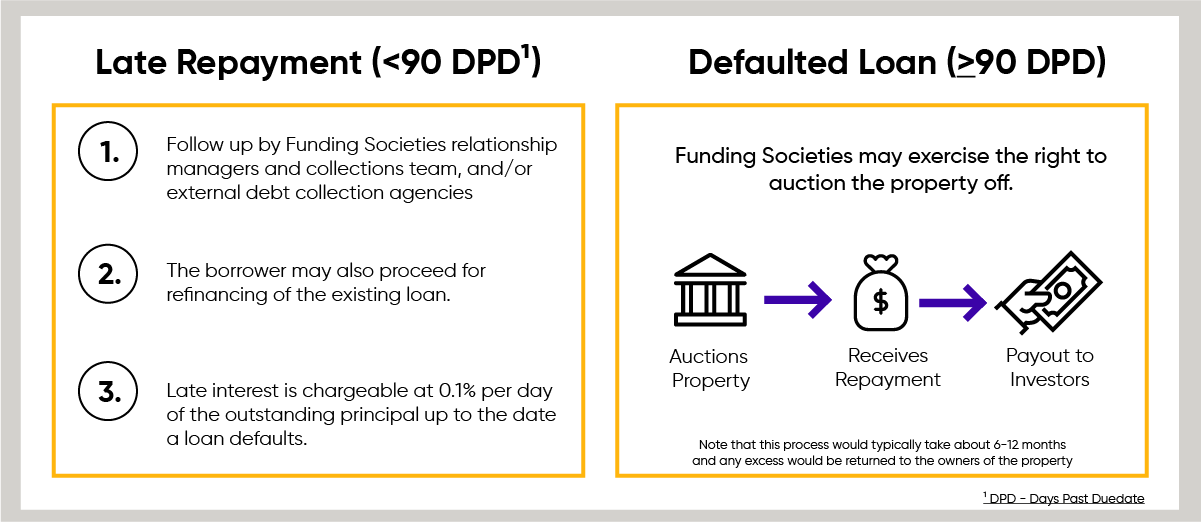
In the case of repayment by borrowers, FS will liaise with borrowers on behalf of investors for collections. If the loan reaches defaults (defined as 90 days past payment due date), Funding Societies will pursue legally to auction the collateralized property. Proceeds from the auction will be used to repay the investors and any excess will be returned to the owners of the property.

In the rare scenario where proceeds from the auction are insufficient to repay the loan, Personal Guarantors (usually Directors of the company) and the borrowing company will be liable for the outstanding due.

TL;DR (Too Long; Didn’t Read)

Given that there is collateral security in the form of a property, Property backed Secured Loans become more secured and typically lower risk compared to other crowdfunding investment products.

For those with a lower risk appetite but still want to potentially earn a return of up to 8%, the Property backed Secured Loans is a product for you to diversify your portfolio in.

Limited Time Promotion: Receive $20 Cashback!

From now till 15 June 2018, sign up as an investor and invest at least $1,000 to be eligible for the $20 cashback. That’s an upfront 2% cashback on your investment!

Here’s how to claim the cashback:

Step 1: Sign up for your new investor account on www.fundingsocieties.com.

Step 2: **IMPORTANT!** Enter MDMAY in the Promo Code section.

Step 3: Complete your registration and activate your account.

Step 4: Invest at least $1,000 before 15 June 2018. Investment can be in one loan or across multiple loans.

Eligible investors will be notified via email of their within one month from the end of the promotion.

This article was first published on Funding Societies’ blog.

Disclaimers:

This article is contributed by Funding Societies.

It should not be construed that Moneydigest is endorsing this article or any of the products and services provided by Funding Societies.

Nothing in this article should be construed as constitute or form a recommendation, financial advice, or an offer, invitation or solicitation from Funding Societies to buy or subscribe for any securities and/or investment products. The content and materials made available are for informational purposes only and should not be relied on without obtaining the necessary independent financial or other advice in connection therewith before making an investment or other decision as may be appropriate.

Read More...

4 Money Attitudes That Can Cost You

Our attitudes toward money affects our financial circumstance. I am not saying that your mere fondness over money will lead you to earning more. Your money attitudes dive beyond your wants. Money attitudes influence how you approach a situation and make your financial decisions.

On that note, here are 4 money attitudes that can potentially cost you:

#1: I HAVE POOR MONEY MANAGEMENT SKILLS

As a finance columnist, I noticed how people differ in handling money. Others write down every little detail of their spending. While, some people believe that they are not good with handling money. This negative attitude towards money shuns opportunities to learn about money management.

Educating yourself about the dynamics of money is important. Your eagerness to wide your knowledge will fuel improvements. Start by reading books and articles on Personal Finance.

Replace Your Negative Attitude With: “I have the ability to learn more about money management.”

#2: MY SELF-WORTH DEPENDS ON MY NET WORTH

It goes without saying that our fast-paced society welcomes symbols of status. When a woman shuffles between different designer bags in the workplace, spectators perceive her as someone with sophistication and wealth. When a woman carries “lesser known” bags, she is seen as someone who is less wealthy.

Why is this skewed ideal so prevalent in our society? Perhaps, modern technology has something to do with it. Nonetheless, this tendency to match self-worth with net worth can potentially harm one’s mental health.

Replace Your Unhealthy Attitude With: “My self-worth depends on the acceptance and understanding of myself.”

Image Credits: unsplash.com

#3: MONEY IS SOLELY FOR SPENDING

Believing that money’s sole purpose is for disposal can lead to mindless spending or debt! Spending your hard-earned cash on lavish or delightful things every once in a while is acceptable. However, you must not overdo it! Make room for savings and investments.

In order to create financial abundance, you must save and allocate your money efficiently. Spending beyond your means will never lead to financial abundance!

Replace Your Exaggerated Attitude With: “The money that I do not spend increases my wealth.”

#4: THE RICH GET RICHER

“The rich get richer and the poor get poorer” is an aphorism that highlights our economic inequality. Let us be honest! Some people are not born with a silver spoon. But, they can do something about it!

Boxing yourself to a certain economic stature limits what you can achieve. You have a choice to take control of your life. You can improve your financial situation as long as you do not give up.

Replace Your Magnified Attitude With: “My financial present and future is entirely up to me.”

Sources: 1 & 2

Read More...