How to start the year by saving

Saving

Although money can seem occasionally to be easy in Singapore, many people are still concerned with saving their wealth for later. The simplest way of earning money is still saving money – this principle will also hold for 2015. No matter what position on the social ladder one is sitting on – savings and earnings are going hand in hand. The international stock market appears currently to be in a better condition than many experts had expected a few years back. Global indices are rising and markets seem stimulated, but they are hungry for more. There are, however, continuously increasing expenses, such as the recently raised credit card interest rates in Singapore. In order to stay financially on track and pay off debts on time, one should start into the New Year with certain saving strategies. When wanting to save money, one should be aware of the fact that mere saving is not effective enough. The combination of saving and investing will not only earn and save money, but also protect its value.

As the credit card interest rates in Singapore have been raised quietly in the end of last year, the hard-earning citizens have to find new ways not to loose more money. Paying the minimum rate of your credit card bill every month, will leave you in the long run with more debt than before. Even paying more than the bare minimum will not do the trick. If the full payment is not made, the interest rates will every month calculate a new and higher debt, due to the interest rate of the month before. This accumulated interest rate can let your debt rise quickly higher than initially planned, if one is only paying the minimum rate or slightly more. The debt will grow proportionately until the full amount is paid back. As the credit card interest rates have been raised about 1%, the debt is even bigger now. Therefore, it is important to pay off the credit card bill in the end of every month. In case there is no other option than stretching the credit card, one should consider a 0% interest instalment payment plan in order to save money. The credit card interest rate can be very tricky and quickly become a vicious circle that is getting increasingly harder to break out of.

Another option for saving money in 2015 is a saving account. An extra amount on the bank account can easily become a save investment. Let the money work for itself. Many experts presume that the saving account interest rates in Singapore will go up. Some banks already have some interesting offers. OCBC has a 2.35% Bonus & Saving Account offer that not only saves your money, but also makes you some more. If one has S$10000 or even more than that, one could potentially get a high and profitable interest rate for the OCBC savings account. The interest rate will go up if no monthly or quarterly withdrawals are made. The very basic rate is only 0.05%, which isn’t much at all and frankly won’t do much to your savings. However, without monthly and quarterly withdrawals, but with additionally added funds of S$10000, one can get a rate of 2.35%. But there are also other banks offering interesting rates. One other example is the 2.08% DBS Multiplier Programme. Extra amounts of Singaporean dollars that won’t be needed throughout the year, should be therefore stored on a savings account. One should watch out for changing rates throughout the year and check with one’s bank for specifics.

One should check its options though. Purely saving without investing might not do the trick. Many Singaporeans are however very interested in long-term saving programmes, such as emergency funds. If one was to save S$10000 in a year, one does have a substantial sum. However, this amount of money will surely not be the same in a decade. The inevitable inflation will decrease the value of the S$10000 eventually. Saving accounts should therefore not be the only long-term option for one’s money. Saving account can be an ideal way to save large and momentarily unneeded amounts of money. Storing money on a savings account is, however, only advisable and beneficial, if that particular amount of money will remain for a long time on the saving account. If there is a chance that one might need the money throughout the year for some reason or another, the savings account isn’t the proper place to store it. Frequent monthly or quarterly withdrawals will reduce your interest rate drastically. Furthermore, in order to protect you money from losing its value due to inflation, one should be investing as well. The combination of investing and saving is ideal.

Another trick to start 2015 by saving some money is connected to one’s car insurance. Firstly, it is advisable to check the individual policies of the car insurance. Often there are unnecessary policies that one can get rid of. Checking the car insurance’s polices one might discover that one is already covered for the same event twice.  Reducing the policies to the bare minimum can help to save a lot of money. Furthermore, there are more tricks to save money with the car insurance. Increasing the deductible of your car insurance will course the premium rate of the insurance to go down. This saved money can be immediately put into a saving account and eventually used for another purchase. When wanting to buy a new car, one could start getting the money for it together a year or more before the actual purchase. Reducing one’s car insurance through different means will save money that can already finance the new car. When having finalised the purchase, one should immediately double check the insurance and eliminate all unnecessary policies. This way one can save straight from the start.

Starting the New Year by saving money isn’t the most difficult and unrealistic venture to do, but it is the combination of saving and investing that it actually makes it profitable and valuable for the individual. A saving account can be lucrative, but only if it is used properly. Therefore, one should be sure to invest and save at the same time.


Read More...

How Much Life Insurance Cover Do I Need?

Life Insurance

Life insurance is an important tool for an individual’s financial plan. Because you don’t have a crystal ball to predict what will happen to you tomorrow and the day after, you need to transfer this risk to a life insurance company – by paying a premium.

Fortunately, you don’t need any divination to find out how much life insurance cover you need. Since this article is penned in the year 2015, i have reasons to believe you belong to the Gen Y’s population and is knowledgeable enough to work out your own insurance needs by following the steps below. That is also the reason why very soon you will be able to purchase life insurance cover directly from the company without the need of financial planners. (If you belong to the Gen X’s, i don’t see why you need any life insurance besides your Medishield or Medishield Life)

Working out how much you need is no rocket science. It’s as easy as sitting down with a calculator on your hand and asking yourself a few questions.

1. Do i have any dependants?

This should be the first question you ask when you buy life insurance.  You want to provide for your loved ones should something untoward happen to you.

Let’s assume Michael has a wife and a 3 years old son that he need to take care of. He is also providing allowance to his aged parents who have retired and not working.

2. How much do they need?

Finding out how much your dependants need is important to determine how much life insurance cover you should be looking at.

Now Michael contributes $2,000 a month to household expenses which include paying for the bills, foods, daily necessities and children expenses. His wife is also working and contribute the other half of the household expenses amounting to $2,000 a month.

If something unfortunate happens to Michael tomorrow, his wife would have to shoulder the responsibility of paying for Michael’s share and may not have enough to cover a monthly household expenses of $4,000 a month.

So Michael wants to protect his share of liability.

He needs to provide for 20 years of household expenses until his son graduates from university and starts working.

He will need to cover himself sufficiently such that the large sum of money paid out can be invested to generate a passive income of $24,000 a year. Let’s assume a modest 4% rate of return, Michael simply divide $24,000 over 4% to work out $600,000. That is the cover he needs to provide a passive income of $24,000 a year for his family.

Once they no longer need this passive income, the bulk of this money could be used to purchase a home for Michael’s son.

3. What about mortgage, other loans or even children’s tertiary education?

For mortgage you would have taken up a mortgage decreasing term assurance to take care of that.

if you look into loans and children tertiary education, you could have factor those into your monthly expenses. That is also to say i am assuming you would have set away a portion of your monthly salary into a portfolio that gives at least 8% of growth to your children education fund.

4. Does that means i don’t need any insurance cover if i have no dependent?

You would hope so. But you might want to look into replacing your income should you become disabled or get critically ill. That is when you should consider getting yourself covered for total permanent and disability until the age you retire.

As for critical illness, a simple rule of a thumb is to cover for 5 years of your income because of the prognosis of cancer (or the survival rate of cancer, being the most common critical illness in Singapore) You can basically go without income for 5 years since you will be focused on recuperating and going for chemotherapy and other cancer treatments.

For hospital cover, don’t forget you have your Medishield or Medishield Life to take care of them.

What’s next?

We should be expecting a web aggregator to be rolled out in the first quarter of 2015. Now that you know how much you need to get yourself covered, most consumers can actually skipped the middleman to pay a lower premium and make use of web aggregator to find the most suitable product at the most affordable price.


Read More...

How a Singaporean Grew $112K to $1 Million in 7 Years

How a Singaporean grew $112K to $1million in 7 years

Eighteen years ago, Lady (not her real name) entered the workforce like many fresh graduates and earns a humble salary of $2,200 per month.

A sole breadwinner of a family of 4, she need to desperately figure out how to survive and get by should a day she loses her job without sufficient savings.

In 2005, during her career transition, she came across her Central Depository statements and noticed that some of the stocks she bought during the early years has yielded some dividends. That was when it struck her that she could actually work towards generating passive income through dividends.

Back then, she did not have any background knowledge in finance and investment but her determination of working towards her goal of financial freedom has spurred her to learn investing by herself.

Like many young investors, she spent her free time reading investment books, finance blogs, watches CNBC and analyse companies on SGX’s website. Her curiosity has allowed her to equip herself with valuable knowledge in investing which is still relevant today.

In 2012, she made her first million dollar and an annual dividend income of $41K.

Q. Are you a spender or saver?

I am a saver although i have a soft spot for travel

Q. You have grew your portfolio to a million dollar from 2005 to 2012. That’s an incredible feat considering that the collapse of the Lehman Brothers happened in 2008 and the Eurozone crisis in 2009. How do you overcome your loss in 2008 and still hit your million dollar goal?

I didn’t see 2008/2009 as a crisis or a loss although some of my counters were in red. In fact, i felt just like my girlfriends during the Great Singapore Sale, but in this case, instead of buying bags, shoes and clothes, i was buying stocks.

Q. You have not looked back since then and continue growing your portfolio and passive income. Did you suffer any setbacks during this period besides the financial crisis?

I have been fortunate. I did not suffer any major setbacks so far. Although i wished i hadn’t sold away Allergen and Citibank too early.

Q. What’s your best and worst investment? And how’s your current portfolio looks like?

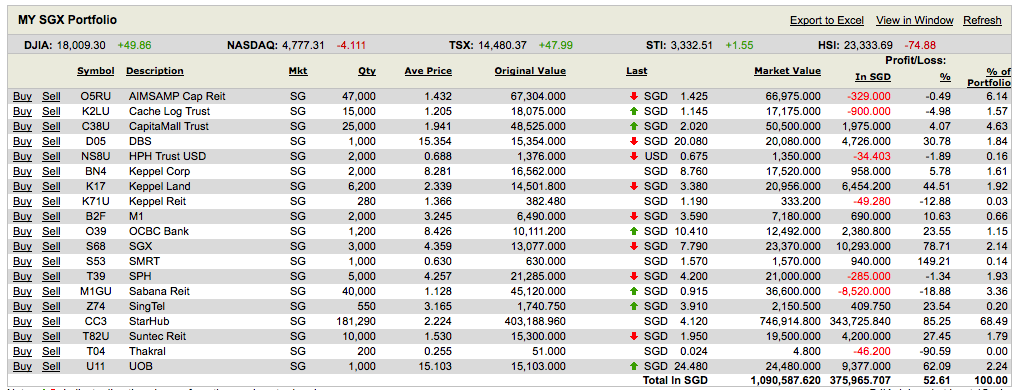
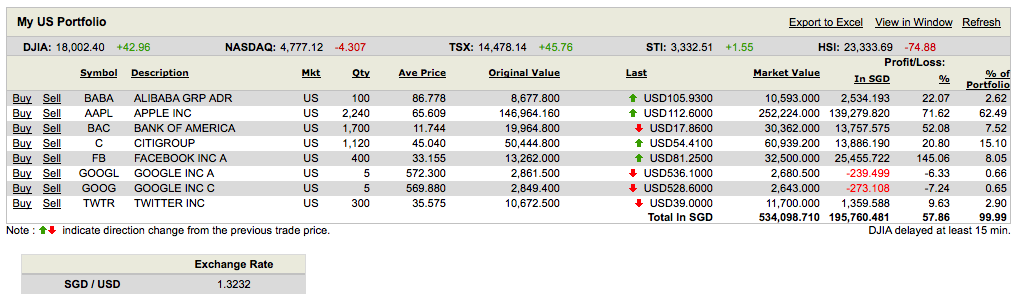
My best investment is Apple (+71%), Facebook (+145%) and Starhub (+85%). Both Apple and Starhub are giving me good returns on dividends yearly. My worst investment of late is Sabana Reit. I share an update of my portfolio every month. You can check out my latest portfolio here: http://ladyyoucanbefree.com/2014/12/23/my-stock-report-card-for-dec-2014/

Q. Are you currently employed or have you retired? If you have retired, what is your current passive income/dividend?

I am currently employed. My current passive income is $59.072.58.

Q. Does your spending habits change as your portfolio grows? Do you spend more than your passive income and how do you manage your personal finance?

I do not spend more than my passive income. I am still learning to improve my spending habits and I learnt that little indulgence do add up a lot. (For example, my indulgence in my favourite iced milk tea) As i said earlier, i also have a soft spot for travel.

Check out my spending habits here: http://ladyyoucanbefree.com/2013/11/30/retirement-planning-project/

Q. What financial planning have you done for yourself? And what’s your retirement plan?

I have just bought myself a retirement home, medical insurance for myself and my family. Moving forward, i will be continuing my journey in accumulating and exploring passive incomes that allows me the freedom to chase after things that i am passionate about and to checkoff my bucket list at http://ladyyoucanbefree.com/2014/05/31/bucket-list/


Q. What is your advice to young adults who have just started embarking on their career journey?

Love what you do and money will follow. Stay Hungry, Stay Foolish. Check out Steve Job’s Stanford Commencement Speech and be inspired!

Q. What about advice to other investors? 

I don’t think i am qualified to provide advice to other investors. I would love for them to drop by my blog at http://www.ladyyoucanbefree.com and share notes with me. Let’s learn from one another.


* Lady’s portfolio has now grow to more than $1.6 million and her passive dividend income currently stands at $59,072.58. She is currently aiming for a passive income of $65K.

This is how her December’s portfolio looks like:

Lady Portfolio Dec-14

(Source: ladyyoucanbefree.com)

Lady USD Portfolio

(Source: ladyyoucanbefree.com)

To get updates on her future portfolio, please visit her website at http://ladyyoucanbefree.com

* Edited to include US’s portfolio that was left out


Read More...

How Much Will It Cost To Live in USA, Singapore, Australia or Italy?

Cost of living is the total expense of maintaining a standard of living in a certain country. This changes over time and is often operationalized in a cost of living index.

In this chart is the comparison of the cost of living of four countries namely: United States of America, Australia, Singapore, and Italy.


Clothing And Shoes Ave. (in SGD) USA SG AUS ITALY
1 Pair of Jeans (Levis) 54.95 111.92 111.35 129.67
1 Summer Dress in a Chain Store (Zara, H&M, F21, etc.) 47.82 63.24 76.26 53.99
1 Pair of Men Leather Shoes 113.77 136.22 147.41 166.62
Total Clothing: 216.54 311.38 335.02 350.28
Rent Per Month Ave. (in SGD)
Apartment (1 bedroom) in City Centre 1,359.20 3,312.03 1,944.27 928.25
Apartment (1 bedroom) Outside of Centre 1,032.05 2,133.33 1,380.82 709.08
Apartment (3 bedrooms) in City Centre 2,313.77 5,955.30 3,335.58 1,634.16
Apartment (3 bedrooms) Outside of Centre 1,743.47 3,579.49 2,186.44 1,192.56
Total Rent: 6,448.49 14,980.15 8,847.11 4464.05
Ave. Salary After Tax (in SGD)
Monthly Salary 4,103.69 3,875.20 4,732.34 2,439.03


All the data were collated from Numbeo. It is a website that stores the world’s largest database of user contributed information about global living conditions.

Before discussing the variables in the chart, let us first explore a brief introduction of these four countries. United States of America, commonly referred to as U.S., is a federal republic country that is consists of 50 states. According to the International Monetary Fund, U.S. has the world’s largest national economy. It is considered as a developed country.

Australia, or Commonwealth of Australia, consists of the mainland and numerous smaller islands. In 2012, International Monetary Fund ranked Australia as the fifth highest per capita income among the world. It is also considered as a developed country.

Singapore, officially known as Republic of Singapore, is an island country in Southeast Asia. Despite its size, Singapore had the third highest per capita income around the world. It boasts its high regard on education, healthcare, and economic competitiveness.

Lastly, Italy is a parliamentary republic in Southern Europe. Human Development Report highlighted that Italy is a very developed country with its economy being the eighth largest in the world.

In the comparative chart above, Italy was shown to have the highest cost in Clothing and Shoes. Most of the famous chain brands originated from the U.S., which is why the country had the least cost on clothing and shoes. Furthermore, it is the reason why some items are cheaper when you buy it on its online store.

The Average Rent per Month is overwhelmingly dominated by Singapore. Renting a bedroom apartment at the city center will cost you about S$3,312.03 in Singapore. With that amount, a person can already rent two 3-bedroom apartments in Italy’s city center. The higher cost of rent in Singapore is due to the 718.3 km2 total area of land wherein millions of people reside.

Image Credits: Lina Hughes via Flickr

Image Credits: Lina Hughes via Flickr

Lastly, in most of the factors, Australia sits strong on the second place. Although rent and clothing may be costly in Australia, the average salary per month is S$4,732.34. It is the highest among the other four countries.

So, if you are moving to a different country and curious about its cost of living, look it up on Numbeo. It has been mentioned in internationally renowned newspapers and magazines such as BBC, Forbes, The Economist, and New York Times among others.

Sources: International Monetary Fund, Numbeo, and Wikipedia

Read More...

5 Ways to Teach Kids About Saving Money

Money gives people, of all ages, the decision-making opportunities they need. Educating your kids to make wise money decisions earlier on will affect their finances in the long run.

The most important thing you must do is to make saving money as fun as can be. Here are 5 Ways to Teach Kids About Saving Money…

1. MONEY INTRODUCTION

Once your children can count and discriminate, introduce them to the different denominations of money. Take a conscious effort in providing them information about money and savings and be ready in answering their countless questions.

Watch this cool way to introduce money and its values:

2. SET UP BUYING GOALS

Setting up realistic goals is the foundation to learning about the value of money and saving. Ask your children what they want to buy with their money. For instance, the toys, video games, and stationery items are the things they shall save money for. These goals will help the children learn to become more responsible.

3. USE A PIGGY BANK OR A MONEY JAR

After identifying the short-term goal, provide your child with a small piggy bank or a money jar where they can fill up their savings with. Have your child draw the picture of the specific toy on the side of the piggy bank or the money jar. Through this, they will be motivated to get what they want.

You may also want to help your child understand that some items will take longer than others to save for. For these long-term goals (e.g., going to Universal Studios), provide them with a bigger money jar.

4. ENCOURAGE SAVING

Be the good example to your children by putting some of your coins into their money jar. Since most young children want to be like their parents, seeing you do it will provide them with inspiration to save.

Aside from this, you may give them money in denominations that encourage saving. For example, give your children a $6 allowance that consists of three 2 dollar bills. Tell them to set aside $2 for their money jar.

5. PLAY GAMES INVOLVING MONEY

Image Credits: Rich Brooks via Flickr

Image Credits: Rich Brooks via Flickr

As I said, the most important thing you must do is to make saving money as enjoyable as can be. Play games that teach children about financial concepts. Such games include Monopoly and The Game of Life. They will not only have fun but it will also shape their money management skills.

Sources: Money Crashers and Family Education

Read More...