Financial Tips For Quiet And Reserved People

Whether you are known to be the quiet or reserved one, you most likely belong to a special group of people who are known as the INTROVERTS.

A common misconception of introverts is that the dislike socializing. Contrary to the popular belief, introverts are drained by social interaction. Many introverts can socialize easily…they just prefer not to.

In fact, you can be more interpersonally connected and emphatic than others. Use these and your other magnificent qualities to your advantage as you enhance your financial life.

To get started, here are some things you can do:

1. ACTIVELY LISTEN

Introverts, in general, tend to be great at listening. This skill can make you a good investor. Before investing your wealth, you must actively listen to what others have done or will do. Analyze the results of their strategies and actions. Then, make your own strategy based on the successful predecessors.

2. STUDY WHAT YOUR ARE SELLING THOROUGHLY

In order to increase your profits in sales, you must know what you are selling in a deeper level. Study your products and services thoroughly so that you can efficiently aid in the client’s needs. And if someone new approaches you, determine if he or she is a potentially good client. As an introvert you understand that it takes more than a wallet to make the sales flowing.

3. REMAIN CALM

Aside from being great at listening, introverts are usually among the calmest people in the world. This quality can be applied in different financial events, especially the unforeseen ones.

So when an unexpected bill arrives, use your natural calm then, come up with a way to pay it. When the market tumbles down, do not sell it right away because of fear; use your innate calmness to contemplate on the situation. As others panic to the unfortunate monetary events, you make levelheaded decisions.

4. WELCOME THE SOCIAL MEDIA

For an introvert, social media is a brilliant manner to communicate with other people in the safety of their own home. Embracing social media can help you to save cash in many ways such as selling your unused or underused items through Facebook, Instagram, or Carousell. You can also browse free tutorials to learn new skills so you would not have to ask a bunch of people in real life.

Image Credits: pixabay.com (License: CC0 Public Domain)

Image Credits: pixabay.com (License: CC0 Public Domain)

The downside to social media is that it can overwhelm you. This is why it is important to spend a minimum amount of time (e.g., 10 minutes/day) so it does not take over your wonderfully humble life!


Sources: 1,2,3,4,5,& 6

Read More...

Not Investing Because It’s ‘Risky’?

Too often we hear of people or even peers who have not begun to explore the idea of investing because they’ve been told that it is ‘risky’. Wait, did you say ‘they’ve been told’? Does that mean that they never even tried their hands on it and come to the false conclusion that investing is risky? Sure, investing entails risk because there’s the possibility of losing money doing it. But do you really know what ‘risky’ mean? Does not losing necessarily equate to ‘no risk’? No.

True risk lies behind what is seldom seen. Having only one source of income is a really big risk. While the money is coming in from your monthly salary, it’s easy to feel safe and secure because you can settle your credit card debts, mortgages and bills. However, it’s this very framed up mindset, that money only comes from working (1 Income Source) that blinds us. We become so comfortable with receiving one paycheck per month that we fail to see the possibility of having multiple paychecks coming in.

job-cuts-sign.gi.top

Have you ever thought about “What happens if I got fired?” With layoffs becoming more and more common these days, it is a very real question. Is it simply just a time to go look for a new job to fix that broken stream of income? Or is it time to think about a greater issue at hand? This is the kind of risk I’m talking about, unforeseen risks. Who knows if another massive labour cut happens and you’re one of the unlucky victim? What would you do without 3-6 months of income? How are you going to pay for the bills now? Now, is having a job truly risk-free?

Consider this, what if you had a job while your investments were paying you cash dividends (Sharing profits with shareholders). Now you would have multiple streams of income, depending on how many different companies that pay out dividends consistently you have invested in. Even if you had lost your job, you still have a couple of income streams that does not even require you to do anything to make sure that money keeps coming in. This in turn creates a buffer for if in the unfortunate event you lose your job temporarily. On the even brighter side, you could have income from your job while your investments continue to pour even more income into your bank account!

Is investment still ‘risky’ when you see this side of the picture? Wouldn’t the risk of having only one source of income be even greater?

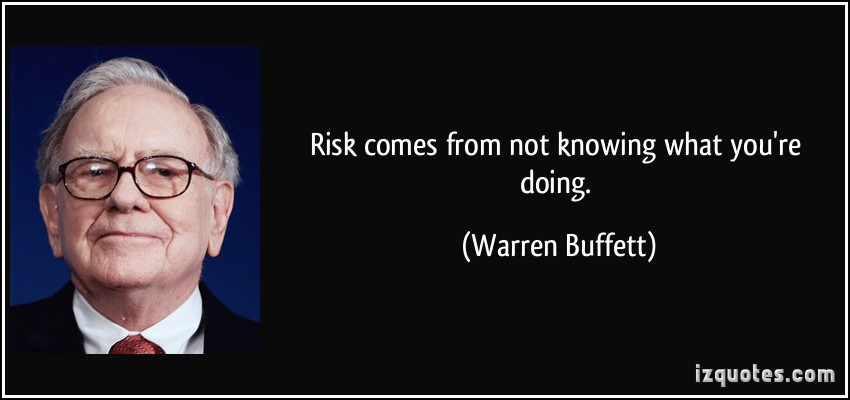
quote-risk-comes-from-not-knowing-what-you-re-doing-warren-buffett-26798


Just because you don’t know how to invest, doesn’t mean you can’t learn how to invest! There are many articles here on MoneyDigest and on the internet that can teach you how to invest. Just remember, which is more risky? Having only one source of income or spending some time to learn how create multiple sources of income.

Read More...

Everything You Need To Grasp About Compound Interest

As an investor, the longer you keep your money on the account, the more you will make out of it. Elevation of your wealth each year is possible because of COMPOUND INTEREST.

With Compound Interest, you will not only earn interest on your principal deposit but also on any interest that is credited to your account. It helps your money to grow at an accelerating rate!

To better understand the concept, here is an illustration:

Say you invested S$50,000 to an account with a 5% interest per year. With the gains you made from compounding, how much would you earn in 3 years?

Year 1: S$50,000+ (S$50,000 x 5%) = S$52,500
Year 2: S$52,500+ (S$52,500 x 5%) = S$55,125
Year 3: S$55,125+ (S$55,125 x 5%) = S$57,881.25

Compounding adds up faster than you may think. As you can see, you earned S$7,881.25 in just three years!

Aside from its definition, here are some things you really need to know about Compound Interest:

1. TIME IS OF THE ESSENCE

The longer you keep your money invested, the greater the rate at which your initial investment produces returns. This is why it is advantageous if you started young. And if your “younger years” passed, the next best thing is to start now.

Calculate the possibilities of your accumulated wealth through a Compound Interest Calculator that is available here.

2. PEOPLE FROM ALL WALKS OF LIFE CAN BENEFIT FROM IT

You do not need to be as financially literate as the people on Wall Street or as rich as Bill Gates because almost any investment will earn a Compound Interest if you leave your account untouched. The same principle and rules apply whether you invested S$1,000 or S$1,000,000.

3. TAKE CALCULATED RISKS

Yes! Compounding is powerful in almost all the circumstances but, you must not fall into the temptation of getting higher returns through higher risks. Unless you know what you are doing, taking on the higher risks can potentially lead to a chain of bad decisions from now until you retire. It is important to take well-informed and calculated risks to prevent destroying everything you once built.

4. PATIENCE IS TRULY IMPORTANT

Compound Interest requires you to sacrifice today to obtain its benefits tomorrow. It only works if you allotted time and effort in growing investment. The results may seem small at first but, you must persevere.

Image Credits: pixabay.com (License: CC0 Public Domain)

Image Credits: pixabay.com (License: CC0 Public Domain)

Certainly, its future rewards are greater than the sacrifice.

Sources: 1 , 2 , & 3

Read More...

DIYInsurance’s First-of-its-Kind Baby Protection Package and Price Beater

DIYInsurance (Do It Your way Insurance) is Singapore’s First Life Insurance Comparison Web Portal launched in June 2014.

As its name suggests, you can now purchase insurance based on your own agenda and not the insurance agent’s agenda. Besides having the option to compare different kind of insurance plans across various insurers, they also rebate 30% of the commissions back to you. That’s an added bonus for making conscientious effort to take care of your own future financial needs!

Good news for every responsible adults out there!

DIYInsurance has unveiled a first-of-its-kind insurance packages last month to provide a more holistic cover to two groups of people that require protection the most —  Baby and Young Working Adult.

For every parents, the birth of your baby signifies happiness and it also means assuming greater responsibility.

As parents, we want to give the best to our children. Besides giving them a memorable childhood, we want to give them a good education and adequate medical treatment if they fall ill or get injured.

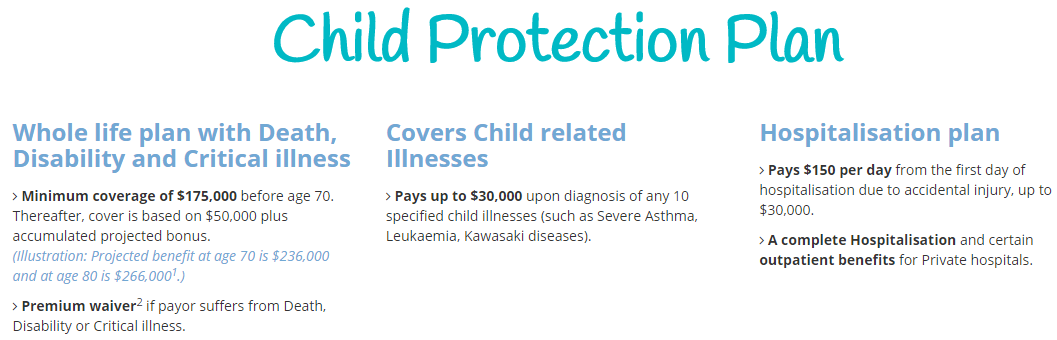
The Child Protection Plan is an insurance package that protects your newborn from day one and it covers everything from child-related critical illnesses to death and disability. A complete hospitalization plan is also included to ensure that their hospital bill are taken care of.

Child Protection Plan

Premium can be as affordable as less than $100 a month, depending on your needs. For more info, visit DIYInsurance here.

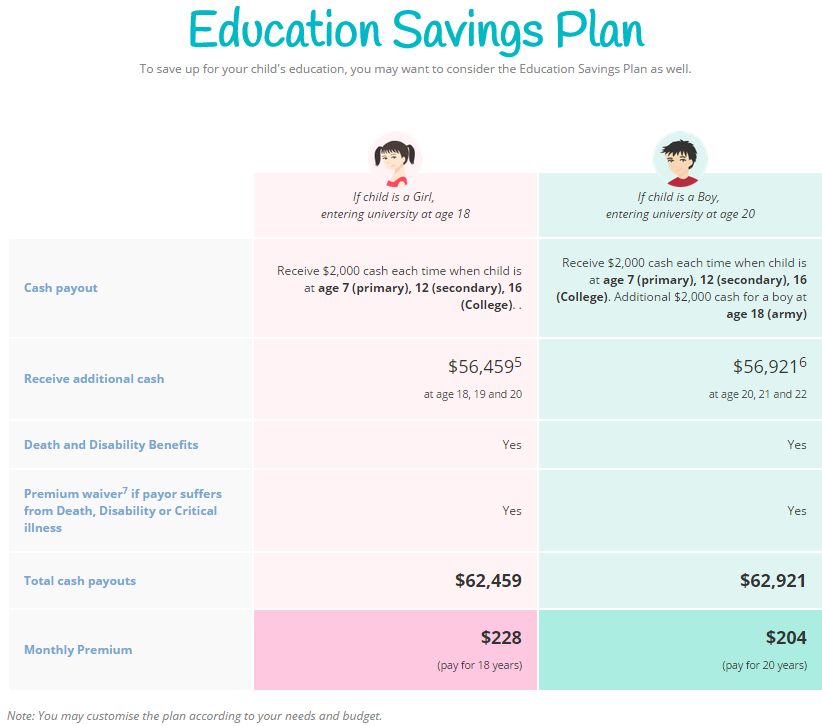
As responsible parents, we want our children’s education to be well taken care of and if your budget permits, the Baby Package also offers an Education Savings Plan that provides cash payout each time when your child reaches the next education milestone. Imagine how grateful your child will feel when they receive a cash payout of $2,000 each time they progress from Primary School to Secondary, and then to College?

An additional lump sum payment will be paid out when they turn 18, 19 and 20 (If your child is a girl) or 20, 21 and 22. (If your child is a boy)

ESP

Get rewarded for being responsible. You are entitled to cash rebates of around $300 for signing up for the Baby Package. A $50 shopping voucher will also be thrown in if you sign up for both the Child Protection Plan and the Education Savings Plan.

Apply Now Button

Enquire more about the package on DIYInsurace’s website here.

* Nobody like being shortchanged, and they understand that. DIYInsurance has also launched the Price Beater option which guarantee to offer you the best insurance deals out there. Got a better quotes from other insurers? Contact them and they’ll beat the price you have been offered and in addition they will give you up to $50 in shopping vouchers to spend! [Until 31 Dec 2015]

Price beater_v4

More information on Price Beater here.

(This article is brought to you by DIYInsurance.)

Read More...

How to navigate the tough economic climate with systematic stock-picking skills

Recent news has been dominated by political and economic slowdown issues in both emerging and developed countries and it shows little sign of abatement. Global and local investors are increasingly feeling queasy about the financial market performances that has inevitably led to spikes in volatility.

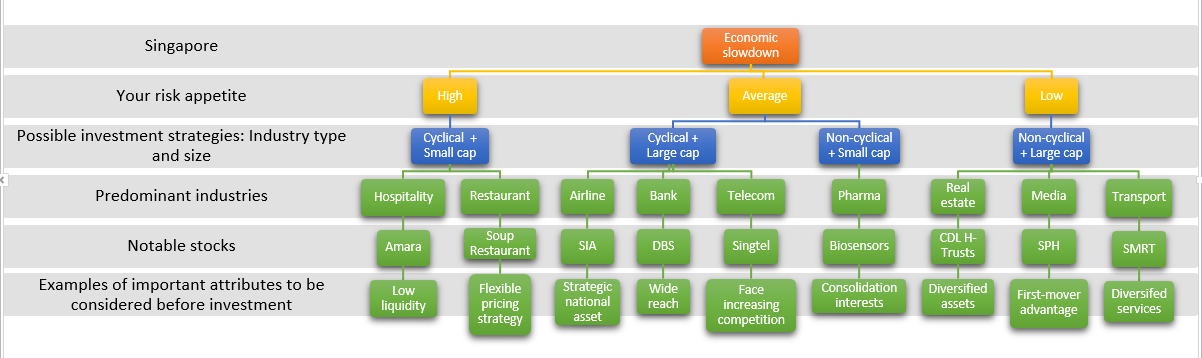
While uncertain economic times may take a typical investor on a rough ride, it presents a cornucopia of gainful opportunities for the learned eye. Indeed, as detailed in the diagram below, the key is to align your risk appetite with the right investment strategies sorted by industry type and size. Next, an insightful analysis would also consider company-specific attributes that could potentially act as a lever or a damper on the stock returns.

It is also crucial to understand and consistently apply the Singapore context to the specific industry and company under review. For example, as shown below, it is paradoxical to categorise the real estate industry as non-cyclical. However, given Singapore’s major land constraint, strategic location, extensive infrastructure and favourable policies for trade and investment, real estate would be significantly less prone to cyclical influences than our counterparts.

A1pic

A step-by-step basic investment guide


Read More...