Get rewards of up to S$288 in value! Sounds too good to be true? Read on.
Moomoo by moomoo Inc. is a stock trading platform that has launched in Singapore in March 2021 and have been offering attractive sign-up offers to expand their customer base. moomoo Inc. the company behind the trading app is a subsidiary of Futu Holdings Limited, a company listed in NASDAQ (NASDAQ:FUTU) and backed by Tencent.
In Singapore, investment products available through the moomoo App are offered by to Futu Singapore Pte. Ltd. (“Futu SG”), a wholly-owned subsidiary of Futu Holdings Limited. Futu SG is a broker-dealer and custodian licensed by the Monetary Authority of Singapore, (License No. CMS101000).
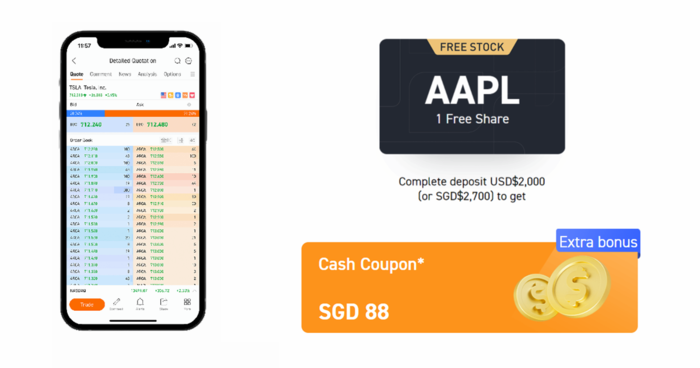
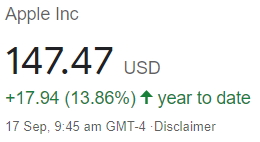
From now till 30 September, they are giving away a free Apple Share to new customers who sign up during this period. As of 17 Sep, the share is worth 147.47 USD or around S$200 in value.
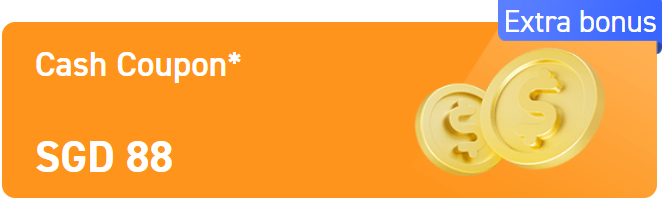
In addition, they are also giving you a S$88 cash coupon can be exchanged for cash in the moomoo app.
That is a total of S$288 in value we are talking about – and they are free once you complete the requirements.
Here’s how to redeem your free share
Sign up for an account here and deposit a minimum of S$2,700, US$2,000 or HK$16,000 within 30 days of account approval. You will need to download the moomoo Trading App.
Trade 5 times on any market and any product.
The free Apple share (AAPL) will be allocated to you automatically once you completed Step 2.
Tip: According to some users, you can easily complete Step 2 by buying and selling a non-volatile stock in the US market. That would make 2 trades. Do it 3 times to complete Step 2. Why US? Because you can buy a single share which sometimes cost you less than $10.
Other benefits of trading on the moomoo app
Investors can enjoy commission-free trades for 6 months plus free access to Market Data for US and SG stock exchanges. T&Cs apply.
If you are planning to start trading in stocks, this is a good start because you can enjoy unlimited commission-free trades in the US, HK & SG markets.
In addition, you also get free real-time quotes and market data for US, SG and China A share markets.
Money Digest receives monetary and other forms of compensation from Affiliates for various advertising, sponsorships (such as sponsored posts or sponsored stories within our editorial content), insertion orders, commercial messaging, and other promotional campaigns that we feature on our website.
“Buy them pre-built or customize the floorplan?” That question is one of the most compelling aspects of a new home purchase for many people in Canada. It’s a choice that comes with complications including cost and terms associated with building your own home.
To determine which option is most advantageous for most, this guide delves into various facets of pre-constructed home purchases processes and their influence on buyers in Canada, most especially Ontario.
Taking Advantage of the Pre-Construction Process
One distinct feature of pre-constructed homes is the opportunity for buyers to deposit smalldown paymentsin early project phases and watch them appreciate over time. Individuals who purchased such buildings back then have seen these structures risen in value.
Intending buyers are encouraged to invest futuristically by purchasing newly pre-constructed homes that will appreciate some years from now, provided that the Canadian real estate market continues to expand.
Most of these residential homes are developed in the Canadian suburbs where competition is low. Is this a significant factor? Of course. These homes are more likely to be situated on larger lots and have increased living space, compared to earlier residential structures. But there is more.
Buyers don’t have to compete aggressively in bidding wars as seen in urban housing markets in locations like Montreal, Greater Toronto Area, Greater Vancouver Area, and Calgary. But before venturing on a hunt for pre-construction homes, take some precautionary measures to prevent unforeseen issues.
Understand Legal Requirements and Purchase Agreements
As with other building types, pre-construction homes come with legally binding agreements, which both parties must honour. On the surface, these agreements appear harmless and mouth-watering. However, upon closer study, some unfavourable provisions may be lurking in the fine print.
Signing such contracts on the spur of the moment without reading the fine print may lock the buyer in a never-ending cycle of disparaging commitments, most of which would be financial. In Ontario, buyers can wait within a stipulated timeframe to ascertain their decision to sign the contract.
This duration is commonly referred to as the “cooling-off” period, which is a legal obligation. The province also mandates warranty coverage on pre-construction homes, which buyers can leverage to ensure that they are not receiving a terrible bargain.
A buyer would also need to sign a purchase agreement with the builder. This legal document is a prerequisite to claiming full ownership of the pre-construction home and it comes with the Tarion Addendum, which comprises:
The Addendum — Documentation showing the critical dates
The Purchase Agreement — Purchase and sale agreement forms
Before signing the agreement, the buyer should seek legal advice from a lawyer to ensure that the transaction is fair and that the buyer is protected legally against potential difficulties.
Know More About the Pre-Construction Builder
Finding out more about a home builder is one method to guarantee that a pre-construction property does not come with any unlawful baggage. One way to do that is to use the Ontario Builder Directory (OBD).
OBD is an online database that provides detailed information about home builders in Ontario, including probable convictions for unlawful construction projects. Potential buyers can use this resource to figure which builder to consult.
Reputable builders in Ontario are licensed to construct new residential structures. They also have a track record of previous homes they’ve built, as well as genuine testimonials to back up their work.
Explore the Warranty Coverage
As previously noted, Ontario legislation provides for warranties on new houses. This coverage is available in a variety of warranties (one, two, and seven years) and caters to:
Materials
Workmanship
Defects
Ontario Building Code violations
Water penetration, and many more
Keep an eye on hidden costs
Charges may appear out of nowhere, leaving the homeowner perplexed. Purchasers may be unaware of them until a few days before closing. In certain circumstances, the fees might be as much as 6% of the initial purchase price.
To be cautious, purchasers should enquire about additional fees and create a budget to avoid unexpected expenditures such as development fees, utility installation fees, and the rest. The maximum charge should ideally be 2% of the purchase price.
Anticipate Pre-Delivery Inspection (PDI)
During the construction process, the builder will invite the buyer over to inspect the home. This is to ensure that the building meets the client’s requirements and satisfaction.In case of an unusually large project, or as a part of the pre-delivery inspection and acceptance, some aspects of the building may be examined.
The builder may furnish the buyer with detailed data in respect of the plumbers, electricians, plasterers, tiler, drainage consultant, roofing company, and other professionals, as part of the pre-delivery inspection and acceptance process. As a tip, buyers can review the PDI checklist available online to know what to examine when on a PDI.
A month before the warranty expiration highlighted in the Addendum, the buyer can conduct a second inspection. Why is this necessary? It is advisable to give the pre-construction building time to settle over the course of varying seasons.
As a result, the customer will be able to assess the structure’s performance under various situations. During this time, possible flaws in the construction may begin to show up. After the second inspection, the buyer can decide whether or not to proceed with the deal.
If Unsatisfied, Get a Real Estate Broker
Working with a real estate broker or agent, particularly one who is familiar with pre-construction properties, expedites the transaction process and guarantees a decent bargain. In most cases, house buyers are only shown model homes to get a sense of what the finished construction will look like.
Real estate brokers, on the other hand, are familiar with the ins and outs of pre-construction developments as a result of their relationships with developers and builders. What exactly does this imply? Builders and developers frequently hire real estate agents to represent them. They are, in other words, the sellers’ agents.
As a result, these professionals work in the best interests of their clients, not the buyer. They guarantee that the builders receive the best deal possible by offering pre-constructed homes at premium prices. It is then in the best interests of house purchasers to choose real estate agents who will represent their interests.
In Conclusion
Most Canadians spend a lot of money on a new house and then find out that’s not the one for them. Before buying a pre-construction house have an experienced broker or agent with a large network to strike a good bargain. A lawyer will come in handy as well. Finding the ideal agent and lawyer may necessitate an extensive search, but the outcomes are rewarding.
The word “cryptocurrency” has been thrown around rather frequently these days. However, this precarious investment may not be for everyone.
In fact, please don’t take our word for it. The Monetary Authority of Singapore (MAS) has warned the public on its volatility, and that risky investment products are unsuitable for retail investors. To be honest, it’s not hard to understand why.
Choo Oi Yee, chief commercial officer for private capital platform ADDX, shared that scammers are tapping onto examples of people who have struck it rich in rousing the greed of investors.
Ms Choo added that there are two scams under the Ponzi scheme:
Money from new investors is used as returns for earlier investors.
Pump & dump: Scammers buy a coin to push its price up misleadingly and then dump it after others jump on the bandwagon.
Hong Qi Yu, the founder and chief executive of the digital trading platform Tokenize Xchange, also commented regarding this issue. He said that scammers might use third-party accounts to hide their mischief.
Common tactics include:
Hacking into accounts
Using undoubting individuals as money mules
Threatening vulnerable individuals to use their accounts
To counter the ever-evolving strategy of scammers, Mr Hong urged legitimate operators to enhance their surveillance of unusual activities. He also recommended “hot” and “cold” crypto wallets to reduce the risk of being hijacked.
Do your homework before cryptocurrency dealings
Image Credits: unsplash.com
With all that said, Ms Choo encourages potential cryptocurrency investors to do their homework. Crypto is complex, and a sound investment strategy involving investing in a range of assets is crucial.
Ms Goh (who declined to give her full name), who lost about S$30,000 to cryptocurrency trading platform Torque, prompted the public to learn about what they’re buying.
“Learn how to use the (crypto) exchange because different exchanges have different fees. You can save a lot on fees if you’re using the right exchange for the right coins.”
Another investor, Andy (not his real name), who lost about S$38,500 as a scam victim, asks investors to do their due diligence.
“The entire blockchain and cryptocurrency space (are) highly volatile. And the technology behind it is very difficult to understand, so unless you’re highly passionate about this whole landscape, don’t see it as a get-rich-quick scheme,” he noted.
When investment opportunities sound too good to be true, they probably are. Don’t let your hard-earned money go to waste via hasty investment decisions.
With an abundance of low-cost investment brokerages and a wide range of investment products, we believe that anyone can get started on investing. Unless your ambition is to become a day trader, you do not need to master technical analysis or complex charting techniques.
Simply carve out your path by following these steps.
#1: OPEN AN INVESTMENT BROKERAGE ACCOUNT
Unlike your comfort food, stocks cannot be bought at a store and taken home in a paper bag. You need to go through an account with an investment brokerage. A brokerage is a company or firm that acts as the middleman to connect you to the stock exchange.
Brokerage companies usually receive compensation by means of commissions or fees that are charged once the transaction has been completed. Brokerage accounts charge through minimum fees (i.e., to pay on each trade) or trading fees (i.e., percentage of each trade). These fees will affect your profits, so ensure that you do your research.
#2: FUND YOUR ACCOUNT
It is necessary to transfer money to your account to begin trading. Take note of the brokerage company’s requirements such as the minimum fee.
These companies generally accept multiple funding methods such as PayNow transfer, FAST transfer via online banking, or overseas remittance. Use a method that suits you best.
#3: DETERMINE WHICH STOCKS TO INVEST IN
Do your research, ask financial questions, and compare the facts to determine which stocks to invest in. There are different types of investment products such as Blue chip stocks and Real Estate Investment Trusts (REITs).
Blue chip stocks are the stocks of well-known, high-quality companies that are leaders in their industries. Investors usually hang on to these stocks for long periods and collect its dividends. Local “blue chips” include Singtel, DBS, and ComfortDelGro. Many Singaporean investors prefer to invest in blue chip stocks because of its perceived certainty and stability. Local blue chips are deemed to be less risky and are often common household names that most Singaporean investors can relate to.
Real Estate Investment Trusts (REITs) allow you to buy shares in a variety of properties. For instance, CapitaLand and Ascendas gives you access to purchase shares in commercial properties such as shopping malls and office buildings. It is one of the most popular options for investors seeking regular income.
#4: ACQUIRE YOUR FIRST SHARES/STOCKS
Once your funds have been sorted out, you can buy your first shares/stocks using your brokerage’s online platform. As a beginner, you may make investing a regular habit by spending a fixed amount every month on generic Exchange Trade Fund. The Exchange Trade Funds (ETFs) are similar to mutual funds in many ways. Although, ETFs are bought and sold throughout the day on stock exchanges.
Image Credits: unsplash.com
The idea is that over the long term, the ETFs will rise. By buying a fixed sum every month, you will be able to spread out your risk through ups and downs. Consistently funding your account is key.
Do you know that according to a study of Singaporeans’ financial wellness state by OCBC last year, only 60% of women have investments? Faring better on the flip side, 75% of male respondents aged between 21 and 65 noted that they are investing.
Are you a novice when it comes to investing? If you have a low-risk appetite and not so investment savvy at the moment, fret not. All you need to take is baby steps.
“You don’t need a lot of money to start investing,” highlighted Vasu Menon, executive director of investment strategy at OCBC Bank. “A regular investment plan where you squirrel away small amounts each month into pre-selected investments is one fuss-free way to start building a portfolio.”
The OCBC Blue Chip Investment Plan allows you to invest in ETFs from just $100 a month. Just in case you’re clueless, ETFs are funds that are listed and traded on the stock exchange.
Even if you do not know much, that’s okay. The great thing about ETFs is that you don’t need a lot of market monitoring, thanks to the dollar-cost averaging. By regularly investing a specific sum of money over time, you can potentially lower your average price per counter.
“Diversify over time by phasing your investments into the markets through a regular investment plan, so that if the markets see a drawdown or sharp volatility, you will have dry powder to buy at lower levels, which reduces your average cost. A regular investment plan allows you to benefit from dollar-cost averaging,” Menon shares.
#2: Unit Trusts
Image Credits: scripbox.com
For folks who want to know that their money is in good hands, unit trusts would be a good investment strategy. To put it simply, an experienced fund manager oversees a pool of funds from a group of investors and uses it to invest in a range of financial assets.
The good news is that you don’t need significant capital to access a diversified portfolio. You can choose between making consistent investments from $100/month or opt for the minimum $1000/month lump sum route.
Purchase methods include cash, Central Provident Fund (CPF) Investment Scheme, and the Supplementary Retirement Scheme (SRS) for selected funds.
“For myself, I started my investment journey by investing my own CPF monies since the funds were just sitting idle in my account, out of sight and out of mind. I took the first step by setting up a CPF investment account and began exploring opportunities to invest,” said Tan Siew Lee, Singapore’s head of wealth management at OCBC Bank.
#3: Robo-Investing
As we come to a close, robo-investing is our last option. Through this investment strategy, novice investors who want to invest actively via algorithms will be able to construct, monitor, and review portfolios.
Menon shares that OCBC RoboInvest could be one way to begin. Selected portfolios just require a small initial investment of US$100, making a fantastic way for almost anyone to kickstart their investment journey.
While we can’t say the same for other robo-investing platforms, Menon assures us that OCBC RoboInvest automates investments with guidance and validation from wealth experts to give you peace of mind.
However, that doesn’t mean a hands-off kind of financial venture. While your portfolio is monitored and periodically re-balanced based on economic and market movements, you hold the final say to approve any changes made to your portfolio.