Here’s how to manage the parenting load with your spouse

an Asian family with young children

Marriage in itself is already a big challenge for many people out there.

Add on a child or two, or more, and your entire paradigm will shift. While some marriages change for the better with a new addition to the family, most couples find themselves with more arguments and disagreements to manage.

The parenting load can be overwhelming if the balance is off. Teamwork is what you need in this child care journey, and we’re here to let you in on some tips on managing the parenting load with your spouse.

#1: Think of it as a business

For those who’ve married over passionate love, shifting your mindset to the family as a business can be the least romantic thing to do. But that’s precisely what you should do to survive the parenting voyage. You see, in a typical setting, business partners don’t always share the same workload.

One might be handling the media and investors while the other gets his hand dirty in the daily operations. As Gary Neuman, a psychotherapist, rightly points out, “No marriage can be fifty-fifty all the time.” You can strive for fairness but don’t anticipate consistent, equal responsibilities every single day.

#2: List down the to-dos

It’s easy to fall into the trap of saying, “I’m doing more than you are.” To avoid that thought spiralling downwards into something even more toxic, be sure to list down the to-dos with your significant other.

“It’s keeping track of what it takes to run your family business. Each person thinks they are doing more than the other person realises,” noted Jenny Anderson, the co-author of It’s Not You, It’s the Dishes: How to Minimise Conflict and Maximise Happiness in Your Relationship. Drawing up the list of things to do can help both parties see if either one’s under or over participating.

#3: Rank and select your tasks

Once you’ve gotten your to-dos written down, it’s time to rank them accordingly. You can do so by heeding Neuman’s suggestion:

Level 1: I like doing this.

Level 2: I can do this but need help.

Level 3: I hate doing this.

This way, you and your spouse can pick and choose the tasks you like doing or don’t mind holding responsibility for. However, if both of you have ranked a particular chore at level 3, then it would make sense for the person who can complete it within a shorter time frame to do so. Well, simply because time is precious.

Final thoughts
a young couple talking

Image Credits: crello.com

Remember that communication is vital. A temporary sour feeling left to ferment and pile up can lead to resentment and emotional explosion in the long run.

If you need to discuss something with your spouse, schedule a time to sit down and talk. You can also consider a fixed weekly or bi-monthly short meeting to address impromptu changes in schedule. This will help both parties to always be in the loop for updates surrounding everyone’s needs.

Read More...

Pocket-friendly solutions to soundproof your home

acoustic soundproof wall panels

From dawn to dusk and beyond those times, you’re facing unbearable noise thanks to your inconsiderate neighbours.

With working from home as the default for many at the moment, it’s starting to get on your nerves. You’re unable to sleep well, and now you have to put up with the excessive giant thumping footsteps and dragging of furniture during the day.

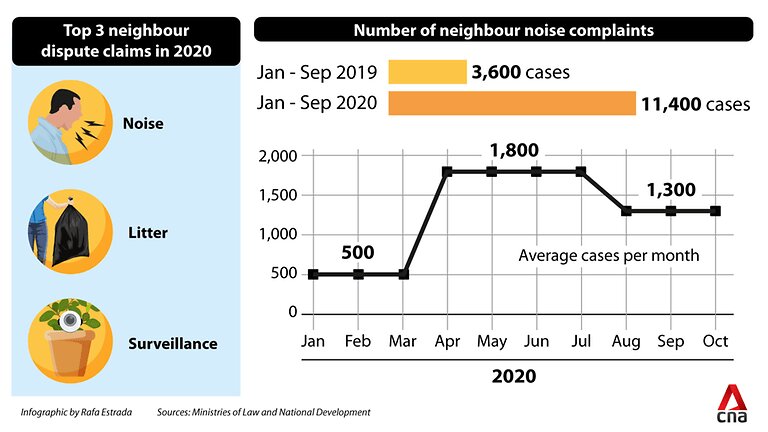
And guess what? You’re not alone. Based on official numbers by the Ministry of Law and National Development, neighbourly disputes rose significantly last year compared to 2019.

Have a look:

neighbourly disputes Singapore

Want to know the “proper” way to get back at your neighbours? Here it is, but just remember it’s going to be a long and tedious process:

flow chart on how to solve neighbourly disputes

Maybe a more intelligent way is to consider some pocket-friendly solutions to soundproof your home while you seek resolutions from the authorities.

#1: Fill air gaps

Holes and cracks on your walls and floor could be the very reason for your restless days and sleepless nights. Check that you’ve covered them with sealant or gap fillers so noise won’t be able to enter. It’s also a relatively straightforward operation to do on your own so you can save your money on labour costs.

#2: Install wall panels

We’re sure you’ve been to studios and noticed the thick panels stuck to the wall. Yes, those will help absorb sounds both from noise disturbances from outside and within the confines of your walls. You can easily purchase them online from Shopee, Lazada, or Amazon and self-install them using spray glue or double-sided tape.

#3: Put up dense curtains
soundproof curtains

Image Credits rollingstone.com

Maybe it’s about time you give your home curtains a new look. But this time around, don’t go for the standard types you can buy from the supermarket. You want to invest in a soundproof curtain that is dense enough to reduce noise. Unsure of how to get those? Head down to the stores and ask to be introduced to curtains made from triple-weave fabric.

#4: Buy sound-dampening door strips

If you have the budget to spare, go ahead and replace your doors and windows. But since we’re looking at pocket-friendly solutions in this article, a better way is to purchase sound-dampening foam or rubber door strips. A one-metre long piece is usually under S$10, and you can cut it accordingly to fit your home doors.

#5: Add rugs and carpets

As we come to a close, do you know that sound waves can bounce off walls and floors? Sometimes, it may seem like the noise is coming from your neighbours above, but the primary source could from the apartment below you. Hence, an excellent way to counter it is to buy furry rugs or those with frays to help absorb unnecessary noise. Get them from Ikea; they won’t cost a lot.

Read More...

Studying in an International School: Is It Worth the Cost?

Generally speaking, international schools are some of the more expensive educational options available. Tuition and miscellaneous fees for most international schools are comparable to those of the most exclusive private schools in the developed world. Yet, enrollment at international schools throughout the world continues to increase, often at rates faster than that of local schools within mainstream educational systems.

Once primarily serving the families of expatriates and diplomats, there has been a worldwide trend in locals enrolling themselves and their children in international education programs. Clearly, many people believe these institutions are worth the high price of admission.

Below are six reasons why you may want to enroll your child in an international school program.

1) International Schools Expose Your Child to a Diverse and Accepting Multicultural Community

Being able to expose your child to a multicultural environment early on can help them cultivate values such as tolerance and empathy for others. A child who only interacts with other people from their own community will often find their practical experience lacking when they go to college. They might find it difficult to act appropriately when they encounter people from cultures other than their own, particularly if they continue their education overseas.

This acceptance and open-mindedness also cuts both ways, and international schools are often a better fit for children who have a hard time adjusting elsewhere. Whereas mainstream schools tend to be designed for one specific culture, international schools provide a safe, structured environment for children of all personalities and backgrounds to interact with one another. This means they may be less likely to face the isolation that “outsiders” experience when in the mainstream school system.

2) These Schools Tend to Provide the Rigor Necessary for Real-World Success

Most parents want their children to succeed in life. Unfortunately, it’s not always possible to guarantee this. However, an education that encourages children to test their limits will often put the odds in their favor.

International schools, particularly those that offer International Baccalaureate and Advanced Placement programs, are often considered to be just as challenging as the top schools in mainstream systems. Nevertheless international education is also often designed to correspond with the interests of the students. Parents who want their children to be prepared for difficult challenges later in life —but who also want their kids to have the flexibility afforded by holistic education—might find that international schools are better-suited for meeting their needs.

3) International schools can better prepare your children for the era of globalization

The world is only becoming more and more connected with time. Borders are becoming less relevant — but not for everyone. Children who are not prepared for the accelerating trend of globalization will often find fewer, less-desirable personal and career opportunities available to them.

In a sense, international schools are at the very forefront of globalization. By enrolling your children in international education programs, you ensure that they are better prepared not just for college, but for the wider world as well.

4) You Can Help Your Children Cultivate a More Universal Point of View

Throughout the world, there has been a growing trend of locals sending their children to international schools, rather than to some otherwise excellent schools in mainstream educational systems.

While they might do this for the other reasons we mentioned, many are also doing it so that their children can avoid dogmatic, insular, or jingoistic thinking that is all too common in mainstream schools, which are often designed to cater to one dominant culture. Parents who consider this aspect of mainstream education to be a problem may consider the modest added cost of international schooling to be well worth it.

5) International Schools Tend to Offer More Extracurricular Activities

International schools have long been known to offer a wider range of extracurricular activities to comparable mainstream schools. This was mainly because international schools used to primarily teach the children of diplomats and expats, who would not otherwise be able to enjoy the pursuits that were popular in their home countries.

Today, however, both locals and foreigners often choose international schools partly because they offer their children a wide range of clubs that would be unavailable in regular schools. The focus of these clubs run the gamut from visual arts, music, and literature to mathematics, sciences, and sports. For children with very special interests, international schools may be the only good option for ensuring they become truly self-actualized.

6) Better Recognition at Top Universities

Parents who want to make sure that their child has a pick of top-tier college programs may consider the extra cost of an international school to be well worth it. International schools that offer International Baccalaureate and Advanced Placement programs are widely recognized by the world’s top universities. Enrolling your child in an international school that offers American curriculum in Singapore, for example, prepares them for the rigors of the American university system. Additionally, many of these institutions of higher learning may also give top-performing students of international schools course credit, saving them time and allowing them more flexibility when they enter college.

Are International Schools Worth It?

For parents who want to spare no expense in ensuring their child receives a well-rounded, worldly, and widely recognized education, sending them to an international school is certainly an attractive option.

While there is no shortage of schools in mainstream systems that provide a high quality of education, most will not be able to provide a nurturing, multicultural environment that empowers children to succeed wherever they are planted. For the most part, this is what parents who send their kids to international schools are paying for. For them, knowing that they are doing their best to help their child succeed in life is worth it, at any price.


Read More...

Practical Tips To Manage Home-Based Learning

Amid the COVID-19 pandemic, home-based learning was rolled out nationwide after schools have closed in April 2020. The safety guidelines encouraged schools and tuition centers to transition to HBL or online learning to educate their students. Simply put, HBL is having lessons and classroom interactions at home.

Eventually, students went allowed back to school.

Time passed and the rise in community cases led to the Ministry of Education’s decision to have a full home-based learning for students in primary schools, secondary schools, and junior colleges (i.e., until May 28, 2021). Furthermore, center-based tuition and enrichment classes will continue with its online learning until June 13.

Students in Singapore had to adapt to these changes and to manage a home-based learning lifestyle. On that note, here are some practical tips to help your child to study at home.

CREATE A CONDUCIVE LEARNING ENVIRONMENT

Whether you have a corner or a room for studying, your child will benefit from having a designated space for learning. Working or studying from home can be a challenge due to the myriad of distractions around us. Thus, it is important to create a space where your child is motivated to learn.

Much like a classroom, having a special learning space can help create the mental and physical divide between personal time and study time. The common elements of a conducive learning environment include good lighting, well-ventilation, accessible learning materials, and distraction-free space.

HAVE A STUDY SCHEDULE

Planning ahead enables you to develop a daily structure for your child to adhere to. This daily structure will allow your child to see what they need to achieve during the day.

Most primary schools in Singapore have their own home-based schedules. Incorporate the school’s schedule to your child’s study schedule. Then, find a time to get to know your child better. Take this opportunity to spend quality time with your beloved one. Ask your child about his interests, dislikes, dreams, and goals.

STAY HEALTHY

With less physical activity indoors, it is important to eat healthy food and to exercise regularly. Although it can be tempting to offer your child sweets and junk food to boost his or her attention, these types of food can give your child energy crashes. Your child is likely to feel a drop in his or her energy level after a sugar high. You do not want to see your child sleeping in front of the computer screen!

Instead, offer periodic breaks and nutritious meals. Letting off steam by exercising can help improve your child’s focus and minimize the stress levels.

ENCOURAGE SOCIAL DEVELOPMENT

Home-based learning entails continuous adjustments from both the parents and the students. This includes the way students interact with their peers. Just because your child is isolated from his or her classmates does not mean that you need to neglect one’s social development.

Create opportunities for interaction by allowing your child to have Zoom/Skype hangouts with his friends. They can stream a movie or play games online. Having “social breaks” after your child accomplishes his school tasks can motivate him more.

OPENLY COMMUNICATE WITH YOUR CHILD’S TEACHER

The key to HBL’s success is to follow the teachers’ instructions. Engagement with the teachers will allow you to maximize the productivity of your child. They will be able to give you helpful suggestions if you are transparent with your child’s current progress. Moreover, talking to people who can understand you can help minimize the stress, especially for teaching younger children.

Image Credits: pixabay.com

You are not alone! These changes are not easy for anyone. Parents can take time off work to supervise their children’s learning habits. Children may find it harder to study at home due to multiple distractions. Teachers must prepare more materials given that they have less control over their classes. Hence, it is important for everyone to work together.

At the end of the day, your common goal is to make learning more effective.

Read More...

Ways to treat erectile dysfunction without surgery

erectile dysfunction

Do you know of someone who has erectile dysfunction (ED)? ED is a condition that deters a man from erecting and staying firm enough to have sex.

Usually, older men face such an issue. But there is also a range of reasons that leads to ED, including:

  • Stress
  • Smoking
  • Depression
  • Overweight
  • Alcohol consumption
  • Cardiovascular-related conditions
  • Overexposure to radiation at the pelvic region
  • Blood flow problems or nerve damage in the penis
  • High blood pressure or unhealthy cholesterol levels
  • Side effects of present treatments or medications for prostate diseases

Ladies, if your partners consistently face a low sexual desire or have difficulties getting an erection, they may have an ED. Similarly, having trouble maintaining that long-awaited erection during intercourse or premature ejaculation could be ED signs.

Thankfully, not all hope is lost.  Here are some ways to treat ED without surgery.

#1: Get up & get moving

For those who are against consuming medicine, maybe you would want to look into getting more active.

The main idea here is to improve your cardiovascular status, and you can do so with running, biking, jogging, or swimming. When there is increased blood flow throughout your body, it could lead to better circulation down there and improve your ED condition.

#2: Turn to oral drugs

Okay, so maybe a couple of you guys out there aren’t able to pump up your physical activity either due to immobility or health issues.

If so, you might want to turn to oral medication like Sildenafil (Viagra). It was the first oral medicine approved to help up the flow of blood to the penis. Thus, when engaging in sexual acts, an erection can be stimulated. Tadalafil (Cialis) and Vardenafil (Levitra) are also alternatives to try.

#3: Consider injection therapy
a syringe and needle

Image Credits: csp.org.uk

Penile injection therapy can help tackle various erection issues related to the nerve, blood vessel, and psychological conditions.

The medical term to note is intracavernosal injection therapy, though most laymen refer to it as penile self-injection. During the process, you can DIY by injecting a small quantity of prostaglandin E1, papaverine, phentolamine, or a combination of these drugs into the side of your penis. The medicine will help relax your blood vessels and direct blood flow to the penis.

However, this method comes with side effects like pain and penile scarring (fibrosis).

#4: Use a vacuum constriction device

The abovementioned method could be too painful for some to bear. Why not use a vacuum constriction device for those who don’t mind putting up with some discomfort?

It is essentially a cylinder to put over your penis. Most are either hand-powered or battery-operated. It works by pumping air out of the cylinder, drawing blood into the penis, and causing an erection. The drawback is that the cylinder band that helps maintain the erection can only stay in place for about 20 minutes or less.

#5: Experience extracorporeal shock wave therapy (ESWT)

As we come to a close, we have ESWT. It is a method that uses low-intensity shock waves to form blood vessels in the erectile tissues. 

As a result, blood flow to the penis area will increase, and your erection will last longer. The good news is that the process is painless and non-invasive. But ready yourself as you may need to go through up to 12 sessions of 20-minute ESWT to see results.

Read More...