An Investment for Property Lovers and Dividend Seekers

Singaporeans are fixated with buying property – and they don’t just stop at one.

In a report published in June 2016, Maybank Kim Eng’s research team found that approximately 1.1 million households in Singapore own the homes they occupy, but there are another 200,000 housing units are currently held as investments. This demand, coupled with land scarcity, means that property in Singapore doesn’t come cheap.

There is however, a more affordable option for those looking to invest in property: real estate investment trusts (REITs). REITs – Singapore REITs (S-REITs) in particular – have been making headlines recently for offering handsome dividends, made even more attractive by a persistent low interest rate environment. If you are a dividend investor, you may want to learn more about this asset class.

How Have Singapore REITs Fared?

According to a Bloomberg report in October 2016, the 7% yield offered by S-REITs exceeded those listed in Australia, the US and Japan. That’s been the driving force behind an approximately 9% increase in the FTSE Straits Times Real Estate Investment Trust index this year as yield-hungry investors flock to the offerings amid record-low interest rates.
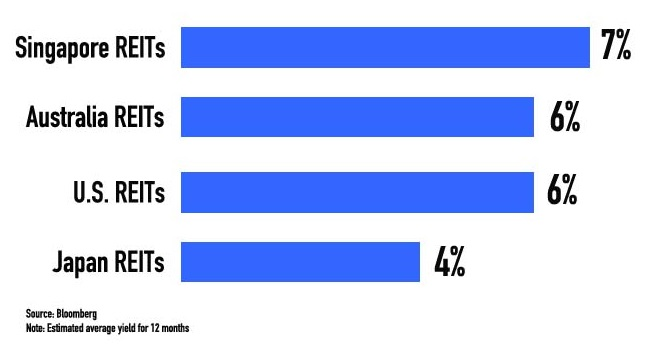
reits1

Findings by SGX My Gateway published on 11 September 2016 also showed that the sector logged an indicative average dividend yield of 6.7% p.a. thus far, compared to that of the Straits Times Index (3.9% p.a.) and MSCI World REIT Index (3.9%p.a.).

Compared to fixed deposit rates? The difference is even wider. In September 2016, the 12-month fixed deposit rate  – or the average rate compiled from that quoted by 10 leading banks and finance companies – was 0.35% p.a.

What is a REIT Anyway?

A REIT is a trust that owns and operates income generating real estate. The rental income or interest payment that is earned by the REIT is passed on to investors in the form of dividends.

Here are more facts about REITs and S-REITs:

  • There’s a reason why S-REITs pay handsome dividends. They are required to distribute at least 90% of their taxable income each year in order to enjoy tax exempt status by IRAS, subject to certain conditions.
  • Investing in one REIT gives you exposure to not just one, but a portfolio of properties, and at a fraction of the price that it would cost you to buy a single property.
  • The portfolio of properties are not limited to those in Singapore. Some REITs have international properties in their portfolio.
  • REITs are more liquid compared to property as they can be bought and sold on stock exchanges throughout the day just like any other stock.

What S-REITs are Out There?

There are different types of S-REITs to choose from, and they are affected by different factors.
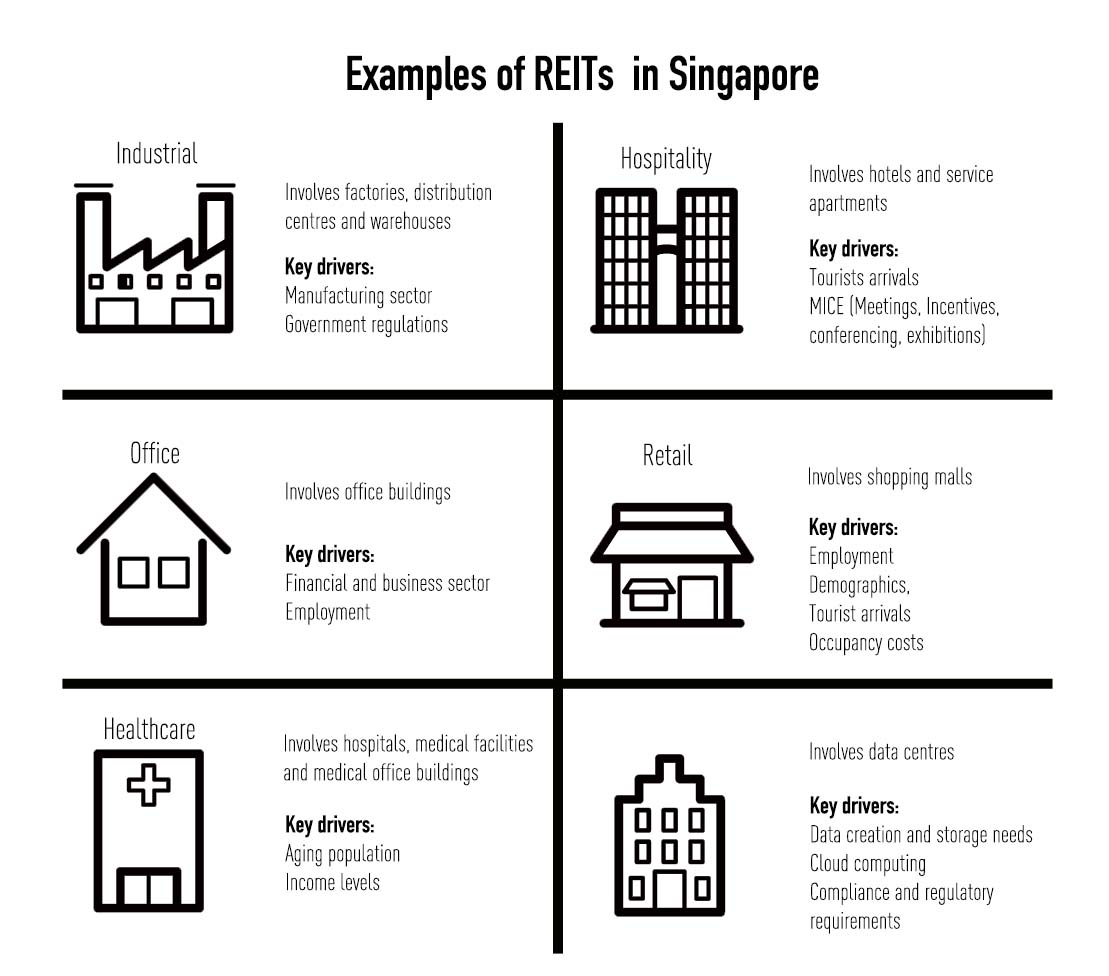
reits2

Maybank Kim Eng’s research team believes that industrial REITs, like Ascendas REIT and Mapletree Industrial Trust, could benefit from public spending’s focus on boosting innovation and productivity. Business parks, science parks and high-spec industrial space will be in demand. So if you are wondering what type of REITs to watch out for, you could consider finding out more about industrial REITs and whether they fit the objectives of your portfolio.


Disclaimer: This message is for general knowledge or information only. It is not an offer or invitation to buy or sell securities, futures or other products or services. Our products or services vary in different jurisdictions, subject to their respective terms and conditions and the licences our affiliates and us hold. This message is not an advice or recommendation for any financial planning, investment, legal, tax or other purposes and, accordingly, no responsibility or liability is assumed by us or our affiliates, whether directly or indirectly, from any person taking or not taking action

Read More...

Alibaba’s Sales Soared High Months After Singapore Bought A Billion In Stocks

My uncle is a proud owner of several holistic spas. Whether his branches are in need of a new machine (e.g., IPL or Laser Hair Removal Machine), he visits Alibaba first. Alibaba is a global marketplace that is relatively prompt and reliable. It is reigns supreme in the world of Chinese e-commerce. Its broad prevalence in Asia is comparable to United States’ Amazon or eBay.

It comes as no surprise that its sales soared up to 55% in the last quarter due to cloud computing. As Chief Executive Daniel Zhang once said: “Our results reflect our increasing ability to monetise our 450 million mobile users through new and innovative social
commerce experiences.” You can expect that this number of users will grow positively each year.

Image Credits: Global Panorama via Flickr Creative Commons (Attribution-ShareAlike 2.0 Generic)

Image Credits: Global Panorama via Flickr Creative Commons (Attribution-ShareAlike 2.0 Generic)

You see, cloud computing is the practice of utilizing a network of remote servers hosted on the Internet instead of using a local server. It manages, stores, and processes data in that manner. Basically, cloud computing allows the users to store and access data online without needing a computer’s hard drive. It allows Alibaba to operate conveniently and swiftly.

What is interesting is the fact that the Government of Singapore purchased a total of US$1 billion (about S$1.38 billion) last June. GIC Private and Temasek Holdings each signed to US$500 million (S$692.15 million) of Alibaba shares, which were priced at US$74 (S$102.44) a piece thru subsidiaries. These shares were a part of the US$8.9 billion (S$12.32 billion) sale by Japan’s SoftBank. SoftBank remains to be Alibaba’s biggest shareholder. The elevated sales of Alibaba showed that the decision to acquire the shares was beneficial – at least for now.

You may think that Alibaba’s local competitors called RedMart and Lazada were shaken by these news, but you are wrong! Alibaba had recently invested in these two companies due to their financial constraints.

Image Credits: pixabay.com

Image Credits: pixabay.com

We can only hope that these circumstances will improve Singapore’s e-commerce platform in the future.

Sources: 1, 2, & 3

Read More...

4 Benefits of a Monthly Investment Plan

Based on a Worldwide Cost of Living survey conducted by the Economist Intelligence Unit, Singapore has been ranked as the world’s most expensive city to live in for the third consecutive year. Indeed, many living in Singapore have to contend with the high property and car prices. Healthcare and education costs are also not far from people’s minds.

Investment is seen as a way to potentially amplify one’s wealth to better fulfil these life goals. But what if you do not have a substantial amount of capital or time set aside for investing? A Monthly Investment Plan or what’s also known as a Regular Savings Plan, could be something for you to consider.

  1. Affordable

There’s a common misconception that you need to have sizeable capital in order to start building a nest egg through investing. However, with a Monthly Investment Plan, you can decide how much to invest based on your personal financial situation. You can even set aside just $100 a month, and put that money into blue chip stocks, exchange traded funds (ETFs) and Real Estate Investment Trusts (REITs) listed on global markets to build your portfolio.

  1. Takes Advantage of Dollar Cost Averaging

Monthly Investment Plans follow the principle of dollar cost averaging. By investing regularly every month instead of trying to time the market and find the best time to buy and sell shares, the risk of investing a large amount in a single investment at the wrong time is reduced.

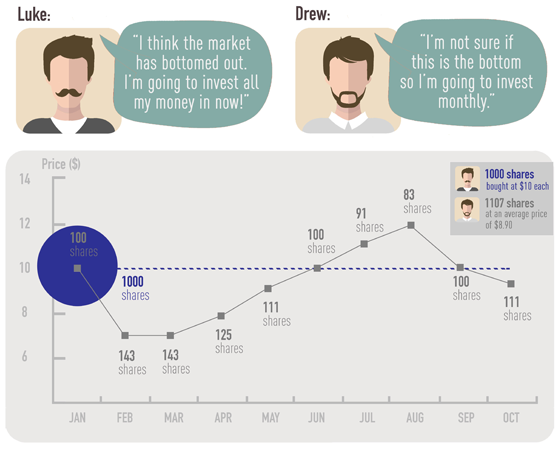
To gain a better understanding of dollar cost averaging, consider this example where two siblings are given $10,000 each, but choose to invest it in different ways.

Luke used the money to buy 1000 shares at $10. Drew, on the other hand, invested a predetermined amount each month, and he ended up buying more shares when the price was low and fewer shares when the price was high.

monthly-investment-plans-graph

Drew’s average price per share ($8.90) is therefore lower compared to Luke’s ($10) – this is how dollar cost averaging works and by extension, how Monthly Investment Plans can help you achieve your investment goals.

  1. Automated and Hassle-Free

No one can exactly foresee and predict the behaviour of the stock market. Instead of trying to time the market and finding the right time to enter and exit, Monthly Investment Plans focus instead on long-term gains, and build your portfolio by automatically buying your shares for you every month. Your work is done at the outset. All you need to do is choose your desired shares and set your monthly investment amount. From that point on, you can sit back and watch as your portfolio grows and your shares accumulate.

  1. Diversification

Monthly Investment Plans enable you to diversify your investment portfolio in a couple of ways.

Most of these plans allow you to invest in ETFs like SPDR STI ETF or Nikko AM STI ETF which are funds that invest in the 30 largest companies listed on Singapore Stock Exchange. More conservative investors can go for these ETFs. In addition to these ETFs, your Monthly Investment Plan may allow for investments into REITs. If you are interested in investing in property, then this is something to look out for; REITs don’t just give you exposure to one property – they give you exposure to a whole portfolio of properties. Some Monthly Investment Plans will also allow you to access stocks listed in markets like the US, Hong Kong, Malaysia and Thailand. Expanding your horizons and looking at offerings listed on these global markets is another way to diversify your portfolio.

If any of these four benefits sound appealing to you, then you should find out more about how Monthly Investment Plans can help you along your investment journey.

Read More...

Which One Is A Better Investment Strategy: Maximizing Or Simplifying?

By definition, maximizing refers to “increasing [something] to the greatest possible amount or degree” while simplifying refers to “making [something] less complex or complicated”. Applying these two opposing strategies to your investments can lead to different results.

Let us find out which strategy is more productive.

With the sole purpose of increasing the value of their portfolios, “maximizers” are vulnerable to the trap of purchasing a product off the bat. They may be too optimistic and expect the best possible outcomes. This idealistic thinking can be far from reality. The truth is, there will always be a few decisions that would not work in your favor.

Aside from investing on the wrong products, maximizers can be overwhelmed and stressed about the abundance of investments that they bought. The mindset of a maximizer is focused on the overall potential that various investment can offer rather than optimizing a single investment.

Sure! You can actually earn five times more than your initial cash-out if you added all of these options. However, can you really pay attention to all of it?

Most people cannot. They end up putting “so-so” effort into each of their investments and fail to achieve the best scenario that they previously envisioned. Also, they end up being drained. Drained investors can become unproductive. Being unproductive may later result to a significant loss.

With all the money at stake, do you still want to maximize?

If your answer is “NO”, try the second strategy called simplifying. Simplifying allows you to create a portfolio that is easier to manage by eliminating complex investments. To tell you frankly, investing does not have to be difficult! You just have to focus on one thing at a time.

Start by analyzing all the possible investment options that you can afford. Next, determine which options suits your personality the best. Remember that investing is more than just about the outcomes.

A powerful mindset that “simplifyers” possess is contentment.

According to Psychologist Barry Schwartz, people who are preoccupied with the best possible outcomes are less satisfied and more susceptible to “buyer’s remorse” than the people who are satisfied with the outcomes that are good enough.

Maximizing can be counterproductive to your investments. The more you try to grow your wealth, the more you can inflict strain and stress to yourself.

Image Credits: pixabay.com

Image Credits: pixabay.com

Sources: 1 & 2

Read More...

Buzzworthy $langs That Every Singaporean Investor Must Know

BID WHACKER

Although it sounds like a superhero’s name, a bid whacker is someone you do not want to invite to the market! Bid whacker refers to the investor who sells below or at the bid price. This act temporarily drives down the market prices of a security. As sellers normally negotiate for a price between the bid and ask quotes, the unconventional bid whackers usually upset other sellers.

TRIPLE WITCHING

Triple witching or Freaky Friday occurs on the third Friday of December, March, June, and September. At this time, the stock market index options and futures expire in one day. This leads to great volumes of trading as investors try to offset their options and futures before the time is up.

BLUE CHIP COMPANIES

You often hear financial gurus advising you to invest on the blue chips, but what do they really pertain to?

Blue chip companies are large companies that are considered to be well-renowned, highly established, and more financially sound. If you want to invest your money in stocks that have proven their strength and profitability through economic downturns then you should consider these companies. International blue chip companies include H.J. Heinz (HNZ) and Disney (DIS) while local blue chip companies include Singapore Press Holdings (SGX: T39) and Singapore Telecommunications (SGX: Z74).

ANKLE BITER

An ankle biter refers to a stock that has low market capitalization. These are also known as small-cap stocks and encompasses many emerging technologies. Ankle biters as an investment tend to be more fickle and typically thinly traded. However, the growth potential in these stocks are higher than the large-cap stocks.

Image Credits: pixabay.com (CC0 Public Domain)

Image Credits: pixabay.com (CC0 Public Domain)

STALKING-HORSE BID

Stalking-horse bid is an initial bid on a bankrupt company’s assets. It usually comes from a serious buyer selected by the bankrupt company itself in order to prevent low-ball offers and enforce an engaging bidding war. Once the stalking-horse bid is received, the bankrupt company will open its doors to other interested companies that are willing to offer their own bids.

With this strategy, the bankrupt company is able to attain the best possible price.

Sources: 1 & 2

Read More...