5 Surefire Ways To Waste Money

Many posts on financial websites concentrate on the positive topics such as the effective ways to spend money and the healthy financial habits of successful people. However, these articles may not highlight the negative habits and practices that cost you money. And some people really need a wake -up call!

To help prevent unhealthy behavior as well as to add in the scarce literature on this topic, here are 5 Possible Ways To Waste Your Money:

1. GIVING IN TO DESIGNER GOODS

As you walk past the Orchard Road, you saw the huge crimson sign that said: “SALE”! Your highly elated self rushed through the counter and bought the first branded bag you saw. The rush was amazing but it did not last for long. The next day, you saw an email from Zalora that they are having discounts on Michael Kors’ watches. The Silver Steel Bradshaw watch used to cost S$439 but it is retails for S$307.30 now. Again, you got excited and bought it right away.

Do really need a new designer watch and a new branded bag when you have dozens at home?

These deals may seem like a bargain at the moment; however, it is just excess spending in hindsight. This is why you must list down all your necessities and stick with it.

2. AVOIDING NEGOTIATION

Although most people know that they are worth more, they are afraid to negotiate for a higher salary. By doing so, they are letting an opportunity and hundreds of cash slide.

Negotiating your salary is a game with all of its players attempting to dominate each other. Dominate the game by researching all the needed information. Go in-depth about the complete aspects of the job and the company. Also, collect data about the average pay and accurate salary opportunities in your position.

3. SHOPPING AT ONE STORE

It may be convenient to complete your shopping list at one place but it can also cost you more. Instead of getting your produce, office supplies, and toiletries at the nearby grocery store (e.g., FairPrice or Cold Storage), consider exploring other options such as the bookstores (e.g., Popular or Kinokuniya) and dollar stores (e.g., Value Dollar or Daiso). Visit the dollar stores for trivial things such as cleaning supplies, greeting cards, clothes pegs, and pet accessories.

4. BUYING BABY CLOTHES REGULARLY

Believe me when I say that babies can have sudden growth spurts so, it is unnecessary to buy loads of baby clothes in advance. It goes the same for shoes, as socks will be sufficient to keep their cute toes warm.

Start saving for baby clothes by asking your friends and family if you can have their child’s outgrown clothes. You will not only help your friends or family members to de-clutter their space but you will also save more.

5. INDULGING ON LUXURY BEAUTY PRODUCTS

With the society’s obsession towards physical appearance, it is no surprise that people spend so much on beauty products. There is an abundance of luxury beauty products in countries such as Singapore, Dubai, United States, and Hong Kong. This is one example:

As you can see Tati, YouTube’s famous beauty guru, disliked her experience with the ridiculous US$330 (S$441) Givenchy Le Soin Noir Lace Face Mask. She could have just purchased a S$2 Korean Snail mask and achieved seemingly similar results.


Sources: 1 & 2

Read More...

How To Effectively Send Money From Singapore To Overseas

Whether you are a concerned parent who needs to send money to your Singaporean child abroad or an honorable foreign worker who needs to send money back home, you must employ some strategies to remit.

The act of sending funds is called remittance. Remittance service involves the transfer of money to an individual that is a resident of another country or an individual that is temporarily staying outside of Singapore. To remit funds effectively, you must choose an appropriate type of service, determine the total cost, and confirm all the details.

SWIM THROUGH A SEA OF OPTIONS

The advancement in technology increased the options for global money transfers. To regulate this, the Monetary Authority of Singapore issues license to qualified remittance services in Singapore. You shall not engage and support the services of unlicensed people.

MoneySense advises the public to remit funds by approaching a licensed remittance agent or an established bank. Nonetheless, here are the common options to remit:

a. Cash to Cash

If your recipient does not have a bank account overseas, an ideal option is the cash-to-cash basis. In this service that is operated by Western Union and SingPost, you walk-in with the cash and let the company deliver it to the recipient of a particular destination. Since your funds will be converted to the country of choice, the service fee and exchange rates can vary.

b. Telegraphic Transfer (thru Banks)

Bank wire transfers move funds from one account to another – no matter where the other bank account is. Although this is usually the weapon of choice, it can be the most costly due to the high service fees and exchange rates. For instance, DBS Overseas Telegraphic Transfer charges about S$20. Payments made through this service usually arrive within 1-4 working days.

Please take note that some banks offer services that will let you remit online or through their Smartphone App.

c. Online Services

The most convenient option of them all is thru online money transfer services such as the renowned PayPal. Paypal enables you to send and accept moneys online without revealing all your financial information. In fact, you can send money to almost anyone with an email address or a handphone number.

What is nice about PayPal transfer is that there is no minimum amount and it charges as low as 0.5%.

FIGURE OUT THE TOTAL COST

The total cost to send money is determined by the fees charged by the service provider, the daily exchange rates, and the total funds that you need to transfer. These factors can vary and fluctuate frequently. Thus, you must collect and compare these information as soon as possible.

VERIFY ALL THE TRANSACTION DETAILS

Once you determined the most economical and convenient option, you must confirm that the provider will be able to promptly deliver your money to your desired recipient. Furthermore, you must verify all the information and get everything in writing. Keep all the receipts, emails, and documents in case something goes wrong.

Sources: 1, 2, & 3

Read More...

6 Effortless Ways To Earn Money

As a kid, I remember asking my father to get me a new toy even though I had plenty of it back home. He looked at me and told me that he cannot purchase it at the moment because “money does not grow on trees.” This old Proverb implies that it is not easy to earn money. However, the modern times enlightened me to a revolutionary realization.

I realized that there are simple, unique, and effective ways to earn money without having to commit loads of your time and exhaust your physical or mental abilities. Hence, I give you the 6 “Effortless” Ways To Earn Money…

1. SHOP FOR FREE

Ever dream of getting paid to shop? I know I had at it was amazing!

The people that shop for a living are called Mystery Shoppers. Mystery Shoppers are paid by the company’s marketing department to report about their experiences as they try the said company’s products, eat at their restaurants, or buy their goods. If you accepted a “mystery shopping” job, you will be paid for your time as well as be reimbursed for anything you bought.

Eager to be one? Check out the current job openings at Gumtree and Jobstreet.

2. ENJOY A GOOD NIGHT’S SLEEP

Sleep has been proven to improve concentration, increase cognitive function, reduce stress levels, and increase one’s Emotional Quotient (EQ). But aside from these, it can also increase your salary! An additional hour of sleep per week has shown an increase in salary by 1.5% over the length of a season. This increase is due to the positive effect of sleep on productivity.

3. DISTRIBUTE FLYERS AND LEAFLETS

You do not have to exhaust your physical and mental skills in order to distribute flyers and leaflets to others. A go-to side job by many students, distributing paper advertisements might sound like a boring task but you can earn decent cash (about S$7/hour) in a span of a few hours. Simply search at Gumtree to apply for this “promotional gig” near you.

4. COMPLETE SMALL TASKS ONLINE

If you have an hour to spare, consider joining websites that pay you for completing small and easy tasks such as signing up for websites, searching articles, making a background image, or linking URL to websites. Creating an account at Fiverr will only take you 5 minutes. With Fiverr.com, you will be paid a minimum of US$5 (S$6.70) for every project you accomplish. Alternatively, you can create an account at Microworkers.com to join more than 600,000 workers worldwide.

5. SELL YOUR PHOTOS

If you love capturing moments and have a collection of creative images that are worthy to be featured on websites then, you can try selling your photos online. Companies are in constant need for images for their websites, brochures, cards, blogs, and other projects. Start by selling your stock photography on Shutterstock or Fotolia. Each website works differently so read through the guidelines first before you commit.

6. GET PAID TO TWEET

If your overactive Twitter page boasts with a relatively large following, you can get paid for posting sponsored tweets to your followers. The rate, which typically ranges from S$0.67 to S$26, depends on the number of your followers as well as other factors such as the creation “age” of your account. An example of this service is manifested by paidpertweet.com.

Image Credits: pixabay.com

Image Credits: pixabay.com

Sources: 1 & 2

Read More...

Know The Typical Features Of Critical Illness Insurance

When you hear the term “Critical Illness Insurance”, what comes to your mind?

If you are envisioning a coverage which offers a payout when the policyholder is diagnosed with a critical illness (e.g., stroke or cancer) then, you are correct!

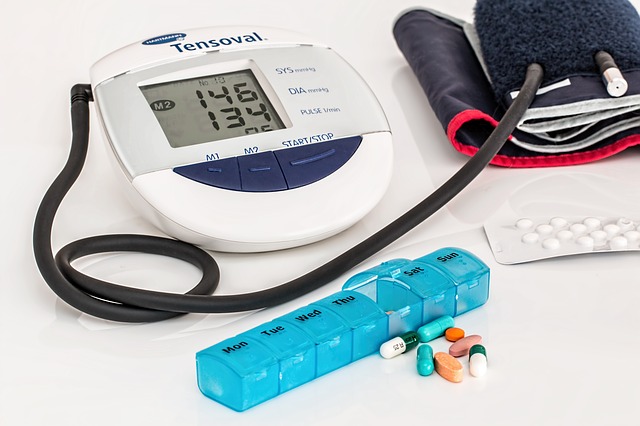
Critical Illness Insurance or Dread Disease Policy is a lump sum payout given in the event that the policyholder is diagnosed with one of the specific illnesses covered by the policy. It can either be sold as a stand-alone policy or a part of a main policy in life insurance or investment insurance. The guidelines and definitions of the 37 critical illnesses are predetermined by the Life Insurance Association of Singapore. This definitions are fixed across the board.

Unlike other forms of health insurance, the benefits of Critical Illness Insurance is paid out in lump sum so that the person can use it not only for medical expenses but also for other living expenses that can result from the ongoing treatment.

COMMON FEATURES

Here are some of the usual features of the Critical Illness Insurance:

1. Its premium is adjusted based on the policyholder’s age-band.

2. The policyholder is allowed to claim no more than one of the critical illnesses listed.

3. There are no restrictions on the utilization of the benefit payment.

4. The critical illness rider will be terminated once you give up the basic policy.

5. A type of health insurance (with a critical illness rider) has an expiration once the policyholder reaches a maximum age.

6. To reduce the risk of moral hazard, there is a limit on the total amount that you can purchase.

7. Upon purchasing the Critical Illness Insurance, there is a waiting period before you can make a claim.

POSSIBLE ISSUES

Given the fixed definitions of the critical illnesses as well as the common features of the Critical Illness Insurance, there are several issues that can possibly happen in different situations. For starters, the benefits can only be paid if the disease EXACTLY meets the standard definition stated by the policy.

For example: Coma is defined as…

“A coma that persists for at least 96 hours. This diagnosis must be supported by evidence of all of the following:

• No response to external stimuli for at least 96 hours;
• Life support measures are necessary to sustain life; and
• Brain damage resulting in permanent neurological deficit which must be assessed at least 30 days
after the onset of the coma.

Coma resulting directly from alcohol or drug abuse is excluded.”

In reference to the definition above, say your beloved spouse had been in a state of coma for the past 48 hours due to substance abuse and you cannot do anything about it because he is not qualified to claim the insurance payout. It will be difficult for you to fork some money at a relatively short notice.

Another issue that can happen is when two or more diseases transpire (co-morbid diseases) and you can only claim for one of it.

Image Credits: pixabay.com

Image Credits: pixabay.com

Furthermore, claiming of the benefits usually has a waiting period. If a critical illness is carried out during the waiting period then, you cannot be paid for its benefits.

Sources: 1, 2, & 3

Read More...

Details of 2016 GST Vouchers Benefits To Be Sent Out by 1 Jul 2016

GST Voucher Featured

The Ministry of Finance has announced in a press release that 1.54 million Singaporeans will receive a letter by 1 July 2016 with details on the 2016 GST Voucher Benefits (GSTV) as well as information on other Budget benefits such as Service and Conservancy Charges (S&CC) rebates, U-Save and Medisave Top-ups.

1. GST Voucher – Cash Payment

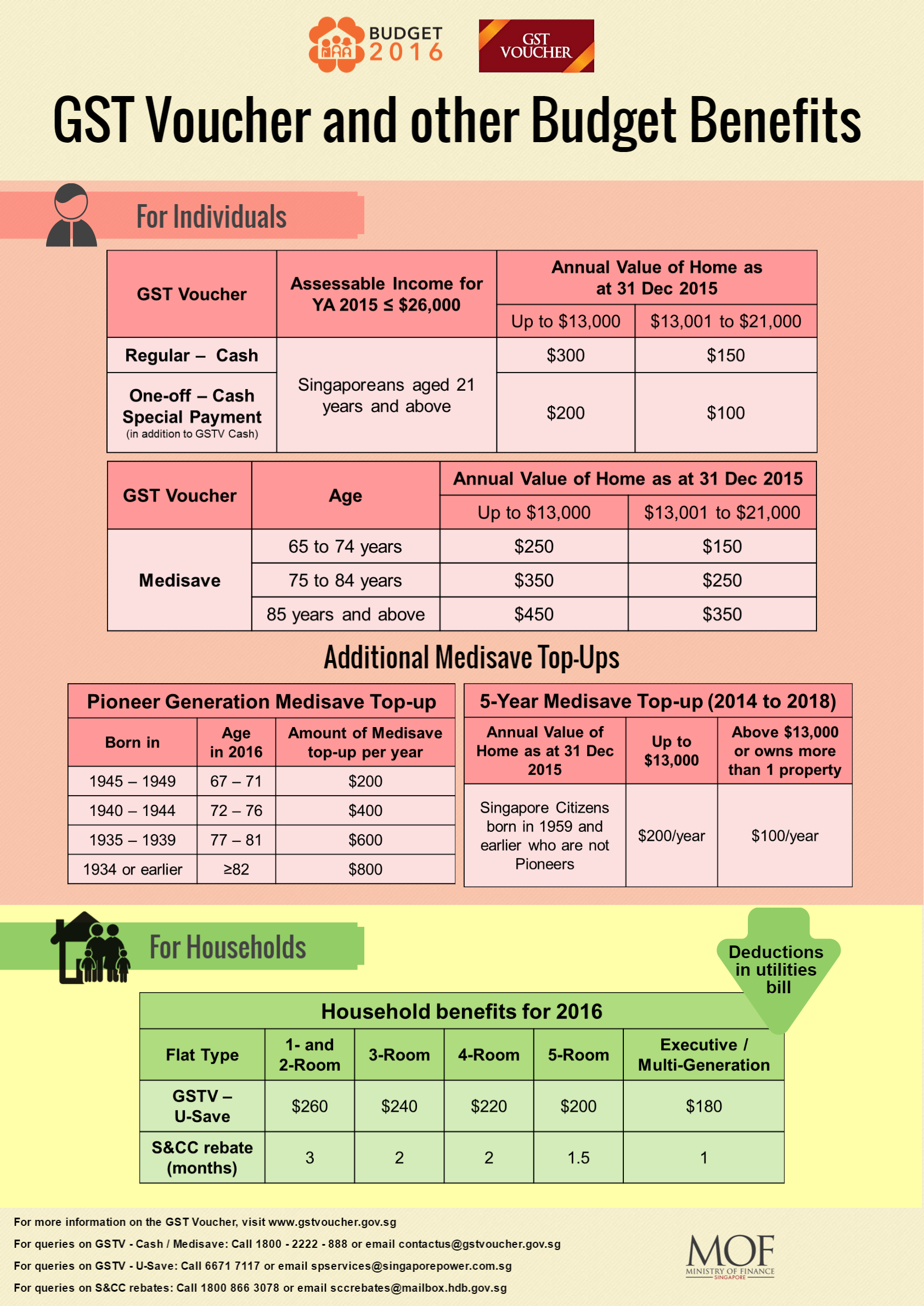
About 1.3 million eligible Singaporeans will receive up to $300 in GSTV – Cash. In addition, as announced at Budget 2016, a one-off GSTV – Cash Special Payment of up to $200 will be provided to support households amid current economic conditions.

This means that eligible GSTV recipients will receive up to $500 in cash in 2016, which will be disbursed in two payments in August 2016 and November 2016.

2. Medisave Top-ups

About 425,000 Singaporeans aged 65 years and above will receive the GSTV – Medisave of up to $450 in August 2016. In addition, Singaporeans born on or before 31 December 1959 (57 years and above in 2016) and do not receive Pioneer Generation (PG) benefits will receive a Medisave top-up of up to $200 each year till 2018. The top-up for this year will also be made in August 2016.
In total:

  • A non-Pioneer aged 65 in 2016 and who is living in an HDB flat (and does not own a second property) can receive $450 of Medisave top-ups this year.

Pioneers would also be receiving their PG Medisave top-ups of $200 to $800 in July 2016. Taking both the PG Medisave and GSTV – Medisave together:

  • A Pioneer aged 70 in 2016 who is living in an HDB flat (and does not own a second property) will receive $450 of Medisave top-ups;
  • A Pioneer aged 85 in 2016 who is living in an HDB flat (and does not own a second property) will receive $1,250 of Medisave top-ups.

You can also refer to the infographic by MOF below:

GST Voucher and other Budgets MOF

More information on Assessable Income and Annual Value of Home:

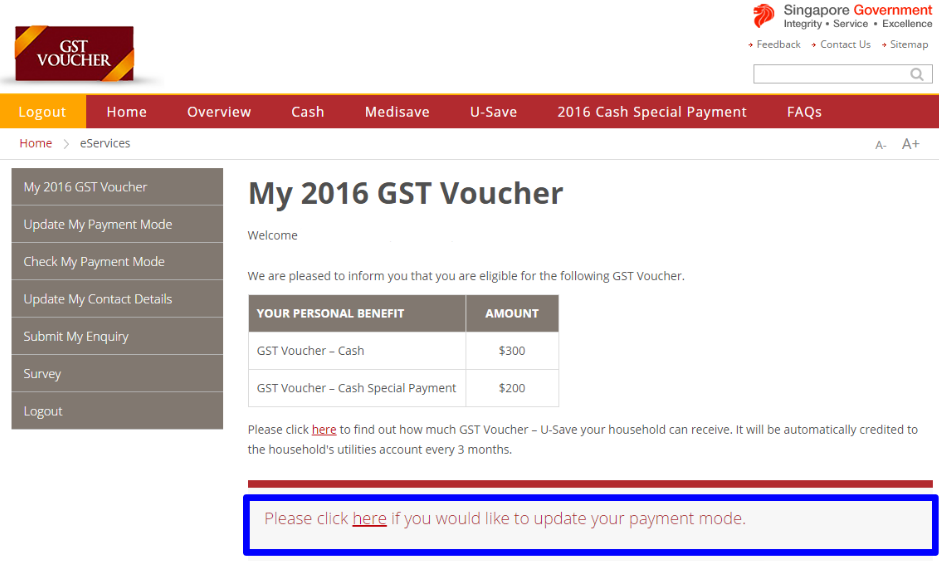
To find out how much you are eligible for, you can log on to https://www.gstvoucher.gov.sg with your SingPass.

You will then see something like this:

GST Voucher Eligibility

* Remember to update your payment mode.

Details on the GSTV can be found at www.gstvoucher.gov.sg, and information on the other Budget benefits can be found at www.singaporebudget.gov.sg. If you require more information, the contact details are as follows:

gstv

Read More...