
How much does tuition cost in Singapore?

Tuition (both private as well as the centers) are highly in demand among parents in Singapore compared to tuitions in the neighboring states as found by a survey conducted by an international news agency where they have found that more than three-quarter of the parents do invest on such academic agencies despite the fact that they cannot expect the best grades by just providing them a tutor. It was also that in Singapore, parents prefer to send their kids for extra classes even before their formal schooling has officially started in order to brush their English as well as their Math’s skills.

Here in this piece of writing we will be talking about the tutoring services available for children of all ages here in Singapore and how much would it cost you to send your child in one of them.

Pros and Cons of the Different Tuition types

1. Private Tuition

  • Advantages
  1. Home tutors engaged from a tuition agency can give one-to-one attention to students that is most desired by parents. Students do have different learning styles and the private tuitions can be designed in order to suit the exact learning style which are not possible in large classrooms or tuition centers/group tuitions.
  2. They can work out at the student’s pace.If the student did not understand something in the class then he/she can consult with the tutor later on at home and clear the problem they are facing in that particular chapter .
  3. Private tutors do take on the responsibility of doing the children’s homework given by the school. Homework of children of Standards 6-12 can be sometimes complicated for several parents with complex arithmetic and science chapters to deal with and this is when private tutors come to the rescue as they have become experts by teaching those subject for a long while.
  • Disadvantages
  1. Private tuitions are generally  expensive compared to other tuition types which is why not everyone can afford them.
  2. It is often very difficult to find a good private tutor that does meet the children’s needs.
  3. Most parents are also concerned about the safety of their children with the adults they do not know for sure, henceforth it is highly recommended for them to refer to a tutor agency that do screen its private tutors and have accurate reference.

2. Group Tuition /Tuition Centers

  • Advantages
  1. More affordable compared to private tuitions
  2. Students do receive materials that help them to understand the topic in a better sense.
  3. Students are able to discuss to share their knowledge and solve their problems      with other peers in the group/class.
  4. Helps with enhancing on social skills
  5. As the tutors in group tuition or tuition centers are working full time therefore it is seen that they are extremely committed to teaching.
  • Disadvantages
  1. As there are many tuition centers available, students are often sketchy which was to choose among the lot that would *actually* work hard on enhancing their skills.
  2. Also sometimes these centers do charge exceptionally which makes them unaffordable to many like private tuitions.

Some Famous Tuition Centers in Singapore

  1. The Learning Lab – This is a very popular and well trusted brand to parents in Singapore for the last 15 years with several branches spread across the country for preschoolers as well as college going teens. Their teaching style comprises of the following factor-knowledge, skills to pass the exams, develop the interest of learning within children.
  2. Mavis Tutorial Centre – This is another popular and yet affordable option to send the kids to if they are studying somewhere between the primary school level and A ‘levels. This, too like the Learning Lab, have branches all across the country.
  3. True Learning Centre –  It employs NIE (National Institute of Education) ,exclusive school that trains teachers-to -be here in Singapore. As they have already held important positions and won several teaching awards in their careers before they joined the center-the curriculum of the center is being exclusively designed by them that ensures the students are receiving the best help possible.

Reliable Tuition Agencies

At first glance, it appears that tuition agencies tend to offer the same service. However, from our experience, some companies go above and beyond and offer more than others. Our personal recommendation is SmileTutor. They are among the best and the most trusted private tutor agency here in Singapore. Here are the reasons why it is the best

  1. Tuition coordinators work around the clock to make sure that the assignments are being fulfilled on time by the pool of active home tutors from the whole range starting from Kindergarten to Junior College.
  2. The tuition matching system does ensure that the tutor being chosen does fulfill all the criteria demanded by the parents of the children.
  3. The highly qualified private tuition assignment coordinators do select the home tutors based on the home tuition rates and fees as requested by the parents.
  4. There is no contract being signed between the two parties which gives the parents the flexibility to change the tutor if they think the tutor is not appropriate for the child. Also the fees are being paid when the classes are being conducted hence no extra agent fees.
  5. The tutor contacts the parents within 6 to 24 hours after the request is being made.


Financial Comparison between Private Tutors and Tuition Centers

There is an average difference of not more than 10 SGD between the private tutors and tuition centers. The median range of the tuition fees for primary section is about 30 SGD per hour, 40 SGD per hour for the Secondary section and more than 55 SGD per hours for Junior College Section.

However for the private tuition, the rate depends on the qualification of the teacher. For a degree holder the rate is usually 30 SGD per hour for the primary section 40 SGD for the lower secondary section, 50 SGD per hour for the upper secondary section and 60 SGD for the Junior College. ,

The rates are however different if the private tutor has been trained from a MOE affiliated institute ,compared to the degree holder teacher who has not trained from NIE all the rates rise by 20 to 30 SGD for each section


Ending  

Parents do always the best for the children expecting them to excel in every stage of life. Therefore tuition or extra classes are not an exception when they notice their kids lagging behind in their academic pursuit. If spending an extra few bucks apart from the usual schooling fees can push up the grades from B to A for instance, they would not think twice to enroll their kids for extra classes. But as there is famous saying, “cut your coat according to your cloth”-an idea about the financial expenses of enrolling them for extra classes would help them decide the type of tuition that suits their economic budget.

 

Read More...

The Best Credit Cards for Frequent Travellers

Many of us are ignorant about how much side benefits our daily spending can reward us because of the many complicated terms and conditions that come with signing on a credit card. But trust me, once you’ve figured out the one (or multiple) card that fits your lifestyle, you’ll wish you had started using them earlier.

Unless you are impossibly rich or are covered by your company, hardly any one of us would be willing to pay over $10,000 for a First Class seat for what may be a few hundred dollars’ worth of flight ticket.

But what if you had the opportunity of enjoying First Class without having to fork out actual money?

That is why accruing air miles on your credit cards is the way to go.

Your next question would then be: what are some of the most travel-friendly credit cards to use to convert as many dollars into air miles?

If you’re a serial traveller, or have a dream to be one, this is going to be one post that will help you re-evaluate your credit card spending with these points below.

I give you a breakdown below on the best credit cards to get the best (miles) bang for your buck with the least limitations.

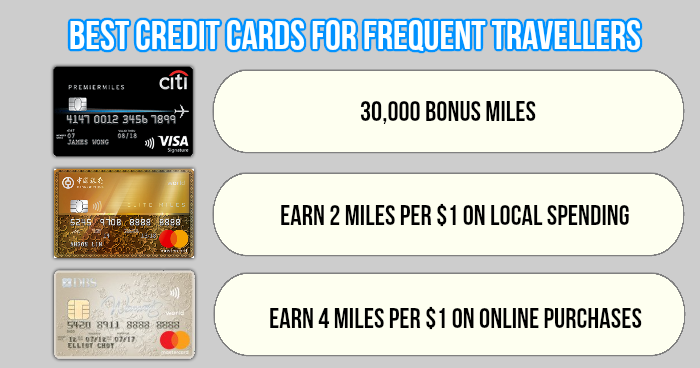
  1. Citibank PremierMiles Visa Card

With a Citibank PremierMiles Visa Card, earn 10 mpd for booking hotels online on Kaligo. What this card trumps over the other credit cards is that you don’t have to pay in foreign currency, there is no limit on spending per month, and you certainly don’t have to fully prepay your reservation online – that means you can cancel your hotel reservations anytime without incurring any charges!

Apart from hotel bookings, earn 2.4 Citi miles per S$1 overseas spend in foreign currency and 1.2 Citi miles per S$1 local spend.

1 Citi Mile = 1 Mile with KrisFlyer, Asia Miles, Royal Orchid Plus and etc.

For new customers – Get 30,000 bonus miles with an annual fee payment of $192.60 and when you spend a minimum of $7,500 within the first 3 months.

Find out more perks about this card here.

  1. DBS Woman’s World Card

Earn 4 miles per dollar when you purchase air tickets online. Unlike other credit cards, this card doesn’t limit you to certain carriers you book with and there is no minimum monthly spending. The only drawback is that you can only spend $2K a month.

  1. UOB Preferred Platinum Visa Card

An easy go-to card for everyday spending. Earn 4 miles per dollar each time you pay with Paywave/ Samsung Pay/ Apple Pay/ Google Pay on the go. The only limit is that you can only spend up to $1000 per calendar month, except where SMART$ are issued.

  1. BOC Elite Miles World MasterCard

Earn 5 miles per dollar on your overseas currency transactions. There is no minimum or maximum spending, so this is one convenient card you can carry around while travelling and not have to worry about using to shop overseas!

Learn more about these credit cards now!

Read More...

Flush Your Financial Worries With Stoicism

“We suffer not from the events in our lives, but from our judgement about them.”
~Epictetus

As I dealt with high levels of stress these past few weeks, I turned to Philosophy for guidance. A school of thought that transformed my mindset by 360 degrees is Stoicism. Stoicism highlights the division between what is happening to the world and how we emotionally respond to it. It is founded by Zeno, a wealthy merchant who had lost it all. In his despair, he turned to Philosophy for strength.

Stoicism helps us deal with our lives through virtues such as logic, temperance, justice, and courage. It encourages its followers to submit to the hardships or good fortune without complaints. Instead, you must understand the world and the people around you in a fair manner.

Image Credits: pixabay.com

Apply this influential way of thinking to your life by following these tips:

ABUNDANCE OVER SCARCITY

Whether you dwell on not having enough money to purchase a car or not having enough money to travel, many people associate money with scarcity. It is easier to complain about not having sufficient funds than engaging in random acts of generosity. You see, having a negative mindset about money can hinder the flow of abundance.

I am not saying that you should give out everything you own! There are other ways to extend your generosity. You can share your expertise or your time to someone in need.

RESPECT OVER CONTROL

Stoics hold a financial mindset that enables them to be respectful, but emotionally detached from money. This mindset allows them to make logical decisions in various area of life.

For them, there is no shame in leading a modest life. However, there is nothing noble about lacking money neither. They perceive money with a relative indifference whereby it has no effect on their self-worth or happiness.

RATIONAL MENTAL STATE OVER EXTERNAL THINGS

Stoicism wants us to realize that money can never solve all of our problems. It can only solve problems within the financial realm. How about the pursuit for happiness? External things such as money, fame, and success can never guarantee happiness.

There is nothing wrong with letting these external things be part of your comfortable life. However, the endless pursuit of these external things can only do damage than good. For stoics, happiness comes from having a rational mental state.

Interested in knowing more about the Philosophy of Stoicism? Watch the short video below.

Sources: 1 & 2

Read More...

Newbie’s Guide To Finding The Perfect Spectacles

Poor vision is a trait that has been passed from the one generation of our family to another. Thus, it comes as no surprise that my sister inherited the trait too. For her birthday, I decided to help her purchase a pair of spectacles. It is a practical and fashionable gift that she can use on a daily basis.

I purchased a new pair in less than ten minutes. I knew the frame that I wanted and came with a budget in mind. While, she took about two hours to select hers. She put a lot of thought in the selection process because she believes in finding the best pair possible. As a savvy consumer, she was on a hunt to find a pair that will last her for several years.

Her actions made me dwell upon the essential steps needed to acquire the “perfect pair”.

WHAT ARE YOUR REQUIREMENTS?

Eye-wear criterion vary from wearer to wearer. Similar to acquiring a new gadget, you must examine the requirements needed to be filled when choosing a pair of spectacles. Where will you use your prescription eye-wear predominantly? Are you going to use it for indoor or outdoor activities?

The more information the optometrist or store personnel is provided with, the easier the selection process will be. Let the professionals know which features will be most beneficial for you.

WHICH FRAME SUITS YOUR FACE?

Choose a frame that compliments your face shape. To identify your face shape, you look directly into a mirror and pull your hair back. The overall contours of your face is your face shape. People with an angular face  should opt for round frames. While people with round faces shall opt for angular frames. How about the ones with heart-shaped faces? Well, they should opt for oval-shaped frames. Lastly, people with oval-shaped faces can choose any type of frame they want.

Image Credits: selectspecs.com

Nonetheless, it is best to take someone with you while you shop. Having a second opinion from a trusted companion can be really helpful.

WHAT ARE YOUR OPTIONS FOR LENSES?

Would you believe that there are more than two options for lenses? The market offers plastic lenses, multi-coated lenses, blue cut lenses, and so on. Choose the spectacle lenses that will best suit your lifestyle.

Plastic lenses are becoming increasingly popular nowadays. High-quality plastic lenses offer protection against scratches and pressure marks. Multi-coated lenses combine anti-reflection, scratch-resistant, UV-protected, and water repellent properties. Lastly, blue cut lenses are used to block the harmful blue light that smartphones, monitors, and laptops emit.

WHAT CAN YOUR INSURANCE COVER?

People who browse intently through the fine print are often rewarded. Unbeknownst to you, your health insurance or employee benefits may cover your eye care expenses. Increase your awareness meter by approaching your HR representative. Ask him or her about the insurance plans or healthcare procedures that the company honors.

Say that your company is covered with the AXA Smart Vision plan. This visionary plan includes comprehensive eye examination, discount on eye-wear, and up to S$300 allowance for frame or contact lens (T&Cs apply).

HOW CAN YOU GET A LONG-LASTING PAIR?

Why will you buy an expensive pair of spectacles when you can get several pairs delivered at your doorstep? This is the mindset of many Singaporeans who subscribe to cheap prescription eye-wear. You see, multiple cheap pairs do not necessarily equate to a single quality pair.

Image Credits: pixabay.com

Purchasing an expensive high-quality pair that will last you for several years is better than purchasing an inexpensive low-quality pair that will last you for several months. Consider your prescription eye-wear as a health investment.

Sources: 1 & 2

Read More...

What On Earth Is Goal-Based Investing?

First and foremost, we must define what traditional investing is. Traditional asset allocation optimizes the structure of a portfolio based on a generalized approach. Although it typically suits the needs of the institutional investors, it is not necessarily adapted to suit the needs of a private investor. A private investor, such as yourself, tends to create different portfolios corresponding to different needs.

On the other hand, goal-based investing is a relatively new approach in investing where the end justifies the means. Investing is directed to attain specific financial goals throughout an investor’s life.

“Goal-based investing involves a wealth manager or investment firm’s clients measuring their progress towards the specific life goals, such as saving for children’s education or building a retirement nest-egg, rather than focusing on generating the highest possible portfolio return or beating the market.” – Investopedia

Simply put, it re-frames success based on an investor’s needs and goals. Say that an investor’s primary goals are to save for the golden years and to save for the educational fund of his grandchildren. Goal-based investment plan would be more conservative for the former and more aggressive for the latter. As you can see, this approach will help you to withstand most market conditions and volatility.

Apply goal-based investing to your wealth management by following these steps:

Image Credits: pixabay.com

STEP 1: DETERMINE YOUR GOALS

Before anything else, you must identify your financial goals depending on your current life stage. Let us dive into some practical examples. As a young working adult, you may be eyeing on the latest gadgets (e.g., smart glasses, laptops, or smartphones). As a devoted parent, you may be considering the different educational options for your child. As a Singaporean reaching 62, you may be thinking about building your retirement fund. Having multiple goals in mind throughout the course of your life is perfectly fine!

STEP 2: ESTABLISH A TIMELINE

As you list down all your financial goals at the moment, you must keep prioritization in mind. Prioritize your goals by examining which ones you need and which ones you want to have. Afterwards, you must create a timeline for your final set of financial goals.

Do you aim to travel next month? Or, do you need to purchase a flat in the next 10 years? Measure the amount of time needed to realistically reach your short-term and long-term goals.

STEP 3: KNOW WHERE YOU START

How can you plan ahead, if you do not know where to start? Pinning your starting point is important in helping you achieve your financial goals. Administer a simple financial assessment by asking yourself a few questions. Firstly, how much money have you saved up? Secondly, do you have an emergency fund? Lastly, how much are your net worth and cash flow?

STEP 4: CREATE AN INVESTMENT PLAN

You are done with determining your final set of goals, setting a realistic timeline, and drafting your starting point. What is next for you? Well, you must put all of the above information together to create an Investment Plan. Create this by looking at four factors namely: risk profile, investment options, target amount, and asset allocation.

STEP 5: EXECUTE THE INVESTMENT PLAN

Investing for your financial goals does not stop with opening a savings account. You do not need to accumulate a massive amount of money to start investing neither. Instead, you must invest in a consistently as early as possible. As you invest religiously throughout your life, you need to review whether there are on the right path. Are you doing these things to achieve your financial goals? If so, continue on.

Image Credits: pixabay.com

Goal-based investing is a relatively new approach in investing where the end justifies the means. It may seem like an obvious or an oversimplified concept, but it represents a departure from the typical risk-tolerance framework. Will this investment strategy work well with your wealth management practices?

Sources: 1 & 2

Read More...